
Many veterans believe that once a service-connected disability rating is granted, it is set in stone forever. While the Department of Veterans Affairs provides strong safeguards for long-standing ratings, benefits are not unconditionally guaranteed. The VA continuously monitors claim files, tracks administrative data, and conducts routine re-evaluations for conditions expected to improve. When potential discrepancies or signs of medical recovery appear, the VA can initiate a rating reduction or complete termination of monthly compensation.
You May Be Able To Increase Your VA Disability Rating. Talk With An Expert First. Free Call.
Understanding these vulnerabilities before they escalate is crucial. Reviewing our VA lowers disability rating complete guide reveals that the VA must follow strict regulatory standards to reduce benefits. However, when veterans make avoidable procedural mistakes or miss key warning letters, they unintentionally forfeit their rights to appeal. Below are the critical warning signs and operational red flags you need to know.
Critical Warning Signs and 10 Red Flags That You Will Lose Your VA Disability
Understanding the warning indicators that put your monthly disability checks in jeopardy allows you to take corrective action before payments are slashed. Here are the ten primary triggers that threaten your benefits:
- Skipping or Failing to Schedule a Required C&P Exam: Under 38 C.F.R. § 3.655, if you fail to report for a scheduled Compensation and Pension (C&P) re-evaluation without establishing good cause, the VA holds immediate legal authority to reduce or discontinue your payments. In Board of Veterans’ Appeals cases (such as Docket No. 230120-316083 involving traumatic brain injury), failing to attend a mandatory re-exam led to a reduction from 40% straight to a noncompensable 0% rating.
- Ignoring Official VA Mail and Address Inconsistencies: The VA sends predetermination notices and scheduling letters via regular mail. If you relocate and do not update your official address in the VA database, you may miss time-sensitive examination dates or appeal windows, resulting in default rating reductions.
- Filing a New Claim That Triggers a Global Re-Evaluation: When you apply for an increase or submit a secondary condition, a VA claims adjudicator pulls your entire claims folder. Under the VA’s holistic evaluation principles, examining an interconnected bodily system can inadvertently expose an existing condition to re-evaluation if old treatment records suggest improvement. Following our 7 critical steps increase VA disability rating helps ensure you file with sufficient evidence to avoid unintended scrutiny.
- Demonstrating Sustained Medical Improvement in VA Records: A temporary symptom reprieve is not enough for a reduction, but routine VA clinical notes reflecting prolonged, material improvement across your daily activities can serve as evidence to justify lowering a non-stabilized rating.
- Failing to Seek Ongoing Medical Treatment: When veterans stop going to medical appointments altogether, their records go silent. If re-evaluated, the lack of current documentation makes it difficult to prove that the disability remains at its historical severity level.
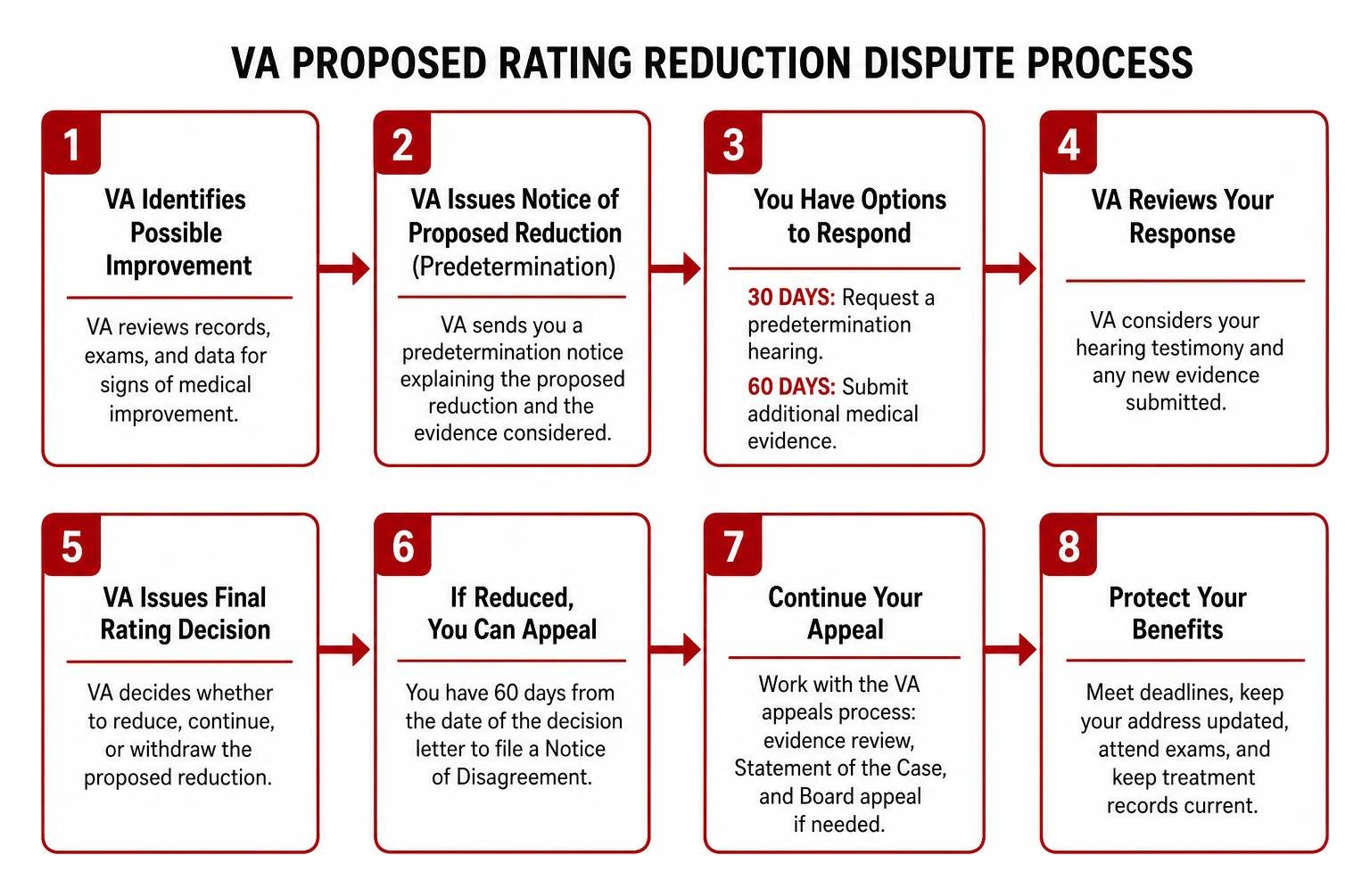
- Receiving a Formal “Notice of Proposed Reduction”: If the VA gathers evidence of improvement, they issue a predetermination notice. You have a strict 30-day window to request a predetermination hearing and 60 days to submit supplemental medical evidence to stop the proposed action.
- Fugitive Felon Status or Active Law Enforcement Warrants: Having an outstanding felony arrest warrant leads to immediate benefit suspension under federal law until the legal warrant is cleared.
- Incarceration Following a Felony Conviction: Spending more than 60 consecutive days in a penal institution triggers automatic statutory payment caps.
- Failing to Report Dependent Removals or Income Changes: Keeping adult children on your award after graduation or not reporting divorces generates overpayments that the VA will claw back through severe monthly withholdings.
- Material Errors, Misrepresentation, or Fraud in the Original Claim: Providing falsified medical reports or military personnel records leads to immediate severance of service connection and permanent forfeiture.
Rating Schedule Overhauls and Incarceration Triggers
In addition to procedural missteps, broader statutory guidelines and major policy modernizations can affect your compensation. A major administrative trigger is felony incarceration. Under federal law, if a veteran is convicted of a felony and incarcerated for more than 60 days, monthly disability compensation is sharply reduced starting on the 61st day. For veterans rated 20% or higher, the monthly payment is capped at the 10% disability rate. For veterans with a 10% rating, their payment is cut by 50%. While these funds are suspended, dependents can apply for an apportionment to avoid severe household financial distress.
Do You Deserve More VA Disability Pay? We May Be Able To Help. Talk To An Expert. Free Call.
Another absolute red flag involves fraud and administrative misrepresentation. Under 38 U.S.C. § 6103, if an individual knowingly submits false statements, fraudulent nexus letters, or fabricated military performance records, the VA imposes total forfeiture of all accrued and future benefits.
Veterans must also stay informed about ongoing rating schedule modernizations as outlined in our VA disability pay 2026 guide. The VA’s restructuring of diagnostic criteria—such as moving sleep apnea from a 50% CPAP-mandated baseline toward an impairment-focused scale (0% for asymptomatic control and 10% for residual impairment), or altering the standalone 10% tinnitus code (DC 6260) to evaluate ringing as a symptom of an underlying condition—highlights the need to understand how grandfathering provisions protect existing awards.
Understanding Rating Reductions, Severance, and Protected Rules
Navigating VA benefit adjustments requires distinguishing between a rating reduction and a severance of service connection. A rating reduction lowers your disability percentage (for example, reducing a lumbar strain from 40% to 20%) while keeping service connection intact. Severance completely eliminates the service-connected status of the condition, usually because the initial decision was based on a clear and unmistakable error (CUE) or fraud.
To determine where your conditions fall, consult our VA disability rating charts ultimate guide.
| Rule Name | Duration Required | Legal Standard for VA Reduction or Severance | Exception |
|---|---|---|---|
| 5-Year Rule (Stabilization) | 5 continuous years | The VA cannot reduce a rating based on a single exam; it must prove sustained, material improvement under ordinary conditions of daily life. | Sustained medical improvement demonstrated across multiple exams over time. |
| 10-Year Rule (Service Connection) | 10 continuous years | The VA is legally prohibited from severing service connection for any condition. | The original grant was established through fraud or misrepresentation. |
| 20-Year Rule (Continuous Rating) | 20 continuous years | The VA cannot reduce a rating below the lowest percentage held during those 20 years. | Fraud or criminal misrepresentation in the original claim. |
| Permanent & Total (P&T) | Designated upon award | Exempt from future routine re-examinations; benefits are locked unless the veteran files a new claim or commits fraud. | Fraud, or new claim reopening the file showing total improvement. |
Protected Rating Rules: 5-Year, 10-Year, and 20-Year Protections
The VA rating schedule contains protective barriers designed to give disabled veterans financial peace of mind as the years pass.
- The 5-Year Stabilization Rule (38 C.F.R. § 3.344): When a disability rating has remained at the same level for five years or more, the VA cannot lower it based on a single favorable examination. The VA must show that the improvement is sustained across multiple medical records and that the veteran’s daily life and working ability have genuinely improved under typical conditions.
- The 10-Year Rule (38 C.F.R. § 3.957): Once service connection is continuously established for ten years, the VA loses the authority to sever service connection entirely, unless the original decision was procured through intentional fraud.
- The 20-Year Rule (38 C.F.R. § 3.951): If a condition has been evaluated at a specific percentage for 20 continuous years, that rating is fully protected. The VA cannot reduce the percentage below that level under any circumstance short of fraud.
- Permanent and Total (P&T) Status: If your conditions are deemed static with no likelihood of medical improvement, you are excused from routine future re-examinations.
Navigating the 10 Red Flags That You Will Lose Your VA Disability with Legal Safeguards
If you receive a Notice of Proposed Reduction, you are protected by constitutional due process. The VA cannot simply turn off or slash your compensation overnight. You have specific procedural rights to challenge the proposal before it takes effect:
- Request a Hearing Within 30 Days: Submitting a written request for a predetermination hearing within 30 days of the date on the notice legally freezes the proposed reduction until the hearing is held and a formal decision is issued.
- Submit Supplemental Medical Evidence Within 60 Days: You have 60 days to present private treatment records, independent medical evaluations, or nexus opinions showing that your condition has not improved.
- Rely on Grandfathering Protections: When the VA modernizes its rating schedules, existing service-connected ratings are typically grandfathered. As long as you do not request an evaluation for an increase under the updated criteria, your current evaluation is generally protected under the historical standards under which it was granted.
Understanding your procedural rights through the complete guide to VA disability claims ensures that you avoid administrative pitfalls when communicating with regional offices.
How to Proactively Protect Your VA Disability Compensation

Protecting your disability rating requires consistent administrative and medical diligence. By actively managing your records and claims files, you eliminate the common oversights that trigger reductions:
- Maintain Current Contact Details: Ensure your primary mailing address, phone number, and email address are always updated on VA.gov. If you move, update your profile immediately to avoid missed examination notices.
- Build an Ongoing Medical Trail: Visit your doctor regularly. Whether you use the Veterans Health Administration or private physicians, maintain regular treatment for all service-connected conditions so your medical records reflect your ongoing symptoms and functional limitations.
- Comply with Prescribed Care: If you are prescribed physical therapy, medications, or assistive devices like CPAP machines or braces, use them consistently and document any persistent issues with your medical team.
- Attend Every Scheduled Exam: If the VA contacts you for a C&P re-evaluation, treat it as mandatory. If an emergency prevents you from attending, notify the VA and the contracted medical provider immediately in writing to establish good cause.
- Promptly Report Dependent Changes: Notify the VA as soon as a child turns 18 (or 23 if enrolled in college), or if a divorce is finalized, to avoid accruing large benefit overpayments.
- Work with Accredited Experts: When responding to a reduction notice, partner with an accredited Veterans Service Officer (VSO), claims agent, or VA-accredited attorney to compile an effective rebuttal.
For a deeper dive into proactive management steps, see how to maintain your VA disability rating in 5 easy to follow steps.
Frequently Asked Questions About VA Disability Reductions
Can the VA reduce my disability rating without sending prior notice?
No. Under federal regulations (38 C.F.R. § 3.105(e)), the VA is legally required to send a formal predetermination notice—known as a Notice of Proposed Reduction—before lowering any service-connected rating that would reduce your monthly payments. This letter must outline the medical reasons for the proposed reduction and detail your right to challenge it. You have 30 days from the date of the letter to request a formal hearing and 60 days to submit new medical records. The only common exception occurs if you fail to attend a mandatory re-examination without good cause under 38 C.F.R. § 3.655, in which case payments can be reduced or suspended after administrative notice.
What constitutes good cause for missing a scheduled C&P exam?
Under 38 C.F.R. § 3.655, “good cause” means an unavoidable, verifiable conflict that made attending the scheduled medical evaluation impossible. Valid examples include:
- Emergency hospitalization or acute illness
- Death or bereavement involving an immediate family member
- Severe, verifiable weather emergencies or natural disasters preventing travel
- Failure to receive the scheduling notice due to documented administrative errors by the VA or its third-party contractors
Simply having a busy work schedule or forgetting the appointment does not meet the legal definition of good cause. If an emergency occurs, you must notify the VA and the exam contractor immediately and submit written proof to protect your claim.
How do proposed rating changes to sleep apnea and tinnitus affect existing ratings?
When the VA updates its rating schedule criteria (such as proposed revisions to sleep apnea or tinnitus), existing service-connected ratings are protected under established grandfathering rules. If you currently hold a 50% rating for sleep apnea based on CPAP use or a 10% standalone rating for tinnitus, the VA will not automatically lower or eliminate your rating simply because the regulations changed. Your rating will remain at its current percentage unless you specifically file a new claim for an increase on that condition or routine medical re-evaluations prove sustained, material recovery under the historical rating criteria.
Conclusion
Your VA disability compensation is a vital, earned benefit that provides essential financial stability for you and your family. While the fear of losing your benefits can be stressful, reductions rarely happen out of the blue. By staying alert to key warning signs—such as missed C&P exams, unmonitored mail, or filing claims without updated medical proof—you can safeguard your hard-earned rating.
Take control of your records, keep your contact details updated, and never ignore an official VA letter. If you are preparing to submit an initial claim or expand your existing coverage, learn the foundational essentials by applying for VA disability benefits the right way, and rely on USMilitary.com for accurate, straightforward guidance every step of the journey.
Free for Service Members & Veterans
Get the military benefits intel no one tells you about.
Weekly updates on VA benefits, pay changes, and money tips — free for service members and veterans.
No spam. Unsubscribe anytime. Your info is never shared.


