
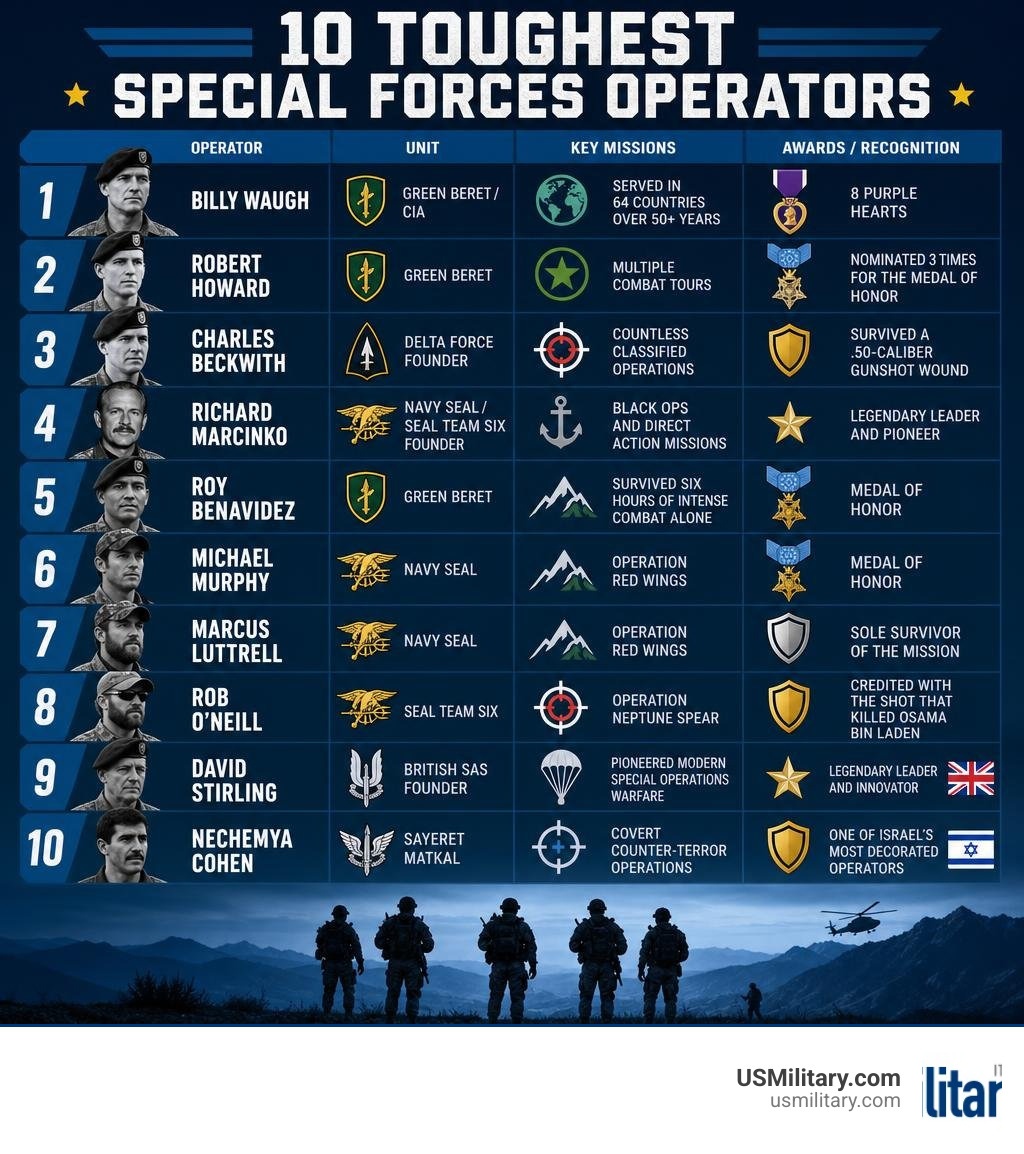
The 10 Toughest Special Forces Operators of All Time includes these legendary warriors:
- Billy Waugh – Green Beret / CIA; served in 64 countries over 50+ years; 8 Purple Hearts
- Robert Howard – Green Beret; only soldier nominated 3 times for the Medal of Honor
- Charles Beckwith – Founder of Delta Force; survived a .50-caliber gunshot wound
- Richard Marcinko – Navy SEAL; founder of SEAL Team Six (DEVGRU)
- Roy Benavidez – Green Beret; Medal of Honor; survived six hours of intense combat alone
- Michael Murphy – Navy SEAL; Medal of Honor; Operation Red Wings
- Marcus Luttrell – Navy SEAL; sole survivor of Operation Red Wings
- Rob O’Neill – SEAL Team Six; credited with the shot that killed Osama bin Laden
- David Stirling – British SAS founder; pioneered modern special operations warfare
- Nechemya Cohen – Sayeret Matkal; one of Israel’s most decorated covert operators
Some soldiers don’t just serve — they redefine what it means to be a warrior. The operators on this list pushed past limits that would stop almost anyone else. We’re talking about men who survived multiple gunshot wounds and kept fighting. Men who jumped into enemy territory with no night vision. Men who hunted the world’s most dangerous terrorists well into their 70s.
Special forces selection is already brutal. Delta Force rejects roughly 90-95% of candidates. The British SAS passes fewer than 1 in 10. Israel’s Sayeret Matkal accepts just 1-2%. The operators on this list didn’t just survive that — they became the best of that small surviving group.
What makes them stand out isn’t just physical toughness. It’s the combination of mental resilience, tactical genius, and an almost impossible willingness to keep going when everything says stop.
I’m Larry Fowler, publisher of USMilitary.com and a longtime advocate for active military and veterans navigating their service and benefits. My years covering elite military careers and the stories behind the 10 Toughest Special Forces Operators of All Time give me a deep appreciation for what these warriors sacrificed — and what their legacies mean for anyone considering a path in special operations today.
Basic 10 Toughest Special Forces Operators of All Time glossary:
- Comparing All The Military Branches Elite Special Forces With One Another
- Green Beret vs Navy Seal
- Special Operations Community
What Defines the 10 Toughest Special Forces Operators of All Time?
To understand what makes someone one of the 10 Toughest Special Forces Operators of All Time, we have to look past the Hollywood action sequences. Raw physical strength is only the entry ticket. The real differentiator is what lies between an operator’s ears.

When we examine the selection processes of tier-one units, we find they are designed to break a person down completely. Whether it is the cold, wet, sleep-deprived misery of Navy SEAL BUD/S or the brutal, lonely land navigation of Delta Force selection, these programs search for a very specific psychological makeup.
We define the toughest operators through three main pillars:
- Extreme Mental Resilience: The ability to make flawless, split-second tactical decisions when completely exhausted, starving, and under fire.
- Unmatched Physical Endurance: Carrying a 100-pound rucksack over mountainous terrain for days, or swimming miles through freezing ocean currents.
- Unconventional Adaptability: The capacity to operate entirely alone in a foreign land, blending in, learning local languages, and training guerrilla forces.
In our guide About the Military’s Special Forces, we highlight how these elite units demand standards far exceeding the general military force. These individuals are trained to look at a zero-fail mission and find a creative, aggressive way to win. For a deeper look at the global landscape of these elite organizations, you can read about the World’s Toughest Special Forces to see how different nations build their premier units.
Profiles of the Toughest Special Forces Operators
The history of special operations is written in the actions of individuals who refused to yield. Let’s look at the incredible careers, sacrifices, and sheer grit of the most legendary operators to ever wear a uniform.
Billy Waugh: The Five-Decade Special Forces Legend
If you wanted to write a movie about the ultimate secret agent and commando, you would just copy the life of William “Billy” Waugh. His military and intelligence career spanned more than 50 years, taking him to 64 different countries.
Waugh enlisted in the Army in 1948 and quickly found his way into the newly formed Special Forces. During the Vietnam War, he served with MACV-SOG, a highly classified, joint unconventional warfare task force. In 1965, during a brutal battle at Bong Son, Waugh was shot multiple times, including a devastating wound to his head. Left for dead in a muddy rice paddy, he survived by sheer willpower.
Instead of retiring, Waugh stayed in the fight. In the 1970s, he pioneered high-altitude, low-opening (HALO) military skydiving, jumping into hostile territory from extreme altitudes without modern GPS or advanced equipment. After retiring from the military as a Sergeant Major, he transitioned to the CIA’s clandestine service. At age 71, shortly after the September 11 attacks, Waugh was on the ground in the rugged mountains of Afghanistan, hunting Osama bin Laden. He was a man who literally could not stop serving.
Robert Howard: The Only Soldier Nominated Three Times for the Medal of Honor
When we talk about raw combat heroism, Robert Howard stands in a class of his own. Serving as a Green Beret in Vietnam, Howard was wounded 14 times during five separate tours of duty.
His courage was so consistent that he was nominated for the Medal of Honor three separate times within a 13-month span. Due to the highly classified nature of his cross-border missions in Laos and Cambodia with MACV-SOG, two of those nominations were downgraded to the Distinguished Service Cross. However, his actions on December 30, 1968, could not be denied.
During a rescue mission for a missing platoon, Howard’s unit was heavily ambushed. He was knocked unconscious by a landmine and severely wounded. When he came to, his weapon was destroyed, and his platoon leader was badly hurt. Armed only with a hand grenade, Howard fought off enemy soldiers, dragged his 200-pound lieutenant through intense fire, organized a defensive perimeter, and even called in airstrikes directly onto his own position to prevent his team from being overrun. As a pillar of the United States Army Special Forces, Howard’s legacy represents the pinnacle of combat endurance.
Charles Beckwith: The Father of Delta Force
Colonel Charles “Chargin’ Charlie” Beckwith did not just serve in elite units; he created the most famous one in the United States. Beckwith was a rugged Green Beret officer who served as an exchange officer with the British Special Air Service (SAS) in the early 1960s. He saw how the SAS operated in small, highly independent, and intellectually flexible teams.
When he returned to the U.S., Beckwith advocated tirelessly for a dedicated, tier-one hostage rescue and counter-terrorism unit. In Vietnam, he commanded Project Delta, utilizing SAS-style long-range reconnaissance tactics. During one mission, he survived a horrific .50-caliber gunshot wound to his abdomen. When the doctor labeled him unsalvageable, Beckwith simply refused to die.
His persistence paid off on November 19, 1977, when Delta Force was officially established. Beckwith designed its selection process to be a psychological meatgrinder, ensuring only those with absolute self-reliance could pass. Though the unit’s first major public mission, Operation Eagle Claw in 1980, ended in tragedy due to helicopter failures in the Iranian desert, Beckwith’s structural changes paved the way for the modern Joint Special Operations Command (JSOC).
Richard Marcinko: The Rogue Warrior of SEAL Team Six
Richard “Demo Dick” Marcinko was the definition of a colorful, aggressive, and incredibly tough operator. During the Vietnam War, he led his platoon on devastating raids in the Mekong Delta, earning a reputation for fierce leadership and tactical brilliance. The North Vietnamese Army even placed a bounty on his head.
Following the failure of Operation Eagle Claw, the Navy realized it needed a dedicated, full-time counter-terrorist maritime unit. Marcinko was tasked with creating it. To confuse Soviet intelligence about the size of the Navy’s SEAL force, he named the new unit SEAL Team Six, even though there were only two other SEAL teams at the time.
Marcinko selected the most aggressive, unconventional operators he could find. He fostered a culture of extreme training, heavy drinking, and absolute mission success. He later created “Red Cell,” a highly classified unit designed to test the security of military bases by infiltrating them using real-world terrorist tactics. For those looking to understand the roots of this community, our Navy SEALs Complete Guide provides excellent context on how Marcinko’s legacy shaped modern naval special warfare.
Roy Benavidez: Legend of the Green Berets
On May 2, 1968, Master Sergeant Roy Benavidez performed what many military historians consider the most astonishing feat of individual survival and heroism in modern warfare.
Hearing a distress call over the radio from a small reconnaissance team surrounded by an entire North Vietnamese Army battalion, Benavidez did not hesitate. He boarded a rescue helicopter armed only with a knife and a medical kit. When he jumped out of the chopper, he was immediately shot in the leg and hit by shrapnel.
Over the next six hours, Benavidez ran through intense enemy fire to save his wounded comrades. He was shot in the abdomen, hit by bayonets, and clubbed by enemy soldiers. Despite being blinded by his own blood, he carried wounded men to the evacuation helicopters, secured classified documents, and personally killed several enemy soldiers in hand-to-hand combat. When he was finally loaded onto the chopper, he was so mutilated that doctors thought he was dead and began zipping him into a body bag. Benavidez spit in the doctor’s face to let them know he was still alive. He survived to receive the Medal of Honor from President Ronald Reagan.
Michael Murphy: The Courage of Operation Red Wings
Lieutenant Michael P. Murphy was the officer in charge of a four-man SEAL reconnaissance team in the Hindu Kush mountains of Afghanistan in June 2005. Their mission, Operation Red Wings, went horribly wrong when they were spotted by local goat herders, who likely alerted a large force of Taliban fighters.
Surrounded on the steep mountain slopes, the four SEALs fought a desperate, retreating battle against overwhelming numbers. All of them were severely wounded. Because of the deep mountain terrain, their radio could not reach headquarters to call for help.
Knowing it meant certain exposure to enemy fire, Murphy stepped out of the protective cover of the rocks and walked into an open clearing to get a clear satellite signal. He successfully contacted the quick reaction force, giving them their location. Even after being shot in the back while making the call, Murphy returned to his position to continue fighting alongside his men. His selflessness earned him the posthumous Medal of Honor and cemented his place in the Navy SEAL Ethos.
Marcus Luttrell: The Lone Survivor
Marcus Luttrell was the only member of Michael Murphy’s four-man team to survive the initial gun battle of Operation Red Wings. Blasted over a cliff by a rocket-propelled grenade, Luttrell suffered a fractured back, a broken pelvis, severe shrapnel wounds, and multiple gunshot wounds.
For days, Luttrell crawled through the brutal Afghan terrain, dehydrated and bleeding, attempting to evade search parties. He was eventually found by local Pashtun villagers who adhered to an ancient tribal honor code known as Pashtunwali. Under this code, the villagers protected Luttrell from the Taliban at the risk of their own lives until American forces could rescue him.
Luttrell’s story of survival, detailed in his book and the subsequent film Lone Survivor, showcases the extreme limits of human endurance. His experience is a testament to the core philosophy of naval special operations, which we explore further in our article on The Only Easy Day Was Yesterday Navy SEAL.
Rob O’Neill: The Operator Who Ended Bin Laden
Rob O’Neill is one of the most highly decorated combat veterans of the modern era, having participated in more than 400 individual combat missions across four war zones. As a member of the elite SEAL Team Six, O’Neill was involved in several high-profile operations, including the rescue of Captain Richard Phillips from Somali pirates.
However, he is best known for his role in Operation Neptune Spear on May 2, 2011. O’Neill was part of the assault element that breached Osama bin Laden’s compound in Abbottabad, Pakistan. Moving up the stairs of the third floor, O’Neill was the first to enter bin Laden’s bedroom, where he fired the shots that killed the world’s most wanted terrorist.
O’Neill’s career represents the surgical precision, intense training, and cold-headed execution required of tier-one operators. His experiences offer invaluable Life Lessons From Navy SEALs for anyone looking to build elite discipline and focus in their own lives.
David Stirling: The Founder of the British SAS
We cannot discuss modern special operations without honoring the man who practically invented the concept. During World War II, British Army officer David Stirling realized that massive, conventional armies were often too slow and predictable to deal with fast-moving desert warfare in North Africa.
Stirling proposed a radical idea: small, highly trained teams of soldiers infiltrating deep behind enemy lines under the cover of darkness to destroy aircraft, fuel depots, and supply lines. This led to the creation of the Special Air Service (SAS).
Stirling personally led numerous deep-penetration raids across the Western Desert, destroying dozens of Axis aircraft on the ground. Field Marshal Erwin Rommel, the famous German commander, referred to Stirling as a “phantom” due to his ability to strike out of nowhere and vanish back into the desert. Stirling’s principles of speed, surprise, and aggression remain the baseline for the World’s Toughest Special Forces to this day.
Nechemya Cohen: Sayeret Matkal’s Most Decorated Soldier
Nechemya Cohen is a legend within the Israel Defense Forces (IDF). He served in Sayeret Matkal, Israel’s premier deep-penetration intelligence and counter-terrorism unit. Sayeret Matkal operates in complete secrecy, often executing highly sensitive hostage rescues and intelligence-gathering missions deep inside hostile territory.
Cohen was known for his incredible tactical mind and absolute calmness under pressure. Alongside future Israeli Prime Minister Ehud Barak, Cohen participated in numerous classified cross-border operations that shaped the security of Israel during the 1960s.
By the time of his tragic death in combat during the Six-Day War in 1967, Cohen had received five decorations for valor and exemplary service, making him the most decorated soldier in Israeli military history alongside Barak. His legacy continues to inspire the ultra-selective Sayeret Matkal selection process today.
Comparing the World’s Toughest Special Forces Units
Every country claims its elite units are the best. But when we look at the raw statistics, we can see how these units compare in terms of selection difficulty and training duration.
| Unit Name | Country | Attrition Rate | Selection / Pipeline Duration | Primary Focus |
|---|---|---|---|---|
| Delta Force | United States | 90-95% | 6 Months (OTC) | Counter-Terrorism, Direct Action |
| Navy SEALs | United States | 70-85% | 12-18 Months | Maritime, Direct Action, Recon |
| British SAS | United Kingdom | 90-95% | 6 Months | Unconventional Warfare, Recon |
| Sayeret Matkal | Israel | 98-99% | 18-20 Months | Intelligence, Hostage Rescue |
| Polish GROM | Poland | 90%+ | 12-14 Months | Counter-Terrorism, Direct Action |
| French GIGN | France | 85-90% | 14 Months | Hostage Rescue, Counter-Terrorism |
While each unit has its own unique geographic or tactical focus, they all share a common goal: weeding out anyone who has even a microscopic sliver of self-doubt. You can read more about how these global units stack up in our comprehensive guide to the World’s Toughest Special Forces.
Selection Standards for the 10 Toughest Special Forces Operators of All Time
The selection phase is designed to find the breaking point of every candidate. For Navy SEALs, this is BUD/S (Basic Underwater Demolition/SEAL) training, highlighted by “Hell Week.” During this five-and-a-half-day stretch, candidates run, swim, and carry heavy inflatable boats on their heads with less than four hours of sleep total.
Delta Force selection, held in the rugged Appalachian Mountains, focuses on extreme land navigation. Candidates must walk up to 40 miles alone with heavy rucksacks over unmarked terrain, culminating in the infamous “Long Walk.” The instructors do not yell or scream; they simply watch to see if a candidate will quit when no one is looking. To learn what it takes to survive these mental and physical trials, check out our breakdown of Navy SEAL Training Success Traits.
Training Pipelines of the 10 Toughest Special Forces Operators of All Time
Passing selection is just the beginning. The actual training pipelines can last up to two years before an operator is considered combat-ready.
During this time, operators master advanced close-quarters combat (CQC), high-altitude military parachuting (HALO/HAHO), combat diving, foreign languages, and demolition. They learn to handle high-stress hostage rescue scenarios using live ammunition, where teammates take turns playing the role of hostages to build absolute trust in each other’s marksmanship. For a detailed comparison of the training differences between the two premier U.S. units, check out our article on Navy SEALs vs Delta Force.
Frequently Asked Questions
Who is considered the most decorated Special Forces operator?
Robert Howard is widely considered the most decorated Special Forces operator in U.S. history. Over his 36-year military career, which included five tours in Vietnam as a Green Beret, he was wounded 14 times, earning eight Purple Hearts, a Medal of Honor, and two Distinguished Service Crosses. Billy Waugh is also highly decorated, with a Silver Star, four Bronze Stars, and eight Purple Hearts over a career spanning five decades.
What is the hardest special forces selection process in the world?
While subjective, Delta Force, the British SAS, and Israel’s Sayeret Matkal are widely regarded as having the hardest selection processes. Sayeret Matkal’s “Gibbush” selection has a pass rate of just 1-2%, while Delta Force and SAS selection courses consistently see attrition rates between 90% and 95%.
How do Navy SEALs and Delta Force differ?
The primary difference lies in their operational environments and command structures. Navy SEALs are maritime special operations specialists under the Navy, focusing on sea, air, and land insertions. Delta Force is an Army unit primarily focused on counter-terrorism, hostage rescue, and direct action on land. For a complete comparison of their missions and pipelines, read our guide on Green Beret vs Navy Seal.
Conclusion
The legacy of the 10 Toughest Special Forces Operators of All Time is not just about their incredible physical feats. It is about their dedication to a cause greater than themselves and their refusal to quit when the stakes were at their absolute highest. These men set the standards that today’s generation of elite warriors strive to meet every single day.
At USMilitary.com, we are dedicated to helping active duty personnel, veterans, and prospective recruits find the resources, career guidance, and military benefits they need to succeed. Whether you are looking to understand VA home loans, navigate disability ratings, or plan your own career path in the armed forces, we are here to support you.
If you are inspired by these legends and want to learn more about the elite career pathways available in special operations, take a look at our head-to-head comparison to Compare Army Delta Force vs Navy SEALs to see where your skills might best serve our nation.
Free for Service Members & Veterans
Get the military benefits intel no one tells you about.
Weekly updates on VA benefits, pay changes, and money tips — free for service members and veterans.
No spam. Unsubscribe anytime. Your info is never shared.


