How Navy Service Can Set You Up for Financial Success for Life
20 Navy Jobs That Can Set You Up For Financial Success For Life is exactly what this guide covers — and the short answer is that these roles combine valuable technical training, security clearances, and leadership experience that civilian employers actively compete for.
Here are the 20 Navy jobs with the strongest path to long-term financial success:
- Nuclear Machinist’s Mate — Civilian avg. $106,847+
- Cryptologic Technician — Civilian avg. $70,000+
- Information Systems Technician — Civilian avg. up to $102,000
- Cyber Warfare Engineer — Civilian avg. $90,000+
- Electronics Technician — Civilian avg. $60,951+
- Air Traffic Controller — Civilian median $122,950
- Naval Aviator — Civilian avg. $202,180 (airline pilot)
- Navy Diver — Civilian avg. up to $150,000
- Explosive Ordnance Disposal Technician — Civilian avg. up to $140,000
- Aviation Rescue Swimmer — Up to $121,000 + bonuses
- Intelligence Specialist — Civilian avg. ~$140,000
- Hospital Corpsman — Civilian avg. ~$68,000+
- Logistics Specialist — Civilian median $76,270
- Legalman — Civilian avg. $50,000–$100,000+
- Construction Mechanic — Civilian avg. $36,000–$80,000+
- Mass Communication Specialist — Civilian avg. $50,000–$90,000+
- Master-at-Arms — Civilian federal law enforcement up to $153,000
- Aviation Boatswain’s Mate — Civilian avg. $72,233+
- Sonar Technician — Civilian avg. $52,000+
- Aviation Electronics Technician — Civilian avg. $60,000–$90,000+
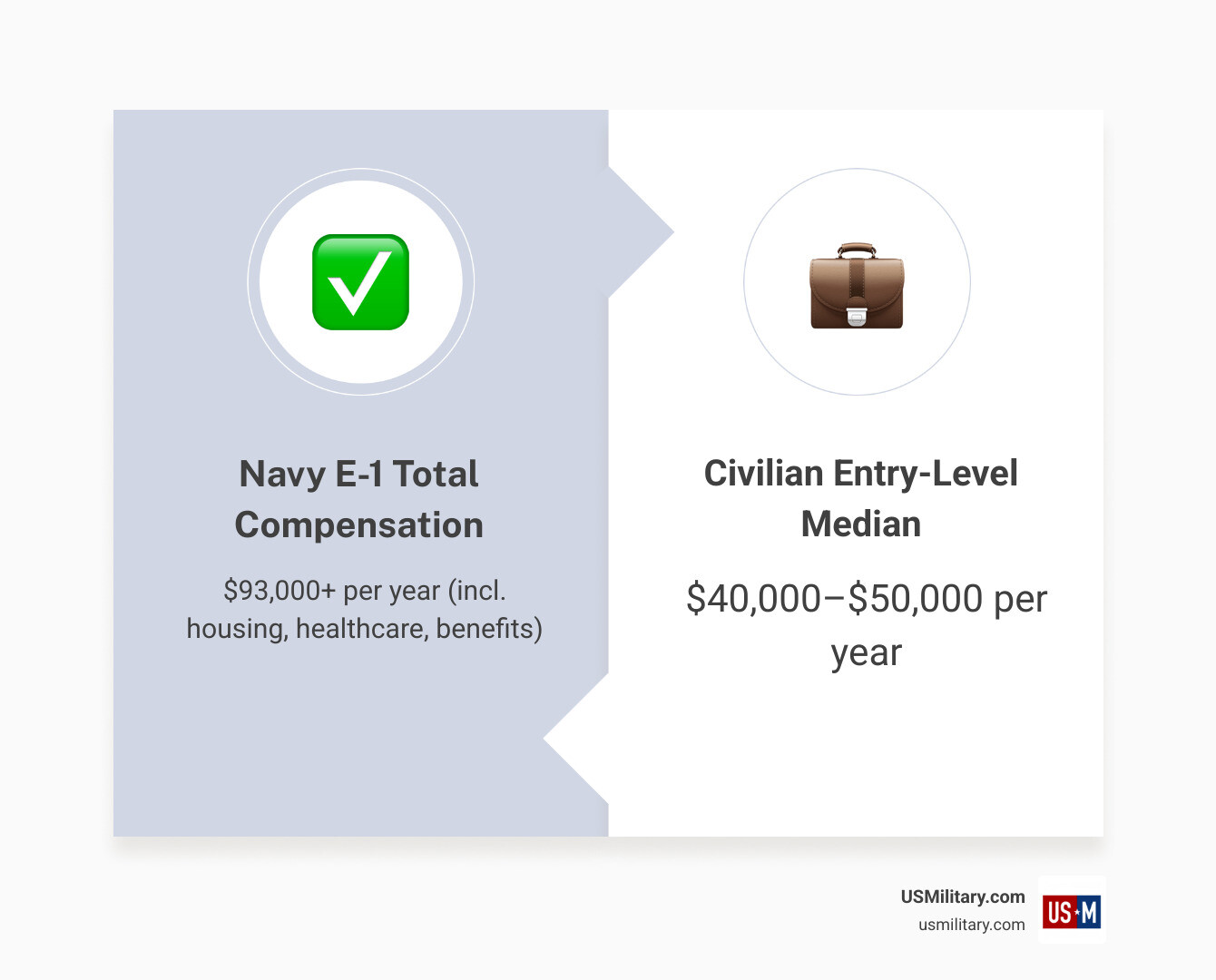
The U.S. Navy doesn’t just train you for military service — it trains you for life. Even an entry-level Navy E-1 Seaman Recruit receives a total compensation package worth over $93,000 per year when you factor in housing, healthcare, and other benefits. Many Navy ratings also come with enlistment bonuses, industry-recognized certifications, and security clearances that give veterans a massive head start in the civilian job market.
In 2026, high-demand fields like cybersecurity (33% projected growth), logistics (30% growth), and nuclear energy are actively recruiting veterans — and Navy training puts you squarely in the pipeline for those roles.
I’m Larry Fowler, publisher of USMilitary.com and a longtime resource for active-duty service members and veterans navigating careers and benefits since 2007 — and the 20 Navy Jobs That Can Set You Up For Financial Success For Life covered in this guide reflect years of tracking what actually works for veterans building wealth after service. Read on for the full breakdown of each role, what you’ll earn, and how to make the most of your time in uniform.
Why Navy Training is a Gold Mine for Financial Success
When we look at the 2026 economic landscape, the most valuable assets a worker can possess are technical expertise and high-level security clearances. The Navy provides both, free of charge, while paying you a salary. This creates a “gold mine” effect where the military invests hundreds of thousands of dollars into your personal human capital.
For instance, a Nuclear Machinist’s Mate receives training valued at over $200,000. In the civilian world, that level of education would typically require massive student loans. Instead, Navy Sailors earn while they learn. Beyond the technical, the Top 6 Figure Military Jobs often share a common denominator: leadership experience. Managing a team of technicians on a multi-billion dollar destroyer at age 23 is a level of responsibility rarely found in entry-level corporate roles.
Furthermore, many of these roles require Secret or Top Secret security clearances. For a civilian employer, sponsoring a new hire for a clearance is expensive and time-consuming. By entering the job market with an active clearance, you become an “instant hire” for government contractors and tech firms. When you Find Careers in the U.S. Navy, you aren’t just looking for a four-year hitch; you’re looking for a lifetime competitive edge.
20 Navy Jobs That Can Set You Up For Financial Success For Life
Entering the Navy requires meeting specific standards, primarily determined by your ASVAB (Armed Services Vocational Aptitude Battery) scores. The higher you score, the more “high-value” ratings become available to you. Training for these roles can last anywhere from a few months to two years, often accompanied by significant enlistment bonuses to attract top talent.

High-Tech Roles: Navy Jobs That Can Set You Up For Financial Success For Life
The digital and nuclear frontiers are where the highest salaries live. These roles demand high ASVAB scores and rigorous “A” School training.
- Nuclear Machinist’s Mate (MMN): This is widely considered one of the Best Jobs In The Navy 2 for financial potential. You’ll maintain nuclear reactors on submarines or carriers. Civilian power plants and energy firms actively recruit MMNs, with average starting salaries around $106,847.
- Information Systems Technician (IT): ITs manage the Navy’s vast computer networks. With the civilian tech sector projected to grow 13% by 2030, these Sailors transition into roles as Network Architects (median pay $116,780) or IT Managers. Check out more on Navy Information Technology Jobs to see the certifications you can earn.
- Cryptologic Technician (CT): CTs deal with the “invisible” side of warfare—signals and networks. They often hold Top Secret clearances and transition into high-paying roles with intelligence agencies or cybersecurity firms. A Submarine Electronic Navy Specialist in the CT field is particularly elite.
- Cyber Warfare Engineer (CWE): As a CWE, you are at the tip of the spear in digital defense. Salaries often exceed $90,000 while in service, and the civilian equivalent—Cybersecurity Analyst—is growing at a staggering 33% rate.
- Electronics Technician (ET): ETs are the “fix-it” experts for everything from radar to communications. This technical proficiency makes them prime candidates for the aerospace and telecommunications industries. Learn more about the Electronics Navy Enlisted Specialist path.
Specialized Operations: Navy Jobs That Can Set You Up For Financial Success For Life
These roles often involve high-stakes environments, requiring nerves of steel and specialized certifications that are rare in the civilian world.
✉ Get updates like this in your inbox
Weekly VA benefit changes, pay updates, and money tips for service members, veterans, and military families. Free, no spam.
- Air Traffic Controller (AC): This is one of the highest-paying civilian transitions possible. The FAA median pay is $122,950. Whether you are in a tower or on a carrier flight deck, your skills are in constant demand.
- Naval Aviator: Flying fighter jets or transport planes translates directly to commercial aviation. Airline pilots can earn over $200,000 annually. For those not yet commissioned, there are several Navy Enlisted Pilot Education Options to explore.
- Navy Diver: From underwater salvage to ship repair, Navy Divers possess skills that the commercial diving industry pays handsomely for, with some specialists earning up to $150,000.
- Explosive Ordnance Disposal (EOD): EOD techs are the world’s premier bomb squads. Post-service, they find lucrative work in government contracting, security, and specialized demolition.
- Aviation Rescue Swimmer (AIRR): Often appearing on the list of Top 10 Jobs In The Navy In 2026, these heroes gain emergency medical and survival skills that lead to high-paying roles in search and rescue or flight nursing.
- Intelligence Specialist (IS): IS Sailors analyze data to see the “big picture.” They are highly valued as Management Consultants or Intelligence Analysts, often earning $140,000+ in the private sector.
Professional and Support Services for Lifelong Wealth
Not every high-paying job is behind a computer or in a cockpit. The Navy’s “backbone” roles offer incredible business and medical opportunities.
- Hospital Corpsman (HM): HMs provide everything from battlefield medicine to clinical care. This is a direct pipeline to becoming a Nurse Practitioner (median pay $195,610) or Physician Assistant. See the Operating Room Navy Enlisted Specialist for surgical tech pathways.
- Logistics Specialist (LS): The Navy moves more gear than almost any company on earth. LS Sailors gain supply chain expertise that is highly valued in the $76,270+ median salary world of civilian logistics. Explore a Great Career In The Navy Supply Corps.
- Legalman (LN): Serving as a paralegal for the Navy, you’ll enforce the UCMJ. Civilian paralegals and legal managers with this experience can easily break into the $70,000–$100,000 range.
- Construction Mechanic (CM): Part of the famous Seabees, CMs maintain heavy equipment. In the civilian construction boom, a master mechanic with Navy leadership can command six-figure salaries as a project manager.
- Mass Communication Specialist (MC): MCs are the Navy’s journalists and PR experts. Their skills in digital media and corporate communication are highly transferable to marketing and art director roles (median $92,500).
- Master-at-Arms (MA): The Navy’s police force. MAs transition seamlessly into federal law enforcement (FBI, US Marshals) where salaries can reach $153,000 per year.
- Aviation Boatswain’s Mate (AB): These Sailors manage flight deck operations. The leadership and safety protocols learned lead to careers in airport management or industrial safety, with average salaries around $72,233.
- Sonar Technician (ST): STs use advanced acoustics to track underwater threats. This specialized knowledge is used in oceanography, oil and gas exploration, and maritime research.
- Aviation Electronics Technician (AT): If an F-18 has a computer glitch, the AT fixes it. This leads to high-paying roles with Boeing, Lockheed Martin, or major airlines. Get the details on Navy F 18 Hornet Enlisted Training.
Maximizing Your Post-Service Earnings with the GI Bill
While your Navy training is world-class, the Post-9/11 GI Bill is the tool that locks in your financial success. We always tell our Sailors: don’t just take the experience; take the credentials.
Using the GI Bill, you can pursue industry-standard certifications that would otherwise cost thousands. For ITs, this means getting your CompTIA Security+ or CISSP—certifications that are often mandatory for high-paying defense contracts. For Naval Aviators, the GI Bill can cover the costs of additional FAA certifications needed for commercial airlines.
If you are in a management-heavy role, such as an Officer or Senior Enlisted, an MBA is a powerful way to translate your military leadership into corporate language. Many veterans use their benefits to attend top-tier business schools, moving into Top Business Jobs In The Navy and eventually into C-suite positions (CIOs can earn $172,900+). Check out the Best Paying Navy Jobs [2024] for more on how education bridges the gap.
Navigating the Transition: From Sea to Six Figures
The transition from a Navy uniform to a business suit can be jarring, but it is where the “financial success for life” part really begins. The most successful veterans start their transition plan at least two years before their separation date.
One of the best resources available is Navy COOL (Credentialing Opportunities On-Line). This program helps you translate your Navy training into civilian certifications while you are still on active duty. For example, if you are a Job In Navy Personnel, Navy COOL can help you earn your PHR (Professional in Human Resources) certification, making you eligible for HR Manager roles paying over $104,000.
Networking is also vital. Veteran networks on platforms like LinkedIn are incredibly supportive. Reach out to former Sailors who are now working in your target industry. They can help you avoid common “transition mistakes,” such as underselling your leadership or failing to translate military jargon on your resume. Whether you were a Surface Warfare Navy Officer or a junior technician, your experience has a market value—you just need to communicate it effectively.
Frequently Asked Questions about Navy Careers
Which Navy job has the highest civilian salary?
While many roles pay well, the Nuclear Field and Air Traffic Control consistently see the highest immediate civilian salaries. Nuclear technicians often start at $100,000+, and Air Traffic Controllers can reach $130,000+ with the FAA. Check out the Top 20 Navy Careers: Skills, Roles, and Opportunities for a side-by-side comparison.
How do security clearances impact post-Navy pay?
An active Top Secret (TS/SCI) clearance is essentially a “golden ticket” in the civilian world. It can add $10,000 to $20,000 to your base salary in industries like cybersecurity, defense contracting, and government intelligence because it saves the employer the massive cost of the background investigation.
Can I get a degree while serving in the Navy?
Absolutely. Through Tuition Assistance (TA), the Navy pays for your college courses while you are on active duty. This allows many Sailors to earn their Associate’s or Bachelor’s degree for free, saving their GI Bill for a Master’s degree or more expensive certifications later.
Conclusion
The path to financial freedom doesn’t have to involve decades of student debt and entry-level “grunt work.” By choosing one of these 20 Navy Jobs That Can Set You Up For Financial Success For Life, you are choosing a career path that rewards technical skill, discipline, and leadership.
Between the competitive base pay, housing allowances (BAH), and the 5% retirement matching through the Thrift Savings Plan (TSP), the Navy provides a financial foundation that is hard to beat in the private sector. When you add in the lifelong benefits of the VA Home Loan and the GI Bill, the “wealth gap” between veterans and their civilian peers often swings in favor of those who served.
At USMilitary.com, our mission is to ensure you have the information you need to maximize these benefits. Whether you are looking for Benefits Of Working As A Navy Surface Warfare Officer or technical training as an EN, the opportunities are there for the taking.
Ready to take the next step? Don’t leave your financial future to chance. Start your journey to financial success today and see how the Navy can forge your path to a wealthy, stable, and purposeful life.
Free for Service Members & Veterans
Get the military benefits intel no one tells you about.
Weekly updates on VA benefits, pay changes, and money tips — free for service members and veterans.
No spam. Unsubscribe anytime. Your info is never shared.


