What the 2026 VA Disability Pay Chart Means for Your Monthly Benefits

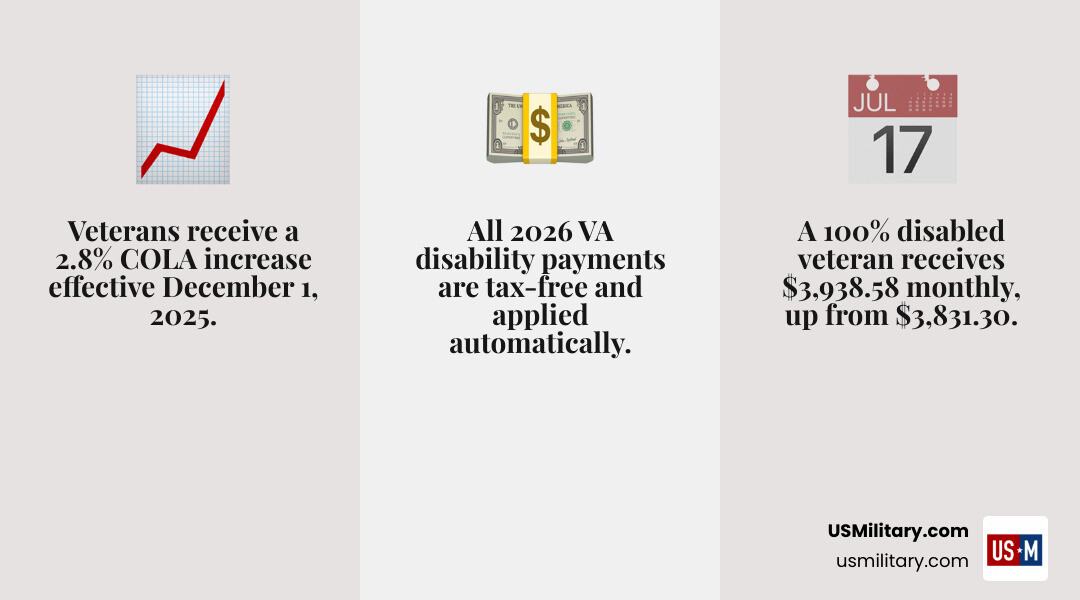
The 2026 VA Disability Pay Chart reflects a 2.8% cost-of-living adjustment (COLA), effective December 1, 2025. Here are the key monthly rates at a glance:
| Disability Rating | 2025 Monthly Rate | 2026 Monthly Rate |
|---|---|---|
| 10% | $175.51 | $180.42 |
| 20% | $346.95 | $356.66 |
| 30% (no dependents) | $537.42 | $552.47 |
| 50% (no dependents) | $1,102.04 | $1,132.90 |
| 70% (no dependents) | $1,759.05 | $1,808.44 |
| 100% (no dependents) | $3,831.30 | $3,938.58 |
| 100% with spouse | $3,727.22 | $4,158.17 |
| 100% with spouse + 1 child | — | $4,318.99 |
All payments are completely tax-free. No action is required — the increase is applied automatically.
These updated rates affect more than just base pay. Veterans rated 30% or higher also receive increased amounts for dependents, including spouses, children, and dependent parents.
I’m Larry Fowler, publisher of the USMilitary.com Network since 2007, where I’ve tracked VA benefits trends — including every annual 2026 VA Disability Pay Chart update — to help veterans and active service members make sense of their compensation. Keep reading for a full breakdown of every rate, dependent add-on, and payment date you need to know.
Understanding the 2026 VA Disability Pay Chart and COLA Increase
Every year, the Department of Veterans Affairs adjusts its compensation rates to ensure that inflation doesn’t eat away at the purchasing power of your hard-earned benefits. For 2026, the cost-of-living adjustment (COLA) is officially locked in at a 2.8% increase.
This adjustment is legally tied to the Social Security Administration’s annual COLA announcement, which is calculated using the Consumer Price Index for Urban Wage Earners and Clerical Workers (CPI-W). When consumer prices rise, your benefits rise to match. The 2.8% bump went into effect on December 1, 2025, which means your very first check of 2026 (delivered in late December) already reflected these larger amounts.
One of the best parts about VA disability compensation is that it is completely tax-free at the federal level. You do not have to report this income on your tax returns, and you don’t have to pay state taxes on it either.
If you want to dive deeper into how these annual changes shape your overall benefit landscape, check out our comprehensive 2026 VA Disability Rates: Everything You Need to Know and review the 2026 VA Disability Changes Guide to see what else has evolved this year. For further analysis on how these rates are calculated, you can also read the 2026 VA Disability Pay Rates & Charts | 2.8% COLA Confirmed resource.
Official 2026 VA Disability Compensation Rates
Navigating VA tables can sometimes feel like trying to read a map of the Pentagon in the dark. But once you understand the basic structure, the 2026 VA Disability Pay Chart is actually quite straightforward.
Your monthly benefit is primarily determined by two factors:
- Your overall combined disability rating (ranging from 10% to 100% in 10% increments).
- The number of eligible dependents in your household (applicable only if your rating is 30% or higher).

For veterans with a 10% or 20% disability rating, the system is incredibly simple. The VA pays a flat rate regardless of whether you are married, have children, or support dependent parents. The idea is that lower rating levels represent mild to moderate conditions that do not trigger family-based supplemental compensation.
To review the official baseline figures straight from the source, you can visit the Current Veterans Disability Compensation Rates page. If you are looking for a complete breakdown of how these tiers stack up, check out our In Depth Guide To Va Disability Rates For 2026.
Base Rates for Veterans with No Dependents on the 2026 VA Disability Pay Chart
If you are a single veteran with no dependents, your monthly check is determined purely by your percentage rating. Below, we have mapped out exactly how much your monthly payment has increased from last year.
| Disability Rating | 2025 Monthly Base Rate | 2026 Monthly Base Rate | Monthly Increase |
|---|---|---|---|
| 10% | $175.51 | $180.42 | +$4.91 |
| 20% | $346.95 | $356.66 | +$9.71 |
| 30% | $537.42 | $552.47 | +$15.05 |
| 40% | $774.16 | $795.84 | +$21.68 |
| 50% | $1,102.04 | $1,132.90 | +$30.86 |
| 60% | $1,395.93 | $1,435.01 | +$39.08 |
| 70% | $1,759.05 | $1,808.44 | +$49.39 |
| 80% | $2,044.89 | $2,102.14 | +$57.25 |
| 90% | $2,297.96 | $2,362.30 | +$64.34 |
| 100% | $3,831.30 | $3,938.58 | +$107.28 |
As you can see, a 100% disabled veteran with no dependents receives a healthy boost of $107.28 more per month in 2026 compared to 2025. Over the course of a full year, that adds up to an extra $1,287.36 in your pocket!
To look closer at these numbers or print out a copy for your files, check out our Va Disability Paychart 2026 or review the Va Disability Pay 2026 portal.
How Dependents Affect the 2026 VA Disability Pay Chart
Once you hit a 30% disability rating or higher, the VA recognizes that your service-connected conditions can impact your ability to support your household. This is where “dependent status” comes into play. You can add a spouse, biological or adopted children under 18 (or up to age 23 if they are enrolled full-time in school), and even dependent parents to your award.
Adding dependents can dramatically increase your monthly payout. For instance, at a 100% rating:
- Veteran alone: $3,938.58
- Veteran with a spouse: $4,158.17 (an extra $219.59/month)
- Veteran with a spouse and one child: $4,318.99 (an extra $380.41/month)
If your spouse requires Aid and Attendance (A/A) due to a severe disability of their own, you can qualify for an additional medical supplement. For veterans at a 100% rating, having a spouse who qualifies for Aid and Attendance adds $201.41 per month to your check. You can see the full breakdown of these specialized medical allowances on the Aid and Attendance Pay Chart 2026.
Each additional child under age 18 adds between $32.00 (at the 30% rating level) and $109.11 (at the 100% rating level) to your monthly check. For an exhaustive look at all possible dependent combinations, we recommend checking out the 2026 VA Disability Pay Rates: Full Chart With All Dependents | claim.vet or referencing the VA Disability Pay Chart Rates for 2026 | Marc Whitehead & Associates guide.
How the VA Calculates Combined Disability Ratings
If you have multiple service-connected disabilities, you might think the VA simply adds your ratings together. For example, if you have a 50% rating for PTSD, a 30% rating for a back injury, and a 10% rating for tinnitus, you might expect a 90% overall rating (50 + 30 + 10 = 90).
Unfortunately, that is not how it works. Welcome to the wonderful world of “VA Math.”

The VA calculates combined ratings using the Whole Person Theory. The logic is that a person can never be more than 100% efficient. Each disability percentage is applied to what is left of your “healthy” body, rather than added to a running sum.
Here is how the VA calculates a combined rating step-by-step:
- Start with 100% efficiency: You are a whole person.
- Apply the highest rating first: If your highest rating is 50% for PTSD, you are now considered 50% disabled and 50% efficient.
- Apply the next highest rating to the remaining efficiency: Your next highest rating is 30% for your back. The VA takes 30% of your remaining 50% efficiency, which equals 15%.
- Combine them: Add that 15% to your initial 50% rating. You are now 65% disabled and 35% efficient.
- Apply the next rating: Your next rating is 10% for tinnitus. The VA takes 10% of your remaining 35% efficiency, which equals 3.5%. Add that to 65%, and you get 68.5%.
- Round to the nearest 10%: The VA rounds up or down to the nearest 10% increment. Since 68.5% is closer to 70% than 60%, your final combined rating is 70%.
Note: If you have disabilities affecting both of your arms or both of your legs, a “bilateral factor” of 10% is added to those specific ratings before combining them, which can give your final number a helpful boost.
To understand this complex calculation process without pulling your hair out, read our easy-to-follow VA Disability Rating Chart 2026 Guide or consult the detailed explanations in the 2026 VA Disability Rates: Updated Compensation Pay Chart article.
Frequently Asked Questions About 2026 VA Disability Pay
When do the 2026 VA disability rates take effect?
The official 2026 rates took effect on December 1, 2025. Because the VA pays disability compensation one month in arrears (meaning you are paid at the end of the month for the time that has passed), your first check reflecting the 2.8% COLA increase was paid on December 31, 2025.
The general rule of thumb is that your monthly payment is issued on the first business day of the following month. However, if the first of the month falls on a weekend or a federal holiday, the Treasury Department issues your payment on the last business day of the preceding month.
Do I need to apply to receive the 2026 COLA increase?
No! You do not need to fill out any paperwork, submit any medical evidence, or call the VA to receive your 2.8% COLA increase. The adjustment is applied automatically to all active VA disability awards. If you are receiving benefits, your monthly direct deposit simply increased starting with your late-December 2025 payment.
How can I increase my VA disability rating in 2026?
If your service-connected physical or mental health conditions have worsened over time, you have every right to ask the VA for an increased rating. To do this, you must submit a claim for an increase through VA.gov, providing fresh medical evidence that shows your symptoms now meet the criteria for a higher percentage.
One of the fastest ways to get a decision is by filing a Fully Developed Claim (FDC). By gathering all your private medical records, doctor’s statements, and nexus letters ahead of time and submitting them all at once, you can often get a decision in a fraction of the time.
If you are ready to take action, check out our guide on How To Increase Va Disability Rating For 2026. We also have helpful resources detailing the 10 Easiest Va Disability Claims For 2026 and our 12 Easiest Va Disability Claims Guide 2026 to help you identify secondary conditions you may have overlooked.
Conclusion
We hope this in-depth guide to the 2026 VA Disability Pay Chart gives you the clarity you need to plan your household finances. Navigating military benefits can be challenging, but you don’t have to do it alone.
Here at USMilitary.com, we are proud to serve as your central hub for military-related guidance. Whether you are looking to secure a VA home loan, explore personal military loans, or maximize your monthly VA compensation, we are here to support you every step of the way.
To keep exploring your benefit rates and ensure you are receiving every dollar you deserve, head over to our comprehensive database of VA Disability Rating Charts today!
Free for Service Members & Veterans
Get the military benefits intel no one tells you about.
Weekly updates on VA benefits, pay changes, and money tips — free for service members and veterans.
No spam. Unsubscribe anytime. Your info is never shared.


