VA Disability Requirements: The Five Basics

To qualify for VA disability compensation, you generally need to meet five core VA disability requirements:
- Qualifying military service, including eligible active duty or training.
- A discharge status that does not bar benefits.
- A current physical or mental condition.
- An event, injury, illness, or exposure tied to service.
- A connection between your condition and service, established through evidence or a VA presumption.
The details matter. A condition diagnosed after discharge may still qualify, and some presumptive conditions do not require you to prove exactly how service caused them.
I’m Larry Fowler, a Navy veteran and publisher of NavySEAL.com and the USMilitary.com Network. Since 2007, our network has covered veterans’ benefits and disability trends, and this guide will help you check the VA disability requirements before you file.
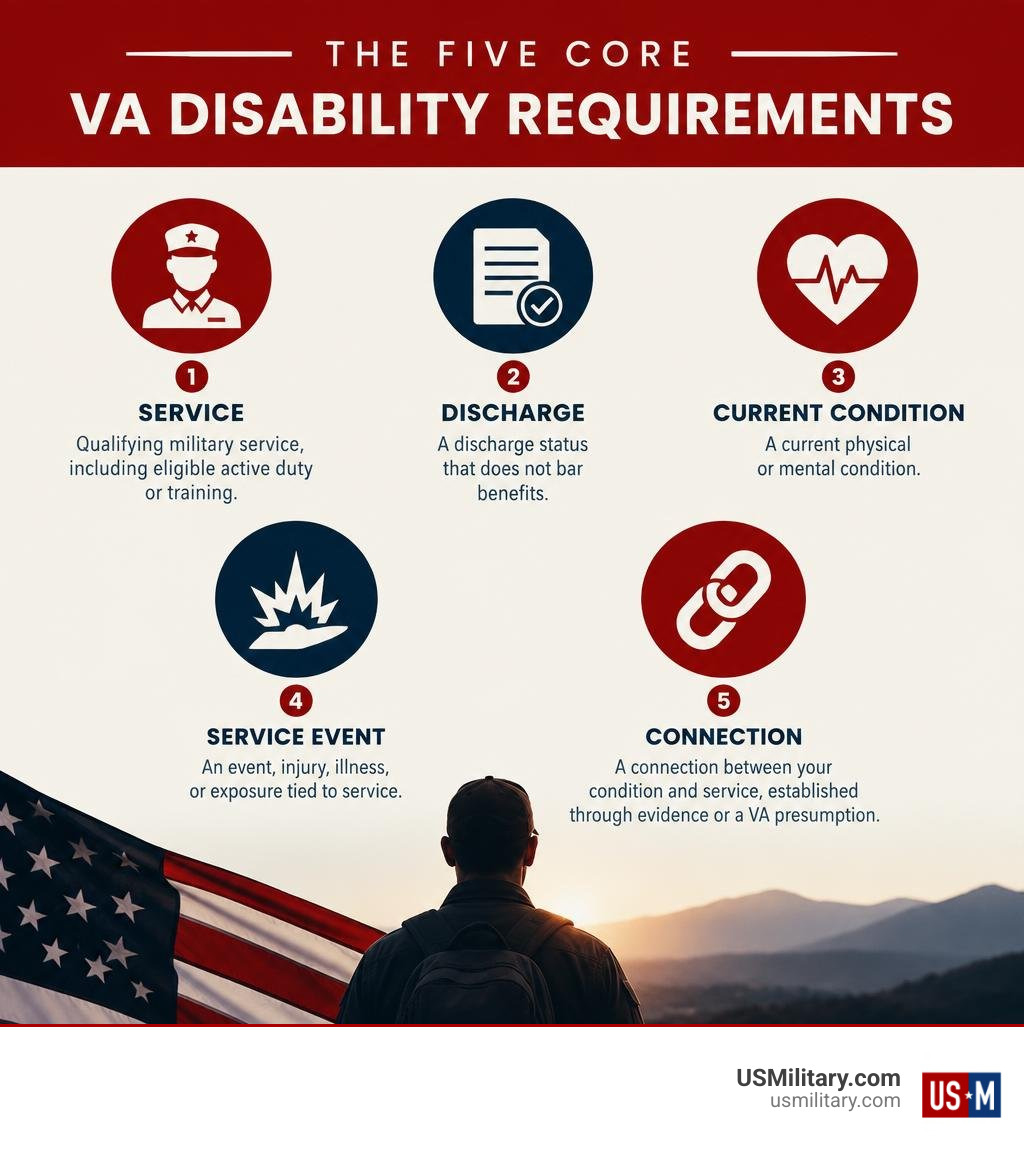
Quick look at VA disability requirements:
Understanding the Core VA Disability Requirements for Eligibility
Navigating Department of Veterans Affairs regulations can sometimes feel like deciphering coded radio traffic. However, the foundational rules governing monthly disability compensation are clearly defined under Title 38 of the Code of Federal Regulations (38 CFR Part 4). The VA disability compensation program delivers tax-free monthly financial support to veterans who sustained injuries or contracted illnesses due to their military service.
To secure these benefits, every applicant must provide concrete proof satisfying each element of the law. Let’s break down these foundational pillars so you know exactly where your claim stands.
Qualifying Military Service and Discharge Characterization
Your journey begins with your service record. To qualify, you must have served on active duty, active duty for training (ACDUTRA), or inactive duty training (INACDUTRA) in the Army, Navy, Air Force, Marine Corps, Coast Guard, or Space Force. Members of the National Guard and Reserve components are eligible if called to active duty by federal orders or if an injury or illness occurred during scheduled training drills.
Discharge characterization is equally critical. By law, your separation must be under conditions other than dishonorable. An Honorable or General (Under Honorable Conditions) discharge satisfies this standard immediately.
If you received an Other Than Honorable (OTH) or Bad Conduct discharge, you are not automatically shut out. You can request a Character of Discharge review directly through the VA when submitting your claim, or pursue a discharge upgrade through your branch’s Discharge Review Board. For practical steps on navigating this process, consult the manual on applying for benefits following a discharge upgrade.
Current Physical or Mental Medical Diagnosis
You cannot receive compensation solely for a painful event that happened decades ago; you must have an active, diagnosed medical condition today. The VA requires clear medical documentation showing a chronic illness, physical limitation, or mental health disorder.
Qualifying issues range from musculoskeletal problems like joint pain to systemic conditions and mental health challenges. Whether you rely on VA health records or private physician notes, your diagnostic paperwork must establish that your condition currently impairs your daily life. Review our comprehensive breakdown of conditions that qualify for VA disability to understand how specific ailments are evaluated.
In-Service Incurrence, Event, or Injury
Next, you must document the specific incident that took place while wearing the uniform. This could be:
- An acute injury during physical training, field maneuvers, or combat operations.
- An illness contracted during deployment or overseas assignment.
- Exposure to hazardous materials, burn pits, or toxic chemicals.
- Military Sexual Trauma (MST) or psychological stressors tied to traumatic events.
Service Treatment Records (STRs) serve as primary evidence. When official records are missing or incomplete, lay statements (also known as buddy letters) from fellow service members, commanders, or family members can corroborate the occurrence of the in-service event.
The Medical Nexus Linking Disability to Service
The medical nexus is often the missing puzzle piece in denied claims. A nexus is the formal medical link connecting your current diagnosis to the incident in your service records.
This connection is established through an Independent Medical Opinion (nexus letter) or during a VA Compensation and Pension (C&P) examination. The physician must state that it is “at least as likely as not” (a 50% or greater probability) that your military service caused or aggravated your current medical disability.
Pathways to Establish Service Connection
Not every claim follows the exact same path. The VA recognizes multiple legal theories to establish service connection, giving veterans distinct avenues to prove their cases.

Meeting Presumptive VA Disability Requirements Under the PACT Act
Proving a direct cause-and-effect link can be difficult when health complications emerge years after military discharge. To remove this barrier, Congress established presumptive service connections. Under presumptive rules, if you served in designated locations during specific time periods and developed a covered condition, the VA legally assumes your service caused the illness—no nexus letter required.
The PACT Act represents one of the largest expansions of presumptive benefits in American history, covering veterans exposed to burn pits, airborne hazards, and toxic substances across Southwest Asia, Afghanistan, and surrounding regions. Presumptions also apply to Vietnam veterans exposed to Agent Orange and former prisoners of war.
Furthermore, under 38 CFR 3.309(a), certain chronic illnesses—such as arthritis, hypertension, or ulcers—qualify for presumptive service connection if they manifest to at least a 10% disabling degree within one year of discharge. Verify your coverage through the official VA disability eligibility criteria.
| Service Connection Pathway | What You Must Prove | Medical Nexus Required? |
|---|---|---|
| Direct | Current diagnosis + In-service event | Yes (Doctor’s nexus statement) |
| Secondary | Current condition caused by an existing service-connected disability | Yes (Etiological link to primary disability) |
| Presumptive | Qualifying service location/dates + Covered diagnosis | No (Connection presumed by law) |
Secondary Service Connection and Associated VA Disability Requirements
Disabilities rarely exist in isolation. If a service-connected condition causes or aggravates a new, separate health problem, the secondary condition is fully eligible for monthly compensation.
Common secondary claims include:
- Developing clinical depression or anxiety secondary to chronic, debilitating back pain.
- Sleep apnea developing as a result of service-connected PTSD or respiratory damage.
- Gastrointestinal disorders like GERD caused by long-term NSAID medication prescribed for service-connected joint injuries.
Filing secondary claims requires clear medical rationale demonstrating proximate causation. To position your secondary filings for success, follow our step-by-step claims filing strategy.
How Disability Ratings Impact Monthly Compensation in 2026
Once service connection is granted, the VA assigns a disability rating ranging from 0% to 100%, in 10% increments. This percentage reflects the severity of your occupational and social impairment under the 38 CFR Part 4 rating schedule.
If you have multiple service-connected disabilities, the VA does not simply add the numbers together using normal arithmetic. Instead, they apply non-additive “VA math,” calculating each subsequent disability against your remaining non-disabled efficiency. For example, a veteran with a 50% rating and a separate 30% rating receives a combined rating of 65%, which rounds up to a 70% disability rating.
Your final combined percentage dictates your monthly compensation and places you into one of eight VA health care priority groups, which determine your copay obligations. You can review current payment tiers and rate schedules in our 2026 VA disability rating schedule and our detailed breakdown of 2026 monthly VA disability compensation rates.
Step-by-Step Process to File Your Claim and Manage Denials
Filing a claim does not have to be intimidating if you approach it systematically:
- Submit an Intent to File (VA Form 21-0966): This sets your effective date. You have one full year from this submission to finalize your evidence while preserving your retroactive payment start date.
- Gather Essential Records: Compile your DD-214, Service Treatment Records, private physician evaluations, diagnostic tests, and lay statements.
- Submit VA Form 21-526EZ: Complete your formal application online via VA.gov or submit a Fully Developed Claim (FDC) by mail to the VA Evidence Intake Center.
- Attend Your C&P Exam: If scheduled for a Compensation and Pension exam, show up on time and describe your symptoms honestly based on your worst health days.
For an extensive walk-through of enrollment steps and medical services, refer to the VA orientation and benefits processing guide.
If the VA denies your claim or underrates your condition, you have three primary appeal pathways under the Appeals Modernization Act:
- Supplemental Claim: Submit new and relevant evidence for review.
- Higher-Level Review (HLR): Request a senior adjudicator re-examine the existing record without submitting new evidence.
- Board of Veterans’ Appeals (BVA): Appeal directly to a Veterans Law Judge in Washington, D.C.
Learn how to address unfavorable decisions by reading our guide on effective strategies to appeal a denied VA claim.
Frequently Asked Questions About VA Disability
What is the minimum service length required to qualify for VA disability benefits?
For disability compensation, there is generally no minimum length of service, provided your injury or illness occurred or was aggravated during active military service or authorized training. However, for general VA health care enrollment without a service-connected rating, veterans who enlisted after September 7, 1980, must generally have served 24 continuous months or the full period for which they were called to active duty.
Can you receive VA disability compensation with an Other Than Honorable discharge?
Yes. You can request a Character of Discharge determination from the VA during your initial application. The VA evaluates whether your discharge was due to circumstances such as undiagnosed PTSD, traumatic brain injury, or combat stress, which can qualify you for benefits for service-connected conditions.
How long do you have after discharge to file a VA disability claim?
There is no deadline or expiration date to file a VA disability claim. You can submit an application 5 months or 50 years after separating from service. However, filing within one year of discharge makes it easier to establish service connection for chronic conditions that appear post-service and locks in the earliest possible effective date.
Conclusion
Securing the benefits you earned through military service comes down to meeting the fundamental eligibility criteria: verified service, an eligible discharge, an active diagnosis, documented in-service events, and a credible medical nexus. Organizing your evidence methodically before filing gives your claim the greatest chance of swift approval.
At USMilitary.com, we are committed to equipping service members, veterans, and military families with actionable, dependable information on compensation, health care, and career transitions. Explore our comprehensive hub of military benefits guidance and veteran resources to maximize your benefits and protect your financial future.
Free for Service Members & Veterans
Get the military benefits intel no one tells you about.
Weekly updates on VA benefits, pay changes, and money tips — free for service members and veterans.
No spam. Unsubscribe anytime. Your info is never shared.



Leave a Reply