Army National Guard Age Limit: Check Your Enlistment Window

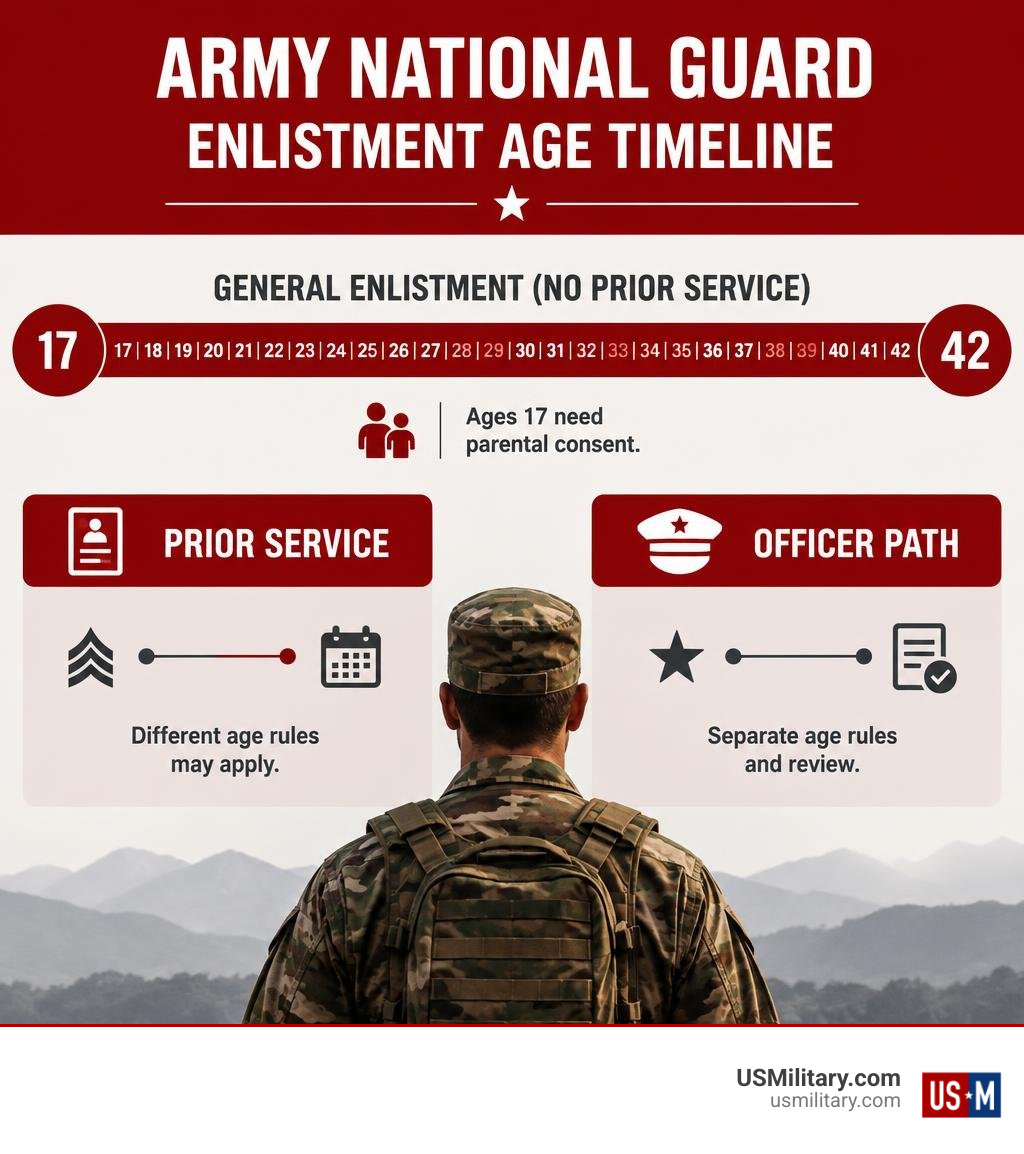
If you have no prior military service, you can generally enlist in the Army National Guard from age 17 through age 42. Applicants who are 17 need parental consent. If you served before, or want to become an officer, different age rules may apply. A Guard recruiter can check your service record and the requirements for the job you want.
I’m Larry Fowler, publisher of USMilitary.com. Since 2007, I’ve helped military applicants and veterans find information on service options, including the Army National Guard age limit; next, we’ll look at how the rules change for prior service and officer paths.
Key Army Guard age limit vocabulary:
Understanding the Standard Army Guard Age Limit for Enlisted Recruits and Officers
Enlisting in the military as an adult with established career and family routines is increasingly common. Under current administrative rules outlined in *Army Regulation 601 – 210, the standard maximum age for non-prior service enlistees in the Army National Guard is up to and including age 42. This policy allows prospective soldiers to start their military journey well into their thirties and early forties. To understand how these rules fit into the broader defense landscape, see our essential guide to military age limits.
Meeting the age standard means completing all preliminary paperwork, passing physical examinations at the Military Entrance Processing Station (MEPS), and taking the enlistment oath before your 43rd birthday. While 42 is the standard upper cutoff for non-prior service enlistments, specific entry paths have different minimums, paperwork rules, and timelines.
Minimum Age Requirements and Minor Consent Rules
The minimum entry age for the Army National Guard is 17. However, 17-year-olds are legally minors and must obtain signed consent from a parent or legal guardian. 17-year-old high school juniors can take advantage of split-training options by attending Basic Combat Training (BCT) during the summer between their junior and senior years and completing Advanced Individual Training (AIT) after high school graduation.
Once an applicant turns 18, they reach the legal age of majority and can enlist independently without parental signatures. Whether an applicant enters at 17 or later, our guide from 17 to 42: the ultimate guide to enlisting in the US military details the education credentials, ASVAB testing milestones, and medical qualifications needed to complete the process.
Officer Commissioning Age Limitations
Earning a commission as an Army National Guard officer involves distinct age limits tied to specific commissioning sources:
- State and Federal Officer Candidate School (OCS): Candidates generally must complete commissioning requirements before age 42, though some state programs prefer commissioning by age 35 to ensure clear career progression paths.
- Direct Commissions: Professionals entering specialized fields such as legal (JAG) or chaplaincy often have extended age limits, sometimes up to 42 or older.
- Warrant Officers: Technical warrant officer paths evaluate existing enlisted expertise and generally accept candidates up to age 42, whereas aviation warrant tracks historically require candidate selection before age 32 (with waivers considered up to 35).
Because military retirement typically requires 20 qualifying years of service, commissioning ages are carefully structured. For a deeper breakdown of officer timelines, explore our overview on navigating officer age requirements.
Statutory Rules: Federal Law Versus Army National Guard Regulations
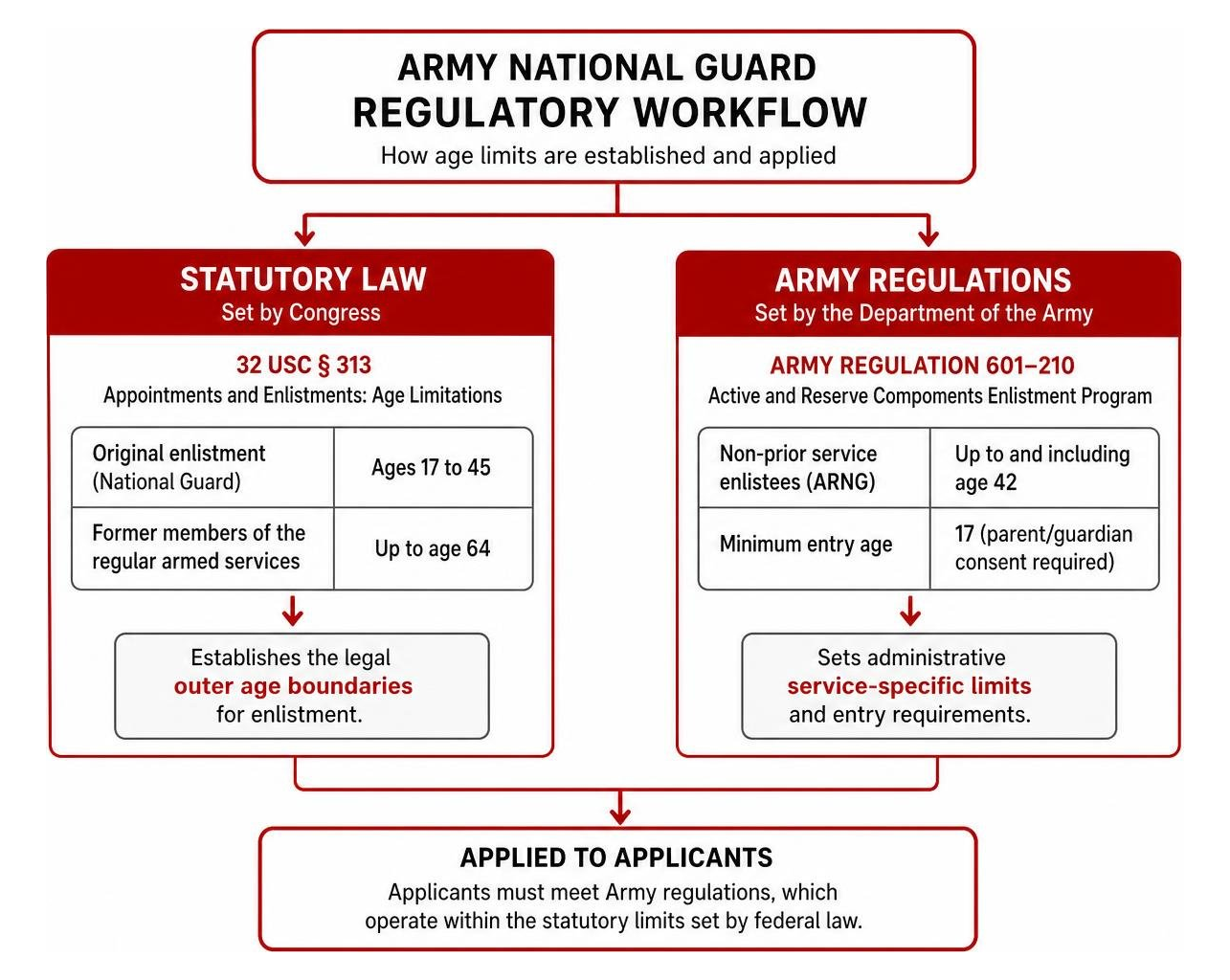
Military age guidelines involve both federal statutes passed by Congress and administrative regulations managed by the Department of the Army. Under federal law, specifically 32 USC 313: Appointments and enlistments: age limitations, the statutory limit for original enlistment in the National Guard is set between ages 17 and 45. The same statute allows former members of the regular armed services to enlist up to age 64.
Complementing this, 32 CFR § 66.6 – Enlistment, appointment, and induction criteria outlines general induction standards across the Department of Defense. While statutory law establishes the outermost legal boundaries (such as age 45 or 64), individual service regulations establish day-to-day administrative ceilings, such as the age 42 cap under AR 601-210. For broader context on how these service thresholds interact, review our analysis on whether you can still serve under current Army age limits.
How Prior Service Adjusts the Army National Guard Age Limit

Prior military service provides significant flexibility for returning veterans. If you previously served in any active or reserve military branch, your maximum enlistment age is calculated using a simple formula:
$$\text{Maximum Age} = 42 + \text{Years of Prior Creditable Service}$$
For example, an applicant who is 45 years old with 5 years of honorable active service has an adjusted entry age of 40 ($45 – 5 = 40$), making them eligible under the standard age 42 baseline. Under Title 32 statutory provisions, former service members can theoretically affiliate up to age 64, provided they can complete any remaining years needed for retirement before mandatory separation. If you have worn the uniform previously, read our guides on how prior service affects military age cutoffs and re-enlistment age limits for returning service members.
Healthcare Specialties and the Army National Guard Age Limit Exception
The National Guard maintains unique provisions for licensed healthcare professionals. Physicians, surgeons, dentists, nurse practitioners, and clinical psychologists often enter through direct commissions rather than basic enlisted pipelines.
Because medical readiness is essential to state and federal missions, healthcare specialists can access age waivers well beyond 42, sometimes commissioning in their late 40s or 50s, depending on the state’s critical needs. For additional details on specialized entry, read about age limits for joining the National Guard reserves.
Comparing Guard and Reserve Age Requirements Across Branches
Enlistment age maximums vary across military branches and components based on operational requirements. The table below outlines how the Army National Guard compares to other reserve and active duty components:
| Branch / Component | Minimum Age | Maximum Enlistment Age (Non-Prior Service) |
|---|---|---|
| Army National Guard | 17 (with consent) | 42 |
| Army Reserve | 17 (with consent) | 42 |
| Regular Army (Active Duty) | 17 (with consent) | 35 (waivers up to 42) |
| Air National Guard | 17 (with consent) | 42 |
| Air Force Reserve | 17 (with consent) | 42 |
| Navy Reserve | 18 | 41 |
| Marine Corps Reserve | 17 (with consent) | 28 |
| Coast Guard Reserve | 17 (with consent) | 40 |
For an in-depth comparison of branches, see our guide on the maximum age to join the military.
Army National Guard vs. Army Reserve Guidelines
The Army National Guard and the Army Reserve share identical administrative age maximums (age 42 for non-prior service), and both utilize AR 601-210. However, their command structures differ:
- Army National Guard: Holds a dual state and federal mission, reporting to state governors during domestic emergencies and the President during federal mobilizations.
- Army Reserve: Operates purely under federal command, specializing primarily in logistical, administrative, and support functions.
Both components require one weekend of drill per month and two weeks of annual training. If you are exploring the federal side, our resource on Army Reserve age waivers provides useful insights into how age exceptions are processed.
Air National Guard and Active Duty Comparisons
The Air National Guard also allows non-prior-service recruits to enlist up to age 42. However, Active Duty Army enlistments generally set their baseline age cutoff at 35, requiring an age waiver to enlist up to age 42. Applicants looking to serve full-time versus part-time can evaluate these branch nuances in our ultimate guide to military enlistment age.
Age Waivers and the Enlistment Process

When an applicant exceeds standard regulatory age caps, an age waiver provides an official path to request a policy exception. Age waivers are evaluated based on several factors:
- Aptitude: High ASVAB line scores indicating strong trainability.
- Critical Needs: Willingness to enlist in a high-demand Military Occupational Specialty (MOS).
- Physical Fitness: Exceptional performance on military physical screening tests.
- Moral Character: A clean background check and financial standing.
The state Adjutant General and the United States Army Recruiting Command (USAREC) have authority to approve waivers. Learn more about these exceptions in our guide on waivers and opportunities for older military recruits.
Steps to Request an Age Waiver
Securing an age waiver requires proactive collaboration with a recruiter. The administrative process follows a structured sequence:
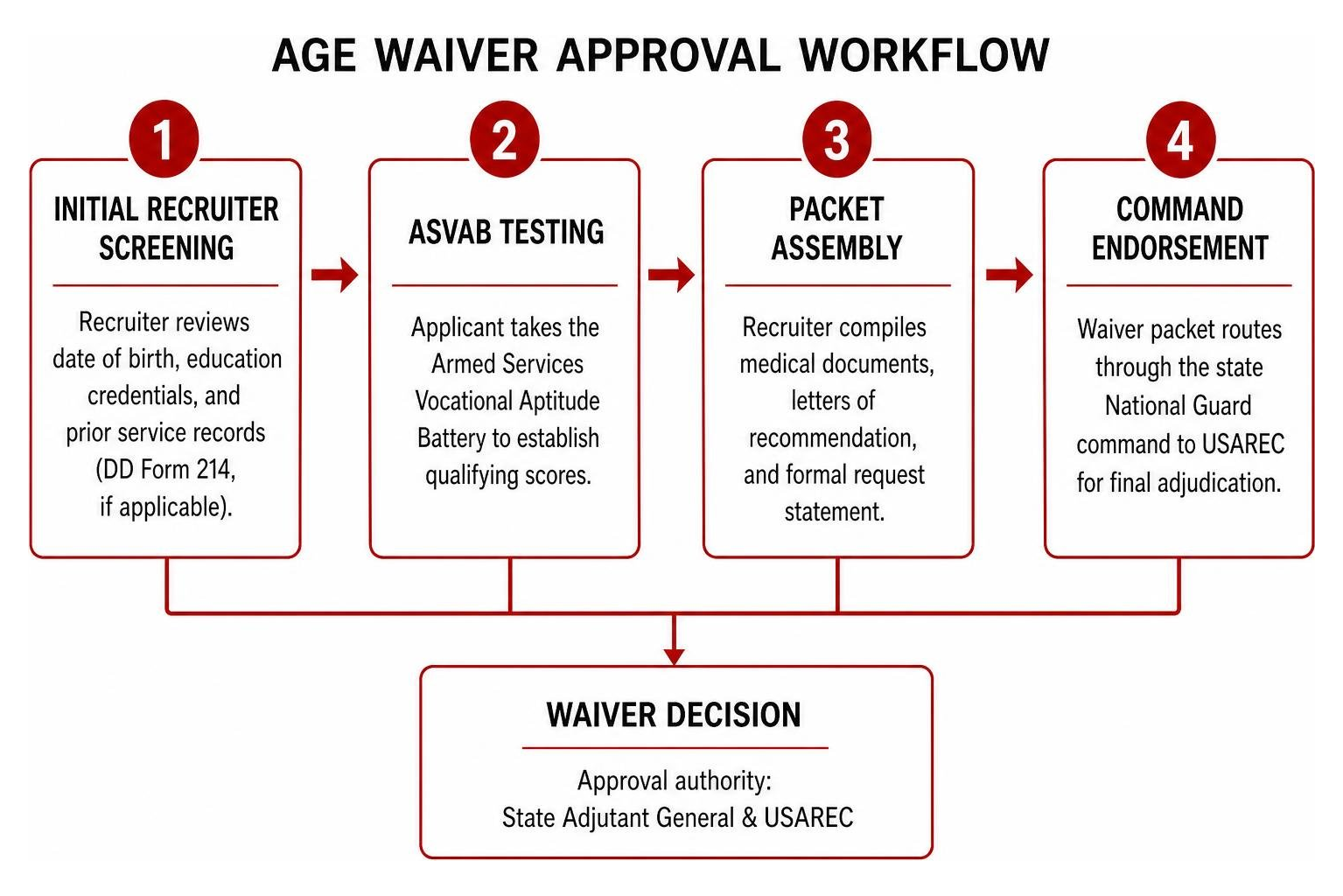
- Initial Recruiter Screening: Your recruiter reviews your date of birth, education credentials, and prior service records (DD Form 214, if applicable).
- ASVAB Testing: You take the Armed Services Vocational Aptitude Battery to establish qualifying scores.
- Packet Assembly: The recruiter compiles your medical documents, letters of recommendation, and formal request statement.
- Command Endorsement: The waiver packet routes through the state National Guard command to USAREC for final adjudication.
To avoid delays, read our advice on what you need to know before you enlist.
Physical and Medical Readiness for Older Recruits
Older applicants must meet the same physical fitness and medical standards as younger recruits. All enlistees must pass the Army Combat Fitness Test (ACFT), which tests muscular strength, endurance, and cardiovascular capacity across age- and gender-adjusted scoring brackets:
- Deadlift (3-Repetition Maximum)
- Standing Power Throw
- Hand-Release Push-Ups
- Sprint-Drag-Carry
- Plank
- Two-Mile Run
Applicants must also meet Department of Defense body composition standards for height, weight, and body fat percentage at MEPS. Understanding physical standards early helps ensure success, as our guide on military enlistment age requirements explains.
Frequently Asked Questions About the Army Guard Age Limit
Can I join the Army National Guard at 42 without prior service?
Yes. Under current Army Regulation 601-210 guidelines, you can enlist in the Army National Guard at 42 without prior service, as long as you complete the MEPS medical evaluation, take the oath of enlistment, and ship to Basic Combat Training before your 43rd birthday.
How does prior military service affect the maximum age to enlist in the Guard?
Prior active or reserve service allows you to subtract your total qualifying years of service from your biological age. As long as your adjusted age is 42 or younger—and you can complete 20 total creditable years before mandatory retirement—you remain eligible to enlist.
What is the maximum age to direct commission as a healthcare officer in the Army National Guard?
Direct-commission healthcare providers (such as doctors, dentists, and nurses) can often receive age waivers that allow entry beyond age 42, up into their late 40s or early 50s, depending on state medical readiness requirements.
Conclusion
The Army National Guard offers flexible service opportunities for individuals across diverse age groups. Whether you are a 17-year-old high school student starting your career or a professional in your early forties seeking community impact and military benefits, understanding your eligibility window is the first step.
At USMilitary.com, we provide comprehensive resources covering VA benefits, military loans, and branch comparisons to help you navigate your service journey. To take your next step, review all military age limits to explore your service options and connect with a local National Guard recruiter today.
Free for Service Members & Veterans
Get the military benefits intel no one tells you about.
Weekly updates on VA benefits, pay changes, and money tips — free for service members and veterans.
No spam. Unsubscribe anytime. Your info is never shared.



Leave a Reply