Why So Many Veterans Are Leaving VA Disability Money on the Table
The 7 Critical Steps You Must Take To Successfully Increase Your VA Disability Rating are what stand between you and the full compensation you’ve earned through your service.
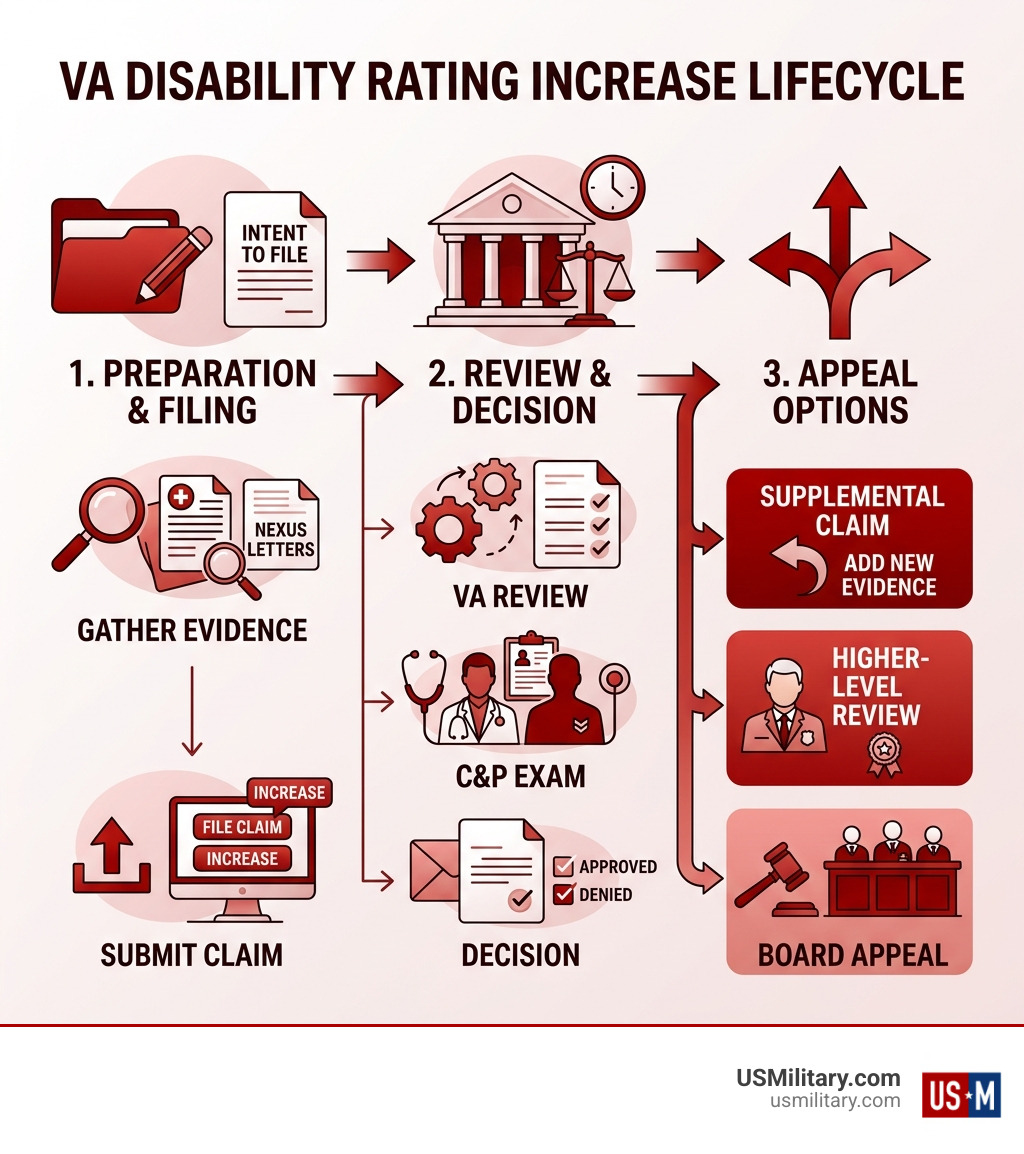
Here’s a quick snapshot of those 7 steps:
- Review your current rating and medical records
- File an Intent to File to lock in your effective date
- Gather strong medical evidence and Nexus Letters
- Identify and claim secondary conditions
- Explore TDIU if your disabilities prevent employment
- Prepare thoroughly for your C&P exam
- Appeal a denial using a Supplemental Claim, Higher-Level Review, or Board Appeal
Nearly 7 million veterans currently receive VA disability compensation — but according to available data, 8 out of 10 are underrated by the VA. That means most veterans are getting less money than they’re entitled to every single month.
Monthly payments range from around $165 at 10% to over $3,700 at 100% (based on 2024 rates). The gap between a 60% and an 80% rating alone can mean more than $700 a month — that’s over $84,000 across a decade.
The VA will not connect the dots for you. It’s on you to build the case.
The good news? The process is manageable when you know what steps to take.
I’m Larry Fowler, publisher of USMilitary.com, where since 2007 I’ve helped active-duty service members and veterans navigate VA benefits — including the 7 Critical Steps You Must Take To Successfully Increase Your VA Disability Rating. Let’s walk through exactly what you need to do to get the rating your service-connected conditions actually deserve.
Basic 7 Critical Steps You Must Take To Successfully Increase Your VA Disability Rating terms:
Understanding the 7 Critical Steps You Must Take To Successfully Increase Your VA Disability Rating

Many veterans believe that once the VA assigns a rating, it is set in stone forever. We are here to tell you that is simply not true. As we move through April 2026, it is more important than ever to realize that your health is not static. Injuries from your time in the Army, Navy, or Marines often worsen as you age. If your service-connected condition has deteriorated, you have every right to ask for an increase.
Filing a VA Disability Claim for an increase is the formal way to tell the VA, “Hey, my symptoms are worse now than they were two years ago.” This process focuses on your current functional limitations. Can you still lift what you used to? Does your PTSD prevent you from holding a steady job? The VA uses VA Form 21-526EZ to process these requests.
Our Increase VA Disability Rating: Complete Guide for 2026 emphasizes that medical evidence is the heartbeat of your claim. Without a clear paper trail showing that your condition has progressed from “annoying” to “debilitating,” the VA is likely to keep your rating exactly where it is.
Important Point One: Review Your Current Rating and Medical Records
Before you fire off a new claim, we need to look at the “rulebook.” The VA uses the VA Schedule for Rating Disabilities (VASRD) to determine how much your condition is worth in percentage terms. Every condition has a specific diagnostic code. For example, if you have a back injury, the VASRD will list exactly what range of motion earns a 20% rating versus a 40% rating.
You should start by checking our List of VA Disability Conditions to see where your symptoms fit. Pull your Summary of Benefits letter and look for longitudinal evidence—this is a fancy way of saying a “long-term record.” You want to show a steady decline in health, not just one bad afternoon. By comparing your current symptoms to the criteria in our In-Depth Guide to VA Disability Rates for 2026, you can determine if you actually qualify for that next bracket.
Important Point Two: Establish an Intent to File for Back Pay
One of the biggest mistakes we see veterans make is waiting until they have every single document ready before notifying the VA. Don’t do that! You should file an “Intent to File” immediately. This “locks in” your effective date.
Why does this matter? Because the VA can take months to process a claim. If you file an Intent to File today and your claim is approved six months from now, the VA owes you retroactive compensation back to today’s date. With the VA Disability Pay Chart 2026 showing higher rates than previous years, that back pay can result in a significant financial windfall.
You have a one-year window from the moment you notify the VA to actually submit your formal claim. This protects you and ensures you benefit from the VA Disability Cost of Living Increase 2026 while you gather your evidence.
Important Point Three: Gather High-Value Evidence and Nexus Letters
If medical records are the heartbeat of a claim, then a Nexus Letter VA is the spine. A Nexus Letter is a document from a medical professional that provides a clear medical rationale linking your current condition (or its worsening) to your military service.
We often talk about Maximizing Your VA Disability Claim: Practical Steps for Better Results, and getting an independent medical opinion is a top-tier strategy. Sometimes, VA doctors are overworked and might miss the nuances of your condition. A private doctor can provide a more detailed look at your functional impairment.
Don’t forget lay evidence, either. “Buddy statements” from fellow soldiers or letters from your spouse can provide a “day-in-the-life” perspective that a 15-minute doctor’s visit can’t capture. When the VA looks at the 2025 VA Disability Ratings data, they are looking for a complete picture of how you are suffering.
Leveraging Secondary Conditions and TDIU for a 100% Rating
Getting to a 100% rating is often difficult because of “VA Math.” The VA doesn’t just add 50% + 50% to get 100%. Instead, they calculate how much “non-disabled” you are. If you are 50% disabled, you have 50% left of “healthy” person. A second 50% rating would take half of that remaining 50%, leaving you at a combined 75% (which rounds to 80%).
To overcome this, many veterans look into How to Get 100 VA Disability by using the bilateral factor (which gives a small bonus for disabilities on both sides of the body, like both knees) or by exploring Special Monthly Compensation (SMC).
| Feature | Schedular 100% Rating | TDIU (Unemployability) |
|---|---|---|
| Rating Requirement | Combined ratings must equal 95% or higher | Often 60% or 70% combined |
| Employment | Can usually work any job | Limited to “marginal” employment |
| Pay Rate | Highest standard monthly rate | Pays at the 100% rate |
| Evidence | Focuses on medical severity | Focuses on inability to work |
Our Step-By-Step Guide on Increasing VA Disability From 80% to 100% is a must-read for anyone stuck in the “80% or 90% club.”
Identifying Secondary Conditions for the 7 Critical Steps You Must Take To Successfully Increase Your VA Disability Rating
A secondary condition is a new health problem caused or aggravated by an existing service-connected disability. For example, if you have a service-connected back injury that causes you to walk differently, you might develop hip or knee problems. That’s a secondary claim.
Common secondary conditions include:
- Radiculopathy (nerve pain/numbness) secondary to back injuries.
- Depression or Anxiety secondary to chronic physical pain.
- Sleep Apnea secondary to PTSD or weight gain caused by service-connected mobility issues.
- GERD (acid reflux) secondary to medications taken for other service-connected conditions.
Check our Top 10 VA Disability Claims list to see which secondaries are most frequently approved. A 100% rating doesn’t just help you; our 100 Percent Disabled Veteran Benefits for Spouses Key Guide explains how it opens doors for your family as well.
Qualifying for Total Disability Based on Individual Unemployability (TDIU)
If your disabilities are so severe that you cannot maintain “substantially gainful employment,” you may qualify for TDIU. This allows the VA to pay you at the 100% rate even if your combined rating is only 70% or 80%.
To qualify, you generally need:
- One service-connected disability rated at 60% or higher, OR
- A combined rating of 70% or higher, with at least one disability rated at 40%.
For 2025 and 2026, the poverty threshold is a key figure (around $15,060 per year). If you earn less than this because of your disabilities, you are a strong candidate. You’ll need to submit VA Form 21-8940 to apply. Stay updated on Navigating Potential 2025 VA Disability Changes: What to Know to ensure you meet the latest criteria for How to Increase VA Disability from 80 to 100 via unemployability.
Mastering the C&P Exam and Avoiding Common Pitfalls

The Compensation & Pension (C&P) exam is often the make-or-break moment in the Process for a VA Disability Claim. This is where a VA-appointed doctor evaluates your condition. A common mistake veterans make is putting on a “brave face.” We were trained in the military to suck it up and drive on, but that is the exact opposite of what you should do here.
We recommend the “worst days” strategy. Don’t tell the doctor how you feel on a good day when the sun is shining and your joints feel okay. Tell them about your worst day—the day you can’t get out of bed, the day the flashbacks won’t stop, or the day your back locks up.
If you have completed Disability Benefits Questionnaires (DBQs) from a private doctor, bring them with you. If you feel overwhelmed, consulting a VA Disability Attorney can help you prepare for the specific questions you’ll face.
Navigating the C&P Exam as Part of the 7 Critical Steps You Must Take To Successfully Increase Your VA Disability Rating
Honesty is paramount, but so is detail. Don’t just say “my knee hurts.” Say “my knee gives out three times a week, preventing me from standing for more than 10 minutes, which makes it impossible to perform my job as a security guard.” This links your symptom frequency to occupational impact.
In our guide 8 Proven Ways to Increase Your VA Disability Rating, we highlight that range of motion is measured with a tool called a goniometer. Stop moving the moment you feel pain. Do not push through the pain to show the doctor how “tough” you are; the doctor will record that as your functional range, potentially resulting in a lower rating.
If the exam feels rushed or the doctor seems dismissive, write down your concerns immediately afterward. You may need to provide these notes to Top VA Disability Lawyers if you need to challenge the exam results later.
What to Do If Your Increase Claim Is Denied
If you get a denial letter, don’t panic. It is not the end of the road. In fact, many successful 100% ratings come after an initial denial. You have three main options for appeal:
- Supplemental Claim: Use this if you have “new and relevant evidence” that the VA hasn’t seen yet. This is often the fastest route, taking about 5-6 months.
- Higher-Level Review (HLR): Use this if you believe the evidence was already there, but the rater made a mistake. A more senior rater will look at your file, but you cannot submit new evidence.
- Board of Veterans’ Appeals: This is a direct appeal to a judge. It takes the longest but is often the most thorough.
If your VA Disability Claim Denied, read the decision letter carefully. It will tell you exactly what was missing (usually the “Nexus” or “Severity”). Follow our guide on What You Must Do If the VA Denies Your VA Disability Claim to choose the right path forward.
Frequently Asked Questions about Increasing Your VA Rating
Can the VA reduce my rating if I ask for an increase?
This is the number one fear veterans have. While it is technically possible because an increase request “reopens” your claim for evaluation, the risk is generally low if your symptoms are truly worsening. There are also protections in place:
- The 5-Year Rule: If you’ve had a rating for 5 years, the VA cannot reduce it unless they show “sustained improvement” over time.
- The 20-Year Rule: After 20 years, your rating is permanent and cannot be reduced below that level except in cases of fraud.
If you are worried, a Free VA Disability Rating Evaluation can help you assess your risk before you file.
How long does the VA rating increase process take?
The timeline varies based on the current claim backlog. Generally, a standard increase claim takes 4-6 months. Supplemental claims are currently moving at a similar pace, while HLRs might take 6-8 months. Board appeals can unfortunately take a year or more. You can track your status on VA.gov as part of the standard Process for a VA Disability Claim.
Do I need a new Nexus Letter for an increase?
If you are already service-connected for the condition, you don’t necessarily need a new Nexus Letter to prove it’s related to your service—the VA already agreed on that. However, you do need medical evidence showing the worsening of the condition. If you are claiming a secondary condition for the first time, then yes, a Nexus Letter VA is absolutely essential to bridge that gap.
Conclusion
At USMilitary.com, our mission is to ensure that no veteran is left behind when it comes to the benefits they earned in uniform. Whether you served in the Air Force, Space Force, or Army National Guard, the 7 Critical Steps You Must Take To Successfully Increase Your VA Disability Rating are your roadmap to financial security.
Don’t let the complexity of “VA Math” or the intimidation of a C&P exam stop you. You took an oath to protect this country; now, let the system work to protect you. We encourage you to Maximize VA Benefits by staying informed, gathering your evidence, and being your own best advocate.
Ready to start? Increase My VA Disability Rating today and take the first step toward the 100% rating you deserve.
Free for Service Members & Veterans
Get the military benefits intel no one tells you about.
Weekly updates on VA benefits, pay changes, and money tips — free for service members and veterans.
No spam. Unsubscribe anytime. Your info is never shared.