Am I Eligible to Be Drafted into the Military Right Now?
Am I eligible to be drafted into the military is a question millions of Americans are asking — especially as global tensions rise. Here’s the short answer:
You are potentially eligible for a draft if you meet ALL of the following:
- You are male (based on sex assigned at birth)
- You are a U.S. citizen or immigrant living in the U.S.
- You are between 18 and 25 years old
- You are registered with the Selective Service System
Important: There is no active draft right now. The U.S. has operated an all-volunteer military since 1973. Registration with Selective Service is not the same as being drafted — it simply means you are on record if a draft is ever reinstated by Congress and the President.
The last American was inducted on June 30, 1973 — a 24-year-old apprentice plumber from Sacramento, California. Over 50 years later, the system remains on standby.
I’m Larry Fowler, publisher of USMilitary.com and a military information resource professional since 2007 — helping servicemembers, veterans, and civilians navigate questions exactly like am I eligible to be drafted into the military. In the sections below, I’ll walk you through everything you need to know about registration, eligibility, exemptions, and what a modern draft would actually look like.
Am I eligible to be drafted into the military glossary:
- Everything You Need to Know About the Military Draft
- Who is eligible for the US draft?
- Who gets pulled first in a draft?
Who is Required to Register with the Selective Service System?
In the United States, the Selective Service System is the agency that maintains a list of names in case a national emergency requires a rapid expansion of our Armed Forces. While our military is currently all-volunteer, the law still requires almost all male U.S. residents to register.
If you are wondering, “Who exactly needs to sign up?” the answer is broader than many people realize. According to federal law, the following groups must register:
- Male U.S. Citizens: All men born in the U.S. or naturalized must register within 30 days of their 18th birthday.
- U.S. Immigrants: This includes permanent residents (green card holders), refugees, asylum seekers, and even undocumented immigrants. If you are male, living in the U.S., and between 18 and 25, the law applies to you.
- Dual Nationals: U.S. citizens who hold citizenship in another country must still register, even if they live outside the United States.
- People with Disabilities: Even if a physical or mental condition might ultimately disqualify someone from serving, they are still required to register unless they are continuously institutionalized or homebound.
The registration requirement is strictly based on the sex assigned at birth. Under current policy, individuals assigned male at birth must register, regardless of their current gender identity. Conversely, those assigned female at birth are not required to register, even if they have transitioned.
To make sure you are in compliance, you can Register for Selective Service online. If you prefer the old-school way, you can Print the registration form and mail it in. For a full list of specific scenarios, check the official guide on who is required and exempt from registering.
Am I Eligible to Be Drafted into the Military Today?
The most common fear we hear is that a simple registration lead to a knock on the door tomorrow. We want to put those fears to rest: There is no draft in effect today.
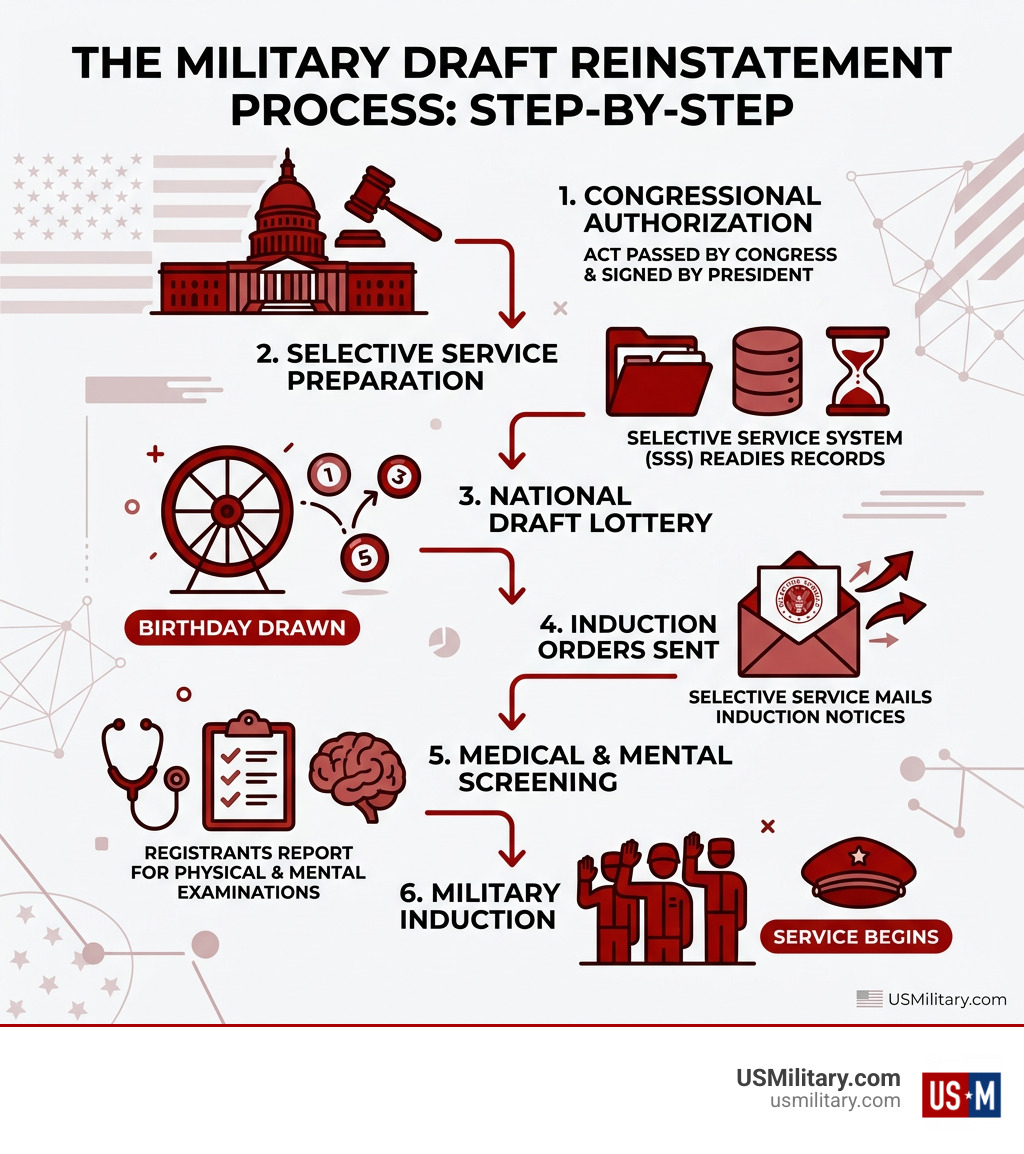
For a draft to return, it would take a literal act of Congress. Specifically, the House of Representatives and the Senate would have to pass legislation to amend the Military Selective Service Act, which would then need to be signed into law by the President. This isn’t something that happens quietly behind closed doors; it would be a major national event debated in the halls of power and across every news station in the country.
If such an emergency were to occur, the process to draft eligible young men would follow a very strict sequence. It’s not just a “everyone grab a rifle” situation. There is a hierarchy of who gets called first based on age.
Registration vs. Induction Priority
| Category | Registration Requirement | Induction Priority (If Drafted) |
|---|---|---|
| Men turning 20 | Mandatory | First Priority (The “Prime” Age Group) |
| Men ages 21–25 | Mandatory | Second Priority (Called in descending order) |
| Men age 19 | Mandatory | Third Priority |
| Men age 18.5 | Mandatory | Fourth Priority |
| Women | Not Required | Not Eligible (Under current law) |
As you can see, the system is designed to target 20-year-olds first. If the military needs more people, they move up to 21, then 22, and so on. The youngest members (18 and 19) are actually the last to be called in the adult pool.
How the Draft Lottery and Prioritization Works
If a draft were reinstated, the “fairness” of the selection would be managed by a random lottery. This isn’t just a computer program; it’s a highly scrutinized public event.
The Selective Service System uses two air-mix machines containing balls. One machine holds balls with every possible birth date (365 days, or 366 for leap years). The other machine holds balls numbered 1 through 365.
The lottery works by drawing one date and one number. For example, if “August 4” is drawn along with the number “1,” then every 20-year-old male born on August 4 would be the very first to receive an induction notice. This process continues until all dates are assigned a “Random Sequence Number.”
Am I eligible to be drafted into the military if I am a woman?
This is one of the most debated topics in modern military history. Currently, the law specifically mentions “male persons” in regard to registration and the draft. Even though women have been eligible for all combat roles since 2013 and make up a vital part of our volunteer force, they do not have to register for the Selective Service.
There have been several court cases and legislative proposals to change this. In 2019, a federal judge actually ruled that the male-only draft was unconstitutional, but that ruling was later overturned. For now, unless Congress changes the Military Selective Service Act, women remain exempt. You can read more about the history of this debate in Drafting Women?.
Am I eligible to be drafted into the military as a healthcare professional?
There is a “special” kind of draft you should know about: the Health Care Personnel Delivery System (HCPDS). In a massive national emergency where there is a shortage of doctors, nurses, or medical technicians, the government can trigger a specialized draft.
Unlike the general draft, which stops at age 25, a healthcare draft could potentially target professionals up to age 54. This system is designed to ensure that both the military and the civilian population have enough medical support during a catastrophe. If you are a doctor or nurse, you can find more details at this FAQ about Health Care Workers and the Draft.
Exemptions, Deferments, and Classifications
Even if your number is called in a lottery, you aren’t headed to basic training the next day. You would first undergo an evaluation to determine your “classification.” During the Vietnam War, these classifications (like 1-A or 4-F) became part of the American lexicon.
If a draft were active today, you could apply for several types of deferments or exemptions:
- Conscientious Objector (CO): If you are opposed to war in any form based on deeply held moral, ethical, or religious beliefs, you can apply for conscientious objector (CO) status. If approved, you might serve in a non-combatant military role (like a medic) or perform alternative civilian service.
- Hardship Deferments: If your induction would cause extreme hardship to your dependents (like a spouse, children, or elderly parents who rely on you), you may be deferred.
- Ministerial and Student Deferments: Ministers and certain students (especially those in the middle of a high school or college semester) can often have their service postponed.
- Surviving Sons: In some cases, if a family has already lost a child to military service, the remaining children may be exempt to prevent the entire family line from being extinguished in war.
Penalties for Failing to Register and Future Changes
We often get asked, “What if I just don’t register?” Our advice is simple: Don’t risk it.
While the U.S. hasn’t prosecuted anyone for failing to register since 1986, the “collateral” penalties are severe and can follow you for the rest of your life. Failing to register is a federal felony. If prosecuted, you could face:
- Up to 5 years in prison.
- A fine of up to $250,000.
Even without a prison sentence, the administrative consequences if you fail to register are immediate:
- Federal Jobs: You will be ineligible for any job with the federal government.
- Citizenship: For immigrants, failing to register can permanently block your path to U.S. citizenship.
- State Benefits: Many states link Selective Service registration to your ability to get a driver’s license or receive state-funded student financial aid.
The Big Change: Automatic Registration in 2026
There is a major update coming to the system. Starting December 18, 2026, the U.S. will move to an automatic registration system. Instead of you having to remember to sign up at the post office or online, the Selective Service will use federal databases to automatically register all eligible men.
If you are already over 26 and realized you never registered, you can’t go back and fix it. In this case, you may need to request a Status Information Letter from the Selective Service to prove to employers or government agencies that your failure to register wasn’t “knowing and willful.”
Frequently Asked Questions about the Military Draft
When was the last time the U.S. had a draft?
The last draft call occurred in 1972, and the authority to induct draftees expired on June 30, 1973. Since then, the U.S. has relied entirely on volunteers to fill the ranks of the Army, Navy, Air Force, Marines, and Coast Guard.
Can I register for the Selective Service if I am over 26?
No. The law only allows for registration between the ages of 18 and 25. Once you reach your 26th birthday, the “window” closes. If you failed to register by then, you may face the permanent loss of certain federal benefits.
What triggers a draft reinstatement during a national emergency?
A draft would only be triggered if the President and Congress determine that the current all-volunteer force is insufficient for a specific national security crisis. This would require a new law to be passed and signed. It is generally considered a “last resort” measure.
Conclusion
At USMilitary.com, we believe that staying informed is the best way to handle the responsibilities of being a citizen. While the question am I eligible to be drafted into the military can feel heavy, the reality is that we live in an era where our military is stronger because every person serving chose to be there.
If you are interested in the military, don’t wait for a draft notice that may never come. There are incredible military career paths available right now that offer specialized training, money for college, and the chance to serve your country on your own terms.
If you’re ready to take the next step and explore what the Armed Forces can do for you, sign up now to speak with a recruiter in your area. Whether you’re interested in the adventure of the Marines or the technical skills of the Air Force, the choice is yours.
Internal Resources for Further Reading:
- Will there be a military draft?
- The complete guide to who gets pulled first in a draft
- Why a military draft could become necessary
Free for Service Members & Veterans
Get the military benefits intel no one tells you about.
Weekly updates on VA benefits, pay changes, and money tips — free for service members and veterans.
No spam. Unsubscribe anytime. Your info is never shared.


