The Army’s S-97 Raider Helicopter: A New Era in Rotorcraft
What is the Army new helicopter S-97 Raider is one of the most searched questions among military enthusiasts and those following U.S. defense technology — and for good reason.
Here’s the short answer:
- What it is: The S-97 Raider is a high-speed, compound helicopter prototype built by Sikorsky Aircraft (a division of Lockheed Martin)
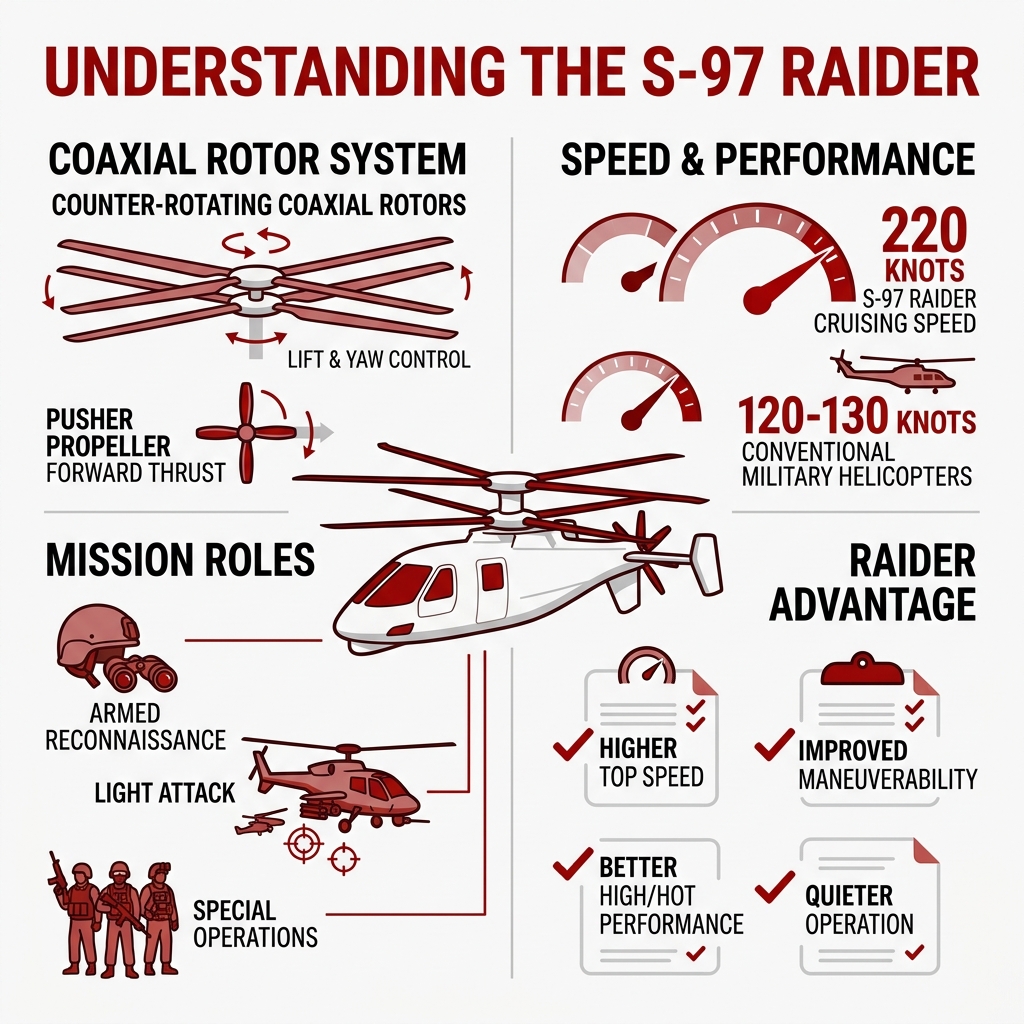
- Speed: Cruises at over 220 knots — nearly double the speed of most conventional military helicopters
- Design: Uses two coaxial (stacked) counter-rotating rotors plus a rear pusher propeller, based on Sikorsky’s X2 Technology
- Purpose: Designed for armed reconnaissance, light attack, and special operations missions
- Army role: Developed to replace aging scout helicopters like the OH-58D Kiowa Warrior
- Status: Currently a technology demonstrator; the Army’s FARA program (its intended competition) was cancelled in 2024
The S-97 Raider isn’t just faster than today’s military helicopters. It moves, hovers, and maneuvers in ways that conventional rotorcraft simply can’t. Test pilot Bill Fell described flying it as piloting “the sportscar of helicopters.”
Whether you’re curious about military aviation careers or just want to understand where U.S. Army helicopter technology is heading, the S-97 Raider is a good place to start.
I’m Larry Fowler, publisher of the USMilitary.com Network, and through over 15 years of covering U.S. military programs and defense technology, I’ve followed the evolution of questions like what is the Army new helicopter S-97 Raider closely. Let’s break down everything you need to know — in plain language.
What is the Army new helicopter S-97 Raider terms you need:
- Latest Update Operation Epic Fury Including Three American Deaths
- Day 4 Operation Epic Fury As Iran Ramps Up New Attacks
- Update On Day 3 Operation Epic Fury 4 And Progress Made
What is the Army new helicopter S-97 Raider?
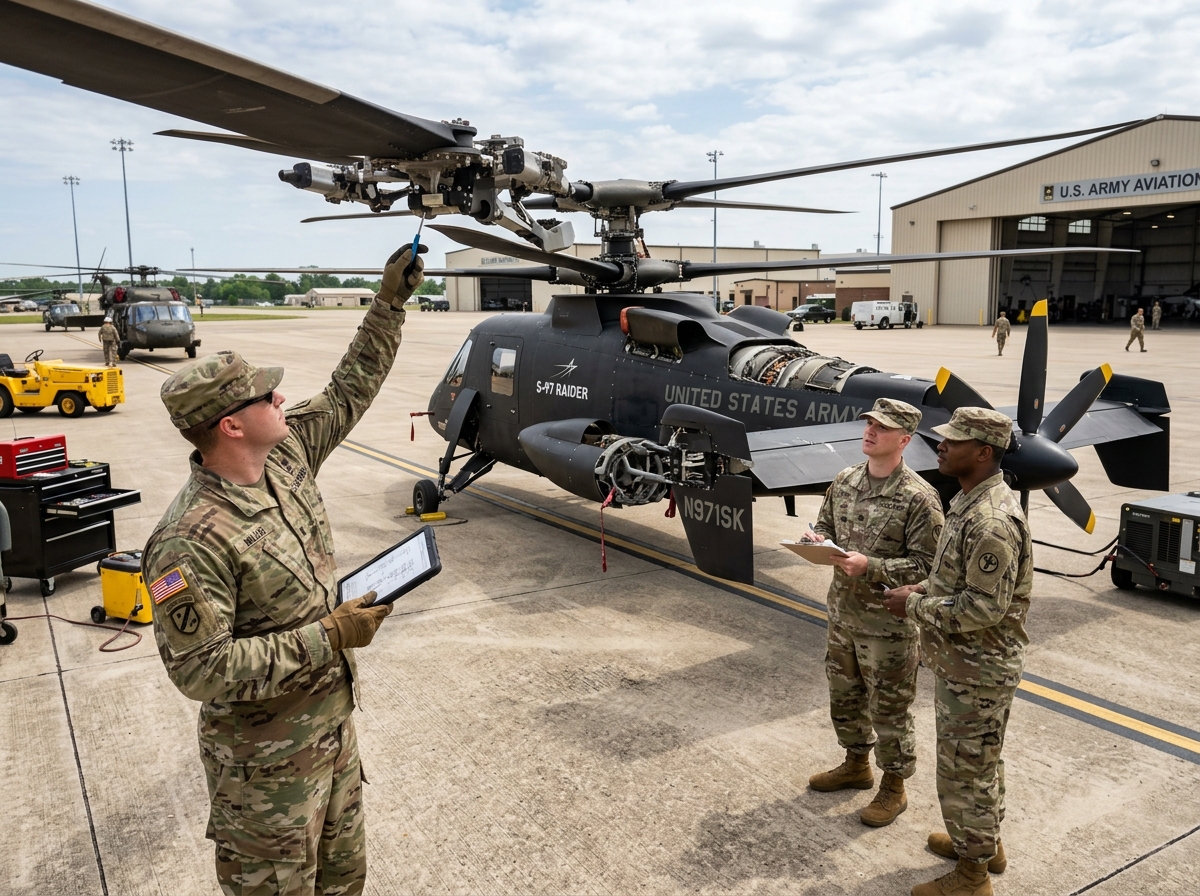
When we talk about the S-97 Raider, we are looking at a “compound helicopter.” If that sounds like a fancy term, don’t worry—it just means it uses more than one way to get moving. While a traditional helicopter uses a single main rotor for both lift and forward movement, the S-97 Raider splits those jobs up.
Developed by Sikorsky Aircraft, the S-97 Raider is a light tactical prototype that was built to show the world what the next generation of vertical lift looks like. It isn’t just a “drawing on a napkin”; it’s a real, flying aircraft that first took to the skies in May 2015.
The Raider was originally pitched for the U.S. Army’s Armed Aerial Scout (AAS) program. The Army needed something to fill the shoes of the retired OH-58D Kiowa Warrior. They wanted an aircraft that could scout ahead of the main force, find the enemy, and provide light attack support if things got hairy.
At its core, the S-97 is built on the Advancing Blade Concept (ABC). This is a technical way of saying that the helicopter uses two sets of rigid blades spinning in opposite directions. This design solves a major speed limit that has frustrated helicopter engineers for decades. We’ll get into the “how” of that in a moment, but for now, just know that the S-97 was designed to be the fastest, most agile scout in the sky.
Revolutionary Design and X2 Technology
Understanding what is the Army new helicopter S-97 Raider technology
To understand why the S-97 is such a big deal, we have to talk about “Retreating Blade Stall.” In a normal helicopter, as you fly faster, the blade moving “backward” (away from the direction of flight) eventually loses lift. This creates a “speed ceiling” that conventional helicopters can’t break through without shaking themselves apart or falling over.
The S-97 Raider uses X2 Technology to beat this problem. By using two coaxial rotors—one stacked on top of the other—the aircraft always has an “advancing” blade on both sides. This balances the lift and allows the helicopter to reach speeds that would make a standard Black Hawk jealous.
Key technological features include:
- Rigid Blades: Unlike the flexible blades on most helicopters, these are stiff. This allows for much tighter control and prevents the blades from hitting each other during aggressive maneuvers.
- Fly-by-Wire: The controls are entirely electronic. This means a computer helps the pilot stay stable, allowing for “point-and-shoot” flying that feels more like a fighter jet than a traditional whirlybird.
- Counter-Rotating System: Because the rotors spin in opposite directions, they cancel out each other’s torque. This eliminates the need for a traditional tail rotor.
Propulsion and the Pusher Propeller
Since the S-97 doesn’t need a tail rotor to stay straight, Sikorsky put a pusher propeller on the back instead. This is the “secret sauce” for its incredible speed.
This six-bladed, variable-pitch propeller provides forward thrust, acting like the engine of an airplane. But it does more than just make the Raider go fast:
- Level Body Acceleration: The Raider can speed up or slow down without tilting its nose up or down. This keeps the sensors and guns pointed exactly where the pilot wants them.
- Rapid Braking: By reversing the pitch of the pusher prop, the pilot can pull a “handbrake” in mid-air, slowing down instantly without losing altitude.
- Whisper Mode: In a hover, the pilot can actually disengage the pusher prop. This reduces the noise significantly, allowing the Raider to sneak up on targets—a feature we call its low acoustic signature.
Key Specifications and Performance Capabilities
The numbers behind the S-97 Raider are genuinely impressive. We aren’t just talking about a 10% or 20% improvement over old tech; we’re talking about a massive leap.
| Feature | S-97 Raider Capability | Conventional Scout (e.g., OH-58) |
|---|---|---|
| Cruise Speed | 220+ knots (250+ mph) | ~120 knots |
| Dash Speed | 240+ knots | ~135 knots |
| Endurance | >2.7 hours | ~2.0 hours |
| Service Ceiling | 10,000 ft at 95°F | Significantly lower in “high/hot” |
| Payload | 6 Troops + Weapons | 0-2 Troops (very limited) |
Power and Weight: The Raider is powered by a single General Electric YT706 turboshaft engine, pumping out a massive 2,600 horsepower. With a Maximum Takeoff Weight (MTOW) of 11,000 lbs, it is light enough to be agile but heavy enough to carry a serious punch. It has a range of about 350 miles (570 km), which is plenty for the “scout and strike” missions it was built for.
One of its most important capabilities is “Hover Out of Ground Effect” (HOGE) at high altitudes. It can hover at 6,000 feet in 95-degree heat while fully loaded. This is critical for missions in mountainous regions like Afghanistan, where traditional helicopters often struggle to breathe.
Mission Roles and Armament Support
Armed Reconnaissance and Special Operations
The S-97 Raider was built for versatility. In the “Armed Reconnaissance” role, it acts as the eyes and ears of the commander. But unlike old scouts that had to run away when they found trouble, the Raider can stay and fight.
Its internal weapons bay can carry a variety of tools for the job:
- Hellfire Missiles: For taking out tanks and hardened structures.
- 2.75-inch Rockets: For area suppression.
- .50 Caliber Gun: With 500 rounds of ammunition.
- 7.62 mm Gun: For anti-personnel roles.
Beyond shooting, the Raider is a fantastic utility player. The cabin has enough room to seat six fully-equipped troops. This makes it a prime candidate for Special Operations missions, where a small team needs to be inserted quickly and quietly into a “hot” zone. If you are interested in these types of roles, you can learn more about Army helicopter aviation careers on our site.
Versatility in Modern Combat
Because the Raider is so agile, it excels in urban environments. It can “pirouette” (spin in place) while moving forward, allowing it to keep its nose—and its weapons—pointed at a target while navigating between buildings.
Other mission capabilities include:
- Close-Air Support (CAS): Providing immediate fire support to troops on the ground.
- Combat Search and Rescue (CSAR): Getting in and out of dangerous areas to rescue downed pilots.
- Aerial Refueling: It is designed to be compatible with refueling tankers, giving it almost unlimited range for long-distance deployments.
- Optionally-Piloted: One of the coolest features is that the Raider is designed to fly with two pilots, one pilot, or even zero pilots. Using Sikorsky’s Matrix Technology, it can fly autonomous missions in high-threat areas where we don’t want to risk a human crew.
Program History and Future Outlook
What is the Army new helicopter S-97 Raider current program status?
The journey of the S-97 Raider began in 2010 when Sikorsky decided to invest $150 million (with suppliers adding another $50 million) to prove that X2 Technology was ready for the big leagues. It was a bold move—building a prototype with their own money before the Army even asked for it.
The Raider had its first flight in 2015 and spent the next several years smashing speed records and performing flight demos. It even made a massive splash at the Paris Air Show, showing the international community that American rotorcraft tech was moving in a radical new direction.
However, in February 2024, the U.S. Army made a shocking announcement: they were cancelling the Future Attack Reconnaissance Aircraft (FARA) program. The Army decided to shift its focus and funding toward unmanned drones and existing platforms.
So, is the S-97 Raider dead? Not at all. While the specific FARA competition ended, the S-97 remains a vital “technology demonstrator.” The data gathered from hundreds of flight hours is being used to develop other aircraft, and Sikorsky continues to fly the Raider to refine autonomous systems and high-speed flight controls.
Relation to SB-1 Defiant and Raider X
The S-97 Raider is actually the “little brother” in a family of advanced aircraft.
- SB-1 Defiant: This is a much larger version of the Raider, developed with Boeing. It was designed to replace the UH-60 Black Hawk as part of the Future Long-Range Assault Aircraft (FLRAA) program.
- Raider X: This was the specific version of the S-97 scaled up by about 20% to meet the Army’s FARA requirements. It featured a larger 39-foot rotor and a more powerful engine.
Even though the Army’s plans changed, the “X2 family” has proven that the technology works. The innovations in rigid rotors and pusher props will almost certainly find their way into the next generation of military and perhaps even civilian aircraft.
Frequently Asked Questions about the S-97 Raider
How fast is the S-97 Raider compared to a Black Hawk?
A standard UH-60 Black Hawk cruises at around 150 knots (about 172 mph). The S-97 Raider can cruise at 220 knots (253 mph) and has reached speeds of 250 knots (287 mph) in a shallow dive. In simple terms, the Raider can get to the fight—and get wounded soldiers out—nearly twice as fast as a Black Hawk.
Can the S-97 Raider fly autonomously?
Yes! The Raider is “optionally-piloted.” It uses advanced fly-by-wire systems and Sikorsky’s Matrix Technology to handle complex flight paths without pilot intervention. This allows it to be used as a high-speed cargo drone or a scout in areas too dangerous for human pilots.
What happened to the S-97 Raider after the FARA cancellation?
While the Army cancelled the FARA program in early 2024, the S-97 Raider continues to serve as a flying laboratory. Sikorsky and Lockheed Martin use it to test new engines (like the GE T901), modular avionics, and autonomous flight software. It remains a key part of their strategy for future international and domestic military contracts.
Conclusion
At USMilitary.com, we believe that staying informed about these technological leaps is vital for anyone serving or considering a career in the armed forces. The S-97 Raider may not be entering mass production for the Army this year, but it has fundamentally changed the way we think about helicopter flight. It proved that you can have the hover capability of a helicopter with the high-speed dash of a plane.
The future of military aviation is fast, agile, and increasingly autonomous. Whether it’s through the S-97 or its successors, the “X2” legacy will continue to provide our troops with the tactical superiority they need on the modern battlefield.
If you’re interested in a future in the air or on the sea, don’t stop here. You can explore Navy jobs and careers or dive deeper into our aviation resources to find the path that’s right for you. The technology is changing fast—make sure you’re ready to fly with it!
Free for Service Members & Veterans
Get the military benefits intel no one tells you about.
Weekly updates on VA benefits, pay changes, and money tips — free for service members and veterans.
No spam. Unsubscribe anytime. Your info is never shared.


