Are Army Rangers Operating in Iran Now? What We Know
Are Army Rangers Operating in Iran Now is one of the most searched military questions amid rising US-Iran tensions — and here’s the short answer:
| Key Fact | Detail |
|---|---|
| Confirmed inside Iran? | No public confirmation of Rangers operating inside Iran |
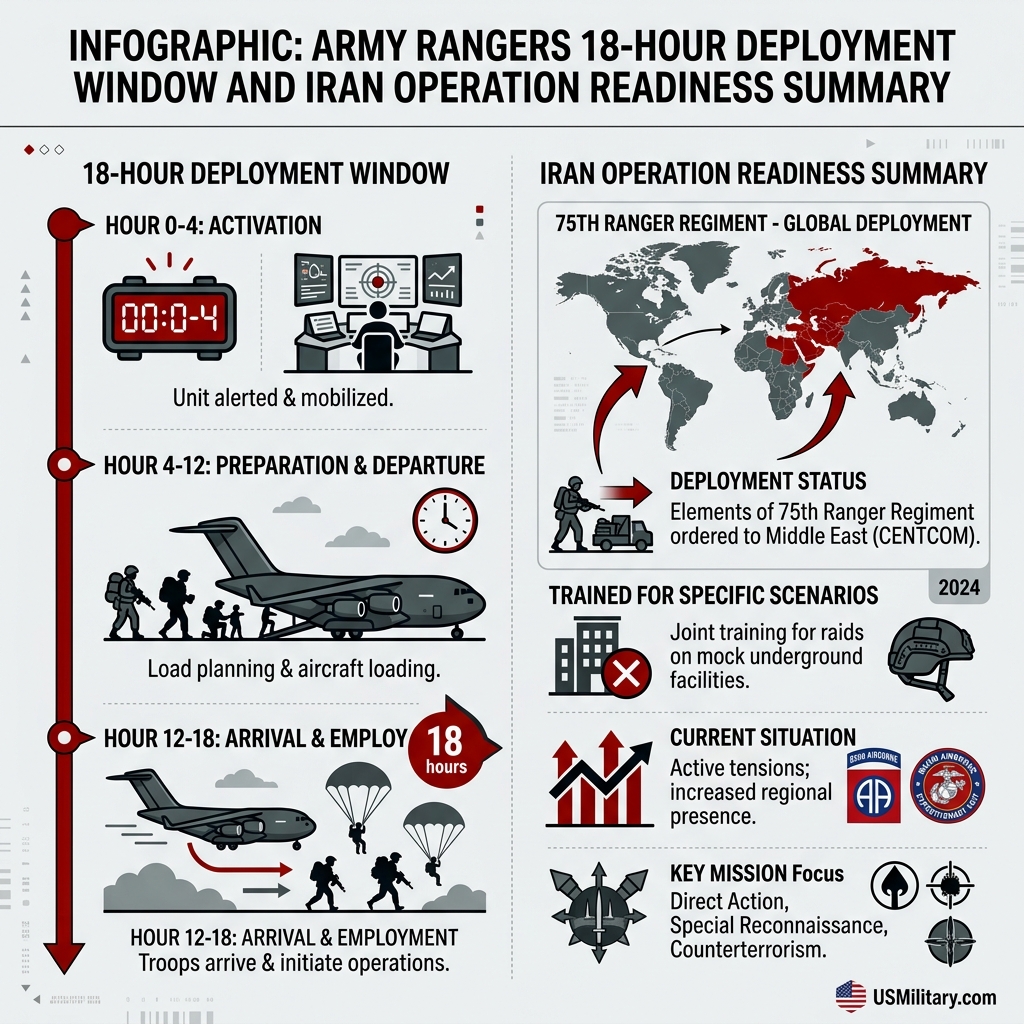
| Deployed to the region? | Yes — elements of the 75th Ranger Regiment have been ordered to the Middle East (CENTCOM area) |
| Training for Iran scenarios? | Yes — Rangers trained with Nuclear Disablement Team 1 in 2024 on mock underground nuclear facility raids |
| Deployment speed | Rangers can deploy anywhere in the world within 18 hours |
| Current tensions | Active US-Iran conflict underway, with thousands of additional troops surging to the region |
As the US military surges forces into the Middle East — including roughly 3,000 paratroopers from the 82nd Airborne and 2,500 Marines — questions about what Army Rangers are doing right now are completely understandable.
The honest answer is nuanced. No official US military statement has confirmed Rangers are operating inside Iran. But confirmed regional deployments, canceled training exercises, and highly specific joint training for exactly this kind of scenario paint a picture worth understanding clearly.
I’m Larry Fowler, publisher of USMilitary.com since 2007, and tracking elite unit deployments and questions like are Army Rangers operating in Iran now is exactly the kind of complex military topic I help break down for service members, veterans, and civilians alike. Let’s walk through everything that’s confirmed, what’s speculated, and what it all means.
Are Army Rangers Operating in Iran Now definitions:
Are Army Rangers Operating in Iran Now?
The question of whether Are Army Rangers Operating in Iran Now is a matter of intense speculation across the Department of Defense and global intelligence communities. Officially, the Pentagon has not confirmed any U.S. boots on the ground within the sovereign borders of Iran. However, the movement of elite units suggests a high state of readiness for exactly that possibility.
Recent reports indicate that an element of the U.S. Army’s 75th Ranger Regiment has been ordered to the Middle East, joining a massive surge of ground forces as tensions escalate. While official denials are the standard for sensitive special operations, the presence of these “Tier 2” units in the U.S. Central Command (CENTCOM) area of operations provides the President with a “ground option” that wasn’t as robust just months ago.
Furthermore, there are unconfirmed reports of Israeli special forces operating inside Iran, allegedly conducting sabotage and target designation. If these reports are true, it raises the question of whether U.S. Rangers are providing over-the-horizon support or preparing to follow suit. We have previously analyzed the likelihood of such movements in our piece on whether a us-military-attack-on-iran-coming/ is imminent. Some analysts even suggest that a ground presence could embolden the iran-people-overthrow-islamic-regime/, turning a military strike into a catalyst for regional change.
Current Deployment Status of the 75th Ranger Regiment
The 75th Ranger Regiment is currently part of a broader “force buildup” in the Middle East. Specifically, a company-sized element from the 2nd Battalion, 75th Ranger Regiment, was identified in reports as moving into the region. This deployment isn’t happening in a vacuum; it coincides with the movement of 3,000 paratroopers from the 82nd Airborne Division’s 504th Parachute Infantry Regiment and approximately 2,500 Marines.
The Army Airborne moves and speculation grew even louder when the military abruptly canceled a major training exercise for an elite paratrooper headquarters element. In military planning, “abrupt cancellations” of training usually mean the unit is needed for a real-world mission. This high-tempo activity is a direct response to the day-4-operation-epic-fury-as-iran-ramps-up-new-attacks/, where the U.S. is seeking to deter further Iranian aggression.
Historical Precedent: Operation Eagle Claw
To understand why people are asking Are Army Rangers Operating in Iran Now, we have to look back at 1980. Operation Eagle Claw was a daring, though ultimately tragic, attempt to rescue American hostages in Tehran. Army Rangers were a core component of that mission, tasked with securing a secondary airfield (Desert One) to facilitate the rescue.
That mission proved that the U.S. is willing to put Rangers on Iranian soil if the stakes are high enough. The geography of Iran hasn’t changed, and neither has the Ranger mission set: high-risk, high-reward raids in hostile territory. You can learn more about the long history of conflict in this region in our article on war-arabia-and-persia-the-past-and-the-future/.
Training for Loose Nukes and Underground Raids
One of the most compelling pieces of evidence suggesting that the U.S. is preparing for a ground mission in Iran is the specific nature of recent Ranger training. In 2024, members of the 75th Ranger Regiment partnered with Nuclear Disablement Team 1 (NDT 1) for a simulated raid on an underground nuclear facility.
This wasn’t just a standard “shoot-and-move” drill. The exercise involved a mock raid under hostile fire on a decommissioned pulse radiation facility. The goal? To practice seizing a site, neutralizing threats, and allowing nuclear specialists to secure radioactive materials before they can be moved or detonated. This “Counter Weapons of Mass Destruction” (CWMD) mission is a top priority as the israel-vs-iran/ conflict threatens to go nuclear.
Mission Objectives for Army Rangers Operating in Iran
If the order were given for Rangers to cross the border, their mission wouldn’t be to occupy Tehran. Instead, they would likely focus on “surgical” objectives:
- Airfield Seizure: Capturing Iranian airbases to allow for the follow-on movement of larger forces or the extraction of captured assets.
- Snatch Raids on Uranium: There is growing concern that Iran may move its near-bomb-grade uranium to secret locations. Snatch raids on uranium would involve Rangers hitting a facility, grabbing the material (or the scientists), and getting out within hours.
- Harming Proxy Support: Rangers could also be used to disrupt the iran-lethal-assistance-to-al-qaeda-hurt/ and other terror groups that rely on Iranian logistics.
Collaboration with Nuclear Disablement Teams (NDT)
The Rangers don’t work alone on these high-tech missions. They provide the “muscle,” while the Nuclear Disablement Teams provide the “brains.” During a NDT mission validation at the Bellefonte Nuclear Power Plant, these teams practiced operating in “hostile environments” where a reactor might be damaged or booby-trapped.
According to the Army, there are only three of these specialized NDTs in the entire force, all based under the 20th CBRNE Command. The fact that they are training so closely with the 75th Ranger Regiment is a clear indicator that the U.S. is serious about the “loose nuke” scenario in Iran.
Tactical Challenges of Army Rangers Operating in Iran
Operating in Iran is a tactical nightmare. It is not Iraq or Afghanistan; Iran has a sophisticated military, rugged mountainous terrain, and some of the most deeply buried facilities in the world.
The Fordo enrichment facility, for example, is buried so deep that even the GBU-57/B Massive Ordnance Penetrator (the world’s largest bunker buster) might struggle to destroy it completely. This is where the Rangers come in. If a bomb can’t reach the target, a human has to. However, the perils of nuclear commando missions are immense, with experts calling such raids “highly perilous, if not nearly impossible.”
Risks of Underground Facilities and Toxic Materials
Inside an Iranian nuclear site like Natanz, Rangers would face more than just enemy soldiers. They would encounter:
- Uranium Hexafluoride (UF6): This gas is used in enrichment but becomes highly toxic and corrosive when exposed to moisture in the air.
- Booby Traps and IEDs: Iranian engineers have had decades to “harden” these facilities with sensors and explosives.
- The “Dirty Bomb” Risk: If a facility is damaged during a raid, it could create a localized radioactive disaster.
| Feature | Conventional Airstrike | Ranger-Led Snatch Raid |
|---|---|---|
| Objective | Destruction of facility | Seizure of material/intel |
| Risk to Troops | Low (Pilot risk) | High (Ground combat) |
| Certainty | Partial (Bunker depth issues) | High (Physical verification) |
| Collateral Damage | High (Explosive spread) | Lower (Surgical) |
| Duration | Minutes | Hours to Days |
The IAEA stockpile reports suggest Iran has over 900 pounds of 60% enriched uranium. Securing that much material would require a massive logistical effort, not just a few guys with backpacks. Some political analysts worry that the iran-democrate-party-demise-is-hate-trump-derangement/ complicates the domestic resolve needed for such a high-risk mission.
The Role of Tier 1 Units and Ranger Support
In Special Operations, there is a hierarchy. “Tier 1” units like Delta Force and SEAL Team Six (DEVGRU) are the ones who usually go through the door to grab a High-Value Target (HVT). The 75th Ranger Regiment, while incredibly elite, often serves as the “Tier 2” support force.
In an Iran scenario, Rangers would likely provide perimeter security, “cordon and search” capabilities, and heavy weapons support. If Delta Force is inside a bunker at Fordo, the Rangers are outside making sure no Iranian reinforcements get within a mile of the entrance. To prepare for this, JSOC hard target training has been ramped up, with the Pentagon requesting millions for new facilities that mimic Iranian underground complexes.
Frequently Asked Questions about Army Rangers in Iran
Has the Pentagon confirmed Rangers are inside Iran?
No. To date, the U.S. Department of Defense has not confirmed that any U.S. Army Rangers are operating inside Iranian territory. All confirmed movements place them in neighboring countries or the broader CENTCOM area of operations.
What is the 75th Ranger Regiment’s role in the Middle East?
The Rangers serve as the U.S. military’s premier light infantry raid force. Their role in the Middle East is to provide a rapid-response capability for direct action missions, such as seizing airfields, capturing enemy leaders, or securing sensitive sites like nuclear facilities.
How do Rangers prepare for nuclear material recovery?
Rangers participate in joint exercises with Nuclear Disablement Teams (NDTs) and the 20th CBRNE Command. These exercises simulate raids on nuclear power plants and research facilities, focusing on tactical movement through radioactive environments and the “handoff” of captured materials to scientific experts.
Conclusion
While we cannot definitively say that the answer to Are Army Rangers Operating in Iran Now is “yes,” the evidence of their readiness is overwhelming. From the surge of the 2nd Battalion to the Middle East to the specialized training for underground nuclear raids, the 75th Ranger Regiment is clearly the “tip of the spear” for any potential ground action.
At USMilitary.com, we remain committed to providing our veterans and service members with the most accurate, nonbiased information on regional stability and strategic deterrence. Whether you are interested in the geopolitics of the Middle East or looking for the Ranger Ready: The Ultimate Guide to Joining the Army’s Toughest, we are your central hub for military guidance. Stay safe, stay informed, and remember: Rangers Lead the Way.
Free for Service Members & Veterans
Get the military benefits intel no one tells you about.
Weekly updates on VA benefits, pay changes, and money tips — free for service members and veterans.
No spam. Unsubscribe anytime. Your info is never shared.


