Why Army Jobs Based on ASVAB Scores Matter for Your Military Career

Understanding army jobs based on ASVAB scores is the fastest way to figure out which Military Occupational Specialties (MOS) you can qualify for before you ever walk into a recruiter’s office.
Here’s a quick answer:
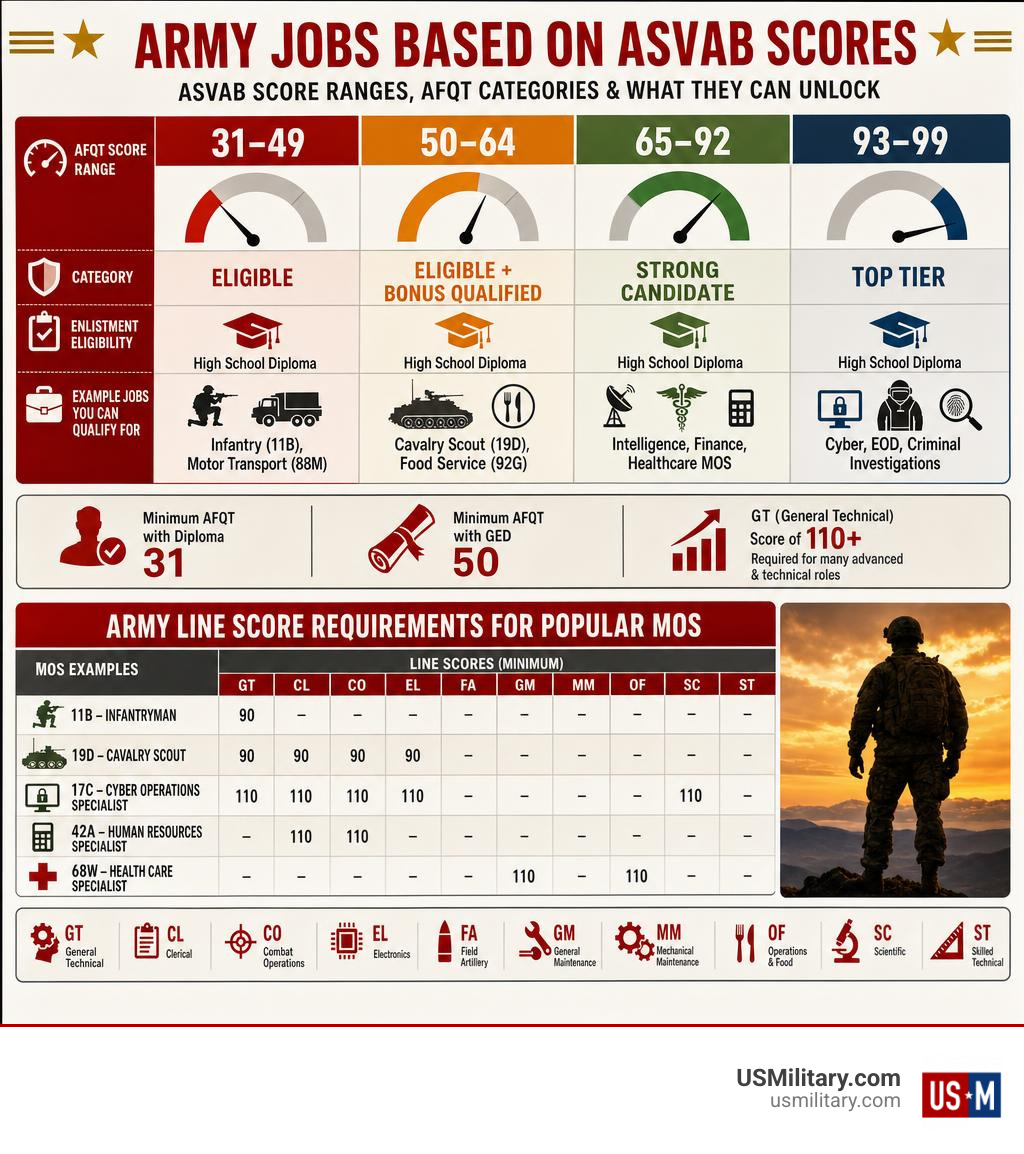
| Your AFQT Score | Enlistment Eligibility | Example Jobs Available |
|---|---|---|
| 31-49 (with diploma) | Eligible | Infantry (11B), Motor Transport (88M) |
| 50-64 | Eligible + bonus qualified | Cavalry Scout (19D), Food Service (92G) |
| 65-92 | Strong candidate | Intelligence, Finance, Healthcare MOS |
| 93-99 | Top tier | Cyber, EOD, Criminal Investigations |
Key facts to know right away:
- The Army requires a minimum AFQT score of 31 to enlist with a high school diploma
- GED holders need a minimum score of 50
- Your AFQT score only gets you in the door — your line scores determine which specific jobs you qualify for
- The Army offers over 150 MOS across combat, technical, medical, intelligence, and support fields
- A GT (General Technical) score of 110 or higher is required for many advanced and technical roles
Your overall ASVAB score is just the starting point. The real career-shaping numbers are your 10 Army line scores — composites of specific subtests that each branch of Army jobs uses to screen candidates.
I’m Larry Fowler, publisher of USMilitary.com since 2007 and a longtime resource for recruits and veterans navigating army jobs based on ASVAB scores and military career decisions. Over the years, this platform has connected hundreds of thousands of aspiring service members with the information they need to make confident enlistment choices.
Army jobs based on asvab scores glossary:
- High Paying Civilian Jobs That The Military Offers Best Training
- Requirements To Join The US Military
- military career paths
Understanding the ASVAB and AFQT Requirements
The Armed Services Vocational Aptitude Battery (ASVAB) is a comprehensive multi-aptitude test designed to measure your strengths, weaknesses, and potential for success in various training pipelines. When you sit down to take the ASVAB, you are actually taking two tests in one. The first part is the Armed Forces Qualification Test (AFQT), which acts as the ultimate gatekeeper for enlistment.
The AFQT is not a separate test; rather, it is a percentile score calculated from four core sections of the ASVAB: Arithmetic Reasoning (AR), Mathematics Knowledge (MK), Word Knowledge (WK), and Paragraph Comprehension (PC). Your AFQT score ranges from 1 to 99, indicating how well you performed compared to a national reference group of test-takers.
To secure your place in the Army, you must meet the minimum AFQT standard. For candidates holding a traditional high school diploma, the minimum qualifying AFQT score is 31. However, if you hold a GED, the qualification standards are higher; you will generally need to score at least a 50 on the AFQT to enlist without a waiver.
That while a 31 gets you in the door, aiming for a 50 or higher is highly recommended because it unlocks valuable enlistment incentives, including sign-on bonuses that can reach up to $50,000 for high-demand technical roles. Understanding these baseline numbers is the first step in mapping out your enlistment journey. For a deeper dive into the overall enlistment process, you can read our steps to join the military or review our comprehensive Army eligibility requirements.
How Army Line Scores Determine Your MOS
While your AFQT score determines whether you are allowed to put on the uniform, it does not dictate what you will actually do once you enlist. That is where Army line scores (also known as composite scores) come into play. Two candidates can score an identical 55 on their AFQT, yet qualify for completely different career paths. One might excel in mechanical comprehension and qualify to work on Apache helicopters, while the other might score exceptionally high in verbal expression and qualify for human resources or intelligence operations.
The Army breaks the ASVAB down into nine individual subtest areas:
- General Science (GS): Physical and biological sciences
- Arithmetic Reasoning (AR): Solving word problems
- Word Knowledge (WK): Vocabulary and word meanings
- Paragraph Comprehension (PC): Reading comprehension
- Mathematics Knowledge (MK): High school geometry and algebra
- Electronics Information (EI): Electricity, circuits, and electronics
- Auto and Shop Information (AS): Automotive maintenance and metal/woodworking tools
- Mechanical Comprehension (MC): Principles of mechanics and physical forces
- Assembling Objects (AO): Spatial awareness and visual relationship analysis
By mixing and matching these subtest scores, the Army calculates 10 distinct line scores. It is these composite numbers—not your overall AFQT percentile—that determine your eligibility for specific Military Occupational Specialties (MOS). If you are looking to maximize your career options, we recommend checking out the complete breakdown of ASVAB Army Line Scores and studying our strategic tips for passing the ASVAB to ensure you hit your target numbers.
The 10 Army Line Scores Explained
To help you understand how your raw subtest performance translates into career opportunities, here is an explanation of the 10 Army line scores, including the formulas used to calculate them:
- Clerical (CL): Determined by combining Verbal Expression (VE, which is a combination of Word Knowledge and Paragraph Comprehension), Arithmetic Reasoning (AR), and Mathematics Knowledge (MK). This score determines eligibility for administrative, administrative support, and financial management roles.
- Combat (CO): Calculated from Verbal Expression (VE), Auto and Shop Information (AS), and Mechanical Comprehension (MC). This score is used for combat arms roles like infantry, cavalry, and armor.
- Electronics (EL): Formed by combining General Science (GS), Arithmetic Reasoning (AR), Mathematics Knowledge (MK), and Electronics Information (EI). This score gates access to advanced technical, computer, and electronics repair roles.
- Field Artillery (FA): Calculated using Arithmetic Reasoning (AR), Mathematics Knowledge (MK), and Mechanical Comprehension (MC). This is crucial for tactical missile systems and artillery operations.
- General Maintenance (GM): Composed of General Science (GS), Auto and Shop Information (AS), Mathematics Knowledge (MK), and Mechanical Comprehension (MC). This line score qualifies you for heavy equipment and vehicle maintenance.
- General Technical (GT): Calculated simply as Verbal Expression (VE) + Arithmetic Reasoning (AR). The GT score is widely considered the most important line score in the Army. A score of 110 or higher is the golden standard required for officer candidate school, green beret selection, and elite intelligence jobs.
- Mechanical Maintenance (MM): Formed by Auto and Shop Information (AS), Mechanical Comprehension (MC), and Electronics Information (EI). This dictates eligibility for aircraft mechanics and automotive repair.
- Operators and Food (OF): Derived from Verbal Expression (VE), Auto and Shop Information (AS), and Mechanical Comprehension (MC). This score qualifies soldiers for heavy vehicle operation and culinary specialist roles.
- Surveillance and Communications (SC): Calculated from Verbal Expression (VE), Arithmetic Reasoning (AR), Auto and Shop Information (AS), and Mechanical Comprehension (MC). This is used for communications and signal operations.
- Skilled Technical (ST): Derived from General Science (GS), Verbal Expression (VE), Mathematics Knowledge (MK), and Mechanical Comprehension (MC). This score is used to qualify for medical, intelligence, and engineering roles.
To get a feel for the actual questions you will face in these categories, you can practice with our free asvab sample questions.
Qualifying for Army Jobs Based on ASVAB Scores
To help you visualize how these requirements translate to actual military careers, we have compiled a detailed table of popular Army MOS codes, their titles, and the minimum line scores required to qualify. This table represents a snapshot of the options available across various career fields, utilizing the latest standards detailed in the Army ASVAB Score Requirements 2026.
| MOS Code | Job Title | Required Line Score(s) | Career Field |
|---|---|---|---|
| 11B | Infantryman | CO: 87 | Combat Arms |
| 12B | Combat Engineer | CO: 87 | Engineering |
| 15T | UH-60 Utility Helicopter Repairer | MM: 104 & CO: 90 | Aviation |
| 19D | Cavalry Scout | CO: 87 | Combat Arms |
| 25B | Information Technology Specialist | ST: 95 & SC: 95 & EL: 95 | Information Tech |
| 31B | Military Police | ST: 91 | Law Enforcement |
| 35F | Intelligence Analyst | ST: 101 | Intelligence |
| 42A | Human Resources Specialist | CL: 95 | Administration |
| 68W | Combat Medic Specialist | ST: 101 & GT: 107 | Medical |
| 88M | Motor Transport Operator | OF: 85 | Logistics |
| 91B | Wheeled Vehicle Mechanic | MM: 88 & CO: 85 | Maintenance |
| 92Y | Unit Supply Specialist | CL: 90 | Logistics |
As you review these requirements, you must meet or exceed the listed line score to enlist in that specific MOS. If you want to explore more options across the military branches, you can read the comprehensive guide on What Jobs Can I Get With My ASVAB Score – ASVAB Advantage.
High-Demand Army Jobs Based on ASVAB Scores
If you score exceptionally well on your ASVAB, you unlock access to some of the most advanced, rewarding, and high-paying roles the military has to offer. The modern Army relies heavily on technical superiority, meaning fields like cyber operations, intelligence, and advanced healthcare are always looking for top-tier talent.
For example, a Cyber Operations Specialist (17C) requires a minimum ST score of 110, alongside a specialized ICTL (Information Communication Technology Literacy) test score. These soldiers defend the nation’s critical digital infrastructure and execute offensive cyber maneuvers. Similarly, becoming an Explosive Ordnance Disposal (EOD) Specialist (89D) requires a GM score of 105 and a physical screening, putting you on the front lines of defeating hazardous threats.
If you are interested in these high-skill pathways, check out our analysis of the best jobs in the army and explore the highest paying military careers to align your high test scores with a lucrative long-term career.
Finding Non-Combat Army Jobs Based on ASVAB Scores
Many recruits are surprised to learn that the vast majority of the Army consists of non-combat support roles. In fact, out of over 150 MOS options, more than 140 are non-combat roles spanning medical, legal, financial, and mechanical support.
If your interests lean toward the medical field, the Practical Nursing Specialist (68C) requires an ST score of 95 and offers incredible training that translates directly to civilian nursing credentials. If you have an eye for detail and finance, the Financial Management Technician (36B) requires a CL score of 101 and prepares you for corporate accounting roles.
These non-combat support roles allow you to serve your country, travel the world, and earn valuable certifications without seeing direct combat. For more information on navigating these support careers, read our guide on the best jobs in the army 3 and discover how to transition these skills into high-paying civilian roles with our six-figure military jobs guide.
Steps to Secure Your Desired MOS
Earning the necessary ASVAB scores is a massive milestone, but it is only half the battle. Once you have your score sheet in hand, you must navigate the enlistment process strategically to guarantee you get the exact job you want in your contract.
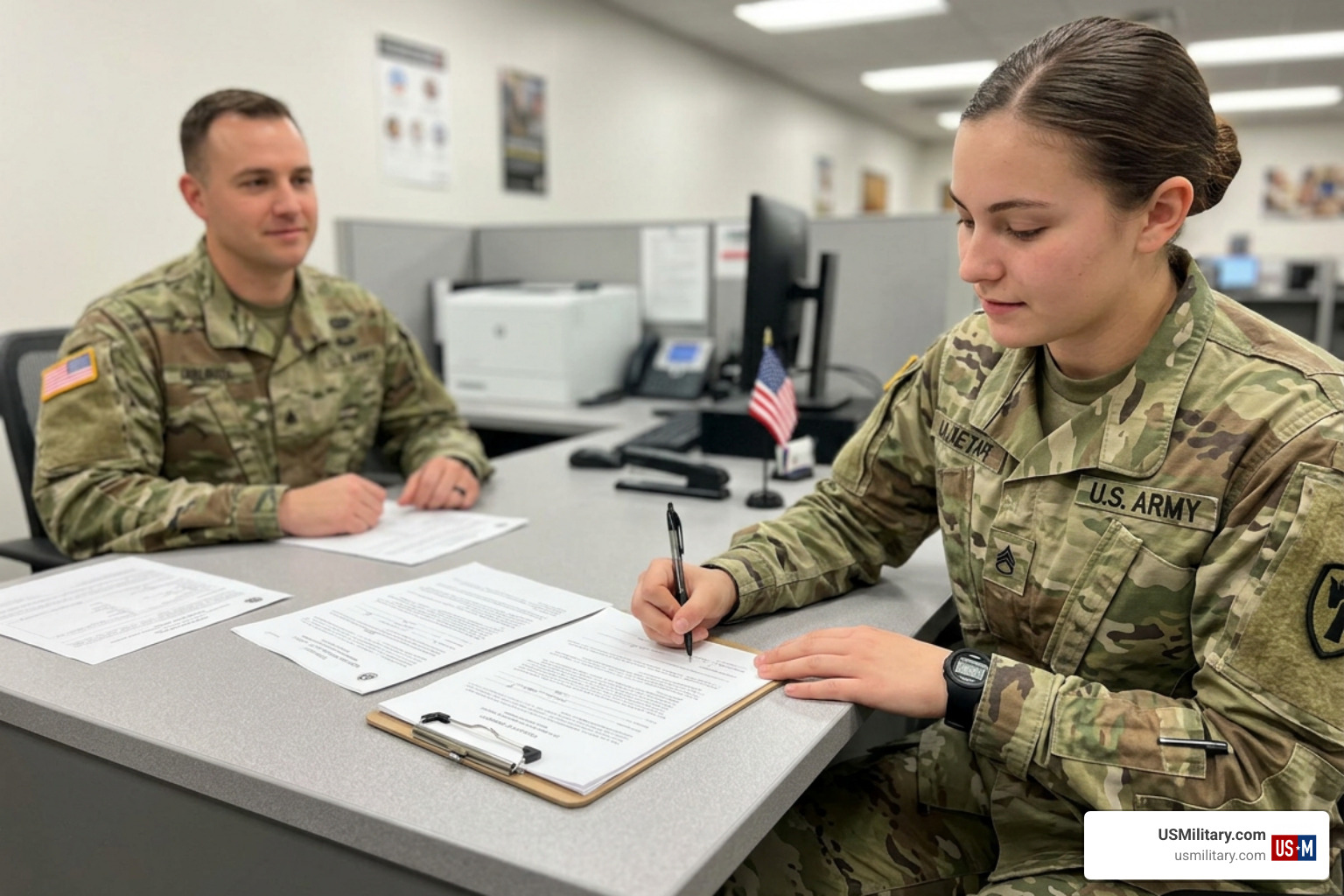
- Review Your Scores with a Critical Eye: Do not let a recruiter rush you. Compare your line scores against the official MOS requirements.
- Verify Additional Qualifications: Many technical and intelligence jobs require more than just an ASVAB score. You may need to pass a physical fitness test (OPAT), clear a background check for a Secret or Top Secret security clearance, or pass a language aptitude test (DLAB) for linguist roles.
- Get It in Writing: In the Army, if a job is not explicitly written into your active duty enlistment contract (specifically DD Form 4), it does not exist. Verbal promises from recruiters are not legally binding. Ensure your specific MOS code and any agreed-upon enlistment bonuses are clearly printed on your contract before you sign.
- Stay Updated on Recruiting Changes: The military landscape shifts constantly. Keep an eye on the latest Army recruiting updates to see if new bonuses or job options have opened up for your score bracket.
Frequently Asked Questions about Army ASVAB Scores
What is the minimum ASVAB score for the Army?
The minimum AFQT score required to enlist in the Army with a traditional high school diploma is 31. If you hold a GED, the minimum required score is 50. In rare cases, when recruiting numbers are tight, the Army may issue waivers for high school graduates who score between 26 and 30, though these waivers are subject to change based on current Army cutoff scores.
Can I retake the ASVAB to get a better Army job?
Yes, you can retake the ASVAB if you are unhappy with your scores or do not qualify for your dream MOS. However, there are strict rules. After your first test, you must wait 30 calendar days before your first retake. If you want to take it a third time, you must wait another 30 days. Any subsequent tests require a six-month waiting period. Be aware that your most recent score is the one that counts, even if it is lower than your previous attempt, so study hard before retaking it!
What is a good GT score for advanced Army jobs?
A General Technical (GT) score of 110 or higher is considered the gold standard. Scoring a 110 or above opens the doors to highly competitive career fields, including CID Special Agent, Intelligence Analyst, Psychological Operations, and Officer Candidate School (OCS). If you are looking to advance your career or commission as an officer later on, aiming for a 110 GT score should be your primary target.
Conclusion
Navigating army jobs based on ASVAB scores is the ultimate key to taking control of your military destiny. By understanding how your subtest scores combine into the 10 Army line scores, you can walk into the recruiting office as an informed, empowered candidate ready to secure a rewarding career path. Whether your goals lie in the high-intensity world of combat arms, the cutting-edge field of cyber defense, or the life-saving missions of military medicine, your ASVAB performance is the foundation of your success.
At USMilitary.com, we are committed to providing you with the accurate, unbiased tools and guidance you need to make the best decisions for your future. Once you have evaluated your career options, the next big question is deciding which path is right for you. Take the next step in your journey and explore our guide: Which military branch should I join? to find the perfect fit for your skills and ambitions.
Free for Service Members & Veterans
Get the military benefits intel no one tells you about.
Weekly updates on VA benefits, pay changes, and money tips — free for service members and veterans.
No spam. Unsubscribe anytime. Your info is never shared.



More Than 90% Of Clients Have Increased Ratings! Why Settle For Less Than You Deserve? Expert Priority Help With Your VA Claim Today! Free Evaluation Call!
The mission of Veteran Services United is to support veterans in filing and winning disability claims by offering expert guidance, advocacy, and personalized assistance. Through dedicated service, Veteran Services United empowers veterans to secure the benefits they have earned, ensuring they receive the care and support they deserve.