If you’re considering a career in the military’s elite forces, the question of Army Ranger school vs. Navy SEAL training, aka Basic Underwater Demolition SEAL training (BUD/S), is critical. Both paths represent the pinnacle of military training and operational readiness. However, the differences are significant, and understanding them is essential to making the right choice.
Table of Contents:
- Understanding the Legacy of Army Rangers and Navy SEALs
- The Birth and Rise of Navy SEALs
- Army Ranger School vs BUDS: Core Missions and Specializations
- Shared Capabilities Among Elite Forces
- Differences in Classification and Entry
- The Grueling Journey: Army Ranger School vs BUDS Selection and Training
- Career Opportunities: Jobs, Perks, Advancement, and Duty Stations
- Conclusion
Duration and Phases
Army Ranger School
- Duration: 62 days
- Phases:
- RAP (Ranger Assessment and Preparation) Week: 1 week
- Benning Phase: 4 weeks
- Mountain Phase: 4 weeks
- Swamp Phase: 4 weeks
- Graduation: 1 week
Navy SEAL BUD/S Training
- Duration: 24 weeks (6 months)
- Phases:
- Conditioning Phase: 5 weeks
- Dive Phase: 4 weeks
- Land Warfare Phase: 4 weeks
- Obstacle Course Phase: 2 weeks
- Final Exam: 1 week
Physical Challenges
Army Ranger School
- Physical challenges include:
- 5-mile run in under 40 minutes
- 12-mile ruck march in under 3 hours
- Obstacle courses
- Swimming and diving tests
- Ranger First Responder medical training
- Students are pushed to their limits with minimal sleep and food
Navy SEAL BUD/S Training
- Physical challenges include:
- 500-yard swim in under 12 minutes and 30 seconds
- 1.5-mile run in under 10 minutes and 30 seconds
- Obstacle courses, including the infamous “Obstacle Course”
- Drown-proofing and swimming tests
- Extreme physical conditioning exercises
- Students are constantly tested and pushed to their limits, with a high dropout rate
Mental and Emotional Challenges
Army Ranger School
- Mental and emotional challenges include:
- Sleep deprivation
- Isolation and separation from peers
- Mental games and puzzles
- Team-building exercises
- Exposure to extreme weather conditions
- Students are constantly evaluated on their leadership, teamwork, and problem-solving skills
Navy SEAL BUD/S Training
- Mental and emotional challenges include:
- Sleep deprivation and constant fatigue
- Isolation and separation from peers
- Extreme physical and mental stress
- Cold weather and wet conditions
- Drown-proofing and underwater tests
- Students are constantly tested on their ability to work under pressure, think critically, and make quick decisions
Dropout Rates
Army Ranger School
- Dropout rate: around 50-60%
Navy SEAL BUD/S Training
- Dropout rate: around 70-80%
Army Ranger School vs BUDS: Core Missions and Specializations
While both fall under the US Special Operations Command (SOCOM), Army Rangers and Navy SEALs have distinct specializations. Army Rangers could be compared to a sledgehammer in terms of their operational approach.
Their strength lies in large-scale, direct-action combat and decisive operations designed to quickly overwhelm an enemy. Navy SEALs, on the other hand, are more like scalpels. Naval Special Warfare values precision.
Ranger’s Role in Direct Action and Raids
The Rangers excel as a highly mobile, airborne light infantry force. This makes them incredibly effective in seizing airfields and conducting large-scale raids. Their training focuses on speed and overwhelming force.
They execute a variety of direct action missions. Three primary objectives are: seizing key terrain, capturing or killing high-value targets , and conducting forcible entry operations. These operations are to be swift and decisive.
Navy SEALs: Precision and Counterterrorism
Navy SEALs are renowned for their precision and effectiveness in carrying out covert operations. Their specialized skill set is important in addressing unconventional and clandestine missions. This skill is needed for counterterrorism efforts.
This expertise stems from extensive experience in hostage rescue , clandestine operations, and foreign internal defense. Their proficiency in unconventional warfare is beneficial in complex, high-stakes situations. SEALs evolved into versatile operators.
Shared Capabilities Among Elite Forces
Despite their differences, Army Rangers and Navy SEALs share some operational capabilities and adaptability. There is some overlap in areas like sniper training. Both are found within their respective special operations groups .
Each unit possesses specific strengths that contribute to mission success. The intense teamwork in both fosters a strong camaraderie among all involved. Both groups conduct rigorous training.
| Aspect | Army Rangers | Navy SEALs |
|---|---|---|
| Primary Role | Specialized Light Infantry | Maritime Special Operations |
| Key Missions | Direct Action Raids, Forcible Entry | Counterterrorism, Foreign Internal Defense, Hostage Rescue |
| Operational Numbers | Larger Units | Smaller Platoons |
| Historical Roots | Since the French and Indian War | World War II UDTs |
| Training Focus | Ranger Training, Direct Action | BUD/S Training, Maritime Operations |
Differences in Classification and Entry
The Army classifies Rangers by their Military Occupational Specialty (MOS), while the Navy categorizes SEALs by their rating, creating some distinctions. Rangers, as members of the 75th Ranger Regiment, hold a specific MOS.
This signifies that individuals within the regiment can have various roles. They’ve all completed specialized training distinguishing their skills from those of conventional Army personnel. This rigorous selection sets them apart.
Navy SEALs: A Defined Path
Navy SEALs have a clearly defined path. You join this elite group after demonstrating exceptional dedication and physical prowess. Navy SEALs evolved into their own rating.
Any Navy sailor can potentially become a SEAL. It requires being a high-performing individual capable of managing significant workloads. The selection process emphasizes finding individuals with the specific skills needed for Naval Special Operations.
Army Rangers Pipeline: Accelerated but Intense
The Army Rangers’ path is comparatively faster than the Navy SEALs’. They are designed to produce highly capable soldiers in the shortest time frame among the special operations branches. However, the Rangers still undergo a demanding and comprehensive selection process.
The program includes the Ranger Assessment and Selection Program (RASP). The coveted Ranger Scroll is earned through dedication and perseverance, and it is a testament to resilience and determination.
Passing RASP is a significant accomplishment. Completing Ranger School provides candidates with the mental fortitude and physical capabilities to withstand extreme duress. Successful completion of all phases of training is required.
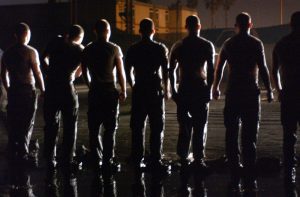
Navy SEALs Training: A Marathon of Mental and Physical Trials
The Navy SEALs’ training pipeline has one of the highest attrition rates in the world. It has a long and arduous history. When candidates enlist, they face BUD/s class challenges that push them to their absolute limits.
Candidates might only rest for a small portion of the day, often just a few hours. The relentless training includes grueling physical activities. It is meant to select only the best.
The training focuses on building mental resilience alongside physical conditioning. Hell Week tests those who are in BUD/S training. It is common to perform tasks in hostile territories.
Army Rangers Duty Stations
Army Rangers acquire invaluable skills throughout their service, from teamwork and leadership to self-reliance and problem-solving. This community of highly skilled professionals is dedicated to excellence and capable of operating in challenging conditions. Rangers lead the way in innovation.
Some potential duty stations include:
- Fort Moore, GA.
- Fort Liberty, NC.
- Fort Campbell, KY.
- Joint Base Lewis-McChord, WA.
Navy SEALs Duty Stations
SEAL training prepares individuals to undertake challenging and complex missions. They continuously train to enhance their skills and confidence across various operational domains. Only a tiny percentage of candidates complete the initial training.
This demonstrates that success requires enduring extreme hardship. The available duty assignments may include:
- Coronado, California.
- Pearl Harbor, Hawaii.
- Little Creek, Virginia.
These locations are key hubs for Naval Special Warfare Command. From these bases, SEAL teams deploy globally. They support a range of missions, from direct action to hostage rescue and counterterrorism.
Conclusion
The decision between Army Ranger School and BUD/S requires careful consideration of the different paths within the military’s special operations forces. Both roles offer unique challenges and opportunities, and both have important contributions.
Understanding the distinct training, missions, and cultures of both is crucial for making an informed career choice. Ultimately, the best option depends on individual aspirations, strengths, and the type of service that provides the greatest fulfillment. Both require a dedication to physical and mental toughness, a commitment to teamwork, and a willingness to face any challenge in service to the nation, no matter the cost.
Want more military info? Find your nearest military recruiter here!


