ASVAB Scores Explained: Minimums for Every Branch at a Glance

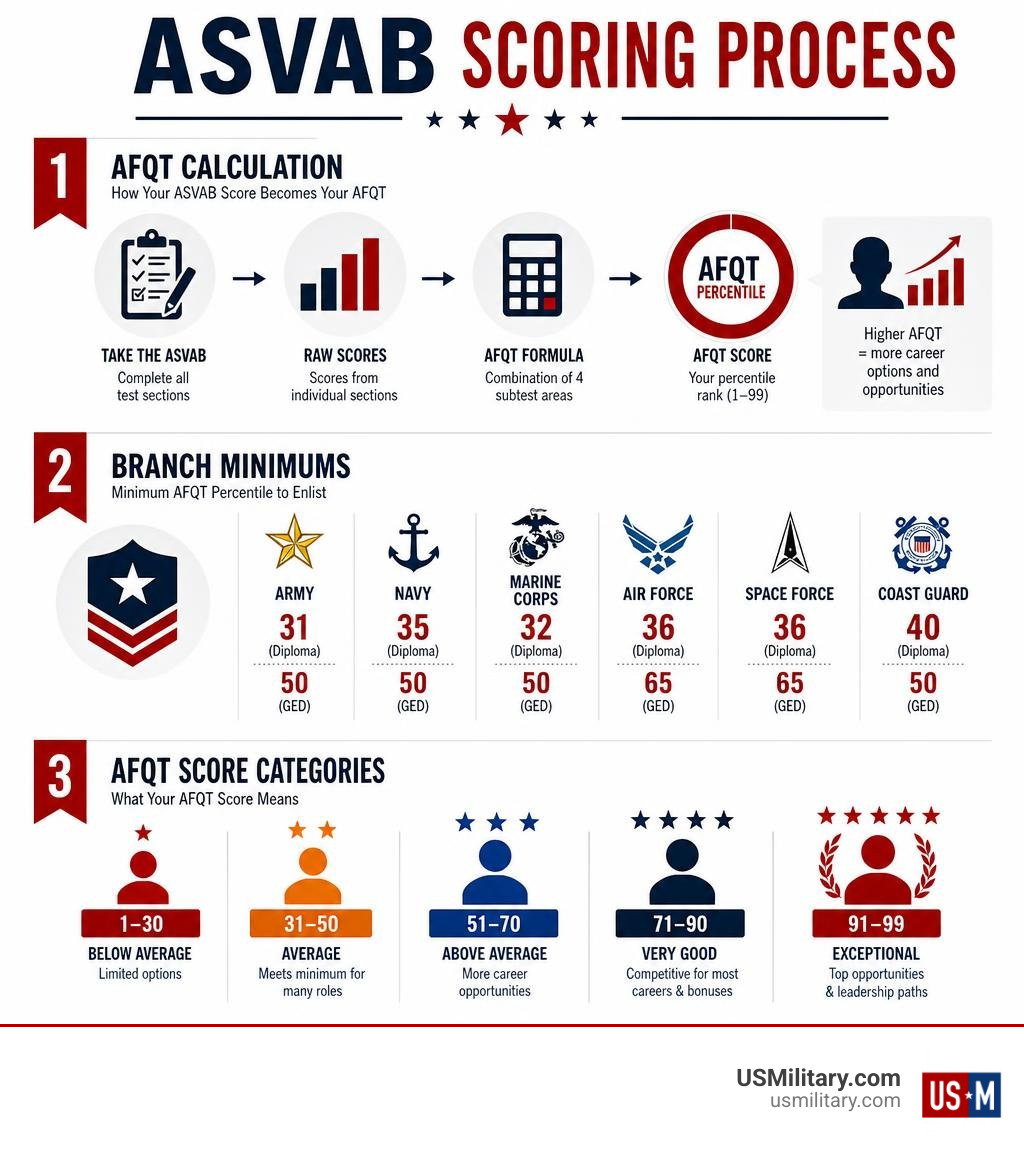
ASVAB scores explained: minimums for every branch of the U.S. military are summarized in the table below:
| Military Branch | Minimum AFQT (High School Diploma) | Minimum AFQT (GED) |
|---|---|---|
| Army | 31 | 50 |
| Navy | 35 | 50 |
| Marine Corps | 32 | 50 |
| Air Force | 36 | 65 |
| Space Force | 36 | 65 |
| Coast Guard | 40 | 50 |
Note: Requirements can shift based on recruiting needs. Always verify with your local recruiter.
Over 1.2 million Americans take the ASVAB every year. But many are caught off guard when they realize their score doesn’t just decide whether they can enlist — it also shapes which jobs they can pursue, what bonuses they qualify for, and how fast they can advance.
Your ASVAB score is essentially two things at once:
- An enlistment gate — your AFQT percentile determines which branches will accept you
- A career key — your line scores unlock (or close off) specific military jobs
Knowing the minimums before you test gives you a real advantage.
I’m Larry Fowler, publisher of USMilitary.com and a longtime resource for military enlistment guidance — including helping hundreds of thousands of recruits understand exactly what ASVAB scores explained: minimums for every branch means for their future. In the sections below, we’ll walk you through everything you need to know, from how scores are calculated to which jobs require the highest numbers.
Discover more about ASVAB scores explained: minimums for every branch:
- High Paying Civilian Jobs That The Military Offers Best Training
- Requirements To Join The US Military
- military career paths
What is the ASVAB and How is it Structured?

Before we jump into the minimum score requirements, let’s demystify what the test actually is. The Armed Services Vocational Aptitude Battery (ASVAB) is a timed, multi-aptitude test developed and maintained by the Department of Defense. It is designed to measure your strengths in verbal, math, science, technical, and spatial domains.
The military uses your results to predict your academic and occupational success in various service roles. To understand the testing process in detail, check out our guide on asvab testing explained.
The ASVAB is administered in two primary formats:
- CAT-ASVAB (Computer-Adaptive Test): Taken by roughly 70% of recruits, this version adapts the difficulty of the questions based on your previous answers. If you answer a question correctly, the next one is harder; if you get it wrong, the next is easier. It consists of 145 questions and has a 154-minute time limit, but most test-takers finish in about 90 minutes.
- Paper-and-Pencil ASVAB: This traditional format is a fixed-form test, meaning everyone gets the same questions regardless of performance. It features 225 questions and takes about 3 hours to complete.
The test is divided into ten distinct subtests. To learn how these individual sections map to military roles, read about beyond the score unpacking the army asvab subtests. The standard scores for these subtests are calculated using a statistical model where the mean (average) is set to 50, and the standard deviation is set to 10. This means a standard score of 60 on any subtest indicates you scored one standard deviation above the national average.
ASVAB Scores Explained: Minimums for Every Branch
When people talk about their “ASVAB score,” they are almost always referring to their Armed Forces Qualification Test (AFQT) score. The AFQT is the single most important number on your score sheet because it acts as the primary gatekeeper for enlistment.
Your AFQT score is not a raw percentage of correct answers. Instead, it is a percentile score ranging from 1 to 99, comparing your performance directly to a national reference group of test-takers aged 18 to 24. For example, if you receive an AFQT score of 60, it means you scored higher than 60% of the reference group.
The AFQT score is calculated using standard scores from only four of the ten ASVAB subtests:
- Arithmetic Reasoning (AR)
- Mathematics Knowledge (MK)
- Word Knowledge (WK)
- Paragraph Comprehension (PC)
The basic mathematical formula combines your Word Knowledge and Paragraph Comprehension scores into a single “Verbal Expression” (VE) score, which is then doubled and added to your math scores.
Each branch of the military sets its own minimum AFQT score requirements based on its unique operational needs. For a detailed breakdown of these requirements, you can explore resources like What ASVAB score do you need? Military branch & role minimums | Achievable or check the ASVAB Score Chart by Branch With Minimum Requirements – ASVAB Advantage .
Let’s look at the baseline minimums for high school diploma holders as of June 2026:
- Army: Requires a minimum AFQT score of 31.
- Navy: Requires a minimum AFQT score of 35 (though they have occasionally accepted scores down to 31 or even lower with specialized education waivers during recruiting shortfalls).
- Marine Corps: Requires a minimum AFQT score of 32.
- Air Force: Requires a minimum AFQT score of 36.
- Space Force: Requires a minimum AFQT score of 36.
- Coast Guard: Historically holds the highest baseline standard, requiring a minimum AFQT score of 40 (which may be lowered to 32 or 36 if a recruit qualifies for a high-demand job and secures a waiver).
For more detailed score breakdowns by branch, you can reference ✍🏼 ASVAB Scores: Score Range, Line Scores 2026 June — Free Questions & Answers and ASVAB Practice Test: Scores Army Navy Air Force Guide 2026 June .
Understanding AFQT Percentiles and Score Categories
To make sense of enlistment eligibility, the military groups AFQT percentile scores into five main categories. These categories indicate a recruit’s general trainability:
- Category I (93–99): Represents the top 8% of test-takers. Recruits in this category are highly sought after and qualify for every branch and almost any job.
- Category II (65–92): Well above average. Excellent prospects for enlistment bonuses and technical roles.
- Category III-A (50–64): Average to above average. Fully eligible for all branches.
- Category III-B (31–49): Average to slightly below average. Meets the minimum enlistment requirements for most branches.
- Category IV (10–30): Below average. Branches are strictly limited by federal law on how many Category IV recruits they can accept annually.
- Category V (1–9): Represents roughly 18% of test-takers. By law, individuals scoring in Category V are ineligible for military enlistment.
For a deeper dive into what these percentiles mean for your career, consult ASVAB scores: What you need to know | Achievable and Understanding ASVAB Scores (With Requirements and FAQs) .
High School Graduates vs. GED Holders: ASVAB Scores Explained: Minimums for Every Branch
Your level of education plays a massive role in how your ASVAB score is evaluated. The military categorizes applicants into Tier 1 (primarily high school diploma holders) and Tier 2 (primarily GED holders).
Historically, Tier 2 candidates have shown higher attrition rates during basic training. Because of this, the minimum ASVAB scores explained: minimums for every branch are significantly higher if you have a GED instead of a high school diploma:
- Army, Navy, Marine Corps, and Coast Guard: Typically require GED holders to score at least a 50 on the AFQT.
- Air Force and Space Force: Require GED holders to score at least a 65 on the AFQT.
If you have a GED, earning at least 15 college credits can upgrade your status to Tier 1, allowing you to qualify under the lower high school graduate score thresholds. To understand how your education level impacts your options, check out What Do ASVAB Scores Mean | ASVAB Career Exploration Program .
Line Scores, Composite Scores, and Job Eligibility

While your AFQT score determines if you can join a branch, your line scores (also called composite scores) determine what job you will do.
Each military branch combines your ten individual ASVAB subtest scores into unique formulas to measure your aptitude for specific career fields. For instance, if you are interested in a mechanical job, the branch will look closely at your Auto & Shop Information (AS), Mechanical Comprehension (MC), and General Science (GS) scores.
To see how these composite scores are structured across different careers, you can read ASVAB Job Score Requirements—What Military Jobs Do I Qualify for? – Peterson’s .
What is a Good ASVAB Score for Competitive Careers?
While meeting the minimum score of 31 or 35 gets you through the door, aiming for a “good” ASVAB score — typically a 50 or higher — is highly recommended.
Scoring above a 50 does three important things:
- Unlocks Enlistment Bonuses: Many branches reserve their most lucrative signing bonuses (which can reach up to $50,000) for recruits who score a 50 or above on the AFQT.
- Broadens Career Paths: Higher scores qualify you for advanced technical, medical, and intelligence roles rather than general labor positions.
- Improves Rank at Enlistment: In some branches, high test scores combined with college credits or JROTC experience can help you enter at a higher paygrade (e.g., E-2 or E-3).
One of the most critical composite scores is the GT (General Technical) score, which is calculated from your Word Knowledge, Paragraph Comprehension, and Arithmetic Reasoning subtests. A GT score of 110 or higher is widely considered the gold standard across multiple branches, as it is the minimum threshold required for officer candidate programs, strike flight crews, and elite technical roles.
Score Requirements for Elite Military Roles: ASVAB Scores Explained: Minimums for Every Branch
If you have your sights set on highly competitive or technical military careers, you must score well above the branch minimums. Here are a few examples of the requirements for elite military roles:
- Cyber Operations Specialist (Army – 17C): Requires a Skilled Technical (ST) composite score of 112 or higher.
- Cryptologic Technician Networks (Navy – CTN): Requires a combined score of AR + MK + EI + GS of 222 or higher.
- Nuclear Power Program (Navy): Requires a combined line score of AR + MK + EI + GS + VE of 252 or higher. This is widely considered one of the academically toughest programs in the military.
- Special Forces (Army Green Beret): Requires a General Technical (GT) score of 110 or higher, alongside rigorous physical screening.
Retaking the ASVAB and Preparation Strategies
If your initial ASVAB score doesn’t meet the minimum for your chosen branch or desired job, do not panic. You can retake the test, but you must follow strict Department of Defense waiting periods:
- Second Attempt: You must wait one calendar month after your first test.
- Third Attempt: You must wait one calendar month after your second test.
- Subsequent Attempts: Any test after the third requires a six-month waiting period.
It is important to note that you cannot choose which score to use; your most recent score is the one that counts, even if it is lower than your previous attempt.
To ensure you improve on your next try, we highly recommend utilizing structured study resources. Start by reviewing asvab sample questions to understand the layout of the test, and read our comprehensive guide on how to ace the asvab test and get the best military career.
For practical, hands-on preparation, we have compiled a blueprint in ready set asvab how to practice your way to army success. You can also test your knowledge directly with our ace the asvab test and get the best military jobs sample test.
Frequently Asked Questions about ASVAB Scores
What is the highest possible ASVAB score?
The highest possible AFQT score is a 99 percentile. Scoring a 99 means you performed better than 99% of the national reference group of test-takers. Doing so places you in Category I and qualifies you for every enlisted career path in the United States military.
Do ASVAB scores expire?
Yes, ASVAB scores are valid for two years from the date of the test. If you do not enlist within those two years, you will need to retake the exam to establish your eligibility.
Can you use a calculator on the ASVAB?
No. Calculators, smartwatches, and outside study aids are strictly prohibited during the exam. All math subtests (Arithmetic Reasoning and Mathematics Knowledge) must be completed using mental math and the scratch paper provided at the testing facility.
Conclusion
Navigating the minimum ASVAB requirements is your very first step toward a rewarding military career. While meeting the baseline minimum of 31 or 35 will allow you to enlist, aiming for a higher score opens doors to better career fields, enlistment bonuses, and faster promotion tracks.
At USMilitary.com, we are committed to providing you with the resources and guidance you need to make informed decisions about your future. Once you have established your target score, take some time to explore our guide on Which military branch should I join? to find the perfect fit for your skills and goals.
For more information on military benefits, career paths, and transition resources, visit our homepage at USMilitary.com or check out Dare to Live Greatly for inspirational insights on leadership and service. Your military journey starts with preparation — study hard, practice consistently, and aim high!
Free for Service Members & Veterans
Get the military benefits intel no one tells you about.
Weekly updates on VA benefits, pay changes, and money tips — free for service members and veterans.
No spam. Unsubscribe anytime. Your info is never shared.


