What You Need to Know About the Six U.S. Military Branches
If you want to Learn About The US Military Branches, here is a quick overview:
| Branch | Domain | Founded |
|---|---|---|
| Army | Land | June 14, 1775 |
| Navy | Sea | October 13, 1775 |
| Marine Corps | Amphibious (land & sea) | November 10, 1775 |
| Air Force | Air | September 18, 1947 |
| Coast Guard | Maritime law enforcement | August 4, 1790 |
| Space Force | Space | December 20, 2019 |
The U.S. Armed Forces operate in over 100 countries, with roughly 1.34 million active-duty personnel and 799,500 reservists. The 2026 military budget stands at $901 billion — about 3.22% of GDP.
Each branch has a distinct mission and domain. Five branches fall under the Department of Defense (DoD). The Coast Guard is the exception — it operates under the Department of Homeland Security in peacetime.
Together, these six branches form the most capable military force in the world, accounting for roughly 37% of total global defense spending.
I’m Larry Fowler, publisher of USMilitary.com — a network I’ve grown since 2007 to help active-duty members, veterans, and those considering service navigate their options. Helping people Learn About The US Military Branches has been central to everything we do here, and this guide reflects nearly two decades of connecting Americans with the military resources they need. Let’s break it all down clearly.
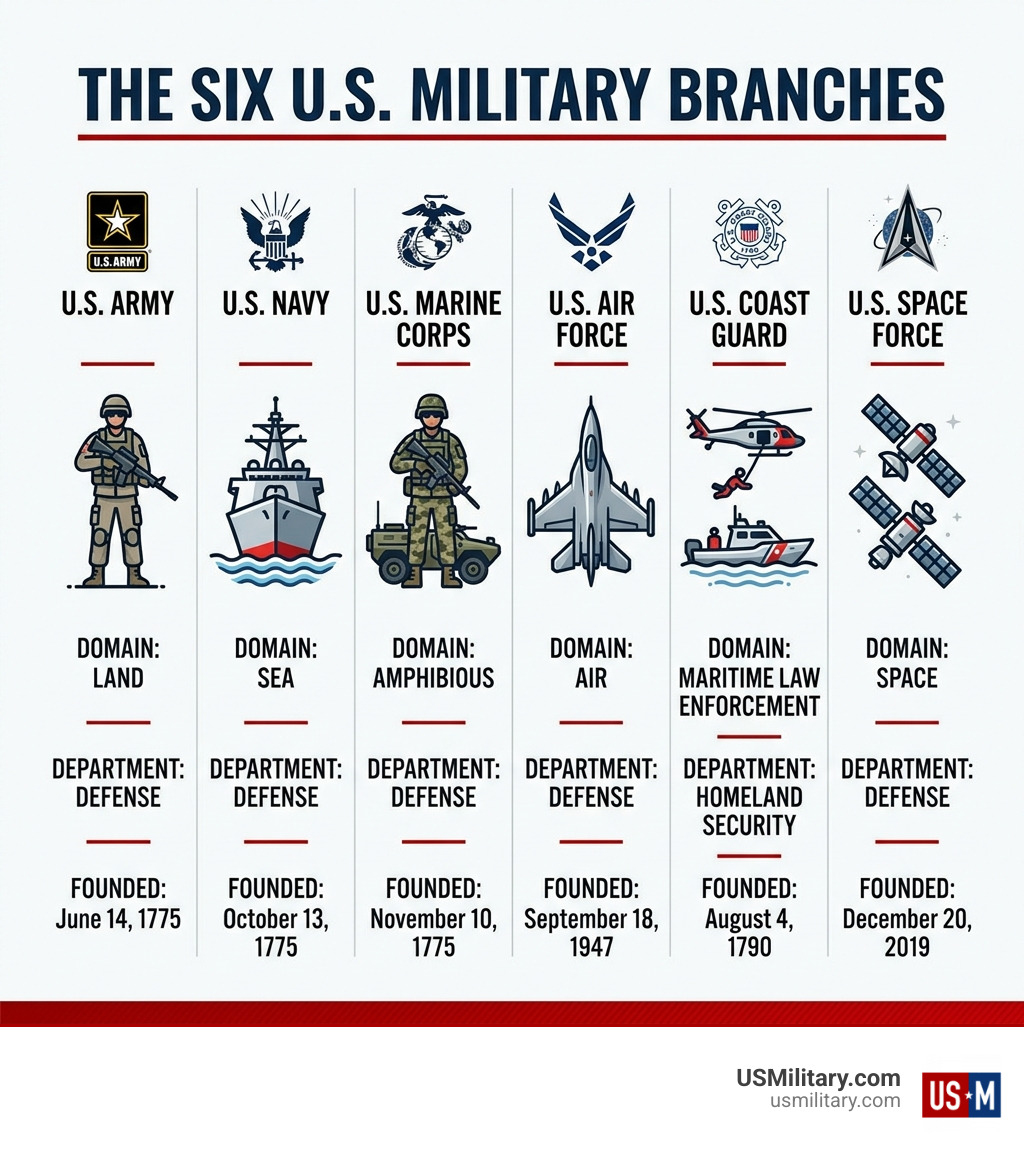
Learn About The US Military Branches: Mission and Domain Overview
When we look at the United States military, we aren’t just looking at one giant organization. We are looking at six distinct teams, each with a specific “home” or domain where they do their best work. Whether it is the dirt under a soldier’s boots, the deep blue of the Pacific, or the silent vacuum of orbit, every branch has a territory to protect.
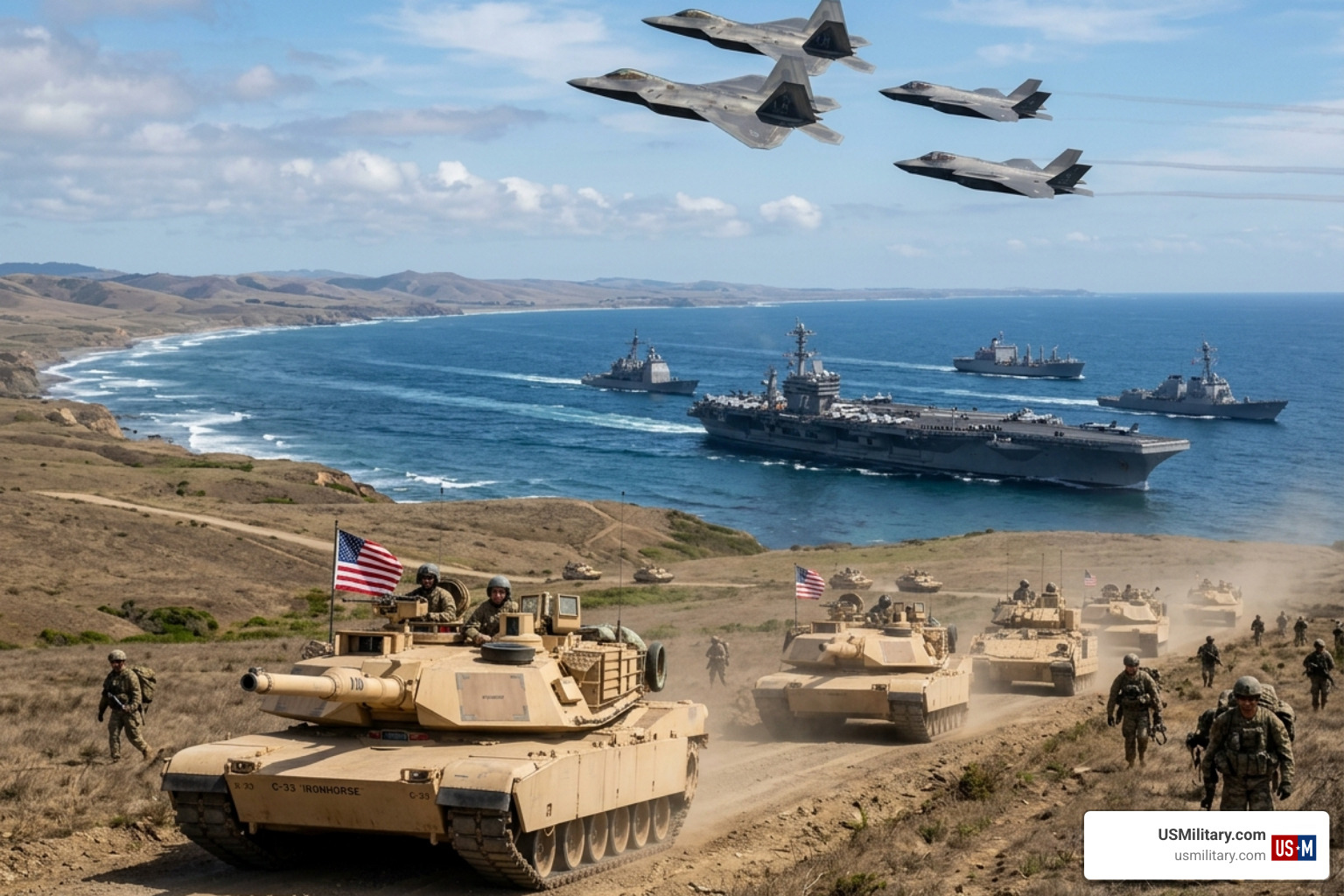
To truly Learn About The US Military Branches, you have to understand that while they often work together in “joint operations,” they each bring a unique specialty to the table. The Military Branches – American Military (U.S. National Park Service) highlights how these services have shaped American history across every landscape imaginable.
| Branch | Primary Mission | Domain |
|---|---|---|
| Army | Land Warfare & Occupation | Land |
| Navy | Sea Control & Power Projection | Sea |
| Marine Corps | Expeditionary & Amphibious Ops | Land/Sea |
| Air Force | Air Superiority & Global Reach | Air |
| Space Force | Space Superiority & Satellite Defense | Space |
| Coast Guard | Maritime Safety & Law Enforcement | Waterways |
Key Responsibilities to Learn About The US Military Branches
Each branch serves a vital role in our national security strategy. If you are exploring the Military Branches in depth, here is what they actually do on a daily basis:
- The Army: As the largest and oldest service, the Army provides the ground forces that protect the United States. They are the experts in land combat, long-term occupation, and providing humanitarian aid on the ground.
- The Navy: Known as America’s forward-deployed force, the Navy maintains freedom of the seas. They operate on, above, and below the water, ensuring that global trade routes remain open and that we can strike from the ocean if necessary.
- The Marine Corps: Organizationally part of the Department of the Navy but a distinct branch, the Marines are often the “first to fight.” They specialize in amphibious operations—moving from ship to shore—and are known for being a fast, mobile, and fierce expeditionary force.
- The Air Force: This branch provides rapid air and space capability. Their job is to control the skies, provide strategic airlift for troops and supplies, and conduct precision strikes anywhere on the planet.
- The Space Force: Our newest branch, established in 2019, focuses on protecting U.S. and allied interests in space. Its members, called Guardians, manage the satellites that provide our GPS, communications, and missile warning systems.
- The Coast Guard: While the other branches focus on combat, the Coast Guard focuses on maritime law enforcement, search and rescue, and environmental protection. They are the guardians of our coasts and internal waterways.
History and Establishment of the Armed Forces
The history of our military is older than the nation itself. The Continental Army was founded on June 14, 1775, before the Declaration of Independence was even signed. Not long after, the Navy and Marine Corps were established to take the fight to the British at sea.
The Coast Guard traces its lineage back to 1790 as the Revenue Cutter Service, established to combat smuggling and collect domestic taxes. For a long time, the “Air Force” was actually part of the Army (the Army Air Corps). It wasn’t until the National Security Act of 1947 that the Air Force became its own independent branch, reflecting the massive importance of airpower shown in World War II. Finally, the Space Force was carved out of the Air Force in December 2019 to address the growing importance of the space domain.
Leadership, Command, and Global Operations
Who is actually “in charge” of this massive machine? In the United States, we have a firm tradition of civilian control over the military. This means the people at the very top are elected or appointed civilians, not active-duty generals.
As of April 2026, the structure remains as follows:
- The President: Serves as the Commander-in-Chief. They have the final say on all military matters.
- The Secretary of Defense (SECDEF): Leads the Department of Defense (DoD) and acts as the principal defense advisor to the President.
- The Secretary of Homeland Security: The Coast Guard reports here during peacetime.
To understand the Us Military structure, you must also look at the Joint Chiefs of Staff. These are the highest-ranking military officers from each branch who advise the President, though they do not have operational command authority over troops in the field. For more on how these leaders interact, check out the official overview of Our Forces.
Unified Combatant Commands and Joint Force Integration
In the modern era, branches rarely fight alone. Instead, they work together under Unified Combatant Commands. These are organized either by geography (like Indo-Pacific Command or European Command) or by function (like Cyber Command or Special Operations Command).
This “Joint Force” integration allows a Navy ship to provide fire support for a Marine unit on the ground, while an Air Force jet provides cover and a Space Force satellite provides the GPS coordinates. This global power projection is why the U.S. maintains roughly 800 military bases worldwide, ensuring theater security in over 100 countries.
Personnel Categories: Active Duty, Reserves, and National Guard
When you Learn About The US Military Branches, you’ll realize that not everyone wears the uniform 24/7. The military is divided into three main categories of service.
- Active Duty: These are full-time service members. It is their “9-to-5” (and then some). They live on or near military bases and can be deployed anywhere in the world at a moment’s notice.
- The Reserves: These are part-time “citizen-soldiers.” They typically train one weekend a month and two weeks a year. They provide specialized skills and extra “heft” to the active-duty force when needed.
- The National Guard: This is a unique component. The National Guard (both Army and Air) has a dual mission. They can be called up by the President for federal missions, but they also report to their state’s Governor for domestic emergencies, such as natural disasters or civil unrest.
If you have more specific questions about these roles, our Us Military Faq covers the nitty-gritty details of service life.
Key Responsibilities to Learn About The US Military Branches
The National Guard and Reserves are the backbone of domestic resilience. When a hurricane hits Florida or a wildfire rages in California, it is the National Guard that delivers food, water, and medical aid. They are constitutionally required and provide a vital link between the civilian population and the military.
How to Learn About The US Military Branches and Joining Requirements
Thinking about joining? It’s a big decision. We often get asked, “Which Branch Of The Military Should I Join?” The answer depends on your goals.
To join any branch, you generally need to:
- Take the ASVAB: The Armed Services Vocational Aptitude Battery determines what jobs you are qualified for.
- Meet Age and Health Standards: Generally, you must be between 17 and 39 (though this varies by branch).
- Physical Fitness: Each branch has its own “boot camp” or basic training designed to push you to your limits.
Whether you want to be a mechanic, a nurse, a pilot, or a computer programmer, there is a career path for you. We recommend talking to recruiters from multiple branches to see which culture fits you best.
Special Operations and Elite Units
Every branch has its “best of the best”—the units that take on the most dangerous and secretive missions. These units require years of training and have incredibly high washout rates.
- Army Green Berets & Rangers: The Green Berets focus on unconventional warfare and training foreign armies, while the Rangers are the premier light infantry raiding force.
- Navy SEALs: Experts in sea, air, and land operations, known for their grueling “Hell Week” training.
- Marine Raiders: The special operations component of the Marine Corps, specializing in direct action and reconnaissance.
- Air Force Pararescue (PJs): Elite rescue specialists who go behind enemy lines to save downed pilots or wounded soldiers.
While these roles are prestigious, they often come with the highest risks. When researching the Military Branch Highest Percentage Deaths, it is important to remember the immense sacrifice these elite warriors make for national security.
Frequently Asked Questions about U.S. Military Branches
What is the newest branch of the U.S. military?
The United States Space Force (USSF) is the newest branch, established on December 20, 2019. While people often joke about “Space Marines,” the reality is much more technical. The Space Force ensures that the satellites we rely on for everything from banking to Uber stay safe from enemy interference. Its members are officially called Guardians.
How does the Coast Guard differ from other branches?
The Coast Guard is unique because it is both a military branch and a federal law enforcement agency. During peacetime, it operates under the Department of Homeland Security (DHS). However, during a formal declaration of war (or when the President directs), the Coast Guard can be transferred to the Department of the Navy to support combat operations.
Which branch is the largest and oldest?
The United States Army holds both titles. Founded on June 14, 1775, it predates the signing of the Declaration of Independence. Today, it consists of about one million soldiers across the Regular Army, Army National Guard, and Army Reserve. It is the primary land-based branch responsible for land warfare and long-term stability operations.
Conclusion
Understanding the U.S. military is the first step toward appreciating the complex shield that protects our nation. Whether you are a student writing a report, a citizen wanting to stay informed, or a potential recruit looking for a future, we hope this guide helped you Learn About The US Military Branches in a clear and meaningful way.
At USMilitary.com, we are dedicated to being your central hub for military-related guidance. From VA disability information and military loans to nonbiased info on the different Branches Of Military, we are here to serve those who serve. Our military is a massive, $901 billion “company” with over 2 million employees, but at its heart, it is made up of individuals—Guardians, Sailors, Soldiers, Airmen, Marines, and Coast Guardsmen—working together to keep us safe.
If you’re ready to take the next step, explore our resources or reach out to a recruiter today. Thank you for taking the time to learn about the brave men and women of the U.S. Armed Forces.
Free for Service Members & Veterans
Get the military benefits intel no one tells you about.
Weekly updates on VA benefits, pay changes, and money tips — free for service members and veterans.
No spam. Unsubscribe anytime. Your info is never shared.


