
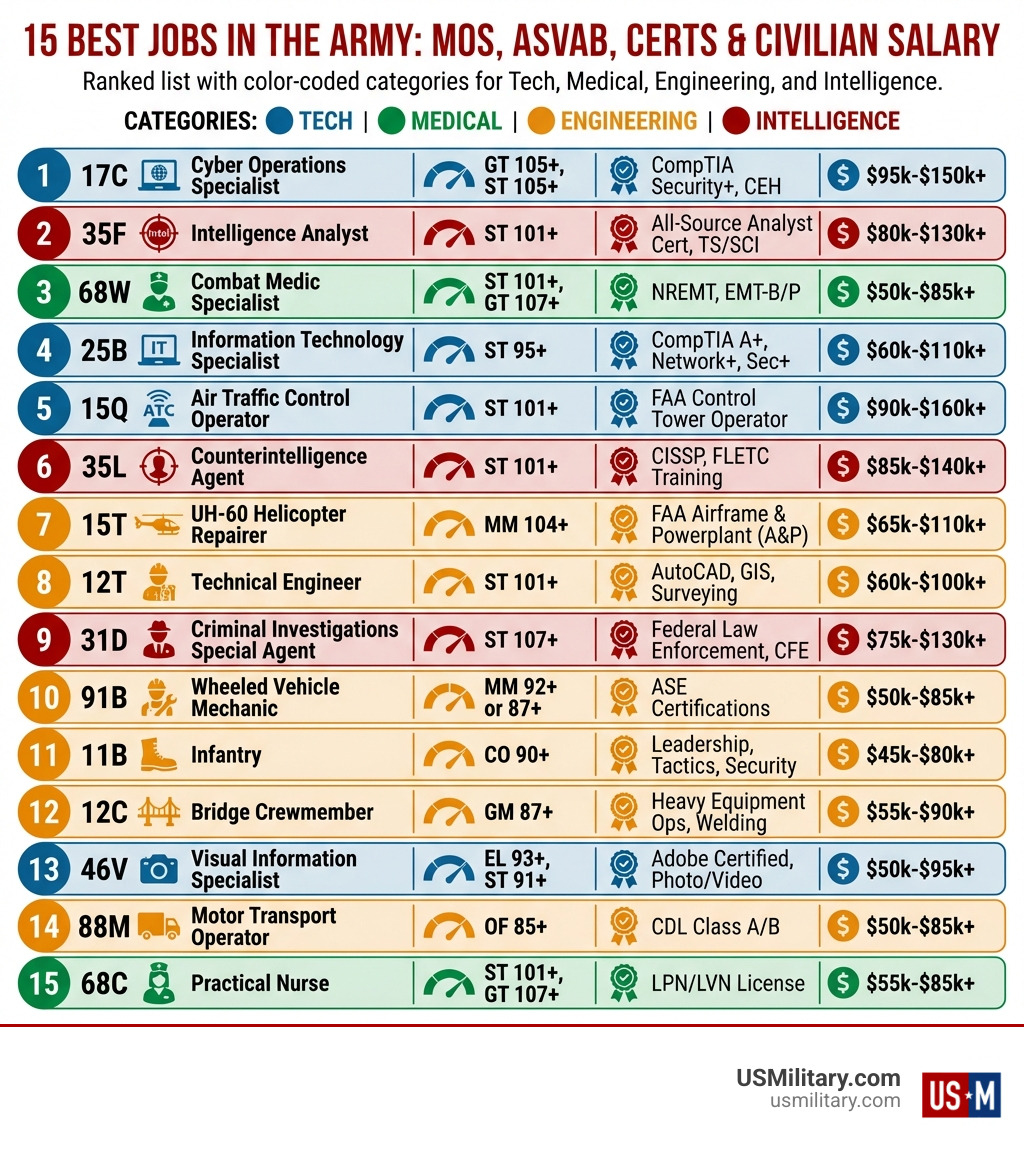
The 15 best jobs in the Army give you real skills, strong pay, and a clear path to a great civilian career when your service ends. With over 200 Military Occupational Specialties (MOS) to choose from, picking the right one can feel overwhelming. Here’s a quick look at the top 15:
- 17C – Cyber Operations Specialist
- 35F – Intelligence Analyst
- 68W – Combat Medic Specialist
- 25B – Information Technology Specialist
- 15Q – Air Traffic Control Operator
- 35L – Counterintelligence Agent
- 15T – UH-60 Helicopter Repairer
- 12T – Technical Engineer
- 31D – Criminal Investigations Special Agent
- 91B – Wheeled Vehicle Mechanic
- 11B – Infantry
- 12C – Bridge Crewmember
- 46V – Visual Information Specialist
- 88M – Motor Transport Operator
- 68C – Practical Nurse
Whether you want to work in tech, medicine, engineering, or intelligence, the Army has a role that fits. Many of these jobs come with enlistment bonuses up to $40,000, industry certifications like CompTIA or NREMT, and skills that employers actively seek after your service ends.
I’m Larry Fowler, publisher of USMilitary.com, and I’ve spent nearly two decades connecting servicemembers and veterans with the resources they need to make smart career decisions — including guidance on the 15 best jobs in the Army. In this guide, I’ll walk you through each role so you can choose the MOS that sets you up for long-term success.
15 best jobs in the Army terms to remember:
When we sat down to rank the 15 best jobs in the Army, we didn’t just look at who gets the coolest gear (though that’s a nice perk). We used a rigorous set of criteria to ensure these roles provide value both during and after your time in uniform.
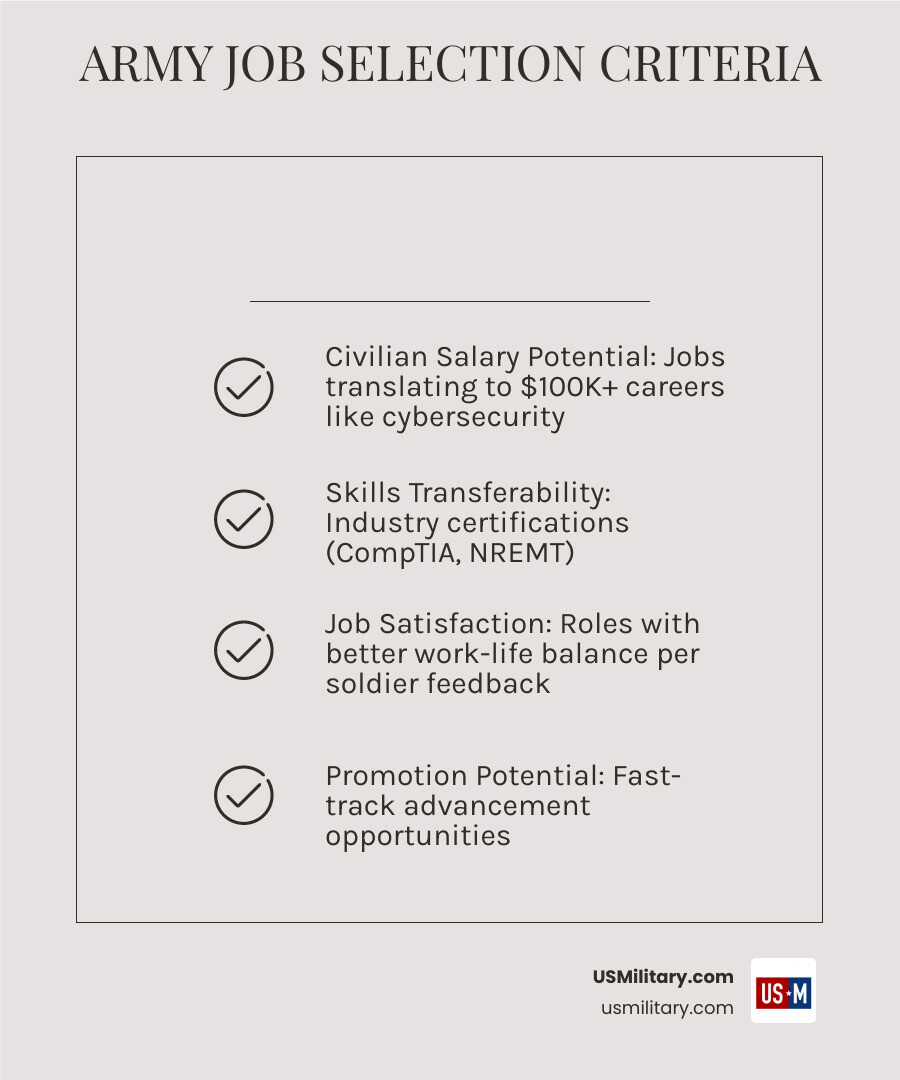
Our selection process focused on four major pillars:
- Civilian Salary Potential: We looked for jobs that translate into high-paying civilian careers. For instance, a Cyber Operations Specialist can easily command a six-figure salary in the private sector.
- Skills Transferability: Can you take what you learned in the motor pool or the lab and use it at a Fortune 500 company? We prioritized MOS codes that offer industry-standard certifications.
- Job Satisfaction and Work-Life Balance: Let’s be honest—some Army jobs “suck” less than others. We factored in soldier feedback from platforms like Reddit to find roles with better-than-average quality of life.
- Promotion Potential: Some fields are “stagnant,” while others offer rapid advancement. We chose roles where hard work is rewarded with rank.
To help you visualize how these stack up, check out our best Army jobs overview for a deeper dive into career longevity. We also highly recommend using Army COOL certification matching to see exactly which civilian licenses you can earn while serving.
Top Technical and Intelligence Roles
In the modern era, the front lines aren’t just in the dirt; they’re in the digital clouds and encrypted frequencies. The Army’s technical and intelligence branches are currently some of the most sought-after roles because they offer a “Top Secret” clearance—a golden ticket in the civilian job market.
If you have a knack for puzzles, coding, or connecting the dots, these roles are for you. From becoming a signals intelligence analyst in the US Army to hunting down internal threats as a criminal investigation US Army enlisted agent, the opportunities are vast. These fields are also where you’ll see the most military innovation, as the Army spends billions to stay ahead of global adversaries.
17C: The Best Jobs in the Army for Tech Enthusiasts
The 17C Cyber Operations Specialist is arguably the “crown jewel” of technical MOS codes. These soldiers execute both offensive and defensive cyberspace operations. Think of it as being a government-sanctioned hacker.
- ASVAB Requirement: High scores in GT and ST.
- Training: Roughly 45 weeks of intensive AIT (Advanced Individual Training) at Fort Eisenhower.
- Civilian Perk: You can earn CompTIA Security+, Network+, and Certified Ethical Hacker (CEH) certifications.
- Salary: In the civilian world, cybersecurity specialists average $58,430, but those with 17C experience often jump straight into senior roles paying over $100,000.
35F: Intelligence Analyst Career Path
The 35F Intelligence Analyst is the “brain” of the operation. You’ll spend your days processing data, assessing battlefield threats, and briefing commanders on what the enemy is likely to do next. This role is a direct pipeline to Army crypto logic intelligence careers and federal agencies like the CIA or FBI.
The key benefit here is the Top Secret/Sensitive Compartmented Information (TS/SCI) clearance. This clearance alone is worth its weight in gold to defense contractors like Raytheon or Lockheed Martin, where analysts can earn between $65,000 and $120,000 annually.
High-Demand Medical and Aviation Careers
If you want a job that feels meaningful every single day, the medical and aviation branches are hard to beat. These roles are high-pressure but come with some of the best civilian transition paths available. Whether you’re an Army medic putting the mission first or an Air Traffic Controller ensuring birds land safely, you are a critical asset.
The aviation field is particularly lucrative. For example, aviation operation careers provide specialized training that is almost identical to civilian FAA requirements. Meanwhile, medical roles like the medical prevention Army specialist focus on environmental health and safety, a booming sector in the private industry.
68W: Combat Medic Specialist and Civilian Nursing
The 68W Combat Medic is the second-largest MOS in the Army and for good reason. You are trained to provide emergency medical treatment on the battlefield.
- Certifications: You will earn your National Registry of Emergency Medical Technicians (NREMT) certification during AIT.
- Civilian Transition: This is a perfect stepping stone toward becoming a Registered Nurse or Physician Assistant. According to the BLS registered nurse job outlook, the field is expected to grow by 15%—much faster than average.
- Pro-Tip: Leverage your Army health and wellness support benefits to finish your nursing degree while on active duty.
Engineering, Trades, and Combat Leadership
Not everyone wants to sit behind a desk or in a hospital. For those who like to build, fix, and lead, the 12-series (Engineers) and 91-series (Mechanics) offer incredible trade skills. And of course, we cannot talk about the Army without mentioning the backbone of the force: the Infantry.
From learning how to get moving as an Army wheeled vehicle mechanic to mastering the technical skills of enlisted interior electrician Army careers, these jobs ensure that the Army—and your future career—stays on track. We also have roles like the combat documentation and production specialist, who uses high-end multimedia equipment to tell the Army’s story.
11B: Why Infantry is Among the 15 Best Jobs in the Army
You might be surprised to see 11B Infantry on a list of “best” jobs for civilian life. While you won’t learn how to code or draw blood, you will learn leadership under extreme pressure.
- The “Suck” Factor: It’s physically demanding and involves frequent deployments.
- The Reward: Employers love veterans who can lead teams through chaos. Many former 11Bs find high-paying roles in management, law enforcement, or as private security contractors (earning up to $22,500 per month).
- Elite Paths: If you’re wondering, “Can you qualify as an elite Army Ranger?“, the Infantry is your primary starting point.
Transitioning from the Army to a Civilian Career
Every soldier eventually hangs up the uniform. The goal is to make sure that when you do, you aren’t starting from scratch. The Army provides a massive safety net for this transition, but you have to be proactive.
We recommend starting your transition plan at least 18 months before your ETS (Expiration of Term of Service) date. Here are the tools you must use:
- Soldier for Life – Transition Assistance Program (SFL-TAP): This is a mandatory program that teaches you how to write a resume, dress for interviews, and understand your benefits.
- DoD SkillBridge: This allows you to spend your last 180 days of service doing an internship with a civilian company while still receiving your full Army pay and allowances.
- GI Bill benefits: Use this to pay for college or trade school after you get out. It can cover tuition, books, and even provide a monthly housing allowance.
- LinkedIn for Veterans: Veterans get a free year of LinkedIn Premium, which is essential for networking with veteran-friendly employers like Amazon, Booz Allen Hamilton, and JPMorgan Chase.
Don’t forget to check the Army Retention and Career Resource Site for updates on how to stay in or move into a better MOS if you decide to re-enlist.
Frequently Asked Questions about Army MOS
What is the highest-paying job in the Army?
While base pay is determined by rank and years of service, certain roles offer massive bonuses and “Special Duty Assignment Pay.” Currently, Military Dental Lab Technicians and Cyber Operations Specialists are among the highest-compensated when you factor in enlistment bonuses and civilian earning potential. Some medical specialists can see total compensation packages that rival private-sector doctors.
How do I choose the right MOS for my interests?
The best way to choose is to take the ASVAB seriously. Your scores determine what jobs you qualify for. We suggest making a list of your top 5 interests—whether it’s working with your hands, solving technical problems, or medical care—and matching them against the ASVAB score requirements. You can also take a “Career Match” quiz on official recruitment sites to see where your personality fits best.
Which Army jobs offer the best work-life balance?
Technical and administrative roles generally offer the most “9-to-5” experience, especially when not deployed. Roles like 42A Human Resources Specialist or 25B IT Specialist often work in office environments with more predictable schedules compared to combat arms or field-heavy roles like Combat Engineers.
Conclusion
Choosing one of the 15 best jobs in the Army is the first step toward a rewarding life of service and a prosperous civilian future. Whether you choose the digital battlefield of a 17C or the high-stakes trauma care of a 68W, the Army offers a unique platform to grow both personally and professionally.
At USMilitary.com, we believe that information is your strongest weapon. Before you sign that contract, do your research, talk to current soldiers on forums, and consult with a recruiter to ensure you’re getting the MOS you want. If you’re ready to take the leap, make sure you understand the requirements to join the Army and start preparing today. Your future self will thank you for the hard work you put in now.
Free for Service Members & Veterans
Get the military benefits intel no one tells you about.
Weekly updates on VA benefits, pay changes, and money tips — free for service members and veterans.
No spam. Unsubscribe anytime. Your info is never shared.



More Than 90% Of Clients Have Increased Ratings! Why Settle For Less Than You Deserve? Expert Priority Help With Your VA Claim Today! Free Evaluation Call!
The mission of Veteran Services United is to support veterans in filing and winning disability claims by offering expert guidance, advocacy, and personalized assistance. Through dedicated service, Veteran Services United empowers veterans to secure the benefits they have earned, ensuring they receive the care and support they deserve.