Why Earning the Ranger Tab Is One of the Military’s Toughest Challenges
How hard is it to become an Army Ranger? Becoming an Army Ranger ranks among the most physically and mentally demanding achievements in the U.S. military. The journey involves two distinct paths: completing the 8-week Ranger Assessment and Selection Program (RASP) to join the 75th Ranger Regiment, or graduating from the grueling 62-day Ranger School to earn the coveted Ranger Tab. Both require exceptional physical fitness, mental toughness, and leadership skills under extreme stress.
Quick Answer: The Difficulty Breakdown
- Graduation Rate: Historically around 50%, with recent rates as low as 42%
- RAP Week Attrition: Accounts for 60% of all failures
- Physical Standards: 49 push-ups, 59 sit-ups, 6 chin-ups, 5-mile run in 40 minutes, 12-mile ruck march in under 3 hours
- Daily Reality: 20 hours of training per day, only 3.5 hours of sleep, 2,200 calories while carrying 65-90 pounds of gear
- Weight Loss: Students lose an average of 25-30 pounds during the course
- Distance: Patrol over 200 miles on foot across three phases
The numbers tell a sobering story. Less than 50% of students complete the first Darby Phase alone. Those who continue face sleep deprivation that causes hallucinations, caloric restriction that forces the body to consume itself, and leadership evaluations where peer reviews can end your journey regardless of physical performance. Whether you’re infantry or in a support role, active Army or from another service branch, the Ranger pipeline separates those with grit from those without it.
I’m Larry Fowler, publisher of USMilitary.com Network since 2007, and I’ve worked with thousands of service members navigating elite military training paths. Understanding how hard is it to become an Army Ranger helps candidates prepare realistically for what many consider the Army’s toughest leadership course.
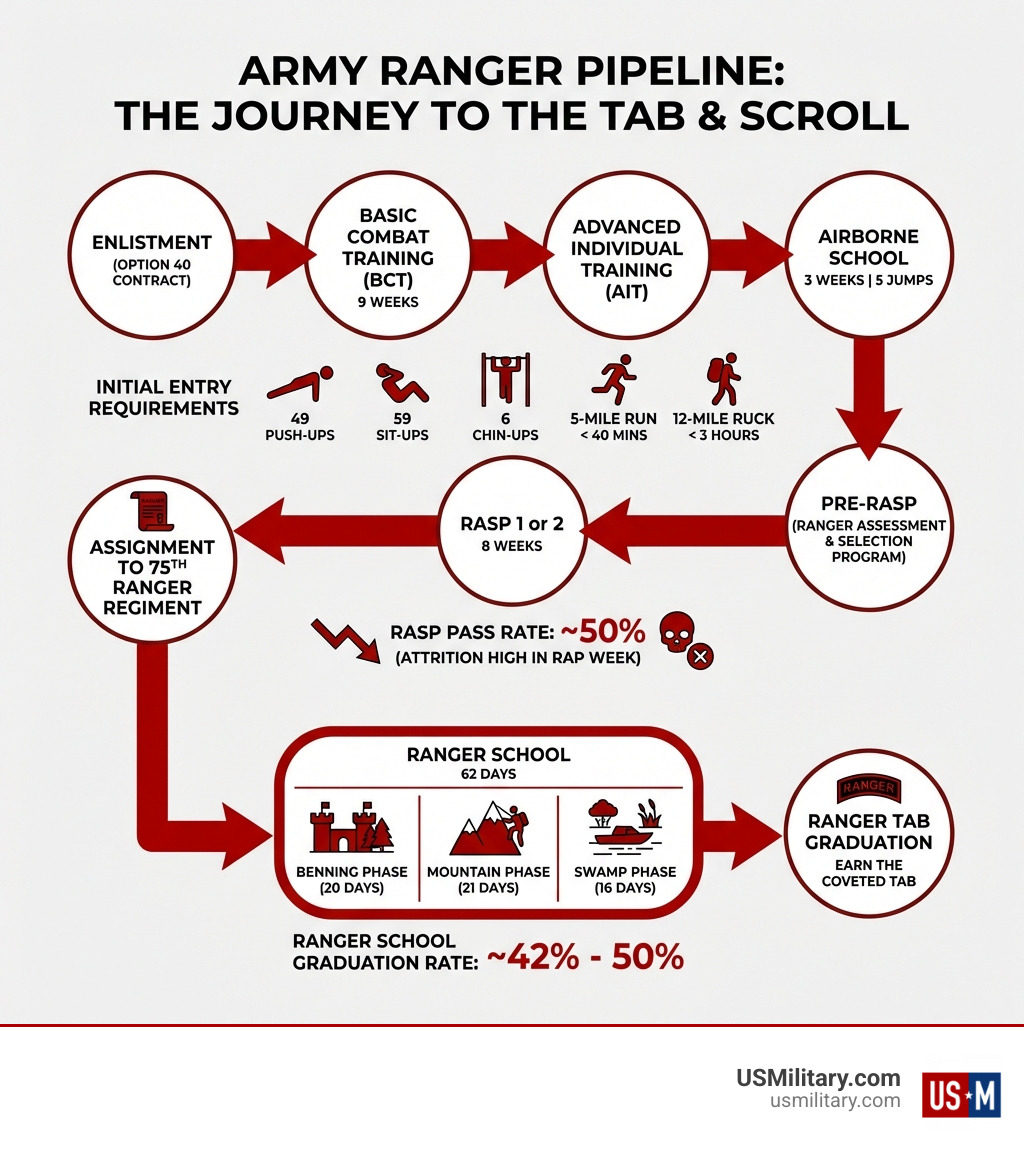
Simple how hard is it to become an army ranger word guide:
Understanding the Path: Tab vs. Scroll
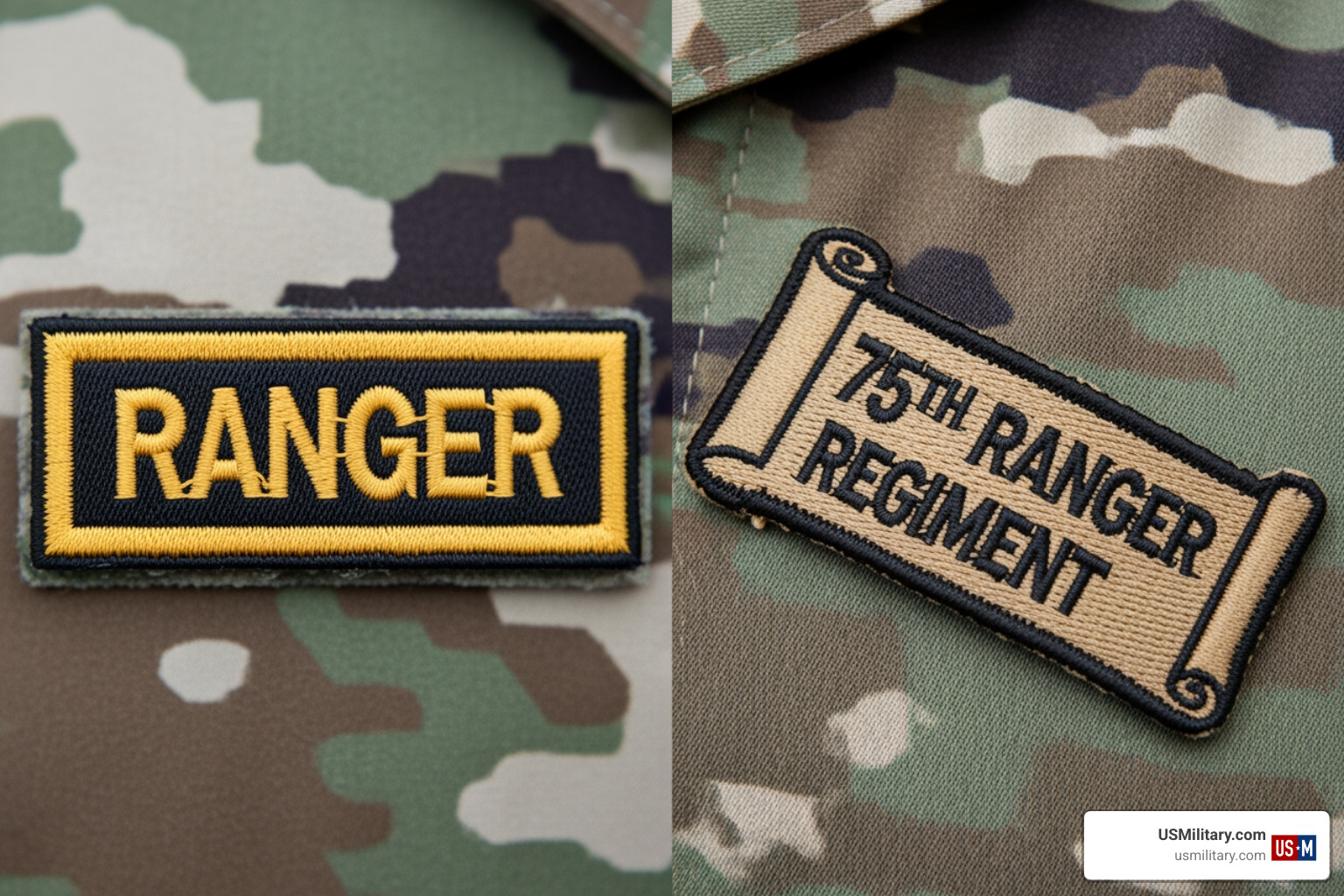
One of the most common points of confusion for those asking how hard is it to become an Army Ranger is the difference between “The Tab” and “The Scroll.” In the military community, these represent two very different achievements, though they share a common heritage.
The 75th Ranger Regiment (The Scroll)
When people talk about someone “being a Ranger” as their job, they are usually referring to a member of the 75th Ranger Regiment. This is the Army’s premier light infantry special operations force. To join, you must pass the Ranger Assessment and Selection Program (RASP).
- RASP 1: An 8-week selection for junior enlisted (E-1 to E-5).
- RASP 2: A 3-week selection for senior NCOs, warrant officers, and officers.
Graduating RASP allows you to wear the tan beret and the “Ranger Scroll” on your shoulder. These Rangers specialize in high-stakes missions like airfield seizures, direct action raids, and personnel recovery. Every member of the Regiment is a volunteer, and they are held to a relentless standard of self-accountability. To learn more about the values that drive these elite soldiers, you can read the Army Ranger Creed.
The Ranger School (The Tab)
Ranger School is a 62-day combat leadership course. It is open to soldiers from across the Army (including support roles), as well as members of other military branches and even allied nations. Completing this course earns you the “Ranger Tab,” a permanent skill qualification worn on the left shoulder.
While all leaders in the 75th Ranger Regiment are required to earn the Tab, not everyone with a Tab is in the Regiment. For many in the regular Army, the Tab is a mark of prestige that proves they can lead under the most miserable conditions imaginable. For a deeper dive, check out the Official Airborne & Ranger Training Brigade Brief.
How Hard Is It to Become an Army Ranger? The Physical Reality
If you aren’t in the best shape of your life, the Ranger pipeline will let you know within the first few hours. The physical demands are designed to weed out anyone who hasn’t prepared with extreme discipline.
The Ranger Physical Assessment (RPA)
The “gatekeeper” of Ranger School is the RPA, conducted during the first week (RAP week). The standards are strict:
- 49 Push-ups: Must be perfect form.
- 59 Sit-ups: Within two minutes.
- 5-mile Run: Must be finished in 40 minutes or less.
- 6 Chin-ups: Dead hang, no “kipping” or swinging.
Following these tests, students must complete a 12-mile ruck march with a 47-pound load (often ending up much heavier with water and extra gear) in under three hours.
RASP vs. Ranger School Physical Standards
| Event | RASP Standards | Ranger School (RPA) |
|---|---|---|
| Push-ups | 49 (2 mins) | 49 (2 mins) |
| Sit-ups | 59 (2 mins) | 59 (2 mins) |
| 5-Mile Run | < 40:00 | < 40:00 |
| Chin-ups | 6 | 6 |
| 12-Mile Ruck | < 3 Hours (35lb pack) | < 3 Hours (47lb load) |
| Swim Test | 15m in gear | Combat Water Survival |
The Toll of Sleep and Caloric Deprivation
The physical tests are only the beginning. The true difficulty lies in the cumulative stress. Students typically conduct 20 hours of training per day, averaging only 3.5 hours of sleep. On top of that, you are restricted to about 2,200 calories a day while burning significantly more.
This leads to an average weight loss of 25-30 pounds. We’ve seen students become so fatigued they experience “Ranger dreams”—vivid hallucinations where they believe they are talking to family members or standing in a grocery store, only to realize they are actually standing in a swamp in the middle of the night.
Combat Water Survival and Land Navigation
You must pass the Combat Water Survival Test (CWST), which includes a 15-meter swim in full uniform, boots, and gear. You also have to ditch your equipment underwater.
Land navigation is another common failure point. Students must navigate through dense woods at night, using only a compass, a map, and “star counts” (pacing) to find remote points. If you can’t find your points, your journey ends before it truly begins.
The Three Phases of Ranger School
Ranger School is broken into three distinct phases, each located in a different environment to test a soldier’s adaptability.
Benning Phase: The Foundation
Located at Fort Moore (formerly Fort Benning), GA, this phase is divided into RAP week and the Darby Phase. RAP week is the “meat grinder,” accounting for 60% of all failures. If you survive that, you move to the Darby Queen obstacle course and begin learning squad-level tactics. You’ll master demolitions, field craft, and troop-leading procedures. For those interested in the science behind the stress, there is scientific research on Ranger School physical effects that highlights how the body reacts to this phase.
Mountain Phase: The Climb
Based at Camp Merrill near Dahlonega, GA, this phase focuses on platoon-level operations in rugged terrain. You will learn mountaineering, knots, and rappelling. The physical toll here is immense; you’ll be patrolling up and down steep mountains with a 70-90 pound ruck. Weather is a major factor here, ranging from blistering heat to freezing snow.
Swamp Phase: The Finish Line
The final stage takes place at Camp Rudder, Eglin Air Force Base, FL. This phase focuses on waterborne operations, using Zodiac boats to navigate coastal swamps. You’ll deal with reptiles, thick vegetation, and the constant threat of hypothermia. By this point, most students are “walking ghosts,” having lost significant body mass and mental sharpness, yet they must still lead complex raids and ambushes.
Why Most Candidates Fail: Attrition and Evaluation
The graduation rate is roughly 50%, but why do the other half fail? It isn’t always because they “quit.”
Peer Reviews and Spot Reports
Ranger School is a leadership course, not just a fitness test. At the end of each phase, your squad members anonymously rate you. If you are a “Blue Cord” (someone who doesn’t pull their weight or is selfish), your peers will “peer” you out. You must maintain at least a 60% approval rating from your squad to advance.
Additionally, Ranger Instructors (RIs) issue “spot reports.” Too many negative spots for lack of discipline or poor tactical performance will result in a “recycle” (repeating the phase) or being dropped entirely.
How hard is it to become an Army Ranger for non-infantry soldiers?
It is entirely possible for non-infantry soldiers (MOSs like medics, cooks, or mechanics) to earn the Tab. In fact, many support soldiers in the 75th Ranger Regiment are highly respected for their tactical proficiency. The main hurdle for non-infantry soldiers is often getting their home unit to fund the school and provide a slot through the Army Training Requirements and Resources System (ATARRS). If you’re wondering how this compares to other elite paths, see our article comparing Rangers vs. Green Berets.
How hard is it to become an Army Ranger for other branches?
Ranger School is the “gold standard” for leadership, and other branches want in.
- Marines: Allotted about 20 slots per year, usually reserved for Recon or MARSOC.
- Air Force: Typically gets 6 slots, often for TACP or PJ candidates.
- Navy: Occasionally, Navy SEALs or divers will attend to sharpen their land-based leadership skills.
For these personnel, the difficulty is often the “Army way” of doing things—specific jargon and procedures that differ from their home branch.
Preparing for the Gauntlet: Requirements and Tips
To even get a shot at Ranger School or RASP, you must meet the baseline requirements:
- General Technical (GT) Score: 105 or higher.
- Security Clearance: Must be eligible for a Secret clearance.
- Citizenship: Must be a U.S. citizen.
- Contract: Many enlist with an “Option 40” contract, which guarantees a slot in RASP after Basic and Airborne School.
Mental Preparation and Resilience
The most important exercise isn’t in the gym; it’s in your head. You have to decide, long before you arrive, that you will not quit. Rangers look for “grit”—the ability to keep moving when you have every reason to stop. Teamwork is vital. If you try to be a “lone wolf,” the school will break you. You must be the person who helps carry the heavy machine gun when your teammate is flagging.
For those looking toward a long-term career, understanding life as an Army Ranger Officer can provide a roadmap for professional development.
Awards and Recognition
Top performers in each class are recognized with prestigious awards:
- Distinguished Honor Graduate: For the student with the highest evaluations.
- William O. Darby Award: For the student who best exemplifies the Ranger spirit.
- Physical Fitness Award: For the highest RPA score.
Frequently Asked Questions about Ranger Difficulty
What is the hardest part of Ranger School?
Most graduates agree that RAP week is the hardest physically, but the Mountain Phase is the hardest mentally due to the combination of steep terrain and extreme sleep deprivation.
Can you fail Ranger School and try again?
Yes. Many students “recycle,” meaning they fail a phase but are invited to try it again with the next class. Some of the best Rangers in history were “triple-recycled,” spending over 150 days in the course to finally earn their Tab.
How many women have graduated from Ranger School?
Since the course opened to women in 2015, dozens have successfully graduated. The first two, Capt. Kristen Griest and 1st Lt. Shaye Haver, proved that the standards would not be lowered for gender, and they earned the respect of the entire Ranger community.
Conclusion
So, how hard is it to become an Army Ranger? It is likely the hardest thing you will ever do. It is a journey that strips away everything—your sleep, your food, your strength—until all that is left is your character. Whether you are seeking the Scroll of the 75th Ranger Regiment or the Tab of Ranger School, you are joining a fraternity of warriors that dates back to the 1600s.
At USMilitary.com, we are dedicated to helping you navigate these elite career paths. If you are ready to start your journey, check out Ranger Ready: The Ultimate Guide to Joining the Army’s Toughest.
Rangers Lead The Way!
Free for Service Members & Veterans
Get the military benefits intel no one tells you about.
Weekly updates on VA benefits, pay changes, and money tips — free for service members and veterans.
No spam. Unsubscribe anytime. Your info is never shared.


