Understanding America’s Elite Maritime Warriors
US Navy SEALs are the United States Navy’s primary special operations force, trained to conduct missions in sea, air, and land environments. Here’s what you need to know:
Key Facts:
- What they are: Elite warriors within Naval Special Warfare Command, part of U.S. Special Operations Command
- Primary roles: Direct action, special reconnaissance, counter-terrorism, unconventional warfare, hostage rescue
- Size: Approximately 2,500-2,700 active-duty operators across 10 SEAL Teams
- Motto: “The Only Easy Day Was Yesterday”
- Founded: January 1, 1962 (though roots trace to WWII)
- Training: Basic Underwater Demolition/SEAL (BUD/S) with a high attrition rate, followed by SEAL Qualification Training
The name itself reveals their unique capability—SEa, Air, and Land—making them one of the most versatile special operations forces in the world.
In times of crisis, when the mission demands warriors who can operate behind enemy lines, capture high-value targets, or conduct reconnaissance in hostile territory, the nation turns to the Navy SEALs. These are the operators who rescued Captain Richard Phillips from Somali pirates in 2009, conducted the raid that killed Osama bin Laden in 2011, and continue to serve on the front lines of America’s most sensitive operations.
But beyond the Hollywood portrayals and legendary status lies a complex organization with deep historical roots, demanding training requirements, and an evolving mission set. Whether you’re considering a career in Naval Special Warfare, researching military career options, or simply want to understand what sets SEALs apart from other special operations forces, this guide breaks down everything you need to know.
From their origins as WWII Underwater Demolition Teams to today’s high-tech warriors facing 21st-century threats, the SEALs represent a unique blend of tradition, innovation, and unwavering commitment to excellence.

From Normandy to the Modern Day: The Historical Evolution of the SEALs
To truly understand the US Navy SEALs, we must journey back to the crucible of World War II, where the seeds of Naval Special Warfare were first sown. The modern-day SEALs trace their lineage to several pioneering maritime commando units formed during this global conflict, units that laid the groundwork for the unique capabilities we see today.
The earliest precursor was the Amphibious Scout and Raider School, established in 1942. These brave individuals were among the first to conduct reconnaissance and demolition missions in support of amphibious landings. Following closely were the Naval Combat Demolition Units (NCDUs), formed in 1943. These “frogmen” were tasked with clearing obstacles and defenses from enemy beaches, often under intense fire. In fact, the grueling “Hell Week” that famously pushes modern SEAL candidates to their limits has its origins in the rigorous training regimen developed for these NCDUs. Their courageous actions during the Normandy landings, particularly on Omaha Beach, were pivotal in ensuring the success of the D-Day invasion.
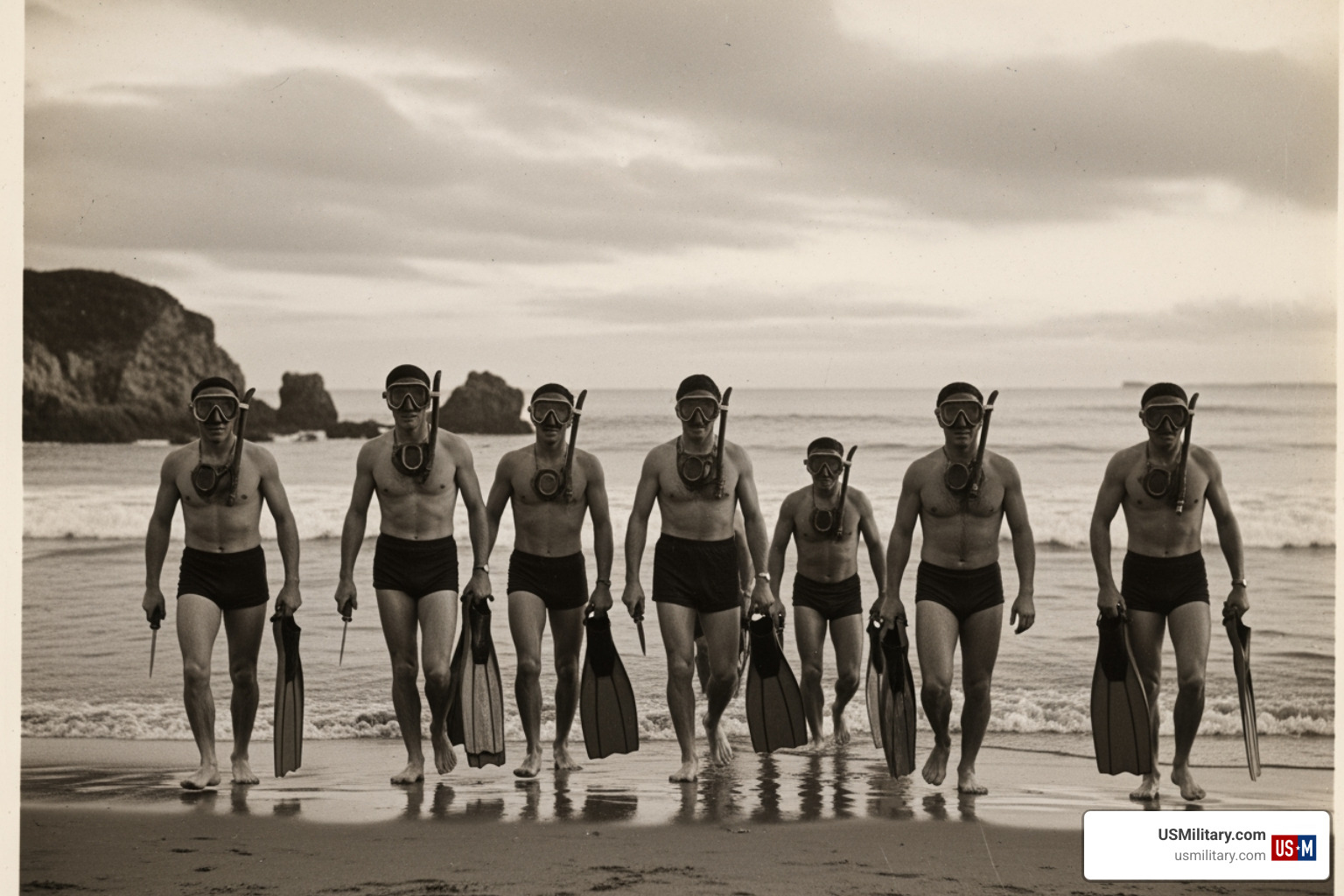
As the war progressed, especially in the Pacific Theater, the operational demands evolved, leading to the creation of the Underwater Demolition Teams (UDTs). These “Naked Warriors” were known for their daring daytime reconnaissance and demolition operations, often swimming in only their swim trunks to minimize drag and improve stealth. The Pacific UDTs originated on Oahu’s windward coast at Waimanalo Beach in December 1943, marking a significant birthplace for what would become the UDT-SEAL teams. These units proved indispensable, clearing beaches for landings across numerous Pacific islands.
The UDTs continued to serve with distinction in subsequent conflicts. During the Korean War, they played a crucial role, particularly at the Inchon landings, conducting vital reconnaissance and demolition missions that paved the way for ground forces.
The Vietnam War era brought further evolution. While a popular urban legend suggests President John F. Kennedy directly ordered the creation of the SEAL Teams specifically for Vietnam, the reality is a bit more nuanced. Kennedy’s administration did significantly bolster the U.S. special operations forces, recognizing the need for unconventional warfare capabilities. This strategic shift ultimately led to the formal establishment of the US Navy SEALs. The Vietnam War saw SEALs engaged in various counter-guerrilla and unconventional warfare operations, often operating in small teams deep within enemy territory. Their effectiveness was notable, as evidenced by the high number of awards received by SEALs during this period, including Medals of Honor, Navy Crosses, Silver Stars, and Bronze Stars. Tragically, by the end of the conflict, 48 SEALs had made the ultimate sacrifice in Vietnam. For a more comprehensive look at this rich heritage, you can explore A detailed history of Naval Special Warfare.
The Birth of the Modern US Navy SEALs
The formal birth of the modern US Navy SEALs occurred on January 1, 1962. This pivotal moment saw the establishment of two dedicated teams: SEAL Team One on the West Coast and SEAL Team Two on the East Coast. Their initial mission sets were primarily focused on counter-guerrilla warfare, unconventional warfare, and various special operations to counter emerging threats, particularly during the Cold War. These early SEALs were designed to operate across all domains—sea, air, and land—a concept that was for its time and remains central to their identity.
The development of their core mission sets during this period laid the foundation for the diverse roles they undertake today, from direct action to special reconnaissance, in environments ranging from the arctic to the jungle.
Post-Vietnam and Special Operations Command
Following the Vietnam War, the role and structure of US Navy SEALs continued to evolve. They participated in critical operations, such as Operation Urgent Fury in Grenada in 1983, and Operation Just Cause in Panama in 1989, where they conducted various special reconnaissance, direct action, and sabotage missions. During Operation Just Cause, for instance, SEALs successfully disabled a Panamanian boat and a Learjet, though we’re still scratching our heads trying to figure out what happened to that Learjet engine!
A significant milestone in the broader special operations community was the establishment of the U.S. Special Operations Command (USSOCOM) in 1987. This reorganization provided a unified command structure and increased funding for all special operations forces, including the SEALs. This strategic shift allowed for greater inter-service coordination, improved training, and the development of specialized equipment, further cementing the SEALs’ position as a premier special operations force. Their capabilities were further showcased during the Persian Gulf War, where they conducted vital missions in support of coalition forces.
The Crucible: Forging a Warrior Through SEAL Training
Becoming a US Navy SEAL is not for the faint of heart. It is a journey through what we affectionately call “the crucible,” a relentless test of physical and mental fortitude designed to forge ordinary individuals into extraordinary warriors. The training pipeline is famously demanding, characterized by extreme physical and mental stressors, a high attrition rate, and an unwavering emphasis on teamwork and perseverance. The unofficial mantra, “It pays to be a winner,” truly encapsulates the spirit required to overcome the monumental challenges.

Basic Underwater Demolition/SEAL (BUD/S)
The cornerstone of SEAL training is Basic Underwater Demolition/SEAL (BUD/S) training, conducted at the Naval Special Warfare Center in Coronado, California. This intensive program is divided into three distinct phases, each designed to push candidates beyond their perceived limits:
First Phase (Physical Conditioning): This initial phase is an absolute gut-check. It focuses on developing advanced physical conditioning, including long-distance swims, runs, and obstacle courses. This phase culminates in the infamous “Hell Week,” a 5.5-day period of continuous training with minimal sleep (often just a few hours total), constant physical exertion, and exposure to cold and wet conditions. It’s a true test of endurance, pain tolerance, and, most importantly, teamwork. Candidates learn that success is not individual but collective. The goal is to identify those who can perform under extreme duress and maintain their composure.
Second Phase (Combat Diving): This phase focuses on developing proficiency in combat diving. Candidates learn open-circuit (Scuba) and closed-circuit (rebreather) diving techniques, underwater navigation, and various combat swimmer tactics. The ability to operate stealthily beneath the surface is a hallmark of the US Navy SEALs.
Third Phase (Land Warfare): The final phase of BUD/S shifts focus to land warfare tactics. This includes small unit tactics, patrolling, demolitions, and weapons proficiency. Candidates learn how to operate effectively in diverse terrestrial environments, completing the “Sea, Air, and Land” spectrum.
Entry into BUD/S is highly competitive, requiring candidates to pass a rigorous Physical Screening Test (PST) with competitive scores, not just minimums. For example, while minimums might be a 500-yard swim in 12:30, 50 push-ups, 50 sit-ups, 10 pull-ups, and a 1.5-mile run in 10:30, competitive candidates often exceed these with times closer to a 10:00 swim, 80-100 push-ups and sit-ups, 15-20 pull-ups, and a 9:30-10:00 run. These scores are just the starting line; the real challenge begins when the training pushes candidates to their breaking point, forcing them to decide if they truly have what it takes.
SEAL Qualification Training (SQT) and Beyond
Upon successful completion of BUD/S, candidates move on to SEAL Qualification Training (SQT). This advanced 26-week program builds upon the foundational skills learned in BUD/S, refining them into the specialized competencies required of a fully qualified US Navy SEAL. SQT covers a vast array of advanced skills, including:
- Weapons Training: Mastery of various firearms, from pistols to heavy machine guns, and specialized sniper training.
- Small Unit Tactics: Advanced techniques for operating in small, autonomous teams, including close-quarters combat (CQC).
- Parachute Training: Both static-line and free-fall (HALO/HAHO) parachuting, allowing for covert insertion from the air.
- Demolitions: Expert use of explosives for breaching, sabotage, and obstacle clearance.
- Medical Training: Comprehensive combat medic skills, including the Special Operations Combat Medic (SOT-M) course, which trains SEALs to provide critical battlefield care.
- Survival, Evasion, Resistance, and Escape (SERE) School: Training to survive in hostile environments, evade capture, resist exploitation, and escape.
After successfully completing SQT, candidates are awarded the coveted Special Warfare insignia, commonly known as the “Trident,” officially signifying them as a US Navy SEAL. This is followed by assignment to a SEAL Team, where they undergo a probationary period and continue to hone their skills through ongoing specialized training. Most deployments typically last between 6 to 8 months, placing them in diverse and challenging environments around the globe. To dig deeper into the rigorous path these warriors undertake, you can Learn more about SEAL training requirements.
Core Missions and Structure of the US Navy SEALs
The US Navy SEALs are renowned for their proficiency in a wide spectrum of special operations missions, operating with unparalleled skill and stealth. Their primary roles and responsibilities are diverse and critical to national security, often requiring them to execute tasks that are too sensitive, complex, or dangerous for conventional forces.
Their core mission sets include:
- Direct Action (DA): Short-duration strikes and other small-scale offensive actions to seize, destroy, capture, recover, or inflict damage on designated targets. This might involve raids, ambushes, or direct assaults on enemy positions.
- Special Reconnaissance (SR): Acquiring information concerning the capabilities, intentions, and activities of an enemy or potential enemy. This often takes place deep behind enemy lines and involves clandestine operations to gather critical intelligence.
- Counter-terrorism: Actions taken directly against terrorism, such as neutralizing terrorist organizations, their leaders, and infrastructure.
- Foreign Internal Defense (FID): Training and advising friendly foreign military and paramilitary forces to enable them to protect their own populations from subversion, lawlessness, and insurgency.
- Unconventional Warfare (UW): Supporting a resistance movement or insurgency against a hostile power. This can involve training, equipping, and advising indigenous forces.
- Other tasks: Including sabotage, demolition, intelligence gathering, and hydrographic reconnaissance, which involves surveying coastal areas and waterways for military operations.
SEAL team personnel are hand-selected, highly trained, and highly proficient in these areas, operating in small, agile units capable of adapting to any challenge.
Significant Operations and Engagements
The history of the US Navy SEALs is punctuated by numerous significant operations and engagements that underscore their critical role in global security. From daring rescues to high-stakes counter-terrorism missions, their impact has been profound.
Here are some notable examples:
- Maersk Alabama hijacking (2009): In a dramatic rescue operation that captivated the world, SEALs from DEVGRU (Naval Special Warfare Development Group, often referred to as SEAL Team Six) successfully rescued Captain Richard Phillips from Somali pirates. Three SEAL snipers simultaneously engaged and neutralized the three pirates holding Phillips hostage, demonstrating incredible precision and coordination.
- Operation Neptune Spear (Osama bin Laden raid, 2011): This highly classified and successful mission saw a team of DEVGRU SEALs infiltrate a compound in Abbottabad, Pakistan, to eliminate Osama bin Laden, the leader of Al-Qaeda. This operation, a culmination of years of intelligence gathering, was a decisive blow against global terrorism.
- Operation Red Wings (2005): While ultimately a tragic loss, Operation Red Wings in Afghanistan highlighted the extreme dangers faced by SEALs. A four-man SEAL reconnaissance team was ambushed by Taliban forces, resulting in a fierce firefight and the loss of three SEALs. A subsequent quick reaction force helicopter, carrying additional SEALs and Army special operators, was shot down by an RPG, leading to the single largest loss of U.S. lives in the Global War on Terrorism, including 17 SEALs. The bravery and sacrifice displayed during this operation are deeply etched into SEAL lore.
- Iraq and Afghanistan Contributions: Throughout the Global War on Terror, US Navy SEALs played an indispensable role in both Iraq and Afghanistan. They conducted countless raids, captured high-value targets like the “Butcher of Fallujah,” and engaged in direct action operations against insurgent forces. Their persistent presence behind enemy lines and their ability to operate in diverse terrains were crucial.
- Morning Glory Oil Tanker Seizure (2014): In another maritime operation, SEALs boarded and secured the rogue oil tanker Morning Glory off the coast of Cyprus, which had illegally loaded oil from a rebel-held port in Libya. This mission showcased their ability to conduct complex boardings and resolve international crises without further escalation.
These operations, among many others, exemplify the courage, skill, and dedication of the US Navy SEALs.
The Naval Special Warfare (NSW) Team: SEALs and SWCC
While the US Navy SEALs often grab the headlines, they are part of a larger, incredibly capable Naval Special Warfare (NSW) team. A crucial component of this team are the Special Warfare Combatant-Craft Crewmen (SWCC, pronounced “swik”). Often affectionately referred to as “boat guys,” SWCC operators are masters of high-speed special operations craft, providing critical mobility and firepower for SEAL missions.
The relationship between SEALs and SWCC is profoundly synergistic. SWCC warriors are specially trained to operate and maintain a diverse inventory of riverine and ocean-going combatant craft. Their primary role includes the clandestine infiltration and exfiltration of SEALs and other Special Operations Forces, shipboard assaults, and intelligence collection in demanding maritime environments. They provide dedicated, rapid mobility in littoral and inland waterway areas where other maritime forces cannot operate, ensuring that SEALs can reach their objectives swiftly and safely.
Together, SEALs and SWCC form a complete fighting force, leveraging their distinct yet complementary skills to achieve mission success in the most challenging environments.
The SEAL Ethos: A Warrior’s Code
Beyond the physical prowess and tactical expertise, what truly defines a US Navy SEAL is their unwavering adherence to the SEAL Ethos. This isn’t just a set of rules; it’s a deeply ingrained warrior’s code that guides every aspect of their lives, both on and off the battlefield. It represents the core values and guiding principles that distinguish these elite operators.
The SEAL Ethos is a powerful declaration, often expressed in the first person, emphasizing personal responsibility and commitment:
- “My Trident is a symbol of honor and heritage. Bestowed upon me by the heroes that have gone before, it embodies the trust of those I have sworn to protect.”
- “I voluntarily accept the inherent hazards of my profession, placing the welfare and security of others before my own.”
- “Uncompromising integrity is my standard. My character and honor are steadfast. My word is my bond.”
- “I will not fail.” This is a profound commitment to mission success and an internal drive to overcome any obstacle.
- Leadership: SEALs are expected to lead by example in all situations, taking charge when necessary and inspiring those around them.
- Discipline and Innovation: They demand discipline in execution but also expect innovation to adapt to evolving threats and challenges.
- Perseverance: The ethos highlights the importance of persevering and thriving on adversity, always getting back up, no matter how many times they are knocked down.
- Loyalty: An unshakeable loyalty to their country, their team, and their mission.
- Continuous Training: A commitment to continuous training, ensuring technical skill, tactical proficiency, and meticulous attention to detail. “Train for war and fight to win.”
This ethos is not merely recited; it is lived. It instills a sense of identity, commitment, and high standards within the SEAL community, ensuring that each operator upholds the legacy of those who came before them.
The Future of Naval Special Warfare
The landscape of global threats is constantly shifting, and the US Navy SEALs are continually adapting to remain at the forefront of national defense. The focus is broadening from primarily counter-terrorism operations, which dominated the post-9/11 era, to addressing the complexities of great power competition. This involves preparing for potential conflicts with near-peer adversaries, requiring a renewed emphasis on maritime operations, strategic reconnaissance, and unconventional warfare in contested environments.
Technological advancements are also changing Naval Special Warfare. This includes integrating cutting-edge equipment for intelligence gathering, advanced communication systems, unmanned underwater vehicles (UUVs), and improved combat gear. Cybersecurity and information warfare are becoming increasingly vital components of their operational toolkit, reflecting the digital battlefields of the 21st century. The Navy is standing up new units to tackle these evolving challenges, ensuring that SEALs continue to possess the unique capabilities needed for future conflicts.
Current Challenges and Outlook
Despite their elite status, the US Navy SEALs face a unique set of challenges in the modern era. Recruitment and retention remain ongoing concerns, as the demanding nature of the profession takes a significant mental and physical toll on operators. The intense operational tempo, coupled with the inherent dangers of their missions, can lead to burnout and long-term health issues.
Maintaining ethical standards within such an elite and high-stakes community is also a continuous effort. Recent investigations into allegations of drug use and misconduct among some SEAL teams underscore the importance of upholding the core values of the SEAL Ethos and addressing cultural issues proactively.
The integration of women into special warfare is another area of ongoing adaptation. Since 2015, all military combat roles, including SEALs, have been opened to women, provided they meet the same rigorous physical and mental standards as their male counterparts. While the path to full integration is still unfolding, the commitment to equal opportunity based on merit is clear.
The evolving global landscape, marked by geopolitical shifts and the emergence of new technologies, requires constant re-evaluation and innovation within Naval Special Warfare. The future will demand adaptable, technologically savvy, and ethically sound operators who can steer an increasingly complex world.
Connecting with the Navy: Live Chat Information
For those interested in learning more about Navy careers, including the demanding path to becoming a US Navy SEAL, or if you have questions about current service, the MyNavy Career Center (MNCC) offers convenient resources. We understand that sometimes you just need to talk to a human!
You can connect with a Navy live chat representative for immediate assistance. Here’s what you need to know:
- MNCC Chat: You can access the chat service directly through MNCC Chat.
- Hours of Operation: The live chat is available Monday-Friday from 8:00 am to 10:00 pm CST, and Saturday-Sunday from 10:00 am to 10:00 pm CST. Please note that it is closed on federal holidays.
- Rules for Engaging: To ensure a respectful and productive environment, users must be at least 17 years of age to enter the chat and are required to enter a username. Profanity, abusive language, or any material deemed unacceptable will not be permitted. Violations may lead to chat termination and could result in being barred from future sessions.
- Troubleshooting the Chat Button: If you find that the chat button is not visible, don’t fret! We’ve identified that some users experience this issue. A common troubleshooting step is to simply try using a different internet browser. The technical team is actively working to resolve this known issue, so your patience is appreciated.
Connecting with these resources can provide valuable insights and guidance for anyone considering a future with the Navy or seeking information about its diverse opportunities.
Frequently Asked Questions about the US Navy SEALs
Here, we answer some of the most common questions we hear about the US Navy SEALs.
What does “SEAL” stand for?
SEAL is an acronym for Sea, Air, and Land, which reflects the diverse environments in which these special operators are trained to function. Their capabilities are not restricted to maritime operations; they are proficient in conducting missions across all three domains, making them one of the most versatile special operations forces in the world. This multi-environment proficiency is a key differentiator and a core reason for their effectiveness in complex global scenarios.
How many active Navy SEALs are there?
While the exact number is often classified for operational security, estimates suggest there are approximately 2,500 to 2,700 active-duty Navy SEALs. These operators are organized into 10 active-duty SEAL Teams, with each team comprising more than 200 men and women (including both SEALs and essential support personnel). Additionally, there are two SEAL Teams organized within the Naval Reserve Component, further augmenting their capabilities. This structure allows for global deployment and continuous operations.
Can women become Navy SEALs?
Yes, they absolutely can. As of 2015, all military combat roles, including those within the US Navy SEALs, were opened to women without exception. This means that female candidates must meet the exact same demanding physical, mental, and ethical standards as their male counterparts to be accepted into the rigorous training pipeline. While the journey is incredibly challenging, the opportunity is there for any qualified individual, regardless of gender, who can successfully complete BUD/S and SQT. We’ve even seen the first female Navy Special Operations Sailor graduate from training, marking a new chapter in Naval Special Warfare.
Conclusion
The US Navy SEALs stand as a testament to human endurance, strategic innovation, and unwavering commitment. Beyond the legendary status and dramatic portrayals, they are a force defined by a rich history stretching back to World War II, an unparalleled and grueling training regimen, and an unwavering ethos that guides every action. From the beaches of Normandy to the battlefields of Afghanistan, and from the high seas to clandestine operations deep within hostile territory, SEALs have consistently answered the nation’s call.
As a critical component of U.S. national security, they continue to adapt to an evolving global landscape, facing new threats with cutting-edge technology and a steadfast dedication to their mission. Their journey is one of continuous challenge, sacrifice, and the relentless pursuit of excellence. For more resources and to compare the diverse elite units within the U.S. military, explore USMilitary.com’s comprehensive guides, such as Compare the Army’s Delta Force vs. the Navy SEALs.
Free for Service Members & Veterans
Get the military benefits intel no one tells you about.
Weekly updates on VA benefits, pay changes, and money tips — free for service members and veterans.
No spam. Unsubscribe anytime. Your info is never shared.


