The Hardest Military Training in the World — What You Need to Know
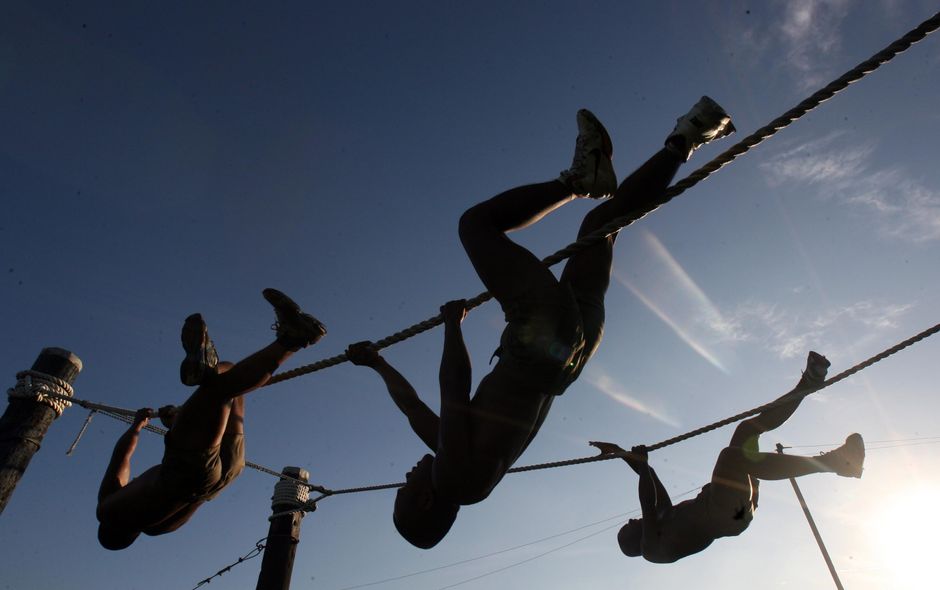
What is Navy SEAL BUD/S Training? Here’s the short answer:
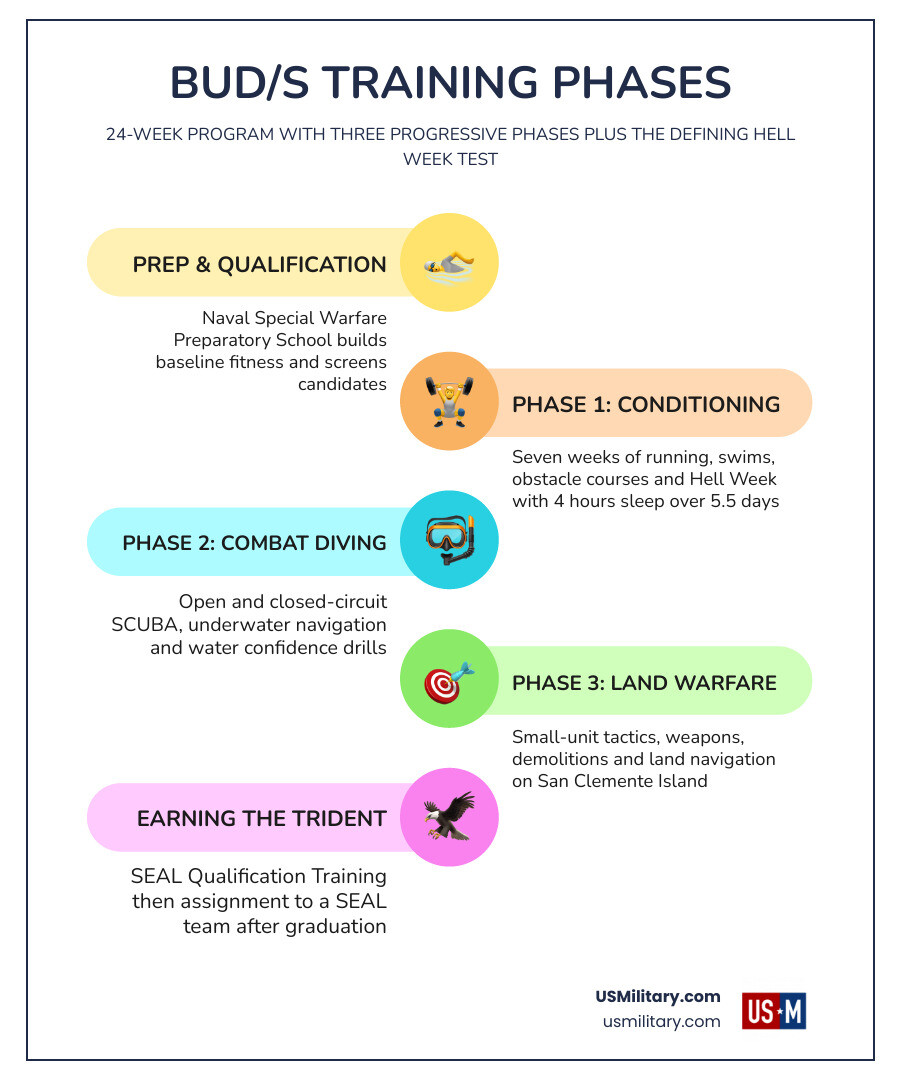
BUD/S (Basic Underwater Demolition/SEAL) Training is a 24-week selection and training program held at the Naval Special Warfare Center in Coronado, California. It is the primary gateway to becoming a Navy SEAL, divided into three phases: Basic Conditioning, Combat Diving, and Land Warfare.
| Key Detail | Quick Answer |
|---|---|
| Full name | Basic Underwater Demolition/SEAL Training |
| Location | Naval Special Warfare Center, Coronado, CA |
| Duration | 24 weeks (6 months) |
| Phases | Basic Conditioning → Combat Diving → Land Warfare |
| Lowest point | Hell Week — 5.5 days, ~4 hours total sleep |
| Overall success rate | ~9.5% from enlistment to graduation |
BUD/S is widely considered one of the most demanding military training programs on earth. Classes often begin with over 200 candidates. Most graduate with 20 or 30 — and sometimes fewer than 10.
The training isn’t just about physical toughness. It’s designed to find candidates who refuse to quit when everything in their body is telling them to stop.
I’m Larry Fowler, publisher of USMilitary.com, and through nearly two decades of connecting Americans with military career resources, I’ve helped thousands of servicemembers understand what Navy SEAL BUD/S training involves and what it truly takes to pursue that path. In this guide, I’ll walk you through every stage — from eligibility requirements to the moment candidates earn the Trident.
Explore more about What is Navy SEAL BUD/S Training:
- A Day In The Life Of A Navy SEAL Operator
- Who Has The Hardest Training: Navy SEALs vs Army Rangers
- Pros and Cons Of Army Delta Force vs Navy SEALs
What is Navy SEAL BUD/S Training?
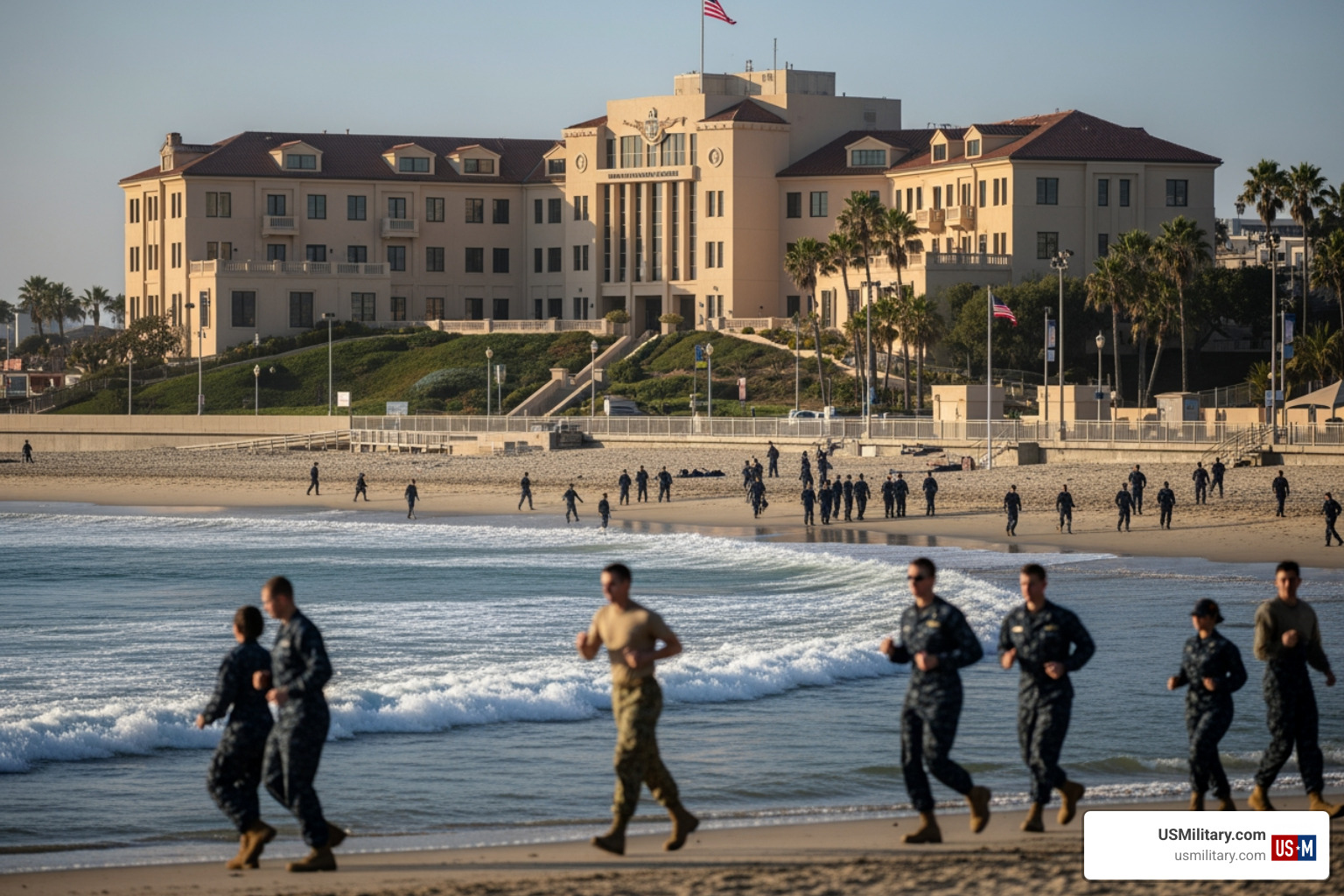
At its core, Basic Underwater Demolition/SEAL (BUD/S) training is the foundational selection course for the United States Navy’s elite special operations force. When people ask, “What is Navy SEAL BUD/S Training?” they are often looking for the secret formula that transforms ordinary sailors into elite maritime operators. In reality, there is no secret formula — only a relentless, 24-week crucible located at the Naval Special Warfare Center in Coronado, California.
The journey does not actually start on the sandy beaches of Coronado. Before candidates ever set foot on the “Grinder” (the famous asphalt courtyard where physical training is conducted), they must first survive the Naval Special Warfare Preparatory School, commonly known as BUD/S Prep, located in Great Lakes, Illinois. This initial two-month conditioning program is designed to build up the candidates’ aerobic capacity and physical durability, ending with a rigorous Physical Screening Test (PST).
Once they pass BUD/S Prep and a three-week Basic Orientation phase in Coronado, candidates officially enter the 24-week BUD/S program. To learn more about this initial pipeline, you can visit the official BUD/S | Navy SEALs portal. We often emphasize that BUD/S is not a program designed to get you in shape; you must arrive in the best shape of your life just to survive the first day.
Qualifying for the Grinder: Requirements and the PST

Before you can even dream of shivering in the Pacific Ocean, you have to prove you have the baseline physical and mental qualifications to get a contract. The Navy does not hand out special operations opportunities to just anyone. The screening process is exceptionally selective, screening out thousands of applicants before they ever ship to boot camp.
To qualify for a shot at BUD/S, candidates must meet the following basic standards:
- Citizenship: Must be a U.S. citizen.
- Age Limits: Must be between 18 and 29 years old (though 17-year-olds can enlist with parental consent, and waivers are occasionally granted for 29- and 30-year-olds on a case-by-case basis).
- ASVAB Scores: Must achieve a composite score of at least 220.
- Security Clearance: Must qualify for a Secret security clearance.
- Vision and Medical: Must meet rigorous physical and vision standards free of major color blindness or limiting medical conditions.
For a detailed breakdown of what it takes to qualify, check out our comprehensive Navy SEALs BUD/S Training Requirements Guide and read our in-depth article on Navy SEAL Physical Requirements.
Physical Standards for What is Navy SEAL BUD/S Training
To even secure a Navy Special Warfare contract, candidates must pass the Physical Screening Test (PST). However, there is a massive difference between the minimum standards required to pass the test and the competitive standards required to actually get selected for a contract.
Historically, candidates with composite PST scores below 800 are three times more likely to fail or quit during training. If you only hit the minimums, you probably won’t get a contract, and you definitely won’t survive the first week of BUD/S.
| PST Event | Minimum Navy Standard | Competitive Target Standard |
|---|---|---|
| 500-Yard Swim (Side or breaststroke) | Under 12:30 | Under 9:00 (or under 17:00 for 1,000m with fins) |
| Push-ups (In 2 minutes) | 50 | 80 – 100+ |
| Sit-ups (In 2 minutes) | 50 | 80 – 100+ |
| Pull-ups (No time limit, dead hang) | 10 | 15 – 20+ |
| 1.5-Mile Run (In boots and pants) | Under 10:30 | Under 9:30 (or under 28:00 for 4 miles) |
Water competency is also heavily evaluated. Candidates must show absolute comfort in the water, as panic is the quickest way to get sent home.
Mental and Eligibility Standards
While physical strength gets you through the door, mental grit is what keeps you in the game. Instructors are not there to be your friends; they are there to find your breaking point. They use psychological tactics, environmental discomfort, and sleep deprivation to plant seeds of doubt.
We often get asked about the demographic and eligibility changes in Special Warfare. Since December 2015, women have been fully eligible to attend BUD/S and attempt to become Navy SEALs. The physical, mental, and tactical standards remain exactly the same for all candidates, regardless of gender. The first female candidate entered the pipeline in 2017, and the Navy continues to evaluate all applicants under the same uncompromising standards. For a complete historical overview of the selection criteria, you can read the United States Navy SEAL selection and training Wikipedia page.
The Three Phases of BUD/S Training
Once orientation is complete, the 24-week BUD/S curriculum officially begins. It is structured into three distinct, progressive phases, each lasting seven weeks. Each phase is designed to test and build a specific set of skills necessary for maritime special operations. To get a broad overview of how these phases fit into the overall pipeline, you can read about Navy SEALs BUD/S Training.
First Phase: Basic Conditioning and Hell Week
First Phase is where the vast majority of candidates “ring the bell” — the physical action of quitting training. Lasting seven weeks, this phase focuses on physical conditioning, water competency, and mental tenacity.
Daily life in First Phase consists of endless running on soft sand, swimming in the cold Pacific Ocean, navigating the grueling Coronado obstacle course, and performing continuous calisthenics. Candidates also learn hydrographic survey operations and basic boat seamanship.
The fourth week of First Phase is the legendary “Hell Week,” which we will cover in detail below. This phase is designed to strip away individual egos and force candidates to rely on teamwork to survive. For more details on this initial test of endurance, see our guide on First Phase Navy SEAL Training BUD/S.
Second Phase: Combat Diving
Second Phase shifts the focus from the beach to the depths of the ocean. This seven-week block is what truly separates Navy SEALs from every other special operations force in the world.
During Combat Diving, candidates learn:
- Open-Circuit SCUBA: Basic underwater operations using standard dive gear.
- Closed-Circuit SCUBA (Rebreathers): Stealth diving techniques that do not produce bubbles, allowing covert infiltration.
- Dive Physics and Medicine: Understanding the physiological effects of pressure, nitrogen narcosis, and decompression sickness.
- Underwater Navigation: Swimming miles underwater in pitch-black conditions using only a compass and depth gauge.
The ultimate test of this phase is “Pool Competency” (Pool Comp). Instructors physically attack candidates underwater — cutting off their air supply, tangling their hoses, and ripping off their masks — to test whether the candidate will panic or systematically solve the problem under extreme stress.
Third Phase: Land Warfare
The final seven weeks of BUD/S take place largely on San Clemente Island, located off the coast of California. This phase transitions the candidates from maritime environments to land-based combat.
Third Phase covers:
- Weapons Handling: Mastery of pistols, rifles, machine guns, and heavy weapons.
- Demolitions: Calculating and placing explosive charges to breach obstacles or destroy targets.
- Small Unit Tactics: Learning how to patrol, ambush, and conduct raids as a cohesive squad.
- Land Navigation: Navigating rugged, mountainous terrain using maps, compasses, and GPS.
While the physical conditioning remains intense, Third Phase requires a high level of academic focus and tactical intelligence.
Surviving Hell Week: The Ultimate Test of Grit
There is no single event in military training more famous — or feared — than Navy SEAL Hell Week. Held during the fourth week of First Phase, Hell Week is a 5.5-day period of continuous physical and mental exertion.
The statistics surrounding Hell Week are staggering:
- Sleep: Candidates receive roughly four hours of total sleep over the entire 5.5 days.
- Distance: Candidates run more than 200 miles, often while carrying heavy inflatable rubber boats (CRRCs) on their heads or hauling logs.
- Exertion: Training runs for more than 20 hours per day, constantly wet, sandy, and cold.
- Attrition: Hell Week alone eliminates more than 75% of the candidates who enter Phase 1.
Hell Week is designed to push candidates far past their perceived physical limits to reveal their true character. It tests determination, teamwork, and the ability to make sound decisions under extreme sleep deprivation and physical pain. Those who survive emerge with a profound sense of brotherhood and the realization that the human body can endure far more than they ever thought possible. You can read a deeper analysis of this brutal event in our article on What is Navy SEAL Hell Week.
Beyond Coronado: The Post-BUD/S Pipeline
Graduating from BUD/S is a massive achievement, but it does not make you a Navy SEAL. Graduation simply means you have completed the selection phase. You do not get to wear the coveted Navy SEAL Trident yet.
Following BUD/S, successful candidates enter the next stages of the training pipeline:
- Basic Parachute Training: A three-week course at Airborne School in Fort Benning, Georgia, where candidates learn static-line and freefall parachuting.
- SEAL Qualification Training (SQT): A grueling 26-week program that takes the basic skills learned in BUD/S and elevates them to combat-ready levels. SQT covers advanced cold weather survival, combat diving, close quarters combat (CQB), tactical medicine, and maritime operations.
- Special Operations Tactical Medic Course: For those chosen to be medics, an additional six-month medical course is required.
To learn more about the complete journey, you can read our overview of the entire Navy SEAL Training pipeline.
Earning the Trident After What is Navy SEAL BUD/S Training
Only after successfully completing SQT does a candidate earn the Navy SEAL Trident (the “Budweiser” pin) and the official Navy rating of Special Warfare Operator (SO).
From the day a candidate signs their enlistment contract to the day they receive their Trident, the overall success rate is only about 9.5%. Once they earn the Trident, they are assigned to a SEAL Team, where they will spend another 12 to 18 months in pre-deployment training before finally deploying to conduct real-world tactical operations.
Frequently Asked Questions About BUD/S
What is the attrition rate for BUD/S training?
The overall attrition rate for BUD/S sits between 68% and 75%. However, when looking at the entire pipeline from signed enlistment to SQT graduation, only about 9.5% of candidates succeed. The greatest number of dropouts occurs during First Phase, particularly during Hell Week, where candidates can choose to quit at any time by ringing a brass bell three times.
Are women allowed to attend BUD/S?
Yes. Since the Department of Defense opened all combat roles to women in December 2015, female service members have been fully eligible to volunteer for BUD/S. The screening, physical, and tactical standards are identical for all candidates.
Where is BUD/S training located?
BUD/S training is conducted at the Naval Special Warfare Center located on Naval Amphibious Base Coronado in Coronado, California. The location is famous for its soft sand beaches and the cold waters of the Pacific Ocean, which play a major role in the physical conditioning and thermal challenges of the course.
Conclusion
What is Navy SEAL BUD/S Training? It is the ultimate test of human willpower. It is a selection process designed to break you physically and mentally, leaving only those with the absolute determination to succeed.
At USMilitary.com, we are dedicated to providing the most accurate, up-to-date resources for those looking to serve their country. Whether you are seeking information on VA home benefits, career comparisons, or tactical training pipelines, we are here to support you. If you are ready to take the first step toward joining the military’s elite, explore our USMilitary.com Navy SEALs Complete Guide today.
Free for Service Members & Veterans
Get the military benefits intel no one tells you about.
Weekly updates on VA benefits, pay changes, and money tips — free for service members and veterans.
No spam. Unsubscribe anytime. Your info is never shared.


