
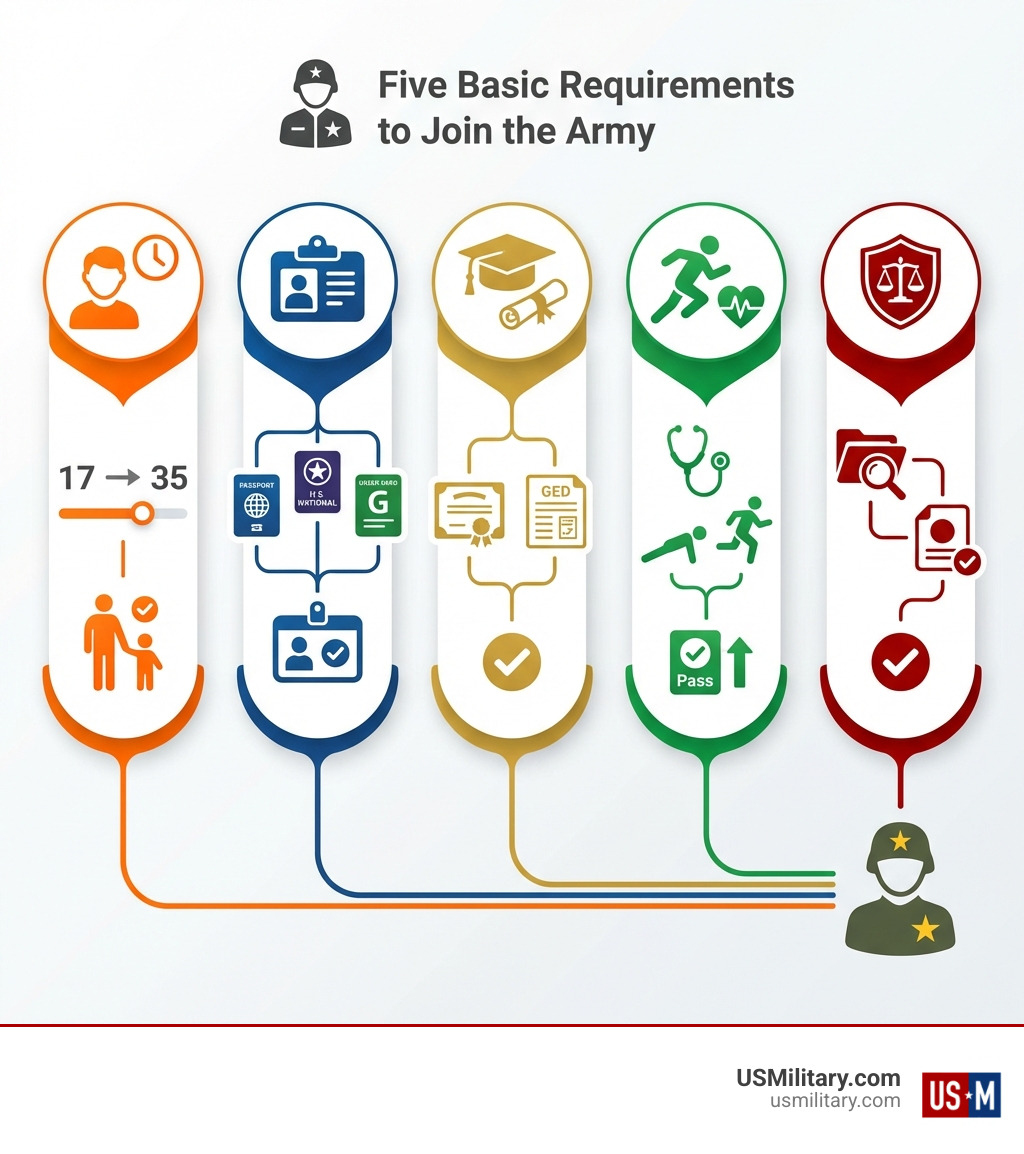
Can I Join The Army? Yes, if you meet five core eligibility requirements: you must be between 17 and 35 years old, be a U.S. citizen or legal permanent resident, have a high school diploma or GED, pass physical and medical screenings, and meet moral character standards. Each requirement has specific criteria, and waivers may be available in certain situations.
Basic Army Enlistment Requirements:
- Age: 17-35 years old (parental consent required if under 18)
- Citizenship: U.S. citizen, U.S. National, or Green Card holder
- Education: High school diploma or GED
- Physical Fitness: Pass medical exam and physical fitness tests
- ASVAB Score: Minimum qualifying score of 31
- Background: Pass criminal background check (waivers possible)
Joining the Army is a significant decision that requires meeting specific standards. These requirements exist to ensure every soldier can perform their duties safely and effectively. While the criteria may seem strict, many people who don’t initially qualify can work with recruiters to address issues or apply for waivers.
The enlistment process can feel overwhelming when you’re trying to figure out if you qualify. Between age limits, citizenship rules, test scores, and medical standards, there’s a lot to consider before you can take the oath and begin your military career.
I’m Larry Fowler, and as the publisher of the USMilitary.com Network since 2007, I’ve helped hundreds of thousands of potential recruits understand Can I Join The Army eligibility requirements and steer the enlistment process. This guide breaks down every requirement in simple terms so you can quickly determine if you qualify and what steps to take next.
Can I Join The Army? word guide:
Core Eligibility Requirements to Join the Army
Starting on a journey with the U.S. Army means committing to a life of service, discipline, and profound personal growth. But before you can wear the uniform, there are fundamental qualifications you must meet. These aren’t just bureaucratic problems; they are the bedrock upon which the strength and integrity of our military are built. Think of them as your first mission: proving you have the basic attributes to begin a career that demands the best.
Our first steps together will involve understanding these non-negotiable standards, which are part of an initial screening process designed to ensure every recruit is ready for the challenges ahead. For a broader look at what it takes to serve, you can explore our resources on Military Qualifications Needed to Join.
What are the age limits for enlisting in the Army?
Age is more than just a number when it comes to military service; it’s a critical factor in determining eligibility. For those asking, “Can I Join The Army?” one of the first questions we address is your age. The Army’s age limit for enlistment is generally between 17 and 35 years old.
If you’re eager to serve but haven’t quite reached adulthood, don’t worry! For individuals under 18, you must obtain the consent of your parent or legal guardian to enlist in the Army. This ensures that young recruits have the necessary family support for such a significant life decision.
It’s worth noting that while these are the standard age limits, there can be exceptions. For instance, individuals with prior U.S. military service or those possessing specialized professional skills (like doctors or lawyers) might be eligible to enlist outside of this typical age bracket. These exceptions are often evaluated on a case-by-case basis, acknowledging the valuable experience and expertise older candidates can bring. For a detailed breakdown of age requirements across all branches, refer to Requirements to join the U.S. military.
What are the citizenship and residency requirements for joining the Army?
Serving in the U.S. Army is a privilege tied closely to citizenship and residency. To answer “Can I Join The Army?” regarding your legal status, we look for candidates who are:
- A U.S. citizen
- A U.S. National (this applies to individuals born in certain U.S. territories or born abroad to U.S. citizen parents)
- A legal permanent resident alien (commonly known as a Green Card holder)
For legal permanent residents, there are some limitations. While a Green Card allows you to enlist, you must be legally residing in the United States and meet all other mental, moral, and physical standards. Critically, you must also be able to speak, read, and write English fluently. The U.S. military cannot assist foreign nationals in obtaining admittance into the United States; immigration procedures must be completed before you can apply to enlist. Questions about immigration should be directed to the U.S. Embassy or the Bureau of Citizenship and Immigration Services. For more specific information on enlistment for non-citizens, you can consult More on enlistment for non-citizens.
What are the educational requirements for enlisting in the Army?
Education is a cornerstone of military readiness, equipping soldiers with the foundational knowledge needed for training and specialized roles. When considering “Can I Join The Army?” your educational background is definitely a factor. We generally require recruits to have either a high school diploma or a General Equivalency Diploma (GED).
While both are acceptable, having a high school diploma is often considered more desirable and can open up a wider range of opportunities within the Army. For candidates with a GED, there are fewer available spots, and your chances of enlistment are significantly improved if you also have some college credits or achieve a higher score on the ASVAB (Armed Services Vocational Aptitude Battery) test. So, if you’re a GED holder, consider bolstering your academic profile to maximize your options!
Can I Join The Army? Physical, Medical, and Mental Standards
Beyond the paperwork, serving in the Army demands a high level of physical, medical, and mental fitness. This isn’t just about looking good in uniform; it’s about being ready to meet the rigorous demands of training and deployment, ensuring your safety and the success of your unit. The Military Entrance Processing Station (MEPS) is where these standards are thoroughly assessed, from your vision to your aptitude. Meeting these standards is a critical step in proving your readiness.

What is the ASVAB test and why is it important for Army enlistment?
The ASVAB, or Armed Forces Vocational Aptitude Battery, is a crucial step for anyone asking, “Can I Join The Army?” This isn’t just another standardized test; it’s a comprehensive multiple-aptitude battery that measures your developed abilities and helps predict future academic and occupational success in the military. It’s mandatory for all military enlistees, and your scores are vital for several reasons:
First, it determines your overall eligibility for enlistment. For the Army, a minimum qualifying score on the ASVAB is typically 31 or better, though rare exceptions can sometimes be made.
Second, and perhaps most importantly, your ASVAB scores play a significant role in determining which specific jobs, or Military Occupational Specialties (MOS), you qualify for. The test is broken down into various subtests, and your performance in different aptitude areas will align you with different career paths within the Army. This ensures that you’re placed in a role where your skills and aptitudes can best be used, benefiting both you and the Army.
To give yourself the best chance, we highly recommend preparing for the ASVAB. There are many resources available, and you can find helpful study materials and practice tests online. Check out Use ASVAB online resources to get started!
What are the physical and medical requirements for joining the Army?
When you consider, “Can I Join The Army?” your physical and medical health are paramount. The Army needs soldiers who are resilient and capable of enduring demanding conditions. This means you’ll undergo a thorough medical examination at MEPS to assess your overall health.
Generally, you must be in good health with no disqualifying medical conditions. This includes a comprehensive evaluation of your physical systems, past medical history, and current health status. We also require recruits to pass a drug screening test as part of the physical and medical requirements, as the Army maintains a zero-tolerance policy for illegal drug use.
Common areas of review include vision (which may have correctable limits), hearing, and the absence of chronic illnesses or conditions that could be aggravated by military service. While certain conditions might initially seem like disqualifiers, many can be managed or waived, depending on their severity and impact on your ability to perform military duties. For a broader understanding of military health standards, our page on Joining the Military offers more insights.
Are there any specific height and weight requirements for the Army?
Yes, the Army has specific height and weight requirements to ensure recruits are within a healthy range to handle the physical demands of military life. These requirements are not arbitrary; they are designed to promote physical readiness and reduce injury risk. When you ask, “Can I Join The Army?” we’ll look at your measurements.
The Army’s weight requirements are broken down by height and age group for both men and women. These are typically presented in charts that specify minimum and maximum allowable weights. For instance, a 5’8″ male in the 17-20 age group will have a different maximum weight than a 5’8″ male in the 30-35 age group.
If a recruit exceeds the maximum weight for their height and age, they may still be eligible if they pass a body fat percentage test. This test measures the percentage of fat in your body, acknowledging that muscle weighs more than fat. The goal is to ensure you possess a healthy body composition. These measurements are officially taken at the Military Entrance Processing Station (MEPS) in stocking feet, with your height rounded to the nearest inch and weight to the nearest pound.
Background Checks, Criminal Records, and Waivers
Integrity and trustworthiness are non-negotiable qualities for every soldier. The Army trusts its members with significant responsibility, from handling sensitive information to operating complex equipment, and sometimes even the lives of others. Therefore, a thorough background check is a standard part of the enlistment process to ensure all recruits meet the high moral character standards expected.
What are the background and criminal record requirements for joining the Army?
To uphold the high standards of the military, all Military Entrance Processing Station (MEPS) applicants undergo a comprehensive background check. This screening is essential for safety and security purposes, making sure that every individual joining the ranks is reliable and trustworthy.
Generally, individuals with a criminal record or several convictions on their record are not eligible to join the military. This includes serious law violations, but even a history of excessive traffic tickets can be scrutinized by the Air Force, for example, as it might indicate a pattern of disregard for rules. Your financial history can also be part of this evaluation, as financial instability might be a flag for security concerns. The key is transparency and open communication with your recruiter about any past issues.
✉ Get updates like this in your inbox
Weekly VA benefit changes, pay updates, and money tips for service members, veterans, and military families. Free, no spam.
Can individuals with a criminal record or felony convictions join the Army?
This is a very common and important question for many potential recruits. While a criminal record, especially a felony conviction, may disqualify you from military service, it’s not always an automatic “no.” We understand that people make mistakes, and the Army evaluates each situation on a case-by-case basis.
Generally, felons are considered ineligible, and the Navy explicitly states that individuals convicted of felonies involving violence, domestic violence, illegal drugs, or sexual misconduct will be disqualified. However, for other offenses, waivers may be available depending on the nature and severity of the crime, how long ago it occurred, and your conduct since. Misdemeanors and juvenile records are also reviewed, and their impact can vary.
The most crucial step if you have any criminal record is to talk to a recruiter. They are the only ones who can evaluate your specific situation, discuss the possibility of a waiver, and guide you through the process. Being honest and upfront with your recruiter from the very beginning is paramount. For more detailed information, you can read our article, Can Felons Join the Military?.
Are there waivers available for individuals who do not meet certain eligibility requirements?
Yes, waivers are indeed available for individuals who do not meet certain eligibility requirements, offering a pathway to service for those who might otherwise be disqualified. The Army, like other branches, understands that life can present challenges, and a single past issue shouldn’t necessarily bar someone from serving our country.
Waivers can apply to various areas, including:
- Age Waivers: For those slightly outside the standard age range, especially if they have prior military experience or specialized skills.
- Medical Waivers: If a medical condition is generally a red flag but is well-managed, non-progressive, or poses minimal risk to military duty (e.g., controlled asthma, corrected vision issues).
- Moral Waivers (Criminal Record Waivers): For certain criminal offenses, particularly non-violent misdemeanors or single felony convictions, where the applicant has demonstrated rehabilitation and good conduct since the incident.
- ASVAB Score Waivers: In some instances, with a strong overall profile, a waiver for a slightly below-minimum ASVAB score might be considered, though this is less common for the Army’s minimum score of 31.
The waiver process involves a thorough review of your individual circumstances, often requiring additional documentation, letters of recommendation, or medical evaluations. It’s a discretionary process, meaning approval is not guaranteed. Your recruiter will be your best ally in navigating this process, helping you understand what waivers might be applicable to your situation and how to best present your case. Honesty and persistence are key!
Choosing Your Path: Active Duty, Reserve, or National Guard
Deciding to serve is a monumental step, and the Army offers several distinct paths for you to contribute. When you ask, “Can I Join The Army?” it’s not just about meeting the requirements; it’s also about choosing the right fit for your life and career aspirations. We’ll explore the differences between Active Duty, the Army Reserve, and the Army National Guard, each offering unique commitments, training schedules, and benefits. For a deeper dive into the decision-making process, consider reading Should I Join the Military?.
Active Duty Army
Joining the Active Duty Army means becoming a full-time soldier. This is the path for those ready for a complete immersion in military life, serving around the clock. Active duty soldiers live on base or in military housing, dedicating their careers entirely to the Army.
This path offers comprehensive benefits, including steady pay, housing, and full medical coverage, along with opportunities for global deployment and rapid career advancement. It’s a demanding but incredibly rewarding experience for those seeking a singular focus on military service. You can learn more about this commitment at Learn about the Active Duty Army.
Army Reserve
The Army Reserve offers a unique blend of military service and civilian life. If you’re looking to serve your country while also pursuing a civilian career or higher education, the Reserve might be your ideal fit. As a part-time soldier, you typically train one weekend a month and for two weeks out of the year.
This structure allows you to maintain your civilian job and life while still enjoying many of the benefits of military service, such as healthcare, educational assistance, and retirement plans. Army Reserve units play a critical role in supporting active-duty missions, providing a highly skilled and flexible force when and where they are needed most. Explore the opportunities available in the Army Reserve.
Army National Guard
The Army National Guard stands out with its dual mission: serving both state and federal authorities. This unique structure makes the Guard an elite group of warriors who dedicate a portion of their time to serving their nation. Each state has its own Guard, and in fact, it is the only branch of the military whose existence is actually required by the Constitution.
National Guard members typically train one weekend a month and for two weeks annually, similar to the Reserve. However, their deployments can be for both federal missions overseas (like active duty) and state-level emergencies, such as disaster relief (hurricanes, floods) or civil support operations. This means you could be helping your local community one day and deploying overseas the next. The Guard offers a profound way to serve your local community and the nation simultaneously. Find more about this distinct path at Discover the National Guard.
Comparing Active Duty, Reserve, and National Guard
To help you decide which path is right for you, here’s a quick comparison of the three primary ways to serve in the Army:
| Feature | Active Duty Army | Army Reserve | Army National Guard |
|---|---|---|---|
| Commitment | Full-time employment, primary career | Part-time, supplementary to civilian career | Part-time, supplementary to civilian career |
| Training Schedule | Daily training, year-round | One weekend a month, two weeks a year | One weekend a month, two weeks a year |
| Pay & Benefits | Full salary, comprehensive healthcare, housing, education, retirement | Part-time pay, healthcare options, education, retirement | Part-time pay, healthcare options, education, retirement |
| Deployment Frequency | Frequent, global, extended durations | Less frequent, can be global or domestic, varied durations | Less frequent, can be global (federal) or domestic (state), varied durations |
| Primary Mission | Global expeditionary land forces | Strategic reserve, support active duty, domestic support | State emergencies, federal combat support, disaster relief |
The Enlistment Process and Beyond
So, you’ve reviewed the eligibility requirements and have a better idea of where you stand. The next logical question is, “What’s next?” The journey to becoming a soldier involves a series of steps, from finding the right person to talk to, to exploring different career paths, and understanding the incredible benefits that come with service. This is where we transition from eligibility questions to actionable steps towards your future.
How can I find a recruiter to discuss my eligibility for the Army?
Finding a recruiter is your essential next step in the enlistment process. They are your primary point of contact, your guide, and your advocate. Recruiters can provide personalized advice on your specific eligibility, discuss waiver possibilities, and help you steer the entire application process.
You can typically find a local Army recruiting office by searching online for “Army recruiter near me.” Alternatively, you can reach out directly via phone:
- For the Army and Army Reserve: Call 1-888-550-ARMY (1-888-550-2769)
- For the Army National Guard: Call 1-800-GO-GUARD (1-800-464-8273)
When you connect with a recruiter, be prepared for an initial interview. This is your chance to ask all your questions and be completely honest about your background, including any medical history or legal issues. You’ll likely need to provide some basic documents, such as your high school diploma or GED, and identification. Asking good questions is key to making an informed decision, so don’t hesitate to ask everything on your mind. Our article, Which Questions Should You Ask a Military Recruiter?, can help you prepare.
What are the opportunities for joining the Army as an officer?
If you aspire to leadership roles and meet higher educational standards, joining the Army as an officer might be the path for you. Officers are the leaders, managers, and decision-makers of the Army. To become an officer, you generally need to have a bachelor’s degree.
There are several routes to commissioning as an officer:
- ROTC (Reserve Officers’ Training Corps): This program allows you to complete your college degree while simultaneously training to become an officer, often with scholarship opportunities.
- Officer Candidate School (OCS): For those who already have a college degree, OCS is an intensive 12-week program designed to train and commission future Army officers.
- U.S. Military Academy at West Point: A prestigious four-year federal service academy that offers a fully funded education and commissions graduates as second lieutenants.
- Direct Commission: For professionals with specific specialized skills (e.g., doctors, lawyers, chaplains), the Army offers direct commissions, allowing them to enter as officers directly into their field.
Becoming an officer opens doors to advanced training, significant responsibility, and a distinguished career. For a comprehensive look at how to pursue this path, visit More on becoming an officer.
What are the benefits of joining the Army?
Beyond the call to serve, the Army offers a robust package of benefits that can significantly improve your life and future. For those asking, “Can I Join The Army?” and considering the long-term advantages, these benefits are a powerful incentive:
- Steady Pay and Allowances: You’ll receive competitive pay, often tax-free in combat zones, along with various allowances for housing (Basic Allowance for Housing – BAH), food (Basic Allowance for Subsistence – BAS), and uniforms.
- Comprehensive Healthcare (TRICARE): The Army provides excellent medical and dental care for soldiers and their families through the TRICARE system, often at little to no cost. You can find more information on Army medical benefits at GoArmy.com and general TRICARE information at TRICARE.
- Education Benefits (GI Bill): One of the most attractive benefits is the GI Bill, which provides generous funding for college or vocational training after your service. This can cover tuition, housing, and books. Learn more at GI Bill and GoArmy.com education benefits.
- Paid Vacation: Soldiers typically accrue 30 days of paid leave per year, which can be used for vacation or to visit family.
- Housing: Active duty soldiers often have the option of living in on-base housing or receiving BAH to cover off-base rent.
- Career Development and Training: The Army offers over 200 different jobs, providing world-class training and certifications that are highly valued in the civilian sector.
- Retirement: After 20 years of service, you are eligible for a military pension, providing financial security for life.
These are just some of the reasons why military service can be a smart choice for your future. For more details on all the advantages, our Benefits of Joining the U.S. Army page is a great resource.
Frequently Asked Questions about Army Enlistment
We know that deciding to join the Army comes with a myriad of questions. Here, we address some of the most common inquiries to help you understand the enlistment process more clearly.
What are some common disqualifying medical conditions for joining the Army?
While the Army aims to be inclusive, certain medical conditions can prevent enlistment because they might interfere with a soldier’s ability to perform duties safely or could be exacerbated by military life. Some common disqualifying medical conditions include:
- Asthma: If diagnosed after age 13 or if you require medication/treatment within a certain timeframe.
- Certain Mental Health Diagnoses: Conditions like moderate to severe depression, anxiety disorders, or ADHD requiring medication or treatment within the last year, particularly if they impact daily functioning.
- Chronic Skin Conditions: Severe or chronic eczema, psoriasis, or acne that could be worsened by military equipment or environments.
- Hearing or Vision Loss: Beyond correctable limits, or uncorrectable conditions that impair function.
- History of Joint Instability: Repeated dislocations, significant surgical repairs, or chronic pain in major joints.
- Serious Allergic Reactions: To common medications, foods, or environmental factors that could be life-threatening in remote settings.
- Diabetes: All types generally disqualify.
These are general guidelines, and the severity, stability, and treatment history of any condition are always considered. A medical waiver might be possible for many of these, especially if the condition is well-controlled and doesn’t pose a risk to military service. Always be transparent with your recruiter and during your MEPS medical exam.
Can I choose my job in the Army?
Yes, to a significant extent, you can choose your job in the Army, also known as your Military Occupational Specialty (MOS). This is one of the most exciting parts of the enlistment process for many recruits asking, “Can I Join The Army?” and envisioning their future career.
Your ability to choose a specific MOS depends primarily on two factors:
- Your ASVAB Scores: Different jobs require different minimum scores in specific sections of the ASVAB. A higher overall ASVAB score and strong performance in relevant aptitude areas will open up more MOS options.
- The Army’s Needs: The Army, like any large organization, has vacancies it needs to fill. While your preferences are considered, the availability of certain jobs can fluctuate.
You’ll work with your recruiter to explore the list of over 200 Army jobs and find roles that align with your interests and ASVAB scores. Once you select an available MOS, it will be guaranteed in your enlistment contract, meaning you will receive the specific job training for that role. We even offer an Army Career Match quiz to help you find suitable roles!
How long is an initial Army enlistment contract?
The initial Army enlistment contract typically ranges from 2 to 6 years. The exact length often depends on the specific Military Occupational Specialty (MOS) you choose, the current needs of the Army, and whether you are enlisting for Active Duty or the Army Reserve/National Guard.
- Active Duty: Most active duty contracts are for 3, 4, or 6 years. Longer contracts may come with additional incentives or bonuses.
- Reserve/National Guard: Initial contracts for the Reserve and National Guard are commonly 6 years, with the understanding that you’ll serve part-time.
After your initial active or drilling service, you may have an additional commitment in the Inactive Ready Reserve (IRR), where you are not actively drilling but could be called upon in a national emergency. Many soldiers choose to re-enlist after their initial contract, often with re-enlistment bonuses or opportunities for new training and assignments. Your recruiter will walk you through the specific contract options available to you.
Conclusion
We’ve covered a lot of ground in answering the question, “Can I Join The Army?” from the basic eligibility requirements like age, citizenship, and education, to the crucial physical, medical, and mental standards, and the importance of background checks and potential waivers. We’ve also explored the different paths available – Active Duty, Army Reserve, and National Guard – and the numerous benefits that come with serving our nation.
The path to military service is a journey of self-findy, rigorous preparation, and immense personal growth. It’s a commitment that offers unparalleled career development, leadership experience, and a chance to be part of something bigger than yourself.
At USMilitary.com, we are dedicated to providing nonbiased resources to help you steer your military journey, ensuring you have all the information you need to make the best decisions for your future. If you’re ready to take the next step, or still have questions, we encourage you to connect with a recruiter. They are your best resource for personalized guidance through the enlistment process.
To learn even more about all the requirements and opportunities, Learn more about all the requirements to join the Army.
Free for Service Members & Veterans
Get the military benefits intel no one tells you about.
Weekly updates on VA benefits, pay changes, and money tips — free for service members and veterans.
No spam. Unsubscribe anytime. Your info is never shared.


