Here’s What You Need to Know About The Ages For Military Draft

Can you be drafted at age 40 — and the short answer is: under current U.S. law, almost certainly not through the standard Selective Service process.
Here’s a quick breakdown:
| Scenario | Eligible at 40? |
|---|---|
| Standard Selective Service draft | No — registration closes at 26 |
| Unorganized militia conscription (10 U.S.C. § 246) | Possibly — covers able-bodied men 17-45 in emergencies |
| Special skills draft (e.g., healthcare) | Possibly — no strict age cap in some proposals |
| Voluntary enlistment/reserves | Yes — some branches allow it with waivers |
The Selective Service System requires men to register between ages 18 and 25. Once you turn 26, your liability under that system ends. A 40-year-old is well outside that window.
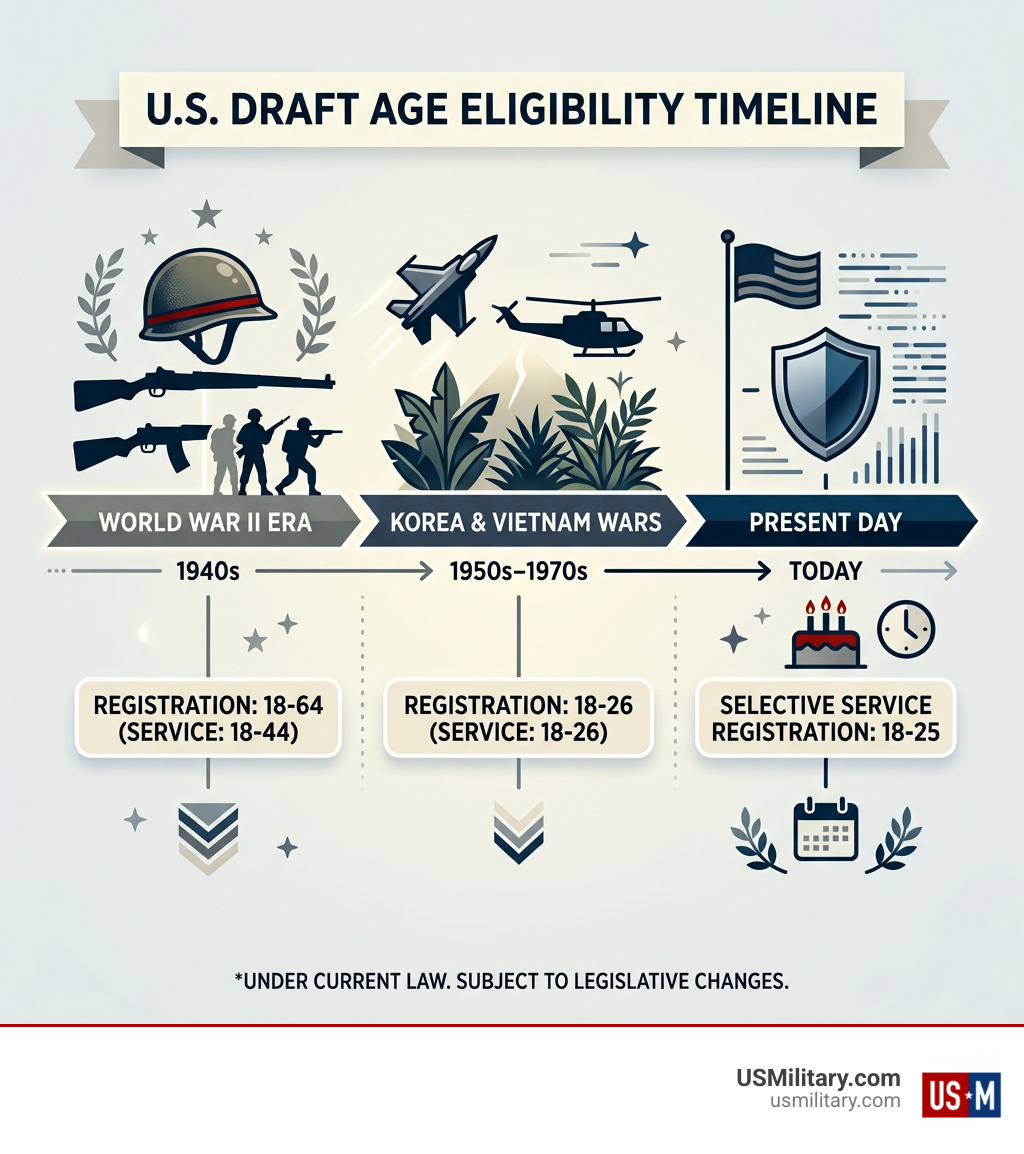
But the full picture is more complicated. Federal militia law, historical wartime expansions, and special skills conscription all create theoretical scenarios where age 40 could fall within reach. During World War II, Congress authorized draft registration for men up to age 64, with active service liability extending to age 44 — a precedent that still gets discussed today.
I’m Larry Fowler, publisher of the USMilitary.com Network since 2007, and I’ve spent years helping servicemembers and veterans navigate questions exactly like can you be drafted at age 40 — from understanding Selective Service obligations to VA benefits. Let’s dig into the details so you have a clear, complete picture.
Know your Can you be drafted at age 40 terms:
Current U.S. Draft Laws and Age Limits
To understand why people ask, “Can you be drafted at age 40?” we first have to look at the gatekeeper of American conscription: the Selective Service System (SSS). Under the Military Selective Service Act, almost all male U.S. citizens and male immigrants living in the U.S. who are between the ages of 18 and 25 are required to register.
This registration isn’t an induction into the military; rather, it’s a database the government maintains just in case a national emergency requires a draft. The law is very specific about the “cutoff” age. Once a man reaches his 26th birthday, he is no longer required to register, and his legal liability for a standard “lottery-style” draft effectively evaporates.
For those currently in the 18-25 bracket, registration is mandatory. Failing to do so is technically a felony, though the government hasn’t prosecuted anyone for it since the 1980s. Instead, they use “soft” penalties—denying federal student aid, government jobs, and even U.S. citizenship for immigrants.
If you want to dive deeper into the specifics of these brackets, you can find more info about current draft ages on our platform.
Registration Requirements at a Glance:
- Who: Almost all men (citizens and immigrants).
- When: Within 30 days of their 18th birthday.
- Up to When: Until the day they turn 26.
- Why: To stay eligible for federal benefits and fulfill a legal civic duty.
So, for a 40-year-old man, the standard Selective Service door is locked and bolted. You cannot register at 40, and the SSS cannot “call you up” through their normal lottery because you aren’t in their active pool.
Can You Be Drafted at Age 40 Under Modern Regulations?

Now, here is where things get a bit “lawyerly.” While the Selective Service focuses on the 18-25 crowd, there is another piece of legislation that often keeps 40-year-olds awake at night: 10 U.S. Code § 246.
This federal law defines the “militia” of the United States. It states that the militia consists of all able-bodied males at least 17 years of age and under 45 years of age. This group is divided into two classes:
- The Organized Militia: This includes the National Guard and the Naval Militia.
- The Unorganized Militia: This includes everyone else in that age bracket who isn’t already in the Guard or the military.
Technically, if you are a 40-year-old able-bodied male, you are a member of the “unorganized militia.” Under extreme emergency conditions, the government has the theoretical statutory authority to call upon the militia for service. However, it’s important to distinguish this from a “draft.” A draft requires an act of Congress and a presidential signature to activate the Selective Service System. A militia call-up is a different legal animal entirely and hasn’t been used in a way that resembles a modern draft in well over a century.
If you are interested in how these ages affect your ability to voluntarily serve, you should learn about military enlistment age requirements. Many branches have actually raised their enlistment ages recently to help meet recruiting goals.
Legal Realities: Can You Be Drafted at Age 40 Today?
Let’s be blunt: In the modern era, the U.S. military is an all-volunteer force. We haven’t seen an active draft since 1973. For the government to reach out and grab a 40-year-old civilian for compulsory service, the United States would have to be in a state of existential crisis—think “Red Dawn” scenarios or a global conflict that has already exhausted the millions of younger men in the 18-25 and 26-35 age groups.
The current system is designed to be “bottom-up.” If a draft were reinstated, the lottery would start with 20-year-olds, then move to 21, 22, 23, 24, 25, 19, and finally 18. There is no current legal mechanism for the Selective Service to leapfrog over those millions of young men to draft a 40-year-old.
While you are worrying about the draft, it’s a good idea to make sure your family’s other safety nets are in place. For instance, you might want to compare insurance options for families to ensure your loved ones are protected no matter what the global situation looks like.
Historical Precedent: Could You Be Drafted at Age 40 in WWII?
History tells us that age limits are not set in stone. The question “Can you be drafted at age 40?” would have had a very different answer in 1942.
After the attack on Pearl Harbor, the United States realized it needed a massive amount of manpower—and fast. In December 1941, Congress amended the Selective Training and Service Act. This amendment required the registration of all men between the ages of 18 and 64.
While the 64-year-olds were mostly registered for “manpower tracking” (to see who could work in factories or essential civilian roles), the liability for military service was extended to include all men from ages 18 to 44. President Roosevelt explicitly supported this, noting that the nation needed to be able to tap into every available resource.
During this time, men around age 40 were often placed in Class 4-A, which meant they were “over the fighting age” for front-line combat but still liable for service if the need became dire. Eventually, the War Department realized that older men were less efficient in high-intensity combat roles and capped the induction age at 38 in late 1942, though the legal authority to go higher remained on the books.
| Conflict | Registration Age | Active Draft Age |
|---|---|---|
| World War II | 18–64 | 18–44 (later capped at 38) |
| Korean War | 18–26 | 18.5–26 |
| Vietnam War | 18–26 | 18.5–26 |
| Modern Day | 18–25 | N/A (All-Volunteer) |
Special Skills and Healthcare Conscription
There is one major exception to the “26-and-under” rule: the Special Skills Draft. This is most commonly discussed in the context of the Health Care Personnel Delivery System (HCPDS).
If the nation faced a massive medical emergency or a war with high casualty rates, Congress could authorize a draft specifically for healthcare professionals—doctors, nurses, technicians, and specialists. Because medical expertise takes years to acquire, a 40-year-old doctor is actually more valuable to the military than a 22-year-old medical student.
In past proposals for a medical draft, the age limits have been suggested as high as 44 or even 55. This is separate from the general “infantry” draft. The military wouldn’t be looking for you to kick down doors; they would be looking for your specialized professional skills.
If you are a professional in your 40s and are actually interested in serving, you don’t have to wait for a draft. You can learn about joining the military at an older age through direct commission programs that value your experience.
Future Changes: Automatic Registration and Legislative Proposals
The landscape of the draft is shifting. In 2024, there has been significant legislative movement regarding how the U.S. handles Selective Service.
A major update involves the National Defense Authorization Act (NDAA) for Fiscal Year 2026. Proposed changes would move the U.S. toward an “automatic” registration system. Instead of relying on 18-year-olds to remember to fill out a form, the government would use existing federal databases (like DMV records or Social Security data) to automatically enroll all eligible males.
While this doesn’t change the age limit—it still targets the 18-25 range—it shows that the government is looking to “tighten” the system. Some critics and lawmakers have expressed concern about a “manpower crisis” in the all-volunteer force, leading to whispers about expanding national service mandates. However, there is currently no serious legislative proposal to raise the draft age to 40 for the general population.
For those worried about how future conflicts might impact their lives, it’s worth asking: Will there be a draft in 2026?. While unlikely, staying informed is your best defense.
And if you’re worried about the financial strain a sudden call-up might cause, it’s never too late to manage debt during service or look into protections like the Servicemembers Civil Relief Act (SCRA).
Frequently Asked Questions about Being Drafted at 40
What is Class 4-A and how does it affect men over 40?
Historically, Class 4-A was a designation used by the Selective Service to identify men who were “over the age of liability for military service.” During WWII, when the registration age went up to 64, 4-A acted as a deferment. It essentially said, “We know who you are and where you are, but you are too old for the current needs of the fighting force.” If you were 40 today and a draft were somehow expanded, 4-A (or a modern equivalent) would likely be your first stop.
What are the penalties for men who failed to register before age 26?
If you are 40 and you never registered for the Selective Service when you were 18-25, you can no longer be drafted, but you might still face “permanent” penalties. You are likely ineligible for federal student loans, federal job training, and jobs within the Executive Branch of the federal government. For immigrants, failure to register can be a major roadblock to obtaining U.S. citizenship, as it is seen as a failure to show “good moral character.”
Are there exemptions for 40-year-olds with family responsibilities?
In any draft scenario—historical or hypothetical—”Dependency Deferments” (formerly Class 3-A) have played a huge role. The government generally avoids drafting the sole breadwinner of a family or someone whose absence would cause extreme hardship to dependents. At age 40, you are statistically more likely to have children, a mortgage, and aging parents. These factors would make you a very low priority for induction compared to a single 20-year-old with fewer societal entanglements.
Conclusion
At the end of the day, the answer to “Can you be drafted at age 40?” is a sigh of relief for most. While the law technically keeps you in the “unorganized militia” until 45, the practical, legal, and political hurdles to drafting a 40-year-old are massive. The U.S. military thrives on the speed and physical resilience of youth, and the current Selective Service System is strictly designed to capture that demographic.
At USMilitary.com, we are dedicated to providing clear, unbiased guidance on everything from draft laws to veteran benefits. Whether you are a 20-year-old looking at your first registration form or a 40-year-old veteran looking for VA disability info, we are here to help.
For a full deep dive into the mechanics of conscription, check out everything you need to know about the U.S. military draft. Stay informed, stay prepared, and remember—your experience is a voluntary asset, not a compulsory target.
Free for Service Members & Veterans
Get the military benefits intel no one tells you about.
Weekly updates on VA benefits, pay changes, and money tips — free for service members and veterans.
No spam. Unsubscribe anytime. Your info is never shared.


