Why Understanding Army Reserve Max Age Matters
The army reserve max age is a critical factor for anyone considering part-time military service, but the answer isn’t as simple as a single number. Here’s what you need to know:
Quick Answer: Army Reserve Age Limits
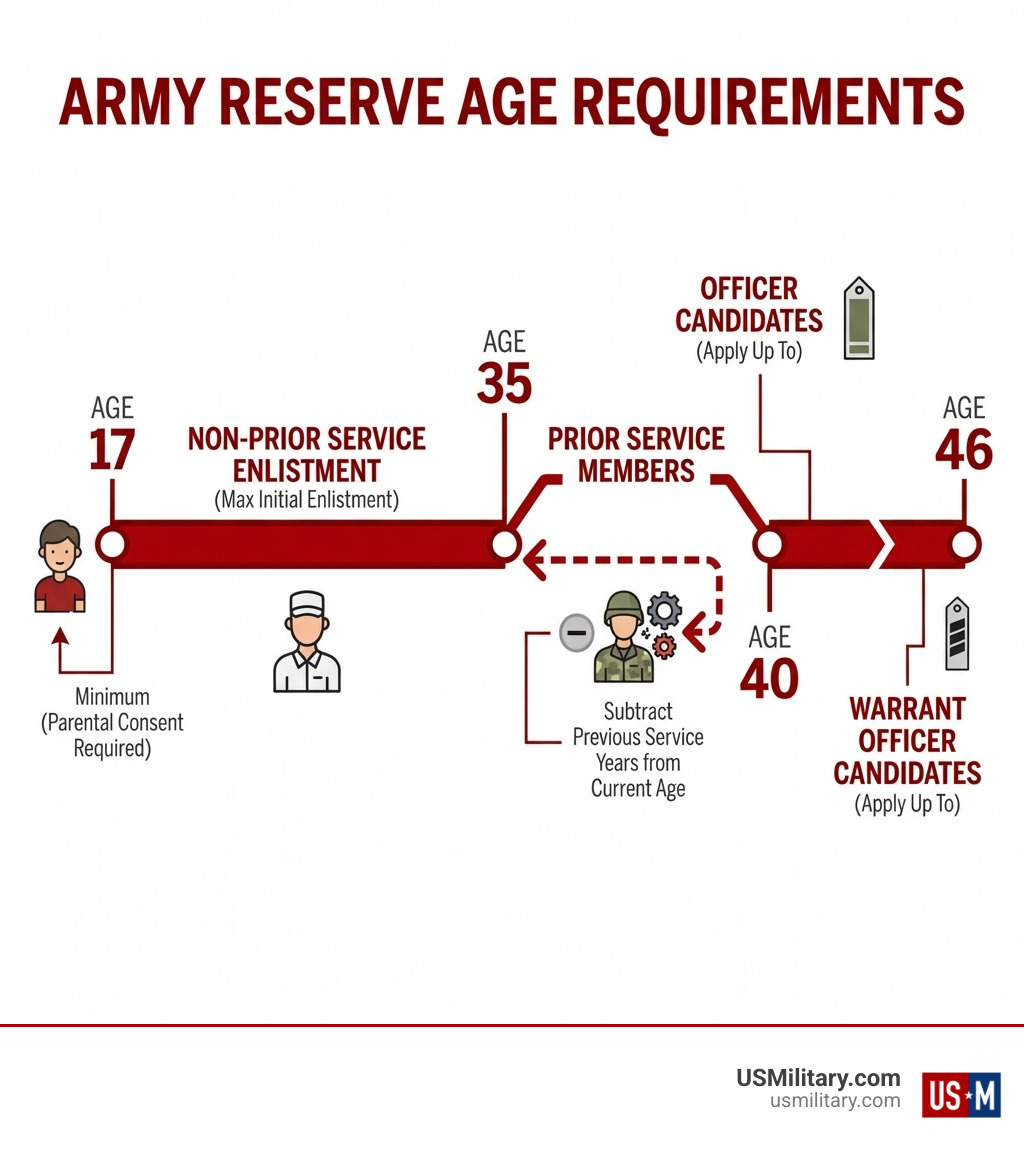
- Standard Maximum Age: 35 years old (must enlist before your 35th birthday)
- Minimum Age: 17 years old (with parental consent)
- Prior Service Members: Can subtract previous years of service from their current age
- Officers (OCS): Maximum age 40 (waivers available)
- Warrant Officers: Maximum age 46 (waivers available)
If you’re exploring military service but worry you’ve aged out of eligibility, you’re not alone. More than 1 in 4 active-duty service members tell us they intend to join the reserves, and many are surprised to learn that the door may still be open even after 35.
The Army Reserve offers a unique opportunity to serve your country while maintaining civilian employment. Unlike active duty, which requires full-time commitment, the Reserve typically involves one weekend per month and two weeks per year. This flexibility makes it attractive to those who want to contribute to national defense without leaving their careers or families behind.
However, age requirements can be confusing. The official regulations reference multiple documents (AR 601-210, AR 135-100), and the rules differ significantly based on whether you have prior military experience, what type of position you’re seeking, and whether you qualify for specialized roles. The good news is that exceptions and waivers exist for many situations, and some applicants can serve well into their 40s.
The Official Army Reserve Max Age for Enlistment
When we talk about the standard enlistment process for the U.S. Army Reserve, we’re generally referring to individuals who have not previously served in any branch of the military. For these non-prior service applicants, there are clear guidelines regarding age. It’s important to understand these foundational rules before exploring the exciting possibilities of waivers and exceptions.
Understanding the Basic Army Reserve Max Age
For those looking to join the Army Reserve without prior military experience, the general rule is that you must be at least 17 years old and enlist before your 35th birthday. This means that if you’re 34, you’re still in the clear, but once you hit 35, the standard path closes.
If you’re 17, we’ll need a little help from your parents or legal guardians to get you started. Parental consent is a must for anyone under 18 wishing to enlist. Interestingly, the Army is quite precise about this: parental consent for 17-year-olds cannot be obtained more than 30 days prior to their 17th birthday. So, no jumping the gun too early!
These age limits are formalized in official Army regulations, specifically Army Regulation 601-210, which governs the enlistment program for both the Regular Army and Reserve Components. This regulation states that non-prior service applicants must generally enlist into the Army Reserve no later than their 35th birthday. While there’s a standard maximum, it’s worth noting that policy exceptions can sometimes be considered by the Director of Military Personnel Management, but these are typically rare for initial enlistment of non-prior service members without exceptional circumstances.
For a general overview of Army enlistment requirements, including age, you can always check out the official U.S. Army requirements page.
How This Compares to Active Duty Army
It’s easy to confuse the age limits for the Army Reserve with those for Active Duty Army, but there’s a distinct difference in commitment and, often, in age flexibility. For active duty, the age limit is also generally 17-35 years old. However, the nature of service is vastly different.
Active duty means full-time military service, where you live and breathe Army life every day. The Army Reserve, on the other hand, offers a part-time commitment, allowing you to balance military service with your civilian career, education, or family life. This typically translates to “one weekend a month, two weeks a year,” though specific units and roles may require more time. This part-time model is a huge benefit for many, allowing them to keep one foot in the military community and one foot firmly in civilian life.
The flexibility of the Reserve component can also lead to a viable path to military retirement. By combining active and reserve service, you could achieve military retirement after 20 years of combined service, which is a significant long-term benefit. So, while the initial army reserve max age might seem similar to active duty, the lifestyle and long-term implications are quite different, making the Reserve an attractive option for a diverse range of individuals. If you’re weighing your options, we’ve got more information on how to choose between being an Army Reservist and Active Duty.
Exceptions and Waivers: Can You Join After 35?
We understand that life doesn’t always go according to a strict timeline, and sometimes the call to serve comes a little later. Good news! For many, the path to service in the Army Reserve doesn’t necessarily end at 35. This section explores the crucial exceptions and waiver opportunities available for older applicants, particularly those with prior experience or specialized skills that the Army values.
The Impact of Prior Military Service on the Army Reserve Max Age
If you’ve previously worn a uniform, the rules change significantly. Prior military service can be a game-changer when it comes to the army reserve max age. The Army recognizes the value of experience and training, and as such, former service members often have extended eligibility.
How does this work? Essentially, prior enlisted service members can subtract their previous years of service from their current age to extend their eligibility. For example, if you’re 41 years old but served four years on active duty, your “adjusted” age for enlistment purposes could be considered 37. This adjusted age might then fall within an acceptable range, especially if the Army has a particular need for your skills or experience. This is a common practice across the military branches; for instance, we’ve seen a veteran who was 41 years old still able to reenlist in the Air Force because their four years of prior service brought their adjusted age to 37, which was under the Air Force’s 39-year-old cutoff for reserves.
The exact maximum age for prior service enlistment into the Army Reserve isn’t a single, universally stated number like it is for non-prior service. Instead, it falls under general age eligibility criteria and specific policies for prior service members, often influenced by the “needs of the Army.” This means that if you have valuable prior experience, the Army may be more flexible with your age, particularly if they need your specific Military Occupational Specialty (MOS) or leadership skills.
Joining the Reserves after active duty can also come with a host of benefits, allowing you to maintain your connection to the military community while pursuing civilian endeavors. We’ve highlighted some of these in our article on the benefits of joining the Reserves.
Waivers for In-Demand Professional Skills
Beyond prior service, the Army Reserve is constantly looking for individuals with specialized, in-demand professional skills. For these critical roles, age waivers are often authorized, allowing applicants well past the standard army reserve max age to join.
Think about professions like medical professionals (doctors, nurses, dentists), chaplains, Judge Advocate General’s (JAG) Corps officers (lawyers), and increasingly, cyber specialists. These are roles where civilian education and experience are highly valued, and the Army Reserve benefits immensely from bringing in seasoned professionals.
For these specialized roles, the standard age limits for initial enlistment or commissioning may be relaxed. While the general rule for non-prior service is before your 35th birthday, and for officers before your 40th, these policy exceptions are frequently made for those with a professional degree or significant experience in a field critical to military operations.
If you possess such skills and are considering serving, your best course of action is to contact an Army Reserve recruiter. They can assess your qualifications and determine if you meet the criteria for a waiver based on your professional background and the current needs of the Army Reserve. Don’t assume your age is a barrier if you bring a unique and valuable skill set to the table!
Age Limits for Army Reserve Officers and Warrant Officers
If you’re eyeing a leadership role or aspire to be a technical expert in the Army Reserve, the age requirements shift a bit. The path to becoming a Commissioned Officer or a Warrant Officer has its own specific set of rules, including different army reserve max age considerations and waiver possibilities. Let’s dig into these distinct routes to service.
Becoming a Commissioned Officer (OCS)

For those with a college degree and a desire to lead, Officer Candidate School (OCS) is the primary route to becoming a commissioned officer in the Army Reserve. If you’re considering this path, we’re looking for individuals who can demonstrate strong leadership potential and meet specific academic and physical standards.
The maximum age for becoming a commissioned officer through OCS in the Army Reserve is generally 40 years old. Specifically, you cannot have reached your 40th birthday at the time the HQDA (Headquarters, Department of the Army) OCS Selection Panel meets. However, and this is a crucial point, age waivers are authorized for applicants who reach their 40th birthday or older by the panel date. This means that if you’re a bit older but have the right stuff, there’s still a strong possibility for you to pursue this path.
Beyond age, there are other important requirements:
- Education: You’ll need a baccalaureate degree or higher from an accredited college or university.
- GT Score: A General Technical (GT) score of 110 or higher on the Armed Services Vocational Aptitude Battery (ASVAB) is required. This is a non-waiverable requirement, so make sure your test scores are up to snuff!
The process for applying for an age waiver involves careful documentation and coordination with the Army Reserve Careers Group (ARCG). They will guide you through the necessary steps to ensure your application is complete and properly considered. For more detailed prerequisites and application guidance for officers, you can refer to the ARCG Officer Pre-Reqs page.
Becoming a Warrant Officer
Warrant Officers are the Army’s highly specialized technical experts and leaders. They fill a unique role, providing deep technical knowledge and experience in specific fields. If you’re passionate about a particular technical area and have the expertise to match, becoming a Warrant Officer in the Army Reserve might be your calling.
The maximum age for Warrant Officer accessions in the Army Reserve is higher than for commissioned officers: you generally cannot reach your 46th birthday at the time the USAREC (U.S. Army Recruiting Command) Warrant Officer Board convenes. Similar to commissioned officers, applicants who are 46 or older by the board date must request an age waiver to apply. This extended age limit reflects the Army’s need for experienced professionals in these highly technical roles.
Key requirements for Warrant Officers include:
- Technical Expertise: You’ll need to meet MOS-specific prerequisites, often requiring prior enlisted experience in a feeder MOS or equivalent civilian certifications and experience.
- GT Score: Like commissioned officers, a GT score of 110 or higher is required, and this is also a non-waiverable standard.
The process of applying for a Warrant Officer position, especially if you require an age waiver, involves working closely with an Officer Accessions NCO. They can help you steer the specific requirements for your desired MOS and guide you through the waiver process. While the link provided is for becoming an officer in the Army National Guard, the principles of age requirements and waivers for technical experts generally align with the Army Reserve’s approach to attracting skilled individuals. If you’re considering this path, reaching out to a recruiter is the best first step.
How Army Reserve Age Limits Compare to Other Components
The U.S. military is a complex mix of active duty, Reserve, and National Guard components, each with its own unique mission and, often, different age requirements. Understanding these differences can help you determine the best fit for your service aspirations, especially concerning the army reserve max age. Let’s take a comparative look at how the Army Reserve stacks up against other components.
Army Reserve vs. National Guard Age Policy
While both the Army Reserve and the Army National Guard are part-time components of the U.S. Army, serving alongside the active duty force, they operate under slightly different umbrellas and, consequently, have differing age policies. The Army Reserve is a federal force, while the National Guard operates under both state and federal authority, responding to both state-level emergencies and federal deployments.
Here’s a quick comparison of their maximum enlistment ages for non-prior service members:
| Component | Minimum Age | Maximum Age (Non-Prior Service) | Maximum Age (Prior Service) |
|---|---|---|---|
| Army Reserve | 17 | 35 | Can subtract prior service |
| Army National Guard | 17 | 45 | 64 (for former Regular Army, Navy, Air Force, or Marine Corps members) |
As you can see, the Army National Guard generally allows for a higher maximum age for original enlistment, up to 45 years old. For former members of the Regular Army, Navy, Air Force, or Marine Corps, the National Guard’s age limit for original enlistment can extend significantly, up to 64 years of age. For reenlistment, a person must be under 64 years of age in the National Guard. Officer appointments in the National Guard are also generally open to those aged 18 and under 64. These details are enshrined in legal statutes like 32 USC 313: Appointments and enlistments: age limitations, which governs the National Guard.
This difference in age policy for the Army Reserve versus the National Guard reflects their slightly different missions and recruitment strategies. For more in-depth information on the National Guard’s age limits, you can visit our dedicated page on National Guard Age Limits.
A Look at Other Military Branches
It’s not just the Army Reserve that has specific age requirements; every branch of the U.S. military, and their respective Reserve components, has its own set of rules. We’ve compiled a quick overview to give you a broader perspective on how the army reserve max age compares to others:
- Marine Corps Reserve: Known for its rigorous physical standards, the Marine Corps Reserve has the lowest maximum age limit, typically 28 years old. This reflects their emphasis on youth and peak physical condition.
- Navy Reserve: The Navy Reserve offers a more flexible age range, allowing individuals to join up to 41 years old.
- Air Force Reserve: The Air Force Reserve has a maximum age of 39 years old, making it accessible to a slightly older demographic, similar to the Air National Guard. If you’re interested in that, we have more information on how to qualify for the Air Force Reserves.
- Coast Guard Reserve: The Coast Guard Reserve generally has a maximum enlistment age of 40 years old.
These variations highlight that if one branch’s age limit doesn’t quite fit your situation, another might. Each branch has unique requirements and missions, so exploring all your options is a smart move.
Frequently Asked Questions about Army Reserve Age
We know that navigating military eligibility, especially concerning age, can bring up a lot of specific questions. We’ve gathered some of the most common inquiries about the army reserve max age to provide clear, concise answers.
Does prior service always guarantee an age waiver?
While prior military service is a significant advantage and can extend your eligibility, it does not automatically guarantee an age waiver or reenlistment. The Army Reserve values your experience, and prior enlisted service members can often subtract their previous years of service from their age to calculate an “adjusted age.” This adjusted age often allows them to fall within standard eligibility limits.
However, if even with your prior service, your adjusted age still exceeds the general maximum for initial enlistment or specific officer/warrant officer programs, a waiver might be necessary. Whether that waiver is granted depends on several factors:
- Needs of the Army: The most critical factor is always whether the Army has a current need for your specific skills, rank, and experience. If you fill a critical shortage MOS, your chances are much higher.
- Overall Qualifications: Your physical fitness, moral character, education, and other qualifications must still meet all current standards. An age waiver won’t compensate for deficiencies in other areas.
- Recruiter Consultation: The best way to understand your specific situation is to consult with an Army Reserve recruiter. They can provide personalized guidance based on your military record and the current accession policies.
So, while prior service opens many doors, it’s not a golden ticket. It significantly improves your chances, but the ultimate decision rests on your complete profile and the Army’s requirements.
What is the maximum age for reenlisting in the Army Reserve?
Reenlisting in the Army Reserve is different from initial enlistment, and the age considerations shift significantly. For current or former service members looking to reenlist, the maximum age is generally much higher. According to Army Regulation 601-280, which governs the Army Retention Program, a Soldier must not be more than 60 years old at their new Expiration of Term of Service (ETS).
This means that if you’re an existing Reservist or a prior service member looking to return, you could potentially serve until just before your 60th birthday, assuming you meet all other retention standards. There are specific provisions for Soldiers who have completed 20 or more years of active Federal service; they will not be reenlisted or extended for any period that would expire after the last day of the month in which they reach age 60.
While the age limit of 60 at ETS is generally non-waiverable, there are sometimes specific provisions for highly experienced individuals. For example, Sergeant Majors and Command Sergeants Major in certain nominative assignments may serve beyond standard limits, sometimes up to age 60 or until the completion of their assignment requirements.
Reenlistment also involves meeting other criteria, such as physical fitness, weight standards, and maintaining a good service record. The Army wants to retain experienced, qualified individuals, and age becomes less of a barrier when you’re already a proven asset.
Are there age restrictions for specific Army Reserve jobs (MOS)?
Generally, the overall enlistment age limits for the Army Reserve (e.g., 35 for non-prior service, with exceptions for prior service) apply broadly across most Military Occupational Specialties (MOS). This means that if you’re eligible to enlist based on your age, you’re usually eligible for most available MOS positions, provided you meet the specific academic, physical, and security clearance requirements for that job.
However, there are nuances:
- Physically Demanding Roles: While there isn’t a strict age cutoff for physically demanding roles like infantry or combat engineer beyond the general enlistment age, older applicants might find it more challenging to meet the rigorous physical fitness standards required for these jobs. The Army needs soldiers who can perform their duties effectively and safely, regardless of age.
- Special Operations: Roles within Special Operations units are exceptionally demanding, requiring peak physical and mental conditioning. While age limits might technically allow for older applicants, the intense selection and training processes often naturally favor younger candidates.
- Officer and Warrant Officer Paths: As we discussed, these paths have their own specific age limits (40 for OCS, 46 for Warrant Officers) and require meeting specific board criteria. For Warrant Officers, there are also “MOS-specific prerequisites” that dictate prior experience or technical certifications, which might indirectly favor individuals who have had time to gain that expertise.
While the basic army reserve max age applies, the practical reality of certain roles, especially those requiring extreme physical exertion or long, specialized training pipelines, means that age can become an indirect factor in selection and success. Always discuss specific job interests with a recruiter to understand all requirements.
Your Path to Service Starts Here
The rules surrounding the army reserve max age are nuanced, but the opportunity to serve may still be open to you, even after 35. We’ve seen that the key lies in understanding the exceptions for prior service, the value of in-demand professional skills, and the distinct age requirements for officer and warrant officer programs. The Army Reserve is a dynamic force that values experience, dedication, and a willingness to serve, and age is often just one factor among many.
The most critical step in exploring your options is to gather your information and speak directly with an Army Reserve recruiter. They are the experts who can assess your unique situation, including your prior service, civilian skills, education, and physical condition, against the current needs of the Army Reserve. They can provide the most accurate and up-to-date information on eligibility, potential waivers, and available opportunities.
Don’t let assumptions about age deter you from exploring a rewarding path of service. Whether you’re a seasoned professional, a former service member, or simply someone who feels the call to serve a little later in life, the Army Reserve might just be the place for you. For more in-depth information on military requirements and to continue your research, USMilitary.com provides a wealth of resources to guide your journey. We’re here to help you understand every step of the way. Learn more about military age limits.
Free for Service Members & Veterans
Get the military benefits intel no one tells you about.
Weekly updates on VA benefits, pay changes, and money tips — free for service members and veterans.
No spam. Unsubscribe anytime. Your info is never shared.


