Coast Guard Life Compared With the Army, Navy, Marines, and Air Force

The Coast Guard is different because its members often carry out live domestic missions every day – including search and rescue, maritime law enforcement, drug interdiction, and environmental response. The Army, Navy, Marine Corps, and Air Force are primarily Department of Defense services that train and deploy to deter or fight conflicts worldwide.
For someone choosing a branch, the simplest comparison is:
- Choose the Coast Guard if you want small crews, maritime work, and a mission focused on protecting people and waters in and near the United States.
- Choose the Army or Marines if you want a ground-combat-centered culture and expeditionary operations.
- Choose the Navy if you want large-fleet life and global sea deployments.
- Choose the Air Force if you prefer air, technical, and support missions that are often based at larger installations.
In peacetime, the Coast Guard serves under the Department of Homeland Security, not the Department of Defense. It can transfer to the Navy during war. With fewer than 50,000 active-duty members, Coast Guard life also tends to mean smaller stations or cutter crews, closer working relationships, and more direct visibility for each person’s work.
I am Larry Fowler, publisher of the USMilitary.com Network since 2007, where I have helped active-duty members, veterans, and future recruits navigate service choices and benefits. This guide explains How is Coast Guard life different from serving in the Army, Navy, Marines, or Air Force so you can match the branch to your career goals, family needs, and preferred daily mission.
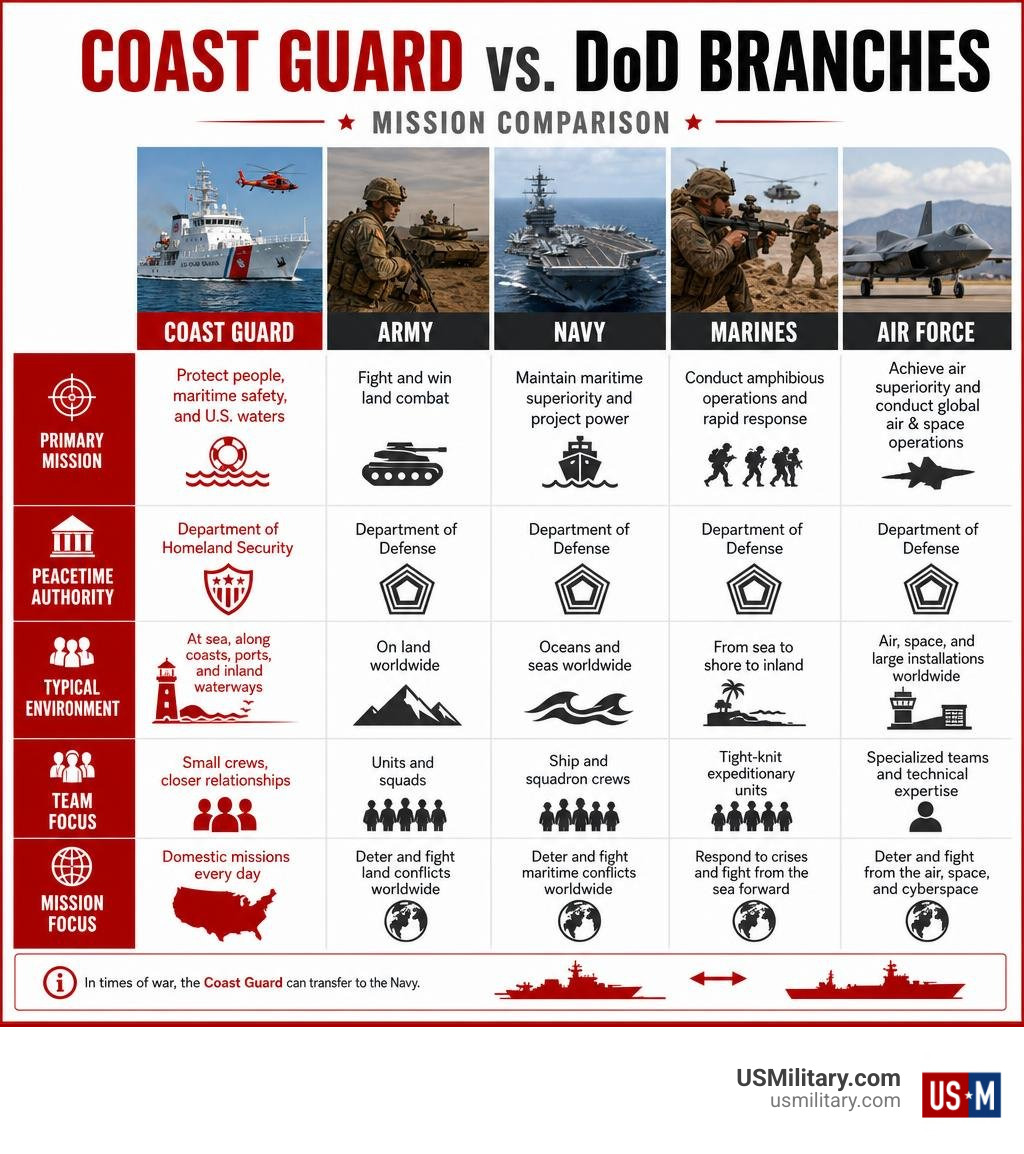
How is Coast Guard life different from serving in the Army, Navy, Marines, or Air Force terms to know:
Primary Mission and Departmental Authority: DHS vs. DoD
When exploring Understanding the 5 Branches of US Military, the most fundamental difference lies in organizational authority and core legal mandates.
The Army, Navy, Marine Corps, and Air Force operate under the Department of Defense (DoD) governed by Title 10 of the U.S. Code. Their primary mission is national defense, deterrence, and preparing to win overseas armed conflicts.
In contrast, the United States Coast Guard operates under the Department of Homeland Security (DHS) during peacetime pursuant to Title 14. This gives the Coast Guard a distinct humanitarian, regulatory, and federal law enforcement authority that DoD branches do not possess.

Key Operational Realities: How is Coast Guard Life Different from Serving in the Army, Navy, Marines, or Air Force?
In DoD branches during peacetime, day-to-day life primarily centers on training, maintaining gear, and running combat simulations to maintain readiness for future international conflicts.
Coast Guard members step directly into live operational missions every single day. Daily life involves:
- Responding to maritime distress calls and executing search and rescue (SAR) missions
- Conducting boarding operations via US Coast Guard Maritime Law Enforcement
- Interdicting illicit narcotics and migrant vessels in coastal and international waters
- Patrolling commercial fisheries and enforcing environmental protection regulations
When a high schooler asked military recruiters what elite units each branch had—such as Navy SEALs, Army Special Forces, or Air Force PJs—the Coast Guard recruiter famously quipped, “The whole damn Coast Guard!” Because crews are compact, junior members perform real-world tactical missions immediately out of training.
The Wartime Navy Transition and Peacetime Law Enforcement
Due to the Posse Comitatus Act, Title 10 military branches are strictly limited from conducting domestic civilian law enforcement. Because the Coast Guard falls under Title 14, its personnel serve as active federal law enforcement officers with full statutory authority to board vessels, carry firearms, and execute arrests.
However, during a formal declaration of war or when directed by the President, the Coast Guard transfers its operations under the Department of the Navy. This dual role has occurred only twice in modern history (World War I in 1917 and World War II in 1941). Exploring Important and surprising differences between the Navy and Coast Guard reveals that while both services master seafaring, the Coast Guard retains an agile domestic focus alongside port security and national defense responsibilities.
Daily Culture, Size, and Station vs. Base Living Conditions

Scale dramatically shapes daily military life. As of August 2026, the Coast Guard maintains fewer than 50,000 active-duty members, supported by over 8,500 dedicated civilian professionals.
Compare that to the sprawling personnel footprints across DoD branches:
- Army: nearly 500,000 active-duty soldiers
- Navy: nearly 350,000 active-duty sailors
- Air Force: over 300,000 active-duty airmen
- Marine Corps: less than 200,000 active-duty Marines
The Coast Guard is smaller than the New York City Police Department, giving it a tight-knit, community-driven culture across its footprint.
Small Unit Cohesion and Rank Hierarchy Dynamics

On a massive Navy aircraft carrier carrying 5,000 sailors, junior enlisted personnel can easily feel like a number. On a Coast Guard cutter with 30 to 100 crew members, everyone from the commanding officer to the newest non-rate knows your name, your strengths, and your family.
While the Coast Guard mirrors the Navy’s rank structure and rating insignias, the daily atmosphere is notably less rigid. Leaders encourage initiative, open communication, and hands-on cross-training. When you transfer to a new unit, you will almost certainly work with people you already know, creating an easier transition than transfers within larger branches. Reviewing What are the advantages of joining the Coast Guard compared to the Army, Air Force, Marines, and Navy confirms that this close cohesion builds high career satisfaction.
Living on Stations, BAH Eligibility, and Relocation Cycles
The Coast Guard maintains small “stations” and sectors scattered along American coastlines, inland rivers, and Great Lakes rather than massive military installations.
Because small stations lack extensive military barracks or dining facilities, junior Coast Guard members frequently qualify for Basic Allowance for Housing (BAH) and separate food rations (BAS) much earlier in their careers than DoD counterparts. Members get to live in regular civilian apartments and houses, enjoying a healthy blend of civilian integration and military camaraderie.
Duty assignments typically rotate every two to four years, but stationing occurs primarily along scenic waterfront communities across the continental United States, Hawaii, Alaska, and U.S. territories. Discover more about balancing military life with family needs through Lifestyle and Family – United States Coast Guard.
Basic Training and Enlistment Standards Across the Branches
Every military branch demands discipline, physical conditioning, and mental resilience, but their basic training pipelines focus on very different operational environments.
| Metric / Branch | Coast Guard | Army | Navy | Air Force | Marine Corps |
|---|---|---|---|---|---|
| Boot Camp Length | 8 Weeks | 10 Weeks | 8 Weeks | 8-9 Weeks | 12-13 Weeks |
| Primary Location | Cape May, NJ | Fort Moore, GA (and others) | Great Lakes, IL | San Antonio, TX | Parris Island / San Diego |
| Min. ASVAB Score | 36 | 31 | 31 | 36 (most score 50+) | 32 |
| Key Physical Test | Rigorous Water Survival | Combat Fitness Test (ACFT) | 1.5-mile Run / Plank | 1.5-mile Run / PT | 54-Hour “Crucible” Event |
Cape May Boot Camp vs. DoD Recruit Training Intensity
Coast Guard recruit training takes place exclusively at Training Center Cape May in New Jersey. At eight weeks long, it is packed with intense physical conditioning, academic memorization, firefighting, weapons handling, and maritime seamanship.
The key differentiator at Cape May is water survival. By the second week of boot camp, all recruits must pass demanding swimming assessments, including jumping from elevated platforms, treading water, and sustained swim strokes. While Marine Corps boot camp emphasizes infantry ground combat and the grueling 54-hour Crucible, Cape May focuses on turning out recruits capable of surviving and operating in dangerous marine conditions. Make sure to review general Coast Guard Requirements before shipping out.
ASVAB Benchmarks and Physical Fitness Criteria
The Coast Guard sets high academic standards, requiring a minimum ASVAB AFQT score of 36 for enlistment, while competitive technical ratings require substantially higher line scores.
Prospective recruits should also check Coast Guard Enlistment Age Requirements for Active Duty and Prior Service to confirm their enlistment eligibility window across active and reserve components.
Career Specialties, Hands-On Missions, and Civilian Transition
Coast Guard careers provide direct pathways into commercial and federal maritime sectors. Enlisted ratings mirror critical skills needed across civilian emergency response, shipping, and aviation industries.
Whether you are deciding between military enlistment or civilian support roles—as detailed in Civilian vs. Enlisted Coast Guard Career Options and our guide on Civilian Careers in the US Coast Guard—the operational experience gained is second to none.
Unique Maritime Ratings and Dual-Role Crew Responsibilities
The Coast Guard offers specialized ratings that have no direct equivalent in ground combat branches:
- Coast Guard Rescue Swimmer Careers: Aviation Survival Technicians (AST) deploy out of helicopters into heavy seas to pull stranded mariners to safety.
- Coast Guard MSRT: The Maritime Security Response Team serves as an elite counterterrorism and high-risk boarding force.
- Become a Marine Science Tech Coast Guard: Marine Science Technicians inspect commercial vessels and coordinate hazmat containment responses.
- Coast Guard Electrician Mate Jobs: Specialists manage shipboard power distribution and electronics maintenance.
In Coast Guard aviation, enlisted personnel handle both ground maintenance/avionics and serve as active flight crew during rescue sorties, unlike DoD branches where flight crews and ground maintenance crews are separate career tracks.
Military Benefits, Healthcare, and Education Portability
Because the Coast Guard is a formal branch of the U.S. Armed Forces, members receive identical military pay grades, TRICARE medical and dental coverage, Post-9/11 GI Bill education funding, and VA home loan eligibility as the Army, Navy, Air Force, and Marines.
Ratings like Coast Guard Career Health Services Technician translate seamlessly to civilian hospital administration, emergency response, and nursing careers upon discharge.
How is Coast Guard Life Different from Serving in the Army, Navy, Marines, or Air Force?
When considering Which Branch of the Military Should I Join and Which Military Branch Best for You, evaluating lifestyle, operational tempo, and personal career expectations is essential.
Direct Comparison of Deployments, Pace, and Work-Life Balance
Deployments in the Coast Guard are generally shorter and more predictable than large Navy cruises or overseas Army rotations:
- Cutter Deployments: Typical patrols on medium or high-endurance cutters last between a few weeks to three months, compared to six to nine-month carrier deployments in the Navy.
- Small Boat Stations: Members work duty rotations (such as 2 days on, 2 days off, alternating weekends) responding to local shoreline emergencies while sleeping in their own homes most nights.
- Domestic Focus: Most members spend their careers stationed inside the United States, providing predictability for military spouses and children.
When comparing sea services, reading Is the Navy or Marines Better helps clarify how global expeditionary footprints differ from domestic shoreline patrol duties.
Making the Choice: Aligning Service Goals with Branch Strengths
If you want to train for expeditionary combat operations overseas, the Army or Marine Corps is your natural home. If you want to work on advanced stealth aircraft or space-defense systems, look into the Air Force or Space Force.
If you want immediate hands-on responsibility, daily search and rescue or law enforcement operations, and a tight-knit coastal lifestyle, get in touch with Coast Guard Recruiters Near Me or connect directly with an active Coast Guard Recruiter.
Frequently Asked Questions About Military Branch Differences
How is Coast Guard life different from serving in the Army, Navy, Marines, or Air Force regarding deployments?
Coast Guard cutter deployments typically last from two weeks up to three months, whereas Navy vessels, Marine MEUs, and Army units regularly deploy overseas for six to nine months at a time. Many Coast Guard station personnel work duty rotations that allow them to live at home year-round.
Does the Coast Guard receive the same military benefits and pay as the DoD branches?
Yes. Active-duty and reserve Coast Guard members earn standard military base pay matching all DoD branches, full TRICARE comprehensive healthcare, BAH housing allowances, tuition assistance, the Post-9/11 GI Bill, and lifetime VA home loan benefits.
Is Coast Guard boot camp harder than Navy or Air Force basic training?
Coast Guard boot camp at Cape May is widely regarded as one of the most physically and mentally challenging recruit programs alongside Marine Corps boot camp. It places heavy emphasis on water survival, swim assessments, physical endurance, and academic memorization within an intense 8-week schedule.
Conclusion
Every branch of the United States Armed Forces provides an honorable path to serve our nation. The Coast Guard stands apart by blending military discipline with active, real-world humanitarian missions and coastal law enforcement every single day.
We encourage you to explore all branches of the military on USMilitary.com to compare benefits, research enlistment requirements, and find the perfect path for your military career.
Free for Service Members & Veterans
Get the military benefits intel no one tells you about.
Weekly updates on VA benefits, pay changes, and money tips — free for service members and veterans.
No spam. Unsubscribe anytime. Your info is never shared.



More Than 90% Of Clients Have Increased Ratings! Why Settle For Less Than You Deserve? Expert Priority Help With Your VA Claim Today! Free Evaluation Call!
The mission of Veteran Services United is to support veterans in filing and winning disability claims by offering expert guidance, advocacy, and personalized assistance. Through dedicated service, Veteran Services United empowers veterans to secure the benefits they have earned, ensuring they receive the care and support they deserve.