Understanding the 2026 Changes to Selective Service Registration
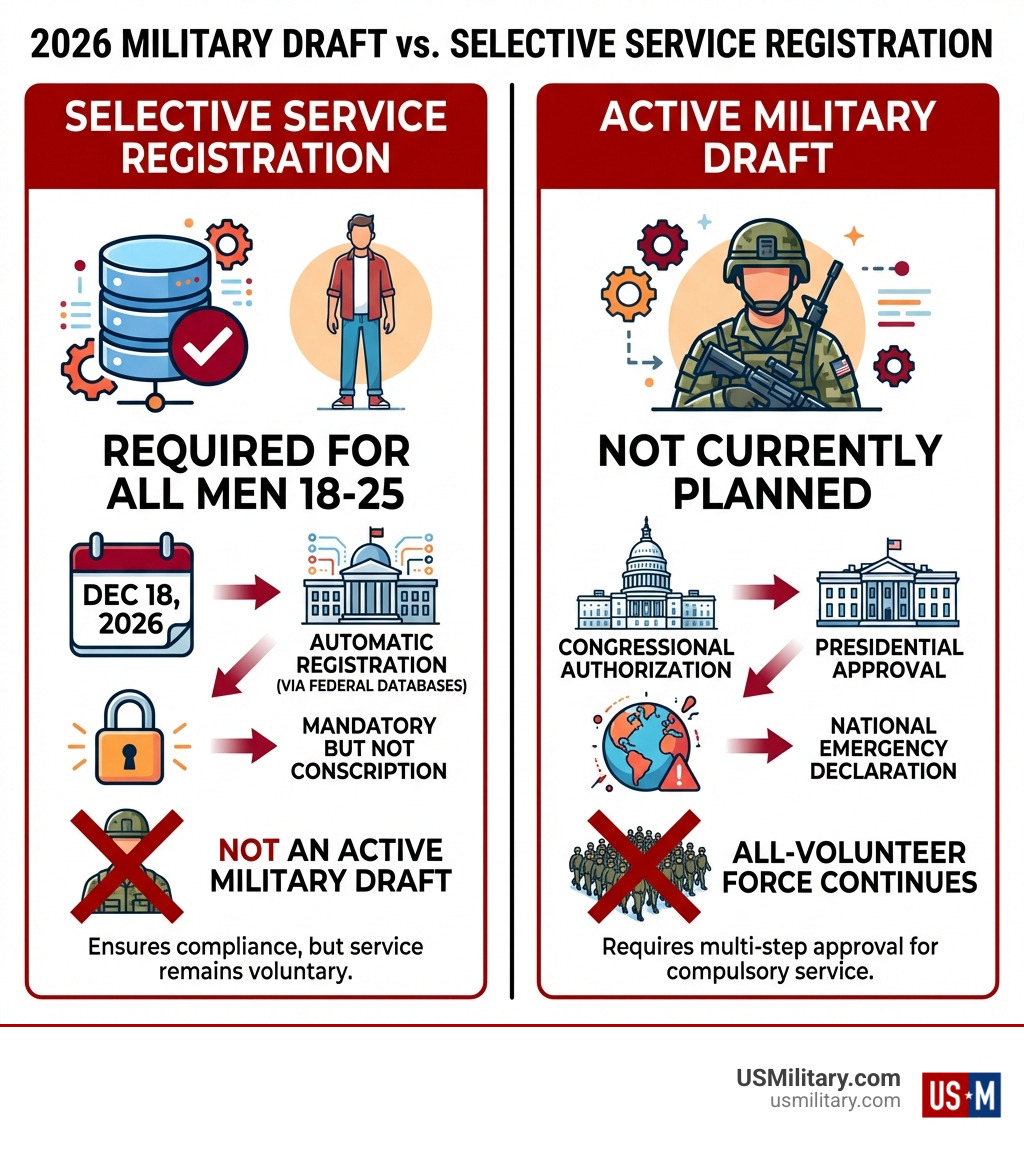
The military draft in 2026 is not being reinstated, but significant changes to how young men register for the Selective Service System are taking effect. Here’s what you need to know:
- No active draft is planned – The U.S. continues to operate with an all-volunteer military force, as it has since 1973
- Automatic registration begins December 18, 2026 – Male U.S. residents ages 18-26 will be automatically registered using federal databases
- Registration remains mandatory – All eligible men must still be registered, but the process becomes automatic rather than self-initiated
- Failure to register carries serious penalties – Fines up to $250,000, five years in prison, and loss of federal benefits
- This is not conscription – Automatic registration is a procedural change to improve compliance with existing law
The shift to automatic registration comes through the National Defense Authorization Act (NDAA) for Fiscal Year 2026, which was signed into law in December 2025. This change addresses longstanding issues with the current system, where many young men fail to register voluntarily, creating an incomplete and inaccurate database.
While global conflicts in Ukraine, the Middle East, and rising tensions with China have sparked renewed public conversations about the draft, there is no congressional action or presidential directive to reinstate compulsory military service. Any future draft would require explicit authorization from both Congress and the President—it cannot happen automatically.
I’m Larry Fowler, publisher of the USMilitary.com Network since 2007, where I’ve helped millions of active service members and veterans steer complex military policies, including changes to the military draft in 2026 and Selective Service requirements. My team has provided critical information to those exploring military service and understanding their legal obligations.
The Shift to Automatic Draft Registration in 2026
A significant change is coming to how young men in the United States register with the Selective Service System (SSS). This change, mandated by a provision in the National Defense Authorization Act (NDAA) for Fiscal Year 2026, will shift the responsibility of draft registration from individuals to the government. This legislative compromise aims to improve the accuracy and completeness of the SSS database, which has long been plagued by low compliance rates under the voluntary system.
Starting on December 18, 2026, the SSS will begin automatically registering male U.S. residents between the ages of 18 and 26. This new process will leverage existing federal government databases, including information from the Social Security Administration (SSA), to identify and register eligible individuals. This means that if you’re a male U.S. resident within that age range, you will no longer need to proactively fill out a form to register with the SSS; the system will do it for you.
This move marks the largest change in Selective Service law since 1980, reflecting a recognition that the current system of self-registration is largely ineffective. While the U.S. has maintained an all-volunteer military since 1973, the SSS remains a crucial contingency measure designed to rapidly provide personnel in the event of a national emergency or war that the all-volunteer force cannot adequately support. The automatic registration provision is intended to streamline this process and ensure a more accurate and ready list of potential draftees, should the need ever arise.
How Automatic Registration Will Work
The automatic registration process is set to take effect one year after the NDAA’s passage, specifically on December 18, 2026. After this date, the Selective Service System will have a year to construct a comprehensive list of all potential draftees by pooling information from various federal databases. The goal is to ensure that the SSS database is as accurate and up-to-date as possible.
Once registered automatically, individuals will receive a notification from the SSS, informing them of their registration status. This notification will also likely request any missing contact or biographical information to ensure the SSS can reach individuals if necessary. This shift is a direct response to the pervasive noncompliance that has plagued the current voluntary system. For years, few young men registered voluntarily, and even fewer reported changes to their addresses. This has resulted in an incomplete and often inaccurate database.
According to Bernard Rostker, who served as Director of the SSS from 1979-1981, the current database is so incomplete and inaccurate that it would be “less than useless” for an actual draft. The challenge for the SSS will be to overcome the lack of a single federal database containing all necessary information for legal registration and to ensure that they have current postal addresses for provable delivery of induction notices. While supporters argue the SSS “already knows who needs to register,” critics point out that successfully delivering a certified letter to every potential draftee requires highly current address information, which federal databases may not always contain.
Arguments For and Against Automation
The move to automatic draft registration has sparked considerable debate, with proponents highlighting its efficiency and opponents raising concerns about privacy and potential misuse.
Arguments for Automatic Registration:
- Commonsense Solution: Supporters view automatic registration as a practical and logical step to address declining registration rates and the burden on individuals. It ensures compliance with existing law without requiring active participation from young men.
- Taxpayer Savings: As noted by Rep. Chrissy Houlahan, automating the process is expected to save taxpayer money by reducing the administrative costs associated with encouraging voluntary registration and chasing non-registrants.
- Improved Compliance and Equity: By making registration automatic, the system aims to improve the equity of SSS registration nationwide, ensuring that all eligible individuals are accounted for, rather than just those who proactively register. This also helps the SSS better fulfill its mission in supporting Department of Defense personnel needs in a national emergency.
Arguments Against Automatic Registration:
- Privacy Invasion: Opponents raise serious concerns about the government’s ability to pool information from various federal databases. They view this as an invasion of privacy and a potential for the weaponization and misuse of personal data.
- Vulnerability for Specific Groups: The Friends Committee on National Legislation, among others, has expressed concern that the automatic system could disproportionately target vulnerable populations. This includes immigrant youth, whose citizenship, immigration, and visa status are crucial for determining draft eligibility, as well as transgender and non-binary individuals, whose sex assigned at birth (a key factor in draft eligibility) may not be consistently recorded across federal and state records.
- Ineffectiveness and Abuse: Critics argue that even with automatic registration, the SSS database will likely remain incomplete and inaccurate due to challenges in maintaining up-to-date address information. An error-filled list could be vulnerable to abuse by other federal agencies. Furthermore, there are fears that scammers could exploit the SSS’s communication channels to trick recipients into providing personal information or visiting phishing sites.
- Erosion of Conscientious Objection: Some argue that automatic registration removes the initial act of refusal for conscientious objectors, potentially making it harder for them to assert their beliefs early in the process.
The debate highlights the tension between the perceived necessity of an updated draft registry and concerns over government overreach and individual rights.
How a Modern US Military Draft Would Work
While automatic registration is a significant procedural change, it does not mean an active draft is imminent. Reinstating the military draft in 2026 or any future year would require a series of extraordinary steps, beginning with a major act of Congress and the President’s approval. The President cannot unilaterally bring back the draft; it demands legislative action and widespread political consensus, typically in response to a severe national emergency or large-scale conflict.
The legal framework for conscription in the U.S. is primarily governed by the Military Selective Service Act. In the event of a draft, the Selective Service System would be activated to perform its core mission: rapidly providing personnel in a fair and equitable manner. This process would begin with a national lottery.
The Lottery System
A modern draft would almost certainly employ a lottery system to ensure fairness and transparency in selection. This system would be based on birthdates and sequence numbers. Here’s how it would generally work:
- Random Drawing: The SSS would conduct a random drawing of birthdates. For example, all 366 possible birthdates (including February 29th for leap years) would be assigned a number in a random order.
- Sequence Numbers: Each birthdate would then be assigned a sequence number based on its order of selection. The lower the sequence number, the higher the priority for induction.
- Order of Call: The first individuals to receive induction orders would typically be those whose 20th birthday falls during the year of the lottery, followed by those turning 21, then 22, and so on, up to age 25. Once a man turns 26, “he is over the age of liability” and would no longer be drafted.
This lottery system was last used during the Vietnam War era and is designed to create a clear and impartial method for determining who is called for service. For more detailed information, we encourage you to visit the official Selective Service System page on the lottery process.
Classification, Deferments, and Exemptions
If a lottery were to be implemented, individuals called up would undergo a comprehensive process of classification and evaluation to determine their suitability for service. This involves physical and mental assessments to ensure they meet military standards. Historically, local draft boards played a crucial role in evaluating individual cases and determining eligibility for various deferments and exemptions.
Common categories for deferment or exemption could include:
- Physical and Mental Unfitness: Individuals deemed medically or psychologically unfit for military service would be exempt.
- Student Postponements: Historically, students were often granted postponements to complete their academic periods, whether in high school or college.
- Hardship Deferments (3-A): These were granted if military service would cause undue hardship to a registrant’s family, such as being the sole provider for dependents.
- Occupational Deferments (2-A, 2-C): Individuals in critical civilian occupations essential to national health, safety, or interest could be deferred. This could include doctors, scientists, or workers in vital industries.
- Ministers of Religion (4-D): Ordained ministers or divinity students were typically exempted from military service.
- Conscientious Objectors: Those with deeply held moral or religious objections to war could seek alternative service (discussed further below).
- Prior Service: Individuals already serving in the military or who have completed their service obligations would be exempt.
The system is designed to be structured and systematic, ensuring fairness and transparency, while also accounting for various individual circumstances and beliefs.
[TABLE] of Historical Selective Service Classifications
To understand how individuals might be categorized in a future draft, it’s helpful to look at historical classifications used by the Selective Service System. These classifications determined a registrant’s availability for military service, or their eligibility for deferment or exemption.
| Classification | Meaning Growth is not a guarantee of a draft, but the discussions around it are certainly intensifying.
The Debate and Potential Triggers for a Draft

The relative calm of the all-volunteer U.S. military may feel stable, but the global landscape is anything but. From the ongoing Russia-Ukraine War to persistent Middle East instability, and the simmering tensions around China and Taiwan, the world stage is fraught with potential flashpoints. These geopolitical realities, coupled with occasional recruitment shortfalls in specific military fields, have brought the military draft back into public discourse. As political scientist Raphael S. Cohen noted in an analysis for Foreign Policy, “After decades of becoming increasingly rare, the military draft is back in the debate.”
Despite the U.S. military’s success in meeting recruiting goals in fiscal 2025 (reaching roughly 103% collectively), concerns about manpower needs persist, particularly as the military plans for strategic growth in 2026. While technology and drones play an increasing role in modern warfare, large-scale conflicts still demand substantial numbers of personnel. The Department of Defense consistently expresses strong support for the volunteer model, but the discussion of a potential draft underscores the underlying challenges faced by an all-volunteer force in an increasingly unpredictable world.
What Could Trigger a Return to Conscription?
While no active draft is currently planned, understanding the circumstances that might lead to its reinstatement is crucial. Our nation has relied on an all-volunteer force for over 50 years, and shifting away from this model would require an extreme national imperative. Possible triggers for a return to conscription include:
- Large-Scale Ground War: A major ground war requiring a massive influx of troops that cannot be met through voluntary enlistment would be the most likely scenario. This would necessitate a rapid and substantial expansion of military personnel beyond what the all-volunteer force could provide.
- Multiple Simultaneous Conflicts: If the U.S. found itself engaged in several significant military conflicts concurrently, stretching existing resources and personnel thin, the demand for additional manpower could trigger a draft.
- Catastrophic National Emergency: A severe domestic national emergency, perhaps one that significantly degrades national infrastructure or requires a widespread military response on home soil, could lead to a call for conscription to protect and rebuild.
- Prolonged Recruitment Shortfalls: While the military has generally met its recruitment goals, prolonged and consistent failure to attract enough volunteers to meet force requirements could eventually force a reconsideration of the draft. This would signal a fundamental inability of the all-volunteer model to sustain national defense needs.
Even if one or more of these triggers were to occur, the reinstatement of a draft would not be an overnight decision. It would involve considerable debate, legal steps, and explicit authorization from both Congress and the President.
Historical Precedents and Modern Discussions
The United States has a long and complex history with conscription, dating back to the American Revolutionary War. We’ve employed the draft in six major conflicts: the American Revolutionary War, the American Civil War, World War I, World War II, the Korean War, and the Vietnam War. Each instance sparked intense public and political debate, highlighting the tension between individual liberty and national defense. For example, Daniel Webster, in 1814, famously argued that “A free government with an uncontrolled power of military conscription is the most ridiculous and abominable contradiction and nonsense that ever entered into the heads of men.”
The shift to an all-volunteer force in 1973 was hailed by many, including Nobel laureate economist Milton Friedman, who considered “eliminating the draft as my most important accomplishment” in the field of policy. However, discussions about a national service mandate or even a potential draft have resurfaced in recent years. In 2024, The Washington Post reported that “a cluster of influential former administration officials and GOP lawmakers … have mused aloud about a national service mandate and other measures to remedy what they see as a ‘crisis’ facing the all-volunteer military.” Interestingly, former President Donald Trump reportedly called the idea of a national service mandate “ridiculous,” indicating a lack of bipartisan consensus on the issue.
These historical precedents and ongoing discussions remind us that while the U.S. currently relies on volunteers, the concept of conscription remains a part of our national defense contingency planning, always subject to the prevailing geopolitical landscape and domestic needs.
Your Rights, Responsibilities, and the Potential Military Draft in 2026
Even with the shift to automatic registration for the military draft in 2026, understanding your rights and responsibilities concerning the Selective Service System is paramount. The law requires nearly all male U.S. citizens and residents aged 18-25 to be registered. While the process is becoming automatic, the legal obligations and potential consequences of non-compliance remain very real.
What are the penalties for failing to register?
Failing to register with the Selective Service System is not a minor infraction; it carries severe legal consequences. It is considered a felony offense, punishable by:
- Fines: Up to $250,000.
- Imprisonment: Up to five years in prison.
- Ineligibility for Federal Student Loans: This can significantly impact educational opportunities.
- Ineligibility for Federal Jobs: Many federal agencies require Selective Service registration as a condition of employment.
- Delays in Immigration Proceedings: For non-citizens, failure to register can cause significant complications and delays in their path to citizenship.
- State-Level Penalties: In most states, non-registrants can also lose eligibility for state student aid and state government jobs.
While no one has been prosecuted for failing to register since 1986, the legal framework is firmly in place. Government statistics suggest that over 1 million men have been denied some form of federal benefits due to non-registration. The SSS has also historically shared lists of non-registrants with the Department of Justice for computer matching, underscoring the seriousness of the requirement.
What are the options for conscientious objectors?
For individuals with deeply held moral, ethical, or religious beliefs that prevent them from participating in war, the Selective Service System recognizes the status of conscientious objector (CO). This is an important right that has been upheld through various historical drafts.
What is a Conscientious Objector?
A conscientious objector is someone who, by reason of religious training and belief or deeply held moral or ethical principles, is conscientiously opposed to participation in war in any form. These beliefs don’t have to be exclusively religious; they can stem from a profound ethical or moral code, but they must be sincere and reflected in one’s consistent lifestyle.
Application Process:
In the event of a draft, individuals would apply for CO status. This typically involves demonstrating the sincerity of their beliefs through written statements, testimonials, and potentially interviews with local draft boards.
Options for COs:
If approved as a conscientious objector, an individual would generally be assigned one of two paths:
- Non-Combatant Military Roles: This involves serving in the military but in a capacity that does not require bearing arms or engaging in combat. Examples might include medical personnel, chaplains, or support roles.
- Alternative Civilian Service: This option involves performing civilian work that contributes to the national health, safety, or interest. This could include work in hospitals, educational institutions, environmental conservation, or other public service roles.
Historically, conscientious objectors have faced scrutiny and social pressure, but their right to alternative service has been a cornerstone of the U.S. draft system. For more detailed information, we encourage you to visit the Conscientious Objectors page on the Selective Service System’s website.
What is the legal framework for the military draft in 2026?
The foundation for conscription in the U.S. rests on the U.S. Constitution, which grants Congress the power “to raise and support armies” and “to provide and maintain a navy.” This authority has been interpreted to include the power to enact a military draft. The specific legislation governing this is the Military Selective Service Act (MSSA).
The MSSA provides the statutory authority for the federal government to maintain the Selective Service System. Over the years, the constitutionality of conscription has been challenged in the courts multiple times, and the Supreme Court has consistently upheld Congress’s power to implement a draft, even in the absence of a formal declaration of war.
One notable legal challenge regarding draft registration was Rostker v. Goldberg in 1981. In this case, the Supreme Court upheld the male-only registration requirement, reasoning that women were excluded from combat roles at the time. However, with women now serving in all combat roles, this rationale has faced renewed scrutiny and is a subject of ongoing debate. While there have been proposals in Congress to expand registration to women, and a federal court briefly ruled the male-only draft unconstitutional in 2019 (a ruling later overturned), current law still requires only men to register. The Supreme Court has generally shown deference to Congress on matters of national defense and military affairs, indicating that any change to include women in registration would likely need to come from legislative action.
Frequently Asked Questions about the Military Draft
The topic of the military draft in 2026 often brings up many questions and understandable concerns. Let’s address some of the most common ones we hear.
Is a draft actually happening in 2026?
No, an active military draft is not happening in 2026. This is a crucial distinction to make. The U.S. military remains an all-volunteer force, and there are no current plans or legislative actions to reinstate conscription. The significant change coming in 2026 is the implementation of automatic registration with the Selective Service System. This is a procedural adjustment to how eligible men are added to the SSS database, making the process more efficient and comprehensive. It is not, however, a call for compulsory military service. Reinstating an active draft would require a new act of Congress and the President’s explicit approval, a process that would only occur under dire national circumstances.
Who would be called up first in a draft?
If a draft were to be reinstated, the Selective Service System would use a random lottery system to determine the order of call. This lottery is designed to be fair and impartial, typically prioritizing younger individuals within the eligible age range.
Specifically, the system is set up such that men turning 20 years old during the year the lottery is conducted would be called first. Following them would be those turning 21, then 22, 23, 24, and finally 25. Once a man reaches his 26th birthday, he is considered “over the age of liability” and would no longer be eligible for the draft. This age-based priority ensures that the youngest adults are considered first, minimizing disruption to older individuals who may have established careers or families.
Can women be drafted into the military?
Under current U.S. law, women cannot be drafted into the military. The Military Selective Service Act specifically refers to “male persons” for registration with the Selective Service System. Therefore, women are not currently required to register.
However, this issue has been a subject of ongoing debate and legal challenges, especially since women have been fully integrated into all combat roles within the U.S. military. While a federal court in 2019 did rule the male-only draft registration unconstitutional, that decision was later overturned on appeal. The Supreme Court has historically deferred to Congress on matters of national defense, suggesting that any change to include women in draft registration would likely need to come from new legislation passed by Congress. Until such legislation is enacted and signed into law, the requirement to register remains male-only.
Conclusion
The landscape of military service and registration is always evolving, and the military draft in 2026 brings a significant procedural update to the forefront. We’ve explored how the National Defense Authorization Act for Fiscal Year 2026 mandates automatic registration for male U.S. residents aged 18-26, a move designed to improve the accuracy and efficiency of the Selective Service System. While this change is substantial, it is crucial to remember that it is a shift in registration method, not a reinstatement of an active draft.
We’ve also digd into how a modern draft would operate, detailing the lottery system, the classification process for deferments and exemptions, and the historical precedents that inform these discussions. Understanding the arguments for and against automatic registration, as well as the potential triggers for an actual draft, provides a comprehensive view of this complex topic. Most importantly, we’ve outlined your responsibilities, the severe penalties for non-compliance, and the rights available to conscientious objectors.
As we move toward 2026, staying informed about these changes is vital for all eligible individuals. While an active draft is not imminent, being aware of the legal frameworks and your obligations ensures you’re prepared for any future developments. USMilitary.com is committed to providing comprehensive resources and up-to-date, unbiased information to help you steer these and other military-related questions.
Learn more about the US military draft and what it means for you
Free for Service Members & Veterans
Get the military benefits intel no one tells you about.
Weekly updates on VA benefits, pay changes, and money tips — free for service members and veterans.
No spam. Unsubscribe anytime. Your info is never shared.



More Than 90% Of Clients Have Increased Ratings! Why Settle For Less Than You Deserve? Expert Priority Help With Your VA Claim Today! Free Evaluation Call!
The mission of Veteran Services United is to support veterans in filing and winning disability claims by offering expert guidance, advocacy, and personalized assistance. Through dedicated service, Veteran Services United empowers veterans to secure the benefits they have earned, ensuring they receive the care and support they deserve.