Understanding the Military Draft and Selective Service Today
The military draft is a system of compulsory military service that has shaped American history through six major conflicts, from the Civil War to Vietnam. While the United States transitioned to an all-volunteer military in 1973, the Selective Service System remains active, requiring nearly all men ages 18-25 to register as a contingency measure.
Key Facts About the Military Draft:
- Current Status: No active draft since 1973; registration still mandatory for males 18-25
- Registration Requirement: All male U.S. citizens and male immigrants must register within 30 days of turning 18
- Penalties for Non-Registration: Up to $250,000 fine and/or 5 years in prison; loss of federal benefits including student aid and government jobs
- Future Changes: Automatic registration begins December 18, 2026, using federal databases
- Reinstatement Requirements: Would need authorization from both Congress and the President during a national emergency
- Women and the Draft: Currently not required to register; subject of ongoing legal and legislative debate
While more than 1 million men have been denied government benefits for failing to register, no one has been prosecuted for non-registration since 1986. The draft remains a legal framework that could be activated in a national crisis, though its implementation would likely face significant public resistance.
As Larry Fowler, publisher of the USMilitary.com Network since 2007, I’ve helped millions of active military members and veterans navigate complex military policies, including questions about the military draft and Selective Service requirements. This guide provides comprehensive information on registration, historical context, and what young Americans need to know about their legal obligations.
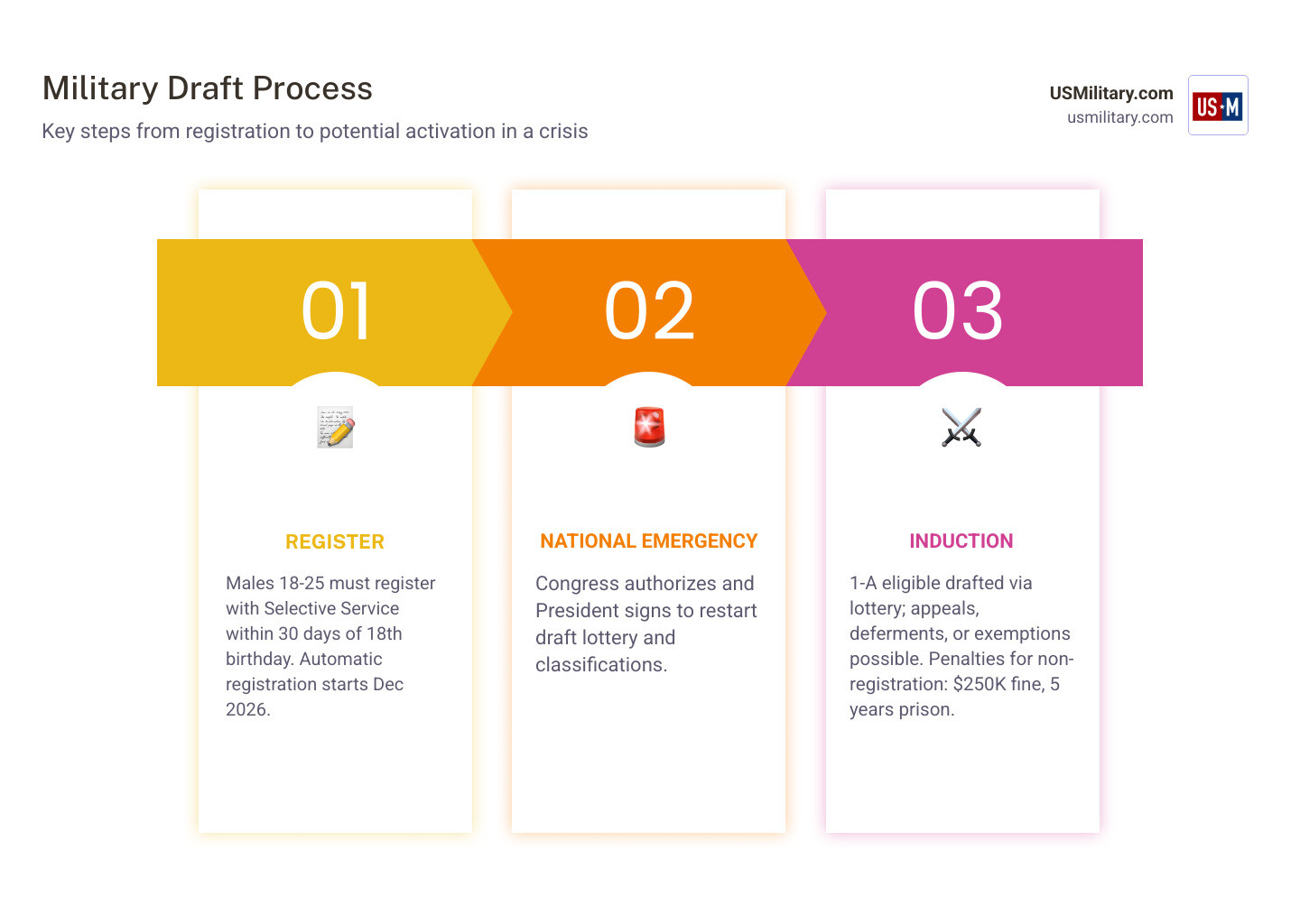
Military draft terms explained:
- Does the US currently have a military draft
- What disqualifies you from the military draft
- age for military draft
Current Status and the Future of the Military Draft

At USMilitary.com, we often receive questions from young men and their parents asking: “Is there a draft right now?” The short answer is no. The United States has operated as an all-volunteer force since 1973. However, the “machinery” of the draft—the Selective Service System (SSS)—is very much alive and well.
Currently, the law requires almost all male U.S. citizens and male immigrants living in the U.S., ages 18 through 25, to register. This isn’t an enlistment; it’s a database. The government keeps this list so that if a massive national emergency occurs, they can quickly identify who is available to serve.
But big changes are on the horizon. A provision in the National Defense Authorization Act (NDAA) is set to transform how this works. Starting December 18, 2026, the U.S. will shift to automatic registration. Instead of 18-year-olds having to remember to sign up at the post office or on a website, the Selective Service System will automatically register eligible individuals by pooling information from other federal databases.
This shift is largely a response to what some experts call an “abject failure” of the current voluntary system. Many young men simply don’t register, and even fewer report their new addresses when they move. By automating the process, the government aims to create a more accurate list, though critics argue this moves the U.S. closer to a draft activation than we’ve been in half a century. You can read more about who must register under the current rules to ensure you’re compliant before the 2026 changes take effect.
Mandatory Registration Requirements for the Military Draft
Who exactly needs to be on this list? It’s broader than you might think. It includes:
- All male U.S. citizens (born in the U.S., dual citizens, and naturalized citizens) living in the U.S. or abroad.
- Male immigrants, including legal permanent residents, refugees, asylum seekers, and even undocumented immigrants.
- Men with disabilities who are capable of functioning in a civilian or military capacity.
There are very few exceptions. Those on active duty, some incarcerated individuals, and those in hospitals or institutions are exempt only while they are in those specific situations. Once they are released or finish their service (if before age 26), they must register.
The benefits and penalties are serious. While the government hasn’t sent anyone to jail for failing to register since 1986, the “soft” penalties are what usually bite. If you don’t register by age 26, you permanently lose eligibility for:
- Federal Student Aid (FAFSA): You can’t get Pell Grants or federal loans.
- Federal Jobs: This includes positions with the USPS and many government contractors.
- U.S. Citizenship: For immigrants, failing to register can be a deal-breaker for naturalization.
- State Benefits: Many states link draft registration to your driver’s license or state-funded financial aid.
Legally, it remains a felony punishable by a $250,000 fine and a 5-year prison term. We always tell our community: it’s just not worth the risk. Spend the two minutes to register and keep your future options open.
History of Conscription in the United States
The military draft isn’t a modern invention; it has deep roots in American history. The U.S. has used conscription in six major conflicts. During the Civil War, the Confederacy passed the first act in 1862, followed by the Union’s Enrollment Act of 1863. Interestingly, back then, you could pay a “substitute” to go in your place—a practice that led to the famous and violent New York City draft riots.
In World War I, the government realized it couldn’t rely on volunteers alone. In the first six weeks of the war, only 73,000 men volunteered when the goal was 1 million. The Selective Service Act of 1917 changed everything. By the end of 1918, 24 million men were registered, and nearly 3 million were inducted.
World War II saw the first peacetime draft in U.S. history with the 1940 Selective Training and Service Act. The scale was massive: 49 million men registered, and 10 million were ultimately inducted. Public support was high initially; in 1940, 71% of Americans supported compulsory military training because they saw the danger of a German-Italian victory. You can dive deeper into these historical conscription records to see how the numbers shifted across different eras.
The Military Draft During the Vietnam War Era
The Vietnam War is perhaps the most controversial chapter in the history of the military draft. Between 1964 and 1973, the draft raised 2.2 million men for service. This era introduced the draft lottery, a televised event where birth dates were drawn to determine the order of induction.
Public opposition was fierce. We saw:
- Draft Dodging: Approximately 570,000 people were classified as draft dodgers.
- Exodus: Nearly 100,000 men left the country, mostly to Canada, to avoid service.
- Legal Battles: Over 210,000 were formally charged with violations, though only 3,250 were jailed.
The inequality of the system—where wealthier men could often secure college deferments while lower-income and minority men were drafted at higher rates—led to a total collapse of public trust. This eventually led to the end of active conscription in January 1973. President Gerald Ford later offered amnesty, and President Jimmy Carter issued a full pardon to Vietnam-era draft dodgers in 1977. You can still view the Vietnam lottery records to see how birth dates were ranked during those turbulent years.
Classifications, Exemptions, and Deferments
If a draft were ever reinstated, the SSS wouldn’t just grab everyone and put them in a uniform. There is a complex classification system designed to determine who is actually fit and available for service.
Historically, these were the heavy hitters:
- 1-A: Available for military service. This is the “ready to go” category.
- 4-F: Not qualified for military service (due to physical, mental, or moral reasons).
- 3-A: Hardship deferment (if your induction would cause extreme hardship to your dependents).
- 2-S: Student deferment (historically used for college students, though this was severely limited during the later Vietnam years).
One of the most important categories is the Conscientious Objector (CO). A CO is someone who, for religious or moral reasons, is opposed to serving in the war. There are two main types:
- 1-A-O: You serve in the military but in a noncombatant role (like a medic).
- 1-O: You do not join the military at all but perform civilian work that contributes to national health or safety (Civilian Public Service).
In WWII, about 52,000 men received CO status. During the Vietnam War, the number of CO exemptions grew significantly as the war became more unpopular. If you’re interested in the ethics and legalities of this, the SSS provides extensive conscientious objection research on how these claims are processed.
Legal Challenges and Reinstatement Debates
Is it legal to force people into the military? The Supreme Court says yes. In 1918, the Court ruled that the draft did not violate the Constitution. However, the most debated legal issue today is male-only registration.
In the 1981 case Rostker v. Goldberg, the Supreme Court upheld the male-only draft because women were excluded from combat roles at the time. But since 2013, all combat positions have been open to women. This has led to new lawsuits. In 2019, a federal judge in Texas actually ruled the male-only draft unconstitutional, though that was later overturned. For now, the Rostker v. Goldberg precedent stands, but many in Congress are pushing for a gender-neutral draft.
Beyond gender, there are also “backdoor” drafts and specialized drafts to consider:
- Stop-Loss Orders: This allows the military to retain service members beyond their contract end date during a crisis. Over 50,000 troops were affected by this during the Iraq War.
- HCPDS (Health Care Personnel Delivery System): This is a “special skills” draft for doctors and nurses. It would include both men and women ages 20–54. You can find more information regarding how medical professionals are categorized under the Health Care Personnel Delivery System.
Arguments for reinstating the draft often center on “social equity”—the idea that if everyone’s children are at risk of being drafted, the country will be less likely to enter “forever wars.” Arguments against it focus on individual liberty and the superior effectiveness of a highly trained, professional all-volunteer force.
Frequently Asked Questions about the Draft
Could the draft be reinstated today?
Technically, yes, but it is politically very unlikely. For a draft to return, it would require a massive national emergency that the all-volunteer force couldn’t handle. Then, Congress would have to pass a law, and the President would have to sign it. The SSS maintains a detailed process to return to a draft that involves a lottery and then a period for draftees to claim deferments or exemptions.
Are women required to register?
No. Currently, only men (as assigned at birth) are required to register. While there have been many legislative proposals to include women—especially since combat roles were opened to them—none have become law yet. This remains one of the most active debates in military policy today.
What happens if I don’t register?
As we mentioned, you likely won’t go to jail, but you will be “locked out” of the American dream in many ways. You won’t get federal student loans for college, you’ll be barred from federal and many state jobs, and if you’re an immigrant, you may never be able to become a citizen. It’s a permanent mistake that is very difficult to fix after you turn 26.
Conclusion
At USMilitary.com, we believe that staying informed is the best way to serve our country and protect your future. The military draft may seem like a relic of the past, but it remains a critical part of our national defense strategy. Whether we continue with our successful all-volunteer force or move toward a system of national service, the requirements of the Selective Service are a reality for every young man in America.
If you have more questions about military service, benefits, or how to navigate your career path, we are here to help. You can stay updated on the latest news, from NDAA changes to VA disability updates, by visiting USMilitary.com. Knowledge is power—make sure you have it.
Free for Service Members & Veterans
Get the military benefits intel no one tells you about.
Weekly updates on VA benefits, pay changes, and money tips — free for service members and veterans.
No spam. Unsubscribe anytime. Your info is never shared.


