The military communication alphabet is a system of 26 code words — one for each letter of the English alphabet — used to spell out words clearly over radio and phone, where static, noise, and accents can turn a simple letter into a deadly misunderstanding.
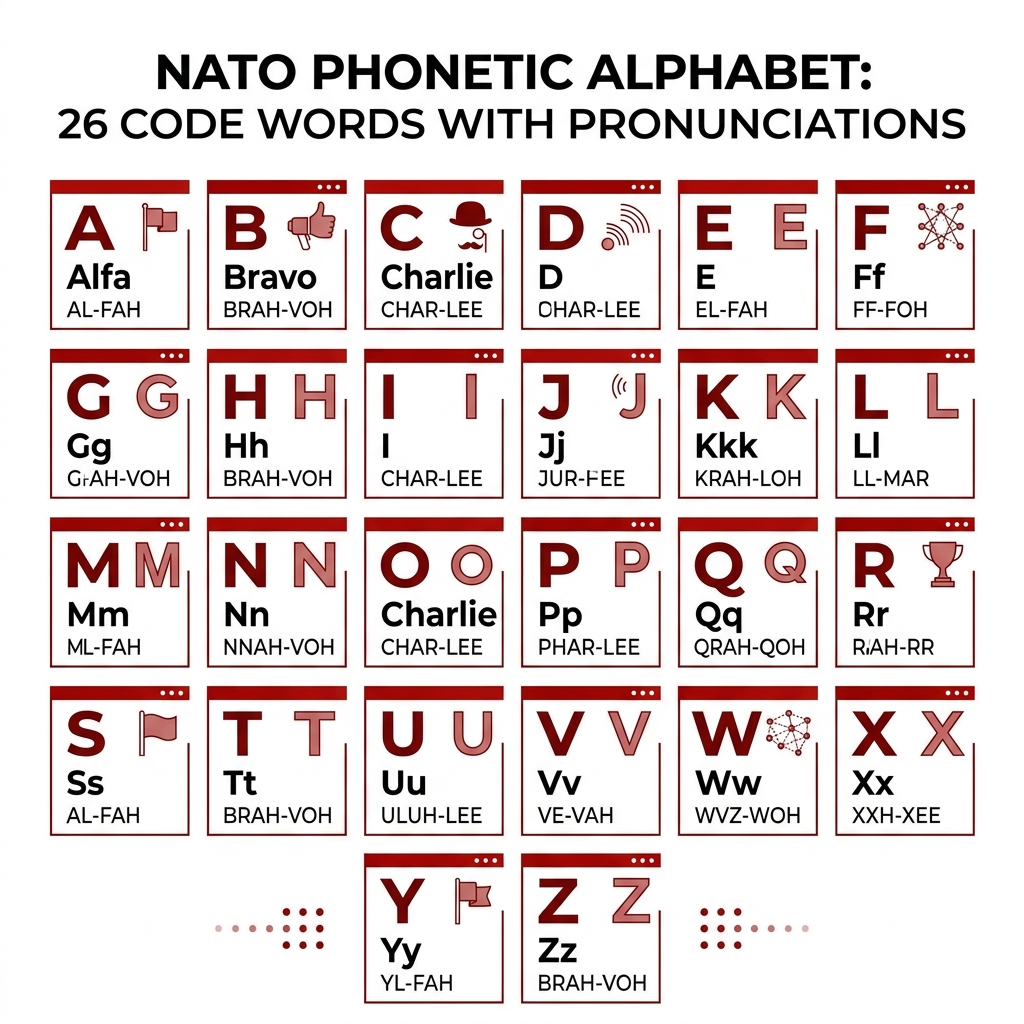
Here’s the full alphabet at a glance:
| Letter | Code Word | Letter | Code Word |
|---|---|---|---|
| A | Alfa | N | November |
| B | Bravo | O | Oscar |
| C | Charlie | P | Papa |
| D | Delta | Q | Quebec |
| E | Echo | R | Romeo |
| F | Foxtrot | S | Sierra |
| G | Golf | T | Tango |
| H | Hotel | U | Uniform |
| I | India | V | Victor |
| J | Juliett | W | Whiskey |
| K | Kilo | X | Xray |
| L | Lima | Y | Yankee |
| M | Mike | Z | Zulu |
Think about how easily the letter “B” sounds like “D,” “E,” or “P” over a crackling radio. Now imagine that confusion happening during a rescue mission or a battlefield order. That’s exactly the problem this system was built to solve.
Officially known as the International Radiotelephony Spelling Alphabet (IRSA), it was adopted by NATO in 1956 after being tested with hundreds of thousands of comprehension checks across speakers from 31 different nations. It’s not just a military tool — aviation, shipping, law enforcement, and even hospital staff use it every day.
I’m Larry Fowler, publisher of the USMilitary.com Network since 2007, and I’ve spent years helping active-duty members, veterans, and recruits understand the tools and systems — like the military communication alphabet — that define military life. In the sections below, we’ll break down everything you need to know, from the history of the alphabet to how it’s used on the ground today.
What is the Military Communication Alphabet?
At its core, the military communication alphabet is a standardized set of words used to represent the letters of the English alphabet in oral communication. While most of us simply call it the “military alphabet” or the “phonetic alphabet,” it carries several official names depending on which organization you ask. It is formally known as the International Radiotelephony Spelling Alphabet (IRSA). You might also hear it referred to as the ICAO (International Civil Aviation Organization) or ITU (International Telecommunication Union) phonetic alphabet.
One common point of confusion we often see is the difference between a “spelling alphabet” and a “linguistic phonetic alphabet.” If you were a linguist, a phonetic alphabet (like the International Phonetic Alphabet or IPA) would be used to describe the actual sounds of human speech. However, in the military and aviation worlds, we use a “spelling alphabet.” Its job isn’t to tell you how a word sounds in a dictionary sense, but to ensure that when you say “B,” the person on the other end of a crackling radio doesn’t hear “D.”
The primary goal of this system is NATO phonetic alphabet, codes and signals standardization. By using a single, globally recognized list of words, forces from dozens of different nations can coordinate complex operations without language barriers getting in the way. Whether you are an American pilot or a French air traffic controller, “Alpha” always means “A.” This multilingual accessibility is a cornerstone of modern global security and US Navy Telecommunications Careers.
The 26 Code Words and Their Pronunciation
Mastering the military communication alphabet requires more than just knowing the words; you have to know how to say them. The system was designed to be “noise-resistant,” meaning the words were chosen because they sound distinct even when there is heavy background noise or radio interference.
To help you master the nuances, we’ve put together a table that includes the specific phonic pronunciations used in training. You’ll notice some odd spellings—these are intentional to help non-English speakers avoid common pronunciation traps.
NATO Phonetic Alphabet Pronunciation Guide
| Letter | Code Word | Phonic Pronunciation (Stress in CAPS) |
|---|---|---|
| A | Alfa | AL-fah |
| B | Bravo | BRAH-voh |
| C | Charlie | CHAR-lee |
| D | Delta | DELL-tah |
| E | Echo | ECK-oh |
| F | Foxtrot | FOKS-trot |
| G | Golf | GOLF |
| H | Hotel | hoh-TELL |
| I | India | IN-dee-ah |
| J | Juliett | JEW-lee-ETT |
| K | Kilo | KEY-loh |
| L | Lima | LEE-mah |
| M | Mike | MIKE |
| N | November | no-VEM-ber |
| O | Oscar | OSS-cah |
| P | Papa | pah-PAH |
| Q | Quebec | kweh-BECK |
| R | Romeo | ROW-me-oh |
| S | Sierra | see-AIR-rah |
| T | Tango | TANG-go |
| U | Uniform | YOU-nee-form |
| V | Victor | VIK-tah |
| W | Whiskey | WISS-key |
| X | Xray | ECKS-ray |
| Y | Yankee | YANG-kee |
| Z | Zulu | ZOO-loo |
You might notice that “Alfa” is spelled with an ‘f’ and “Juliett” has an extra ‘t.’ This was done because, in some languages like French, a single ‘t’ at the end of a word might be silent, and ‘ph’ isn’t always pronounced as ‘f.’ By tweaking the spelling, the ICAO ensured that the Evolution and Rationale of the ICAO Word-Spelling Alphabet remained consistent across 31-nation comprehension testing.
This level of detail is exactly what you would learn if you chose to Serve as a U.S. Army Interpreter and Translator, where precision is the difference between success and failure.
History and Evolution of Military Phonetics
The military communication alphabet we use today didn’t just appear overnight. It is the result of over a century of trial and error.
In the early days of radio, different branches and nations had their own systems. The 1913 Navy Bluejackets’ Manual included an early version, but it was far from universal. By 1927, the CCIR (International Radio Consultative Committee) developed a version for telegrams, which the ITU updated in 1938.
However, the real push for a unified system came during World War II. The U.S. used the JANAP (Joint Army/Navy Phonetic Alphabet), famously known as the “Able Baker” alphabet. If you’ve ever watched an old war movie and heard a soldier say “Able, Baker, Charlie, Dog,” you’re hearing the WWII-era precursor to our current system.
While “Able Baker” worked for English speakers, it was difficult for international allies to use. After the war, the ICAO began working with Jean-Paul Vinay, a professor of linguistics, to create a truly global standard. They tested hundreds of thousands of words before finally settling on the current list. In 1956, the ICAO officially adopted the alphabet, and NATO followed suit on March 1, 1956.
Several words were replaced in this final transition. For example, “Nan” became “November” and “Sugar” became “Sierra.” Since that 1956 adoption, the alphabet has remained remarkably stable, providing a consistent foundation for ICAO aviation safety standards and military operations worldwide.
Beyond the Battlefield: Who Uses the Alphabet?
While we often associate these codes with soldiers in foxholes, the military communication alphabet is a workhorse in the civilian world.
Aviation and Shipping The most prominent users are pilots and air traffic controllers. Every flight plan, tail number, and taxiway is communicated using these words. Similarly, the IATA airline identifiers and IMO maritime communication protocols rely on the alphabet to exchange port names and vessel details without error.
Global Trade and Logistics In shipping, a single misheard digit in a container number can lead to thousands of dollars in losses. Logistics professionals use the alphabet to confirm Bill of Lading numbers and port codes (like CNSHA for Shanghai).
Public Safety and Professional Services
- Law Enforcement: Police officers use it to call in license plate numbers (e.g., “1-2-3-Adam-Boy-Charles” in some local variants, though many are moving to the NATO standard).
- Information Technology: IT workers use it to communicate complex serial numbers or software keys over the phone.
- Medical Contexts: Doctors and nurses use it to spell out difficult drug names or patient identifiers to ensure absolute accuracy.
Whether you are looking into a Communication Job as a US Army Satellite Systems Operator or working in a local hospital, this alphabet is a skill that translates across almost every industry.
Advanced Tactics: Numbers, Punctuation, and Slang
Communication in the military isn’t just about spelling out names; it involves a whole “language” of numbers, prowords, and shorthand.
Pronouncing Numbers
To avoid confusion, some numbers are pronounced differently than they are in standard English:
- 3 (Tree): Said as “TREE” to avoid the “th” sound which can be hard to hear.
- 4 (Fower): Said as “FOW-er” (two syllables).
- 5 (Fife): Said as “FIFE” with a strong ‘f’ at the end to distinguish it from “fire.”
- 9 (Niner): Said as “NINER” to distinguish it from “five” or the German word “nein” (no).
Military Slang and Prowords
The alphabet has also birthed a unique set of slang terms that we use in daily military life:
- Bravo Zulu (BZ): This comes from naval signal flags and means “Well Done.”
- Charlie Mike (CM): “Continue Mission.”
- Oscar Mike (OM): “On the Move.”
- Zulu Time: Refers to Greenwich Mean Time (GMT), the universal time standard for the military. You can learn more about understanding military time here.
- Victor Charlie (VC): A historical term for the Viet Cong during the Vietnam War.
- 11 Bravo: The MOS (Military Occupational Specialty) code for Army Infantry.
Regional Variants
While the NATO standard is the goal, you may still encounter regional variations. For instance, in the Philippines, “Hawk” is sometimes used for “Hotel.” In Indonesia, “London” might replace “Lima” because lima is the local word for the number five. Even in the U.S., some airports might swap “Delta” for “Dixie” or “David” to avoid confusion with Delta Air Lines.
Understanding these nuances is a key part of the Radio and Communications Security Repairer Jobs in the National Guard.
Frequently Asked Questions about the Military Communication Alphabet
Why is the military communication alphabet called “phonetic” if it isn’t linguistic?
It’s actually a bit of a misnomer. In linguistics, a “phonetic alphabet” maps out every individual sound (phoneme) in human speech. The military communication alphabet is technically a “spelling alphabet.” However, because it uses words to represent the phonetic sound of a letter, the name stuck. Its purpose is clarity, not linguistic transcription.
How does the military communication alphabet ensure clarity across different accents?
The system uses “acrophony”—choosing words where the first letter is the one being represented. The words were chosen after hundreds of thousands of tests with 31 different nationalities. The researchers looked for words with distinctive sounds that didn’t rhyme with others and were resistant to the “auditory illusions” caused by radio static.
Are there different versions of the military communication alphabet used today?
While the NATO/ICAO standard is the “gold standard” used by the U.S. military and international aviation, some local police departments and specific countries still use older or regional versions. For example, British police sometimes use “Indigo” instead of “India,” and some maritime organizations use a slightly different set of words for numbers (like “Unaone” or “Beesosorrow”).
Conclusion
Mastering the military communication alphabet is one of the first steps toward true professionalism in the armed forces. It’s more than just a list of words; it’s a commitment to clarity, precision, and safety. Whether you are preparing for Military Basic Training or looking to advance your civilian career in aviation or logistics, these 26 words are your key to being understood in even the most chaotic environments.
At USMilitary.com, we are dedicated to providing you with the resources you need to succeed in your military journey. From understanding tactical communications to finding the right career path, we are here to support our service members and veterans every step of the way. If you’re ready to take the next step, Master the Military Alphabet and start communicating like a pro today.
Free for Service Members & Veterans
Get the military benefits intel no one tells you about.
Weekly updates on VA benefits, pay changes, and money tips — free for service members and veterans.
No spam. Unsubscribe anytime. Your info is never shared.


