Is Age Really Just a Number? What You Need to Know About the Age Waiver for Army Reserve
Getting an age waiver for Army Reserve enlistment is possible — and more common than most people think. Here’s a quick breakdown:
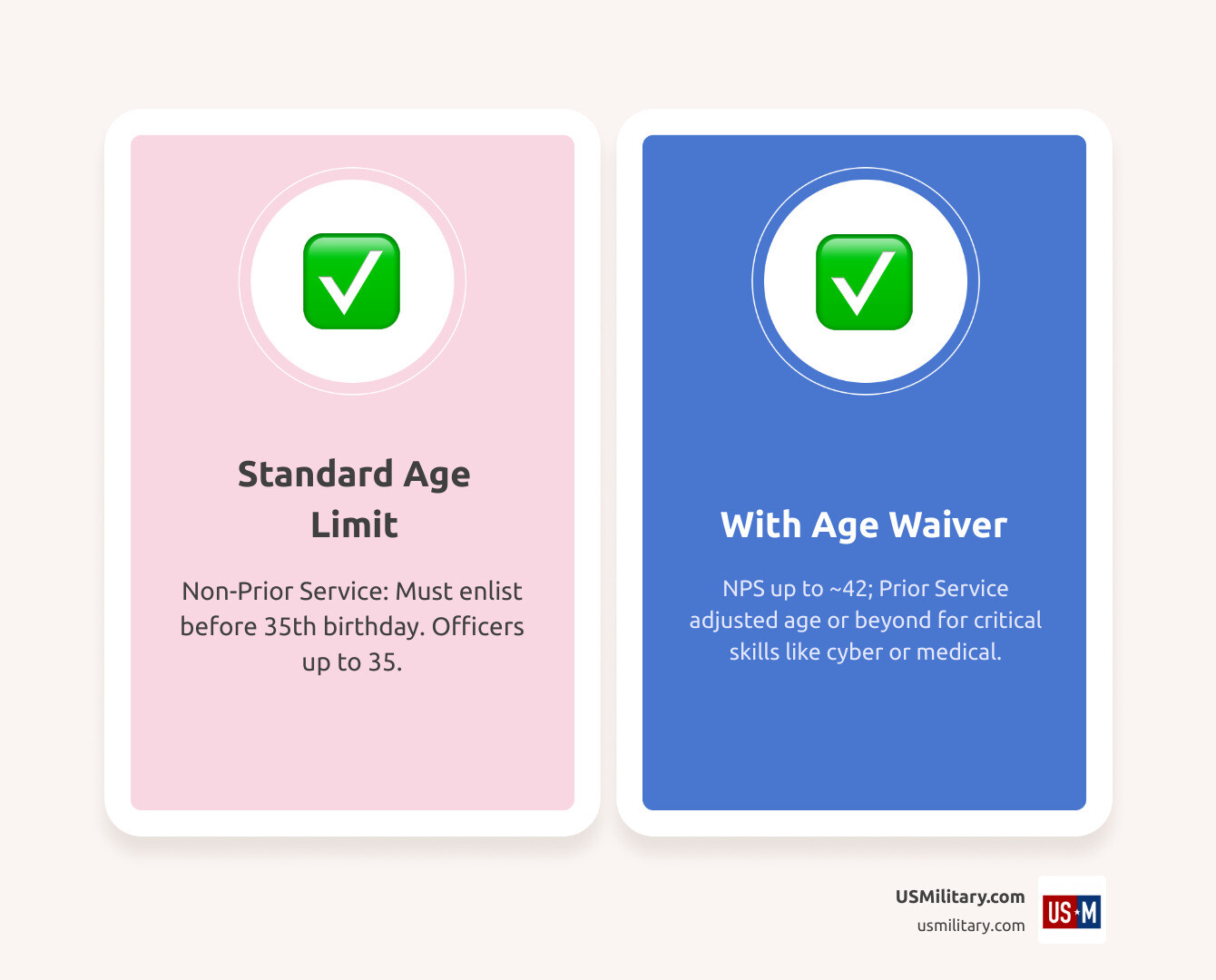
| Applicant Type | Standard Age Limit | Max Age With Waiver |
|---|---|---|
| Non-Prior Service (NPS) | 35 years old | Up to ~42 (case-by-case) |
| Prior Service | Adjusted age (subtract service years) | Up to ~42 or beyond for critical roles |
| Officers (OCS) | 35 years old | Up to 40 |
| Warrant Officers | 46 years old | Case-by-case |
| Reenlistment | Up to age 60 at ETS | Up to 62 (Sanctuary Program) |
Think your age disqualifies you from the Army Reserve? You might be wrong.
The Army Reserve has more flexibility on age than most people realize. While the standard cutoff is your 35th birthday for non-prior service applicants, waivers are granted regularly — especially for people with prior military service or in-demand skills like healthcare, cybersecurity, or aviation.
Real people are making it happen. One 42-year-old had his age waiver approved in just two days by Army Reserve Command. A 59-year-old with a prior spinal fusion secured both an age waiver and a medical waiver for a critical shortage MOS. These aren’t flukes — they’re the result of knowing the process and finding the right recruiter.
This guide walks you through exactly how it works, step by step.
I’m Larry Fowler, publisher of USMilitary.com, where I’ve spent nearly two decades helping active-duty members, veterans, and aspiring recruits navigate complex military topics — including the age waiver for Army Reserve process. Let’s break it all down so you know exactly where you stand and what to do next.
Age waiver for army reserve word guide:
- army reserve max age
- army reserve officer age limit prior service
- can i join the military at 43 years old
Understanding the Standard Age Limit and the Age Waiver for Army Reserve
When we talk about joining the military, the first thing most people look at is the calendar. According to Army Regulation 601-210, the standard maximum age to enlist in the Army Reserve for non-prior service (NPS) applicants is 35. This means you must typically raise your right hand and swear in before your 35th birthday.
However, “standard” doesn’t mean “absolute.” The Army Reserve often has different needs than the active-duty component, leading to more frequent approvals for an age waiver for Army Reserve. While the U.S. Army requirements and age standards are the baseline, the Reserve component is designed to leverage civilian expertise, which often comes with a few more candles on the birthday cake.
If you are over 35, you aren’t automatically disqualified. You are simply “exception-based.” This means a recruiter must submit a formal request to show why your skills, fitness, and background outweigh the fact that you’ve passed the standard cutoff. For more info about your age and the Army, it is vital to understand that the Army Reserve is looking for quality over a specific birth year.

The Difference Between NPS and Prior Service Applicants
The rules change significantly if you have worn the uniform before. For prior service (PS) members, the Army uses a “subtraction formula” to determine eligibility. Essentially, you take your current age and subtract the number of years you previously served on active duty or in a reserve component.
For example, if you are 41 years old but served six years in the Navy, your “adjusted age” for enlistment purposes is 35. This often allows veterans to bypass the need for a formal age waiver for Army Reserve entirely, as they technically fall back within the standard window. This policy is part of why joining the Army National Guard or Reserve is such a popular path for veterans who want to continue their service.
Why the Army Grants Age Exceptions
Why would the Army want a 40-year-old recruit? It comes down to the “Needs of the Army.” We see waivers granted most often when an applicant fills a “critical shortage” role. If the Army is short on cybersecurity experts, linguists, or specialized engineers, they are much more likely to overlook a few extra years of age to get that expertise into a unit.
How Prior Service and Specialized Skills Impact Eligibility
Your professional background is your biggest leverage when seeking an age waiver for Army Reserve. The Army Medical Department (AMEDD), for instance, has its own set of rules. We have seen medical professionals, such as doctors and nurses, join well into their 40s and 50s because their civilian training is invaluable.
In one notable case, a 59-year-old with specialized medical skills (MOS 61M) was granted a waiver despite having a history of spinal fusion. This proves that if your skill set is rare enough, the Army will work hard to get you through the door. This flexibility is one of the key benefits of looking beyond active duty age limits for joining the reserves.
Calculating Your Adjusted Age for Enlistment
Calculating your eligibility doesn’t require a math degree, but you do need to be precise.
- Start with your current age.
- Subtract your total years of prior honorable service.
- If the result is 35 or lower, you are generally eligible without a waiver.
- If the result is over 35, you will need to pursue a waiver.
That you must still be able to complete 20 years of qualifying service for retirement before reaching the mandatory retirement age (usually 60 or 62). Meeting the requirements to join the Army at an older age requires a clear path to that 20-year mark.
High-Demand Roles and the Age Waiver for Army Reserve
Certain Military Occupational Specialties (MOS) are “waiver-friendly.” If you are looking into Army National Guard careers or Reserve roles in these fields, your chances of approval skyrocket:
- Aviation (15-series): While pilot slots have strict age caps (usually 27.5-32), maintenance and support roles are often more flexible.
- Cybersecurity (17-series): The Army is in a “war for talent” with the private sector.
- Healthcare (60-68 series): Doctors, surgeons, and specialized nurses are always in high demand.
Step-by-Step Guide: How to Apply for an Age Waiver for Army Reserve
Applying for an age waiver for Army Reserve is not something you do alone. It is a coordinated effort between you and your recruiter. Here is the standard operating procedure:
- Find a “Can-Do” Recruiter: Not all recruiters want to do the paperwork for a waiver. If one tells you “no,” call another. Dial 1-888-550-ARMY to find local offices.
- The ASVAB and Physical: You cannot get a waiver for a “maybe.” You must first prove you are worth the effort by scoring well on the ASVAB and passing the physical at the Military Entrance Processing Station (MEPS).
- The Paperwork: Your recruiter will help you prepare DA Form 4187 (Personnel Action).
- The Justification: You will likely need to write a letter of justification. This is your chance to explain why your civilian experience makes you an asset.
- Submission: The packet goes to the Army Reserve Careers Group (ARCG) or U.S. Army Reserve Command (USARC) G-1 for approval.
Securing a waiver is a test of patience. We’ve seen approvals come back in 48 hours, while others take months. Knowing how to join the National Guard and Reserves means being ready for a bit of “wait and see.”
The Step-by-Step Process to Secure an Age Waiver for Army Reserve
The process is linear. You won’t even see available jobs (MOS) in the system until that age waiver is officially stamped “Approved.” This can be frustrating, but it’s why we recommend having a “Top 3” list of jobs you want so you’re ready to sign the moment the waiver clears. Any issues regarding military enlistment—like minor medical history—should be handled simultaneously to avoid multiple delays.
Physical and Medical Standards for Older Applicants
Don’t think that an age waiver gives you a pass on the treadmill. In fact, older applicants are often scrutinized more closely. You must meet the same height/weight standards and eventually pass the Army Combat Fitness Test (ACFT).
We recommend starting a fitness regimen months before talking to a recruiter. Focus on joint health and functional strength. When asking, “Are you the average age for enlistment?“, the answer for most is “no,” but your fitness level should say “yes.”
Officer and Warrant Officer Age Requirements
If you are looking to lead, the age rules are slightly different. For Officer Candidate School (OCS), the standard max age is 35, but waivers are frequently available up to age 40. For Warrant Officers, who are the Army’s technical experts, the limit is even higher at 46.
According to the ARCG Officer Pre-Reqs and age guidance, candidates must possess a General Technical (GT) score of 110 or higher. If you have a professional degree, such as a JD or MD, you might qualify for a Direct Commission, which often has the most generous age flexibility of all. This is a common route for those exploring National Guard opportunities in legal or medical fields.
Officer Candidate School (OCS) Age Exceptions
To get an OCS waiver, you generally need to show significant leadership experience in your civilian career or have high college credits. The Army wants to see that your “life experience” translates into “leadership potential.” This is especially true for specialized roles like the Army National Guard Chaplain Corps, where maturity is a prerequisite for the job.
Officer and Warrant Officer Age Waiver for Army Reserve Criteria
Warrant Officer Flight Training (WOFT) is the exception to the “older is fine” rule. To become an aviator (MOS 153A), you generally must appear before the board before age 32, with very few waivers granted beyond that. However, for technical Warrant Officers (like CID or Signal Corps), being 40+ is often seen as an advantage because of the depth of technical expertise you bring.
Serving Beyond 60: The Sanctuary Program and Retention
What happens once you’re in? Standard policy requires Reserve soldiers to retire at age 60. However, the “Sanctuary Program” exists to protect those who are close to their retirement benefits.
If a soldier has between 18 and 20 qualifying years for retirement, they can be retained up to age 62 to ensure they reach that 20-year milestone. This requires approval from HQDA G-1 and a medical retention statement from a commander. Understanding these nuances is one of many 3 reasons to join the Army National Guard or Reserve: the system is designed to help you reach your finish line.
For those interested in the legalities, 32 USC 313: National Guard age limitations provides the federal framework for these age caps, but the Army Reserve follows similar logic to ensure force readiness.
Frequently Asked Questions about Army Reserve Age Waivers
What is the absolute maximum age to join the Army Reserve with a waiver?
While 35 is the standard, we have seen non-prior service waivers approved up to age 42. For prior service members, the “adjusted age” can allow people in their 50s to serve, provided they can reach 20 years of service by age 62.
Can I join the Army Reserve at 45 if I have never served?
It is extremely rare for a 45-year-old with zero prior service to join unless they are a licensed physician, chaplain, or high-level cyber expert. For most general MOS roles, the “hard cap” even with waivers is usually around 42.
Does the Army Reserve have different age limits than the National Guard?
Yes. The National Guard often allows non-prior service enlistment up to age 45 depending on the state’s needs. The Army Reserve (which is federal) tends to stick closer to the 35-year-old limit but offers more robust waiver pathways for technical roles.
Conclusion
At USMilitary.com, we believe that your desire to serve shouldn’t be dismissed just because of a date on a birth certificate. The age waiver for Army Reserve process is the Army’s way of saying, “If you’re talented and fit, we want you.”
Whether you are a veteran looking to return to the fold or a civilian professional wanting to give back, the first step is always the same: talk to a recruiter. Be persistent, stay fit, and keep your eye on your career goals. The military community is built on diversity of experience, and that includes the wisdom that comes with age.
Ready to see if you qualify? Check the current age limit to join the military and start your journey today. We are here to support you every step of the way.
Free for Service Members & Veterans
Get the military benefits intel no one tells you about.
Weekly updates on VA benefits, pay changes, and money tips — free for service members and veterans.
No spam. Unsubscribe anytime. Your info is never shared.


