What Is the Military Enlistment Process? A Step-by-Step Overview
The military enlistment process is the path you follow to officially join the U.S. Armed Forces — from your first conversation with a recruiter to the moment you ship out to basic training.
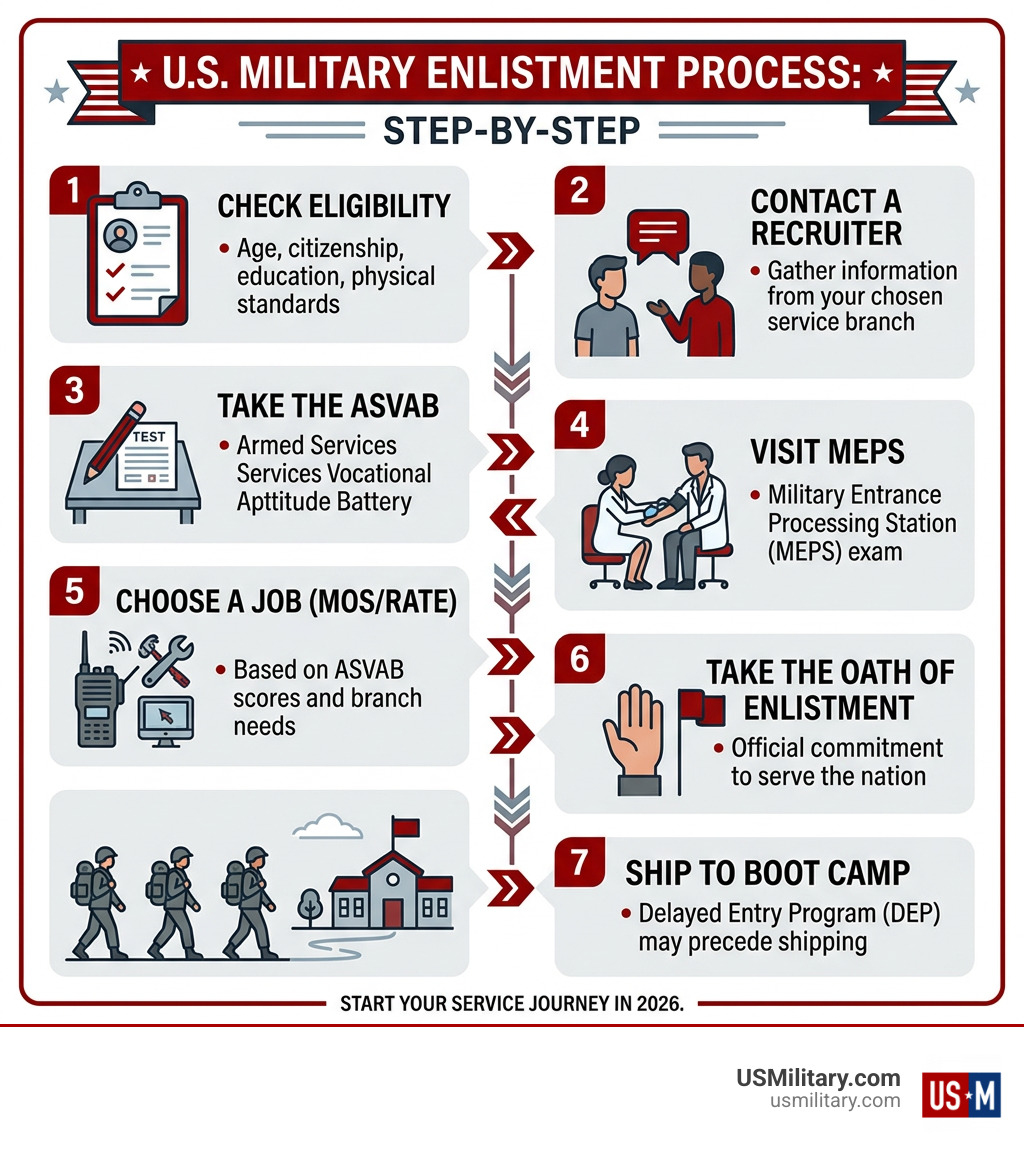
Here are the core steps, in order:
- Check eligibility — age, citizenship, education, and physical health
- Contact a recruiter — for your chosen branch
- Take the ASVAB — the aptitude test that shapes your job options
- Visit MEPS — complete your medical exam, career counseling, and background review
- Choose a job — based on your scores, needs, and branch availability
- Take the Oath of Enlistment — your official commitment to serve
- Ship out or enter DEP — either head to boot camp soon or join the Delayed Entry Program
It can feel overwhelming at first. Each branch has different rules, timelines, and requirements — and finding clear, trustworthy information isn’t always easy.
But the good news? The process follows a predictable structure, no matter which branch you’re considering.
I’m Larry Fowler, publisher of the USMilitary.com Network, and I’ve spent nearly two decades helping people navigate the military enlistment process — connecting thousands of qualified prospects with Army, Navy, Air Force, Coast Guard, and National Guard recruiters. In this guide, I’ll walk you through every step so you know exactly what to expect.
Common Military enlistment process vocab:
- Active duty recruiters near me
- Military recruiter near me
- Top 10 lies military recruiters tell prospects today
Phase 1: Meeting Eligibility and the Military Enlistment Process
Before you ever set foot in a recruiting office, you need to know if you meet the baseline requirements to join the U.S. military. Eligibility isn’t just about being “tough enough”; it’s a combination of legal, medical, and educational standards.
One of the most frequent questions we hear at USMilitary.com is about the Age Limit to Join Military service. These limits have shifted recently as branches look to expand their talent pools. For example, the Navy raised its maximum age to 41 in late 2022, and the Air Force now accepts recruits up to age 42.
| Branch | Minimum Age | Maximum Age (Enlisted) |
|---|---|---|
| Air Force | 17 | 42 |
| Army | 17 | 35 |
| Coast Guard | 17 | 41 |
| Marine Corps | 17 | 28 |
| Navy | 17 | 41 |
| Space Force | 17 | 42 |
Note: 17-year-olds require parental consent to enlist.
Beyond age, you must be a U.S. citizen or a non-citizen with a valid U.S. Permanent Resident Card (Green Card). Non-citizens must also be able to speak, read, and write English fluently. It is important to remember that joining the military cannot be used as a way to enter the U.S. or obtain a visa.
Physical standards are also rigorous. Every recruit must pass a medical exam and meet height/weight requirements. If you’re looking at the Army specifically, check out An Essential Guide to Army Eligibility Requirements for a deeper dive into their specific standards.
Education and Testing in the Military Enlistment Process
Your brain matters just as much as your brawn. Traditionally, a high school diploma has been the gold standard for enlistment. While you can join with a GED, many branches limit the number of GED holders they accept each year. You can improve your odds as a GED holder by earning college credits or scoring higher on your entrance exams.
Interestingly, the Navy recently introduced a new policy: as of early 2024, they may waive the high school diploma requirement for recruits who score a 50 or higher on the Armed Forces Qualification Test (AFQT). This is part of a broader trend of Preparing for the Military by Succeeding in the Classroom.
The AFQT is actually a subset of the ASVAB. If you want the “real deal” on how these tests work, you must read The Truth About the ASVAB Test. Your scores here don’t just determine if you get in, but what jobs you can do once you’re there.
Choosing Between Active Duty, Reserve, and Guard
One of the biggest decisions in the military enlistment process is choosing your service “flavor.”
- Active Duty: This is your full-time job. You live on or near a base and serve 24/7.
- Reserve: You serve part-time, typically “one weekend a month, two weeks a year,” while maintaining a civilian career or going to school.
- National Guard: Similar to the Reserves but with a dual mission. You can be called up by your State Governor for local emergencies or by the President for federal missions. If this sounds like your path, learn how to Join the National Guard or see How to Choose Which Reserve to Join Military units.
If you have a four-year college degree, you might consider the officer path rather than enlisting. Officers are the managers and leaders of the military. Many students use Your Guide to Understanding the ROTC to pay for college while preparing for a commission.
Phase 2: Working with a Recruiter and the ASVAB
Once you’ve done your initial research, it’s time to talk to a professional. You can Find Military Recruiter 2023 (and 2024/2025!) through our platform to get started.
Think of the recruiter meeting like a two-way interview. They are looking for quality candidates, but you should be looking for the right fit. We recommend bringing a parent or a trusted friend for support. To make the most of your time, review these Top Questions to Ask Military Recruiters Before Joining.
Each branch has a different culture and mission. You might find that you’re a better fit for the Air Force if you love technology, or perhaps the Marines if you’re looking for the ultimate physical challenge. There are 4 Great Military Branches to Choose From (plus the Coast Guard and Space Force), so don’t feel pressured to sign with the first one you visit.
Mastering the ASVAB for Job Placement
The Armed Services Vocational Aptitude Battery (ASVAB) is a mandatory multiple-choice exam. It covers everything from math and science to mechanical and electronic knowledge.
Your score determines your “line scores,” which the military uses to see if you’re qualified for specific roles, such as:
- MOS (Military Occupational Specialty) – Army/Marines
- NEC (Navy Enlisted Classification) – Navy
- Rate – Navy/Coast Guard
- AFSC (Air Force Specialty Code) – Air Force
If you are a student, check out Military Jobs for High School Seniors to see how your current studies might translate to a high-tech military career. For study help, always use Official ASVAB Resources to ensure you’re practicing with the right material.
Phase 3: Navigating the Military Entrance Processing Station (MEPS)
MEPS is where the “rubber meets the road.” It is a joint-service station where you’ll spend a full day (or two) undergoing a battery of tests to ensure you are fit for service.

At MEPS, you will go through:
- Medical Evaluation: A full physical exam, including vision and hearing tests.
- Lab Work: Blood and urine samples to check for underlying health issues or drug use.
- Interview: A sit-down with a medical professional to discuss your health history.
Many recruits get nervous at MEPS, but as the personnel there often say: “If you’re nervous, it means you care.” If you think you’re ready, Ready for Your Military Boot Camp? Think Again! — MEPS is the gatekeeper that decides if you move forward. You can also visit the MEPS Official Site for a layout of what to expect.
Disqualifications and Waivers in the Military Enlistment Process
Not everyone passes MEPS on the first try. Common medical disqualifiers include asthma (if diagnosed after age 13) or ADHD (if you’ve taken medication within the last year). However, don’t lose hope! The military has a robust waiver process. Cases are often looked at individually, and many people with past medical issues successfully join.
Legal history can also be a hurdle. While the military has a zero-tolerance policy for certain crimes, we often get asked, Can Felons Join the Military Today?. The answer is: sometimes, with a “moral waiver,” depending on the nature of the offense and the needs of the branch.
Body modifications are another big topic. The Air Force, for example, allows one neck tattoo (behind the ear, max one inch) and specific hand tattoos (like a single ring band). If your ink is prejudicial or offensive, however, it will likely be a hard “no.”
Phase 4: The Oath of Enlistment and Shipping Out
If you pass your physical and pick your job, you’ll reach a milestone moment: the Oath of Enlistment. You’ll stand at attention, raise your right hand, and pledge to defend the Constitution of the United States. This is a solemn commitment that officially makes you a member of the military.
After the ceremony, you’ll face two options:
- Direct Ship: You head to basic training within a few days.
- Delayed Entry Program (DEP): You commit to a future ship date, usually within a year. This is common for high school seniors who want to finish their diploma before Departing for Enlisted Military Boot Camp.
Knowing these Things to Expect in Military Enlistment can help you plan your personal life (and your goodbyes) before you leave.
Surviving Basic Training and Beyond
Basic training, or “boot camp,” is where you transition from civilian to sailor, soldier, airman, guardian, or Marine. It typically lasts between 8 and 12 weeks.
- Navy Boot Camp: Located at Great Lakes, IL, it lasts about 10 weeks. Learn more about Navy Boot Camp specifics.
- Army Boot Camp: Focuses heavily on combat readiness. Check out our tips for Getting Through Army Boot Camp.
You’ll face the Physical Readiness Test (PRT) or its equivalent in every branch. For example, a 17-year-old male in the Navy needs to be able to do at least 42 push-ups and 50 sit-ups to meet the baseline. It’s tough, but our Daring Guide to Surviving Military Basic Training can help you arrive prepared.
Benefits and Career Advancement Opportunities
Enlisting is a service to your country, but it also provides a massive boost to your personal future.
- Financial: You’ll receive a steady Military Salary, housing allowances, and 30 days of paid vacation per year.
- Bonuses: Many high-demand jobs offer cash incentives. Do You Qualify for a Military Enlistment Incentive? Check the latest Military Education Funding Options to see what’s available.
- Education: The GI Bill and Tuition Assistance can pay for your degree. Programs like the COOL Program even help you get civilian certifications for the skills you learn in uniform.
- Healthcare: Tricare provides comprehensive health coverage for you and your dependents.
For a full list of perks, see the Benefits of Joining the Military.
Frequently Asked Questions about Enlisting
Can non-citizens join the U.S. military?
Yes, provided you have a U.S. Permanent Resident Card (Green Card) and are currently living in the U.S. You must be fluent in English. Serving in the military can often provide an accelerated path to U.S. citizenship.
What are the current age limits for each branch?
As of 2024, the limits for enlisted personnel are:
- Air Force: 42
- Navy: 41
- Coast Guard: 41
- Army: 35
- Space Force: 42
- Marines: 28
How long does the enlistment process take?
It varies. If you are highly motivated and have no medical issues, you could go from your first recruiter meeting to MEPS in just a few weeks. However, if you require waivers or are in the Delayed Entry Program, it could take several months or even a year before you ship out.
Conclusion
The military enlistment process is a journey of transformation. It requires patience, preparation, and a sincere desire to serve. Whether you are looking for adventure, a way to pay for college, or a lifelong career, the military offers opportunities you won’t find anywhere else.
At USMilitary.com, we are here to support you every step of the way. When you’re ready to take that first step toward a life of honor and service, we can help you Find a recruiter near me to get the conversation started. Your future starts now.
Free for Service Members & Veterans
Get the military benefits intel no one tells you about.
Weekly updates on VA benefits, pay changes, and money tips — free for service members and veterans.
No spam. Unsubscribe anytime. Your info is never shared.


