Is the quality of active military life getting better in 2026?
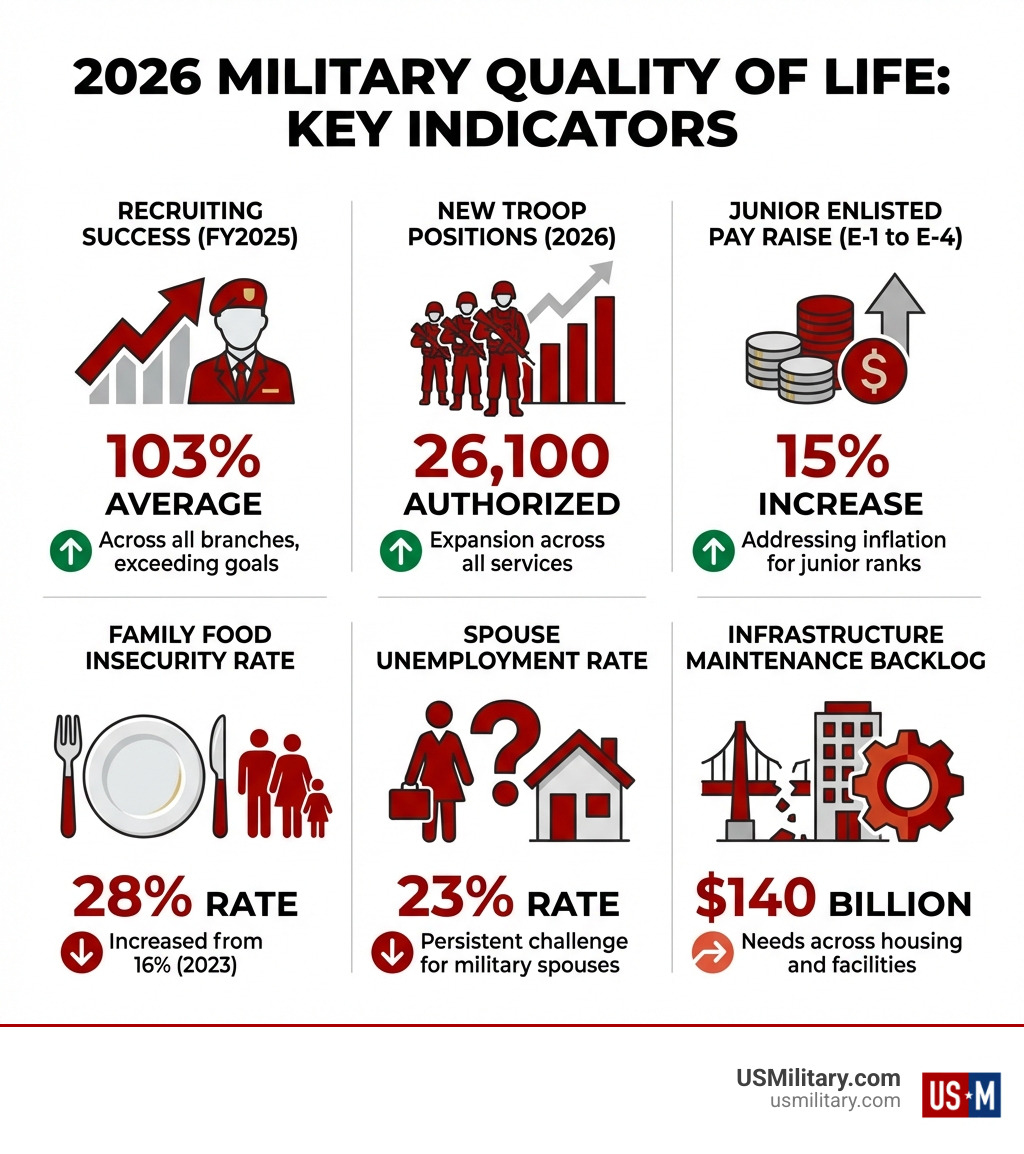
Is the quality of active military life getting better in 2026? The answer is mixed but cautiously optimistic. While recruiting has hit historic highs with all branches averaging 103% of their goals in fiscal 2025, and Congress has authorized significant pay raises and troop increases, persistent challenges remain in housing quality, spouse employment, and food insecurity.
Quick Answer: Key Quality of Life Indicators for 2026
| Indicator | Status | Details |
|---|---|---|
| Recruiting Success | ✓ Improving | 103% average across all branches in FY2025 |
| Pay Increases | ✓ Improving | 15% raise for E-1 to E-4; BAH restoration to 100% |
| Troop Growth | ✓ Expanding | 26,100 new positions authorized across services |
| Food Insecurity | ✗ Worsening | Increased from 16% (2023) to 28% (2025) |
| Spouse Unemployment | ✗ Persistent | 23% unemployment; 70% underemployed |
| Housing Quality | ~ Mixed | $140B maintenance backlog; new initiatives starting |
| Child Care Access | ✗ Challenging | Long waitlists; staffing shortages in high-cost areas |
| Morale (UK comparison) | ✗ Low | 59% rate morale as ‘low’ (AFCAS 2025) |
The U.S. military enters 2026 with genuine momentum. After years of missing recruiting targets, fiscal 2025 marked the strongest performance in 15 years. The Army recruited 62,050 soldiers (101.72% of goal), the Navy brought in 44,096 sailors (108.61%), and other branches similarly exceeded expectations. This success came as Congress authorized the largest troop expansion in recent memory—26,100 additional active-duty positions through the fiscal 2026 National Defense Authorization Act.
But recruiting success doesn’t automatically translate to better quality of life for those already serving. Military families face stark realities that undermine optimism. Food insecurity nearly doubled from 16% in 2023 to 28% in 2025, with 22% of families reporting they ate less than they should due to lack of resources. Military spouses continue to struggle with 23% unemployment and 70% underemployment rates. Barracks plagued by mold, pests, and safety hazards remain a top concern despite congressional attention.
The fiscal 2026 NDAA does bring concrete improvements. Junior enlisted personnel (E-1 to E-4) received a 15% pay increase, addressing years of wages not keeping pace with inflation. The Basic Allowance for Housing is being restored to cover 100% of costs after years of reductions. The 14th Quadrennial Review of Military Compensation found that overall military pay exceeds civilian benchmarks—enlisted at the 82nd-83rd percentile, officers at the 76th—yet targeted problems persist.
International comparisons offer sobering context. The UK’s Armed Forces Continuous Attitude Survey 2025 shows only 42% of British service members satisfied with military life, the lowest level on record, with 59% rating morale as “low.” Meanwhile, Canadian Armed Forces applications jumped nearly 13%, though officials say this has no connection to geopolitical tensions.
The real test for 2026 isn’t just adding bodies—it’s whether the military can absorb 26,100 new service members without “hollowing out” the force. Training pipelines, leadership bandwidth, family services, and infrastructure all face strain. As one analysis noted, “The real question facing the force isn’t whether it can recruit more people. It’s whether the system can absorb them without hollowing itself out.”
I’m Larry Fowler, publisher of the USMilitary.com Network since 2007, where I’ve tracked trends in VA benefits, military recruiting, and is the quality of active military life getting better in 2026 for hundreds of thousands of active-duty personnel and veterans. Through my work providing highly qualified prospects to all service branches, I’ve witnessed how quality-of-life factors directly impact recruiting and retention success.
Important Is the quality of active military life getting better in 2026 terms:
As we look toward the remainder of the year, the question of whether life in uniform is actually improving depends heavily on who you ask. For a new recruit entering through a streamlined medical screening process, the “on-ramp” to service has never been smoother. For a junior petty officer living on a ship in a maintenance shipyard, the struggle remains very real.
The Fiscal 2026 National Defense Authorization Act (NDAA) serves as the primary engine for change. We are seeing a massive shift in how the government views the “All-Volunteer Force.” After years of focusing on high-tech weaponry, the pendulum is swinging back toward the people who operate those systems. With 26,100 new billets authorized, the military is growing for the first time in years, which could eventually reduce the operational tempo (OPTEMPO) for overworked units.
Recruiting Trends and Historic Momentum
The U.S. military achieved an averaging 103% recruiting success rate across all active-duty branches for fiscal 2025. This turnaround is historic, considering the “recruiting crisis” headlines of 2022 and 2023.
- Army: Recruited 62,050 (101.72% of goal)
- Navy: Recruited 44,096 (108.61% of goal)
- Air Force: Recruited 30,166 (100.22% of goal)
- Space Force: Recruited 819 (102.89% of goal)
- Marine Corps: Hit 100% precisely while maintaining its famously rigorous standards.
Much of this success is attributed to smarter marketing and military-changes-with-president-trump era policy shifts that prioritized “Be All You Can Be” messaging over more divisive campaigns. Additionally, the Delayed Entry Program (DEP) is off to a historic start in 2026, already meeting 40% of its accession goals early in the fiscal year. For those wondering, “can-i-join-military-2026,” the answer is yes, and the branches are currently highly motivated to bring in qualified candidates.
Strategic End-Strength Authorizations
The troop surge isn’t just about filling gaps; it’s a strategic expansion to meet global threats, particularly in the Indo-Pacific. The 2026 end-strength authorizations include:
- Army: Increasing by 11,700 to reach 454,000.
- Navy: Increasing by 12,300 to reach 334,600.
- Air Force: Increasing by 1,500 to reach 321,500.
- Space Force: Increasing by 600 to reach 10,400.
- Coast Guard: Growing to 50,000.
While these numbers are positive for national security, we must ask if the current infrastructure—barracks, clinics, and child care centers—can handle the influx. There is no current evidence of a us-military-draft-in-2026, as the volunteer numbers remain strong enough to meet these growth targets.
Financial Stability and Compensation Reforms
One of the most significant factors in determining if is the quality of active military life getting better in 2026 is the wallet. For years, junior enlisted members felt the squeeze of inflation more than almost any other demographic. In 2026, we are seeing a “course correction.”
Is the quality of active military life getting better in 2026 through pay reforms?
The 14th QRMC findings emphasized that while military compensation is generally competitive, the “floor” for junior members was too low. Consequently, the 2026 pay initiatives include a massive 15% basic pay raise for E-1 through E-4.
Beyond basic pay, the Basic Allowance for Housing (BAH) is being restored to cover 100% of median rental costs, reversing the 5% “out-of-pocket” expectation that has frustrated families since 2019. When you look at the military-pay-chart-2025 and compare it to the 2026 projections, the jump is the largest in recent memory. Furthermore, 2025-va-disability-rates and 2026 adjustments ensure that those transitioning out or serving with injuries are also seeing their purchasing power protected against inflation.
Is the quality of active military life getting better in 2026 for military families?
While the numbers on the paycheck look better, the “lived experience” for families shows some troubling trends. The Blue Star Families 2025 survey (released in early 2026) highlights that financial strain remains the most persistent challenge.
- Food Insecurity: Alarmingly, 28% of active-duty families reported low or very low food security in 2025/2026, up from 16% in 2023.
- Spouse Employment: The unemployment rate for military spouses sits at 23%, with 70% of those who are employed reporting they are “underemployed” (working jobs below their education or experience level).
- Child Care: 41% of families spend more than 20% of their income on child care, and 67% face long waitlists.
Congress is responding by fully funding fee assistance programs and increasing pay for Child Development Center (CDC) staff to solve the staffing shortages that keep these centers half-empty.
Infrastructure and Housing: Tackling the $140 Billion Backlog
The Department of Defense faces a staggering $140 billion maintenance backlog for its global infrastructure. For a service member, this isn’t just a number—it’s the mold in their shower or the broken HVAC in their barracks.
Improving Unaccompanied Housing Standards
The Navy, in particular, has faced scrutiny over “shipyard living.” Following tragic suicide clusters on ships like the USS George Washington, leaders are finally moving sailors off ships during long maintenance periods. New initiatives for 2026 include:
- Mandatory Wi-Fi in all barracks (treating it as a utility, not a luxury).
- Pilot programs for privatized unaccompanied housing (similar to family housing).
- “Resiliency fairs” to prepare crews for the mental toll of industrial environments.
We are also seeing army-troops-back-from-covid era restrictions fully lifted, allowing for better social cohesion and morale-building events that were sidelined for years. For those dealing with long-term health issues from poor housing, understanding va-disability-ratings-2026 is more important than ever.
Healthcare Access and Behavioral Health
Medical readiness is the backbone of the force, but there are currently 2,107 unfilled behavioral health positions across the Military Health System (MHS). To combat this, 2026 sees a major push for:
- Telemedicine: Expanding virtual visits to bypass local provider shortages.
- Direct Hire Authority: Allowing bases to hire civilian doctors faster.
- Aid and Attendance: Ensuring families of veterans have the support they need, with updated aid-and-attendance-income-limits-what-to-know-for-2026 helping more people qualify for home care.
Global Perspectives: How the U.S. Compares to Allies
The U.S. is not alone in its struggle to balance military readiness with quality of life. However, our 2026 outlook appears more stable than many of our closest allies.
| Metric | United States (2026) | United Kingdom (2025) | Canada (2026) |
|---|---|---|---|
| Recruitment | 103% of Goal | Struggling | 13% App Increase |
| Pay Satisfaction | Improving (34%+) | 34% (Low) | Moderate |
| Overall Morale | Moderate/Rising | 59% “Low” | Moderate |
| Key Issues | Housing/Spouses | Pay/Accommodation | Retention/Housing |
The UK AFCAS 2025 report paints a grim picture, with satisfaction at historic lows. In contrast, the U.S. has been more aggressive in its pay raises and infrastructure spending. Canada has seen a surge in applications, but experts suggest this is due to domestic economic factors rather than a sudden desire for military life.
Morale and Retention Trends Abroad
In the UK, only 42% are satisfied with service life. While we don’t have a direct U.S. equivalent of the AFCAS, retention remains a “quiet risk” for the U.S. military as it grows. Many experienced NCOs are feeling the burn of training a massive influx of new recruits. We’ve seen recent-military-retirement-benefit-changes designed to keep these experienced leaders in the force longer, but the lure of the civilian job market remains strong.
Potential Roadblocks: Civilian Cuts and Training Capacity
Growth comes with growing pains. The surge of 26,100 new troops will put immense pressure on “The Forge”—the training pipelines that turn civilians into soldiers.
Balancing Growth with Readiness
There is a significant concern regarding the civilian workforce. Approximately 16,000 Army civilian employees have agreed to deferred resignation plans, and other branches face similar losses. These civilians run the gyms, the chow halls, and the administrative offices. If these positions aren’t backfilled, the “administrative friction” for active-duty members will increase, meaning more time spent on paperwork and less time on the mission.
We are also watching the soldier-life-cycle-changes-way-army-preps-troops-for-eventual-transition to ensure that as we grow the force, we aren’t just “churning and burning” people. True quality of life requires predictable home time and competent leadership, both of which are stressed during rapid expansion. As we celebrate veterans-day-2025 and look toward 2026, the focus must remain on the human element of the machine.
Frequently Asked Questions about Military Life in 2026
Will there be a military pay raise in 2026?
Yes. In addition to the standard annual cost-of-living adjustment (COLA), the 2026 NDAA includes a targeted 15% increase for junior enlisted members (E-1 to E-4) to ensure a living wage that competes with the private sector.
Are barracks conditions improving in 2026?
There is a massive policy shift toward improvement, including a $140 billion long-term plan to address the maintenance backlog. In 2026, you can expect more aggressive mold remediation and the rollout of universal Wi-Fi in unaccompanied housing.
How is the military addressing spouse unemployment?
The DOD is pushing for more “licensure compacts” between states, allowing spouses to keep their professional licenses (nursing, teaching, etc.) when they move. There is also an expansion of child care fee assistance to make it easier for spouses to enter the workforce.
Conclusion
At USMilitary.com, we believe that the quality of active military life is at a critical turning point. The data suggests that is the quality of active military life getting better in 2026 is a “yes” when it comes to pay and recruiting momentum, but a “work in progress” regarding family stability and housing.
The 2026 outlook shows a military that is finally putting its money where its mouth is. By addressing junior enlisted pay and restoring housing allowances, the government is making a long-term bet on the resilience of the All-Volunteer Force. However, for these gains to be permanent, we must solve the “hollow force” risks of training bottlenecks and civilian workforce cuts.
Whether you are currently serving or thinking about joining, the benefits-of-military life in 2026 offer a unique path to stability in an uncertain world. We will continue to monitor these trends to ensure you have the most accurate, nonbiased information available.
Free for Service Members & Veterans
Get the military benefits intel no one tells you about.
Weekly updates on VA benefits, pay changes, and money tips — free for service members and veterans.
No spam. Unsubscribe anytime. Your info is never shared.


