Why Your Military Service Opens the Door to Homeownership
Eligibility VA loan requirements determine if you can access one of the most valuable benefits earned through military service. To qualify, you generally need:
- 90 consecutive days of active duty during wartime, OR
- 181 days of active duty during peacetime, OR
- 6 years of service in the National Guard or Reserves, OR
- 90 days under Title 10 or Title 32 orders (with at least 30 consecutive days for Title 32)
- A discharge that is other than dishonorable
- A valid Certificate of Eligibility (COE)
You may also qualify as a surviving spouse or through specific discharge exceptions.
Since 1944, the VA home loan has helped over 25 million service members, veterans, and their families buy homes by removing common financial barriers.
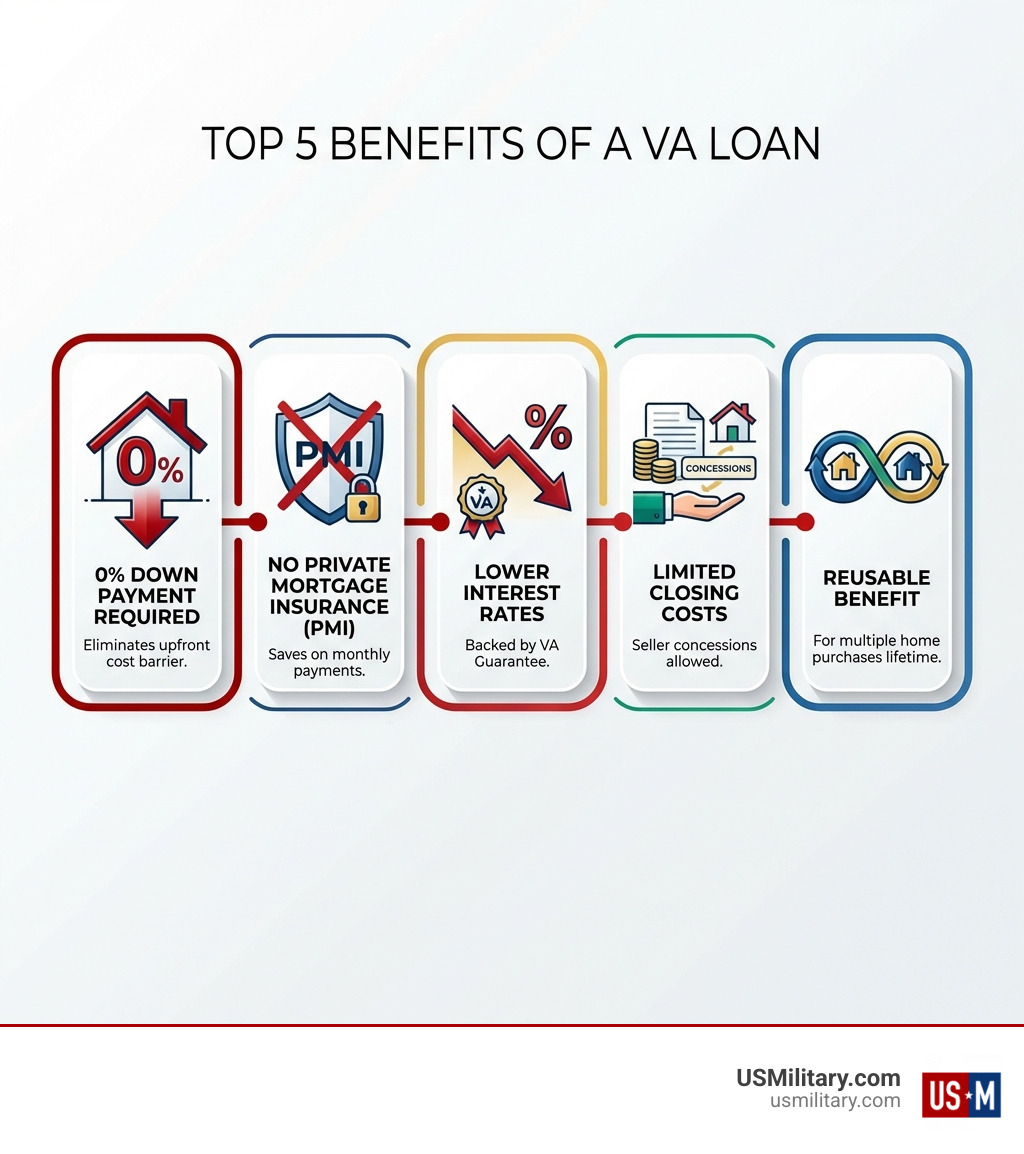
Here is what makes VA loans unique:
- Zero down payment required in most cases
- No private mortgage insurance (PMI) to pay
- Competitive interest rates backed by the government
- Limited closing costs with seller concessions allowed
- Reusable benefit throughout your lifetime
Understanding your eligibility starts with your service history, but it does not end there. Lenders also evaluate your credit, income, and the property you want to buy. This guide breaks down each requirement so you know where you stand and what to do next.
Whether you are on active duty, recently separated, or a veteran, your service has earned you this benefit. This article will help you understand how to use it.
The Three Pillars of VA Loan Eligibility
Think of Eligibility VA loan as a three-legged stool: your military service, your financial health, and the property you want to buy. All three legs must be sturdy to access this benefit. The Department of Veterans Affairs (VA) does not issue loans directly. Instead, it guarantees a portion of the loan from a private lender. This guarantee reduces lender risk, leading to better terms for you, like no down payment or private mortgage insurance.
The VA sets the service-based eligibility rules, but individual lenders apply their own financial requirements. It is a partnership that works to your advantage. To learn more about the broader benefits of military service, including home loan benefits, check out our guide on Servicemember Home Loan Benefits.
General Eligibility VA loan Requirements
At its core, general Eligibility VA loan hinges on a few key factors:
- Certificate of Eligibility (COE): This official VA document proves you meet the service requirements. Lenders cannot process your VA loan without it.
- Lender’s Credit Requirements: The VA does not set a minimum credit score, but lenders do. Most look for a FICO score of 620 or higher.
- Income Requirements: Lenders need to see a stable, sufficient income to afford mortgage payments. They will review your debt-to-income (DTI) ratio and residual income.
- Occupancy Requirements: The home you buy with a VA loan must be your primary residence. This means you, your spouse, or your dependents will live in it.
The Role of the VA vs. The Lender
It is crucial to understand the distinction between the VA’s role and the lender’s. The VA’s primary job is to establish service-based eligibility and guarantee a portion of the loan. They set the broad guidelines for service, discharge status, and the overall benefit structure.
However, the VA does not lend the money. Private lenders—banks, credit unions, and mortgage companies—do. Because the VA guarantees part of the loan, lenders can offer competitive rates, often with no down payment and no PMI, which is rare in conventional lending.
Despite the VA guarantee, lenders have their own financial criteria, called “lender overlays.” These are additional requirements to manage their risk, including:
- Credit Score Benchmarks: While the VA does not mandate a minimum score, most lenders require a FICO score of around 620.
- Debt-to-Income (DTI) Ratios: Lenders assess your DTI, which compares your monthly debt payments to your gross monthly income. Most VA lenders prefer a DTI of 41% or less, though some flexibility exists.
- Residual Income: This unique VA requirement is the discretionary income left each month after paying major expenses. The VA sets specific guidelines based on family size and region to ensure you have enough for daily living.
So, while the VA opens the door, the lender determines if you are financially ready to walk through it.
What a VA Loan Can Be Used For
The VA loan is a versatile benefit. It is not just for buying a single-family home. You can use a VA loan to:
- Buy a home: This includes new construction, existing homes, or a condo in a VA-approved project.
- Build a home: Finance the construction of a custom residence.
- Refinance a loan: Use an Interest Rate Reduction Refinance Loan (IRRRL) for a lower rate, or a cash-out refinance to pull equity from your home.
- Improve a home: Make energy-efficient improvements or other modifications.
- Buy a manufactured home and/or lot: VA loans can be used for manufactured housing.
- Purchase and improve a home simultaneously: Combine the purchase with immediate improvements.
To explore all the ways you can use this benefit, we encourage you to Learn more about VA home loan types.
Decoding Your Service Requirements for Eligibility VA loan
Your military service is the cornerstone of Eligibility VA loan. The requirements vary based on when and how you served. The VA reviews your service records, discharge status, and character of service to determine if you meet the criteria. Generally, an “other than dishonorable” discharge is required.

Active Duty, Veterans, and Service Eras
Minimum service requirements for active duty members and veterans depend on the service era. The VA categorizes these periods around major conflicts and peacetime. The following table is a general overview; the VA reviews each case individually.
| Service Era | Minimum Service Requirement | |
|---|---|---|
| World War II | September 16, 1940 – July 25, 1947 | 90 days active duty. If less, discharge due to service-connected disability. |
| Korean War | June 27, 1950 – January 31, 1955 | 90 days active duty. If less, discharge due to service-connected disability. |
| Vietnam War | August 5, 1964 – May 7, 1975 | 90 days active duty. If less, discharge due to service-connected disability. |
| Gulf War (and subsequent conflicts) | August 2, 1990 – present (date to be determined) | 24 continuous months of active duty, or the full period (at least 90 days) for which you were called to active duty. If less, discharge due to hardship, government convenience, reduction in force, certain medical conditions, or service-connected disability. |
| Peacetime (various periods) | July 26, 1947 – June 26, 1950; February 1, 1955 – August 4, 1964; May 8, 1975 – September 7, 1980 (Enlisted); May 8, 1975 – October 16, 1981 (Officer) | 181 days continuous active duty. If less, discharge due to service-connected disability. |
| Post-September 7, 1980 (Enlisted) / Post-October 16, 1981 (Officer) | Anytime after these dates | 24 continuous months of active duty, or the full period (at least 181 days) for which you were called to active duty. If less, discharge due to hardship, government convenience, reduction in force, certain medical conditions, or service-connected disability. |
For active-duty service members, Eligibility VA loan can be established after 90 days of continuous active duty. To verify your service and ensure you have the correct documentation, you can Request your military service records.
National Guard and Reserve Members
Service in the Reserves or National Guard also counts towards Eligibility VA loan, but with specific requirements:
- 6 years of honorable service: You must have completed six creditable years in the Selected Reserve or National Guard. Your discharge must be honorable, or you must have been placed on the retired list or continue to serve.
- 90 days of non-training active duty: Alternatively, if called to active duty for purposes other than training, you may qualify with shorter service. This often includes:
- Title 10 orders: 90 days of cumulative active duty.
- Title 32 orders: 90 days of cumulative active duty, with at least 30 of those days being consecutive.
To prove service for a COE, you might need NGB Form 22 (Report of Separation and Record of Service) or NGB Form 23 (Retirement Points Statement).
Surviving Spouse Eligibility VA loan
The VA loan benefit also extends to certain surviving spouses. Eligibility VA loan for surviving spouses falls into a few categories:
- Unmarried surviving spouse: You may be eligible if you are the un-remarried spouse of a veteran who died in service or from a service-connected disability.
- Died in service: If your spouse died in the line of duty, you are typically eligible.
- MIA/POW spouse: If your spouse is listed as missing in action (MIA) or a prisoner of war (POW), you may also qualify.
- Dependency and Indemnity Compensation (DIC): If you receive DIC benefits, you are generally eligible.
- Remarriage rules: Specific rules apply to remarriage. Eligibility may be retained if remarriage occurred at age 57 or older on or after December 16, 2003. These dates are crucial, so verify your specific situation with the VA.
Surviving spouses often need to submit VA Form 26-1817 or VA Form 21P-534EZ, along with supporting documents like the veteran’s DD214, your marriage license, and the death certificate.
Exceptions to the Minimum Service Rules
The VA recognizes certain exceptions to the minimum service rules, allowing for Eligibility VA loan even with shorter service periods:
- Early separation: If you were discharged early for reasons beyond your control.
- Hardship discharge: If your discharge was due to a documented hardship.
- Government convenience: Discharges at the convenience of the government can qualify.
- Reduction in Force (RIF): If your service was curtailed due to a RIF.
- Certain medical conditions: Discharges due to specific medical conditions.
- Service-connected disability: This is a significant exception. If you were discharged for a service-connected disability, you are typically eligible regardless of your length of service.
In these cases, the VA will review your service records to determine if your circumstances meet the criteria for an exception. It’s always worth applying for a COE, even if you’re unsure.
The Certificate of Eligibility (COE): Your Golden Ticket
The Certificate of Eligibility (COE) is the official document that opens up your VA home loan benefit. It is not a loan approval, but a verification from the VA that you meet the service requirements to apply for a VA-backed loan. Think of it as your military ID for homeownership: it proves you have earned this benefit.

What is a Certificate of Eligibility (COE)?
A COE is a VA-issued document that verifies your military service and confirms your Eligibility VA loan benefits. It provides proof to lenders that you meet the service requirements set by the Department of Veterans Affairs. The COE also shows your “entitlement codes,” which indicate how much of your VA loan benefit is available.
How to Obtain Your COE
Getting your COE is the first actionable step in the VA loan process. You have a few convenient ways to obtain it:
- Through a VA-approved lender: This is often the fastest method. Most lenders can access the VA’s online system and issue a COE in minutes.
- Online via VA.gov: You can request your COE directly through the VA’s website. If you have an eBenefits account, you can often get it instantly. Request your COE online now through the VA’s portal.
- By mail with Form 26-1880: You can download and complete VA Form 26-1880, “Request for a Certificate of Eligibility,” and mail it to the VA. This method can take 4 to 6 weeks.
Regardless of the method, you will need to provide proof of service, such as a DD Form 214 or the appropriate National Guard/Reserve forms.
What if I have Used My VA Loan Before?
The VA home loan is a lifetime benefit that you can use multiple times. This means you can often reuse your entitlement, even if you have had a VA loan in the past. This process is called “restoring entitlement.”
You can typically restore your full entitlement if:
- You sell the property and the loan is paid in full: If you sold the home you bought with a VA loan and paid it off, you can apply to have your full entitlement restored.
- You use a one-time restoration: The VA allows a one-time restoration of full entitlement if you have repaid your prior VA loan but still own the property.
- Another qualified veteran assumes your loan: If another veteran assumes your VA loan and substitutes their entitlement for yours, your entitlement can be restored.
Restoring your entitlement usually involves submitting VA Form 26-1880. Understanding this process can be a game-changer for long-term homeownership. For more details on loan transfers, check out our guide on Assumable VA Loan.
Beyond Service: Lender and Property Requirements
While military service is the key to opening the VA loan benefit, it is not the only factor. Lenders also assess your financial fitness, and the property you want to buy must meet certain standards.
Credit Score and Income
The VA does not set a minimum credit score, but private lenders do. Most lenders typically require a FICO score of around 620. Lenders also evaluate your income to ensure it is stable, reliable, and sufficient to cover your mortgage and living expenses. They look at two main metrics:
- Debt-to-Income (DTI) ratio: This compares your total monthly debt payments to your gross monthly income. Most VA lenders prefer a DTI of 41% or less. Compensating factors like high residual income might help if your DTI is higher.
- Residual income: Unique to VA loans, this is the money you have left over each month after paying all major debts. The VA sets specific residual income guidelines based on your family size and region. This helps ensure you can afford day-to-day needs and can sometimes offset a lower credit score.
Even if your credit is not perfect, the VA loan’s flexibility often makes it more accessible than conventional loans. To estimate your monthly payments, use our VA Loan Calculator.
The VA Funding Fee
The VA funding fee is a one-time charge most VA loan borrowers pay. It helps sustain the program for future generations by offsetting the cost to taxpayers. Since VA loans do not require a down payment or private mortgage insurance, this fee is how the program supports itself.
The fee is a percentage of the loan and varies based on:
- First-time vs. subsequent use: The fee is typically 2.15% for first-time users with no down payment and 3.3% for subsequent users.
- Down payment amount: Making a down payment decreases the fee. For example, a 5% down payment drops the first-time user fee to 1.5%.
- How you choose to pay it: The funding fee can often be rolled into the loan amount, so you do not have to pay it out of pocket.
To understand all homeownership costs, it is a good idea to Check out the home loan toolkit.
Who is Exempt from the VA Funding Fee?
While most borrowers pay the funding fee, certain individuals are exempt:
- Veterans receiving VA compensation for a service-connected disability.
- Veterans who are Purple Heart recipients.
- Eligible surviving spouses.
- Service members with a pending disability claim who are entitled to receive compensation.
Confirming your exemption status can lead to significant savings.
Occupancy and Property Rules
The VA loan program is designed to help you secure a primary residence. Because of this, there are strict occupancy and property requirements:
- Primary residence: The property must be your primary home. You, your spouse, or your dependents must intend to live there.
- Eligible properties: These include single-family homes, condos in VA-approved projects, and multi-unit properties (up to four units) as long as you occupy one unit.
- No investment properties: VA loans cannot be used for purely investment properties or vacation homes.
The property must also meet the VA’s Minimum Property Requirements (MPRs) to ensure it is safe, structurally sound, and sanitary. A VA-approved appraiser will evaluate the property to confirm it meets these standards. While you cannot use a VA loan to Buy Land with a VA Loan for speculation, it is possible if it is part of a construction loan for your primary residence.
Frequently Asked Questions about VA Loan Eligibility
Navigating loan eligibility can bring up many questions. Here are answers to some common ones from our military community:
Can I get a VA loan with a bad credit score?
While the VA doesn’t set a minimum credit score, most lenders look for a FICO score of around 620. However, VA loans offer more flexibility than conventional loans. Lenders may consider “compensating factors” such as:
- Strong residual income: Having plenty of money left over after monthly expenses.
- Low debt-to-income (DTI) ratio: A DTI well below the 41% guideline.
- Stable employment history: A long, consistent work history.
- Cash reserves: Significant savings can show financial stability.
If your credit is a concern, connect with a VA-approved lender. Many offer credit consulting services to help you understand your options and improve your score.
What happens if I don’t meet the minimum service requirements?
As discussed, several “discharge exceptions” can still grant you Eligibility VA loan even if you don’t meet the standard service duration. These include discharges for hardship, convenience of the government, reduction in force, certain medical conditions, or a service-connected disability.
If you were discharged for one of these reasons, you should still apply for a Certificate of Eligibility (COE). The VA will review your service records to determine if you qualify.
If your discharge was “other than honorable,” you typically aren’t eligible. However, you may be able to apply for a “discharge upgrade” through your service branch or request a “Character of Discharge review” from the VA. A successful review could open the door to VA loan eligibility.
How many times can I use my VA loan benefit?
One of the best parts of the VA loan is that it’s a lifetime benefit. You can use it multiple times, provided you meet the eligibility requirements each time. It’s even possible to have more than one VA loan at once under specific conditions.
The key is “restoring entitlement.” You can get your full entitlement back if:
- You sell the home purchased with the VA loan and the loan is paid in full.
- A qualified veteran assumes your VA loan and substitutes their entitlement for yours.
- You use a one-time restoration after repaying a prior VA loan in full, even if you still own the home.
This flexibility means your VA loan benefit can support your homeownership journey through different life stages.
Your Path to Homeownership
Understanding Eligibility VA loan is the critical first step on your path to homeownership. It is a multifaceted process involving your service history, financial health, and the property you wish to buy. The VA loan is a powerful benefit earned through your service, offering significant advantages like no down payment and no private mortgage insurance.
Key takeaways are:
- Service is the first step: Your military service dates, duration, and discharge type are paramount.
- Get your COE: The Certificate of Eligibility is your official proof. Get it quickly through a lender or VA.gov.
- Financial readiness matters: Lenders will look at your credit score, income, DTI, and residual income.
- Property must meet standards: The home must be your primary residence and meet VA’s Minimum Property Requirements.
At USMilitary.com, we are committed to providing clear, practical resources for our military community. We encourage you to explore all the benefits you have earned. If you are ready to take the next step or want more information, we invite you to Explore all your military benefits. Your service has opened the door; now you can decide when to walk through it.
Free for Service Members & Veterans
Get the military benefits intel no one tells you about.
Weekly updates on VA benefits, pay changes, and money tips — free for service members and veterans.
No spam. Unsubscribe anytime. Your info is never shared.


