Understanding America’s Most Elite Special Operations Forces
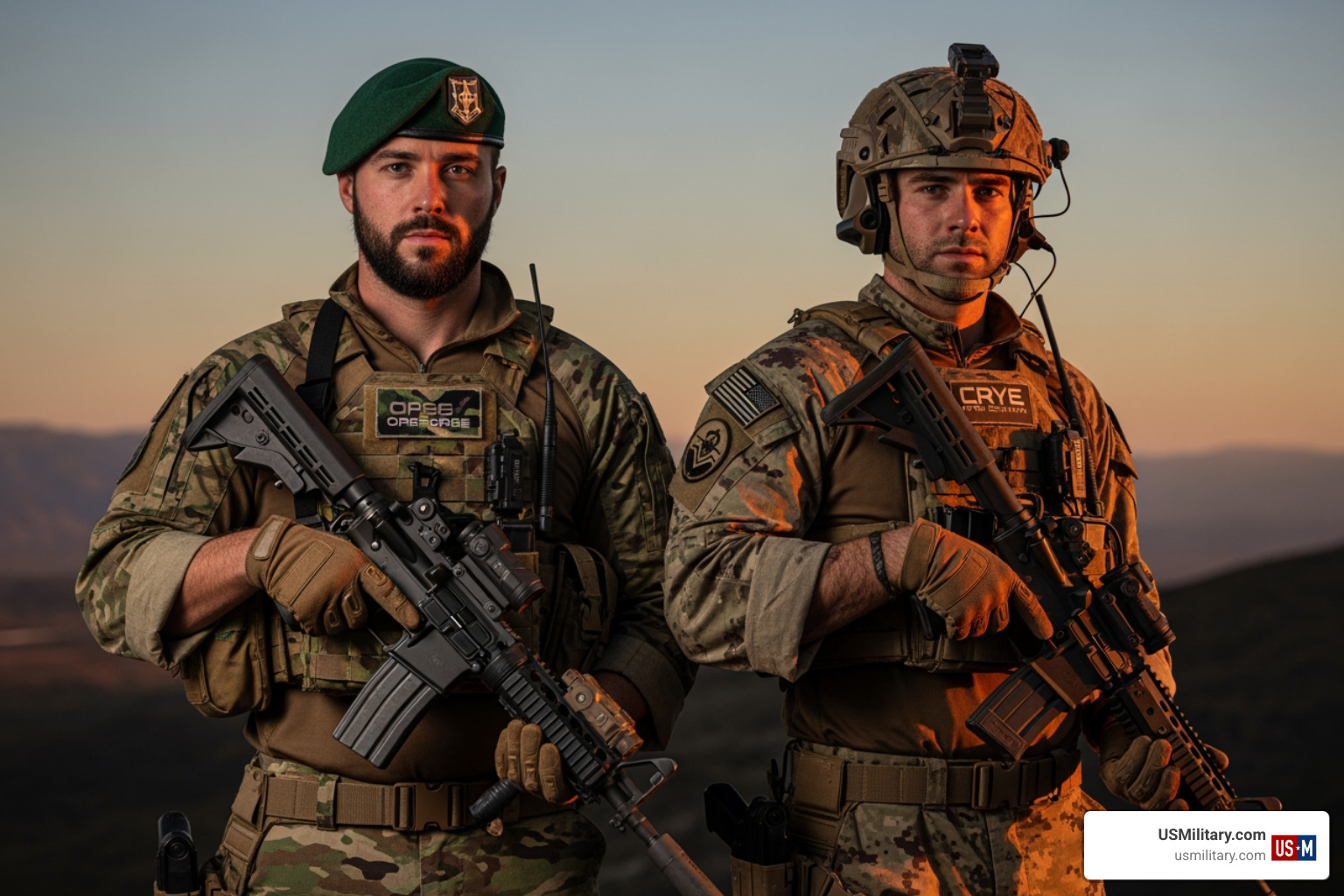
When exploring military service, understanding green beret vs navy seal differences is crucial for anyone considering a career in special operations. These two elite forces represent the pinnacle of military training and capability, but they serve distinctly different roles within U.S. Special Operations Command (SOCOM).
Quick Answer: Green Beret vs Navy SEAL Key Differences
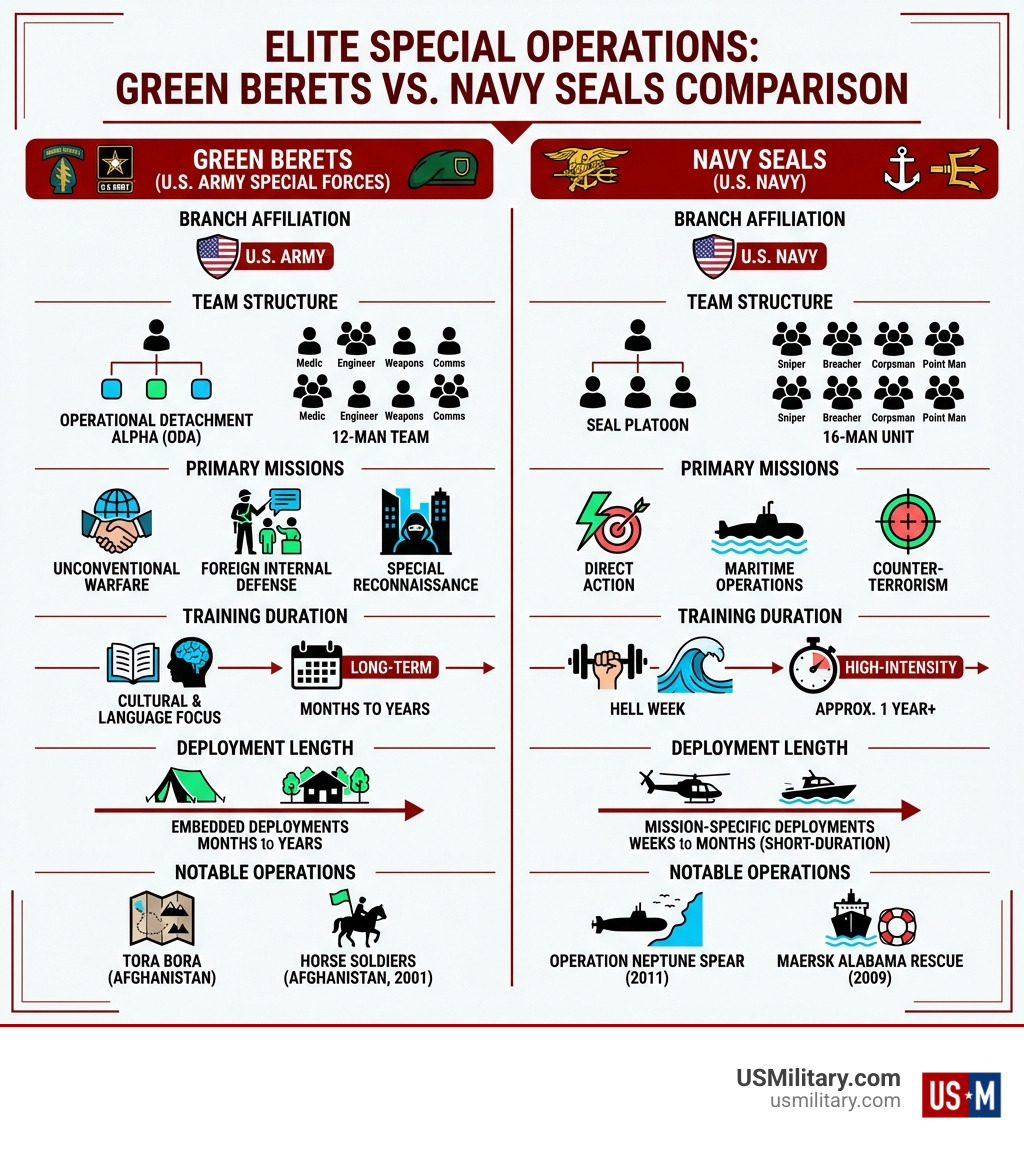
| Factor | Green Berets (Army Special Forces) | Navy SEALs |
|---|---|---|
| Primary Mission | Unconventional warfare, training foreign forces | Direct action, maritime operations, counter-terrorism |
| Team Size | 12-man Operational Detachment Alpha (ODA) | 16-man platoon |
| Operating Environment | Primarily land-based, remote locations | Sea, air, and land (maritime focus) |
| Deployment Style | Long-term embeds (months to years) | Short-duration, high-intensity missions |
| Training Focus | Language, cultural skills, guerrilla warfare | Underwater operations, Hell Week, direct action |
| Branch | U.S. Army | U.S. Navy |
| Size | ~7,000 active duty | ~2,500 active duty |
| Motto | “De oppresso liber” (To Free the Oppressed) | “The Only Easy Day Was Yesterday” |
The Bottom Line: Green Berets specialize in working with local forces in unconventional warfare, often for extended periods. Navy SEALs excel at swift, direct-action missions and maritime operations. Both are exceptionally capable, but their missions and methods differ significantly.
The confusion between these units is understandable. Both represent the most highly trained operators the U.S. military can provide. Both undergo brutal selection processes that most candidates fail. Both operate under the most dangerous conditions imaginable.
But asking “which is better?” misses the point entirely. The real question is: better at what?
Green Berets are masters of unconventional warfare—embedding with foreign forces for months or years, speaking local languages, and building guerrilla armies from the ground up. They’re known as “quiet professionals” and “soldier-diplomats” for good reason.
Navy SEALs are the Navy’s premier special warfare operators, capable of inserting from submarines, conducting lightning-fast raids, and eliminating high-value targets. Their maritime expertise sets them apart from nearly every other special operations unit.
I’m Larry Fowler, publisher of the USMilitary.com Network since 2007, and I’ve helped thousands of active duty and veteran service members steer their military careers, including understanding the green beret vs navy seal distinction and other special operations pathways. Through years of connecting recruits with military branches and tracking trends in special operations, I’ve seen how critical it is to understand these differences before committing to such a demanding career path.
Terms related to green beret vs navy seal:
Historical Origins and Core Missions
To truly appreciate the nuances of the green beret vs navy seal discussion, we must first understand their historical roots and the foundational missions that shaped them into the elite forces they are today. Both units emerged from the crucible of global conflicts, evolving to meet specific, critical needs of the U.S. military.
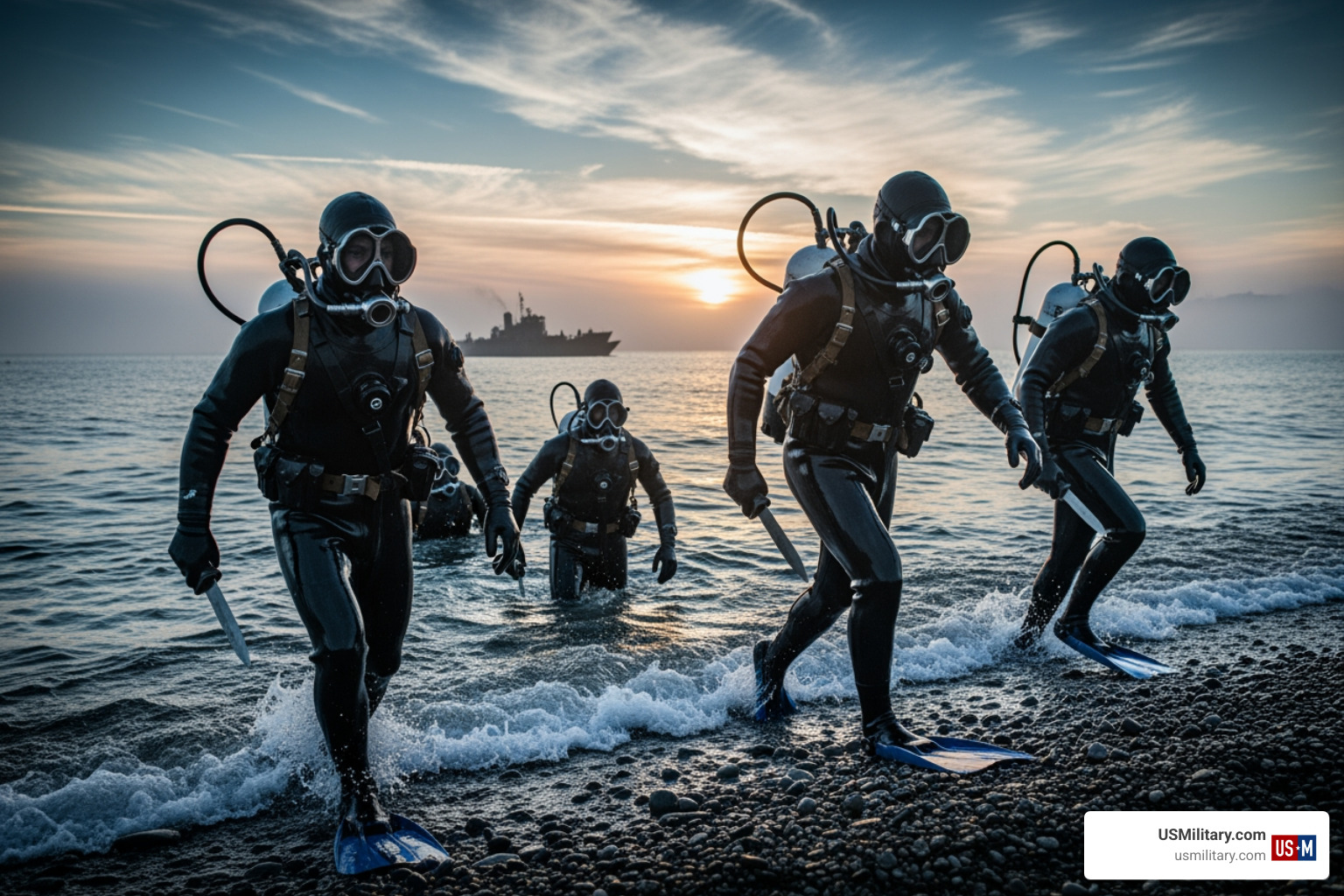
The origins of our modern special operations forces can be traced back to World War II, a period that highlighted the necessity for specialized units capable of operating behind enemy lines or in unique environments. Presidential support, notably from President John F. Kennedy, played a pivotal role in the formal establishment and recognition of both the Army Special Forces (Green Berets) and the Navy SEALs, pushing for the development of unconventional warfare capabilities across the services.
Green Beret: The “Quiet Professionals”
The U.S. Army Special Forces, famously known as the Green Berets due to their distinctive headgear, were officially formed in 1952. Their lineage, however, draws from earlier specialized units like the First Special Service Force of World War II, a joint American-Canadian commando unit. The Green Berets’ core mission revolves around Unconventional Warfare (UW) and Foreign Internal Defense (FID). This means they are experts in training, advising, and assisting indigenous forces in foreign countries to fight for themselves, often against insurgencies or external threats. Their motto, “De oppresso liber” (To Liberate the Oppressed), perfectly encapsulates this philosophy.
We often refer to Green Berets as “soldier-diplomats” because their success hinges not just on combat prowess, but on their ability to build rapport, understand local cultures, and communicate effectively—often in foreign languages. They embed with partner nations for extended periods, providing long-term strategic impact rather than just short-term tactical wins. While their primary focus is UW and FID, they are also highly skilled in special reconnaissance, direct action, hostage rescue, and counter-terrorism, among other missions. Their work is typically less publicized, earning them the moniker “Quiet Professionals.”
Learn more about Special Forces careers at USMilitary.com.
Navy SEAL: Sea, Air, and Land Warriors
The Navy SEALs, an acronym for Sea, Air, and Land, were officially established in January 1962, also a direct response to President Kennedy’s call for unconventional warfare capabilities. Their heritage traces back to the elite frogmen of World War II, including Naval Combat Demolition Units (NCDUs) and Underwater Demolition Teams (UDTs). These early units were crucial for clearing beaches and obstacles ahead of amphibious invasions, earning them the nickname “frogmen.”
SEALs are the U.S. Navy’s principal special operations force, specializing in maritime operations. Their ability to operate seamlessly across sea, air, and land environments is what truly sets them apart. Their missions primarily involve Direct Action (DA), special reconnaissance (SR), counter-terrorism, and personnel recovery. They are known for rapid insertion, precision strikes, and their unparalleled expertise in underwater operations, which is a key differentiator from most other military units. Their unofficial motto, “The Only Easy Day Was Yesterday,” speaks volumes about their relentless pursuit of excellence and endurance.
Learn more about Navy SEAL training at USMilitary.com.
The Gauntlet: Training and Selection
Both Green Berets and Navy SEALs are forged through some of the most rigorous training pipelines in the world. The selection processes for both programs are extremely rigorous, designed to push candidates to their physical and mental breaking points, ensuring that only the most resilient and capable individuals earn the right to wear their respective insignias. Very few who start the process are able to complete the training and actually become Navy SEALs or Green Berets. The attrition rates are notoriously high, demanding an extraordinary level of physical fitness, mental toughness, grit, and resilience. Teamwork evaluation is also a critical component, as these elite operations rely heavily on cohesion and mutual support.

Becoming a Green Beret
The path to becoming a Green Beret begins with the Special Forces Assessment and Selection (SFAS). This 24-day test is designed to determine if a candidate possesses the necessary physical, mental, and psychological attributes to be a Special Forces soldier. After successfully navigating SFAS, candidates move on to the Special Forces Qualification Course (Q-Course), which can last from 6 months to over a year, depending on their specialty and language requirements.
The Q-Course is comprehensive, covering everything from advanced special operations tactics and survival skills (including SERE School – Survival, Evasion, Resistance, and Escape) to medical training and demolitions. A significant emphasis is placed on language and cultural training, critical for their foreign internal defense missions. The U.S. Army recently shortened its Special Forces Training program, but it remains incredibly challenging. The current program includes a six-week Special Forces preparation course focused on physical fitness before the SFAS. Green Berets are often highly educated, with many possessing post-graduate degrees, reflecting the intellectual demands of their role as “soldier-diplomats.”
Compare Army Ranger and Green Beret roles at USMilitary.com.
Becoming a Navy SEAL
For aspiring Navy SEALs, the journey starts with one of the most infamously difficult training pipelines in the U.S. military: Basic Underwater Demolition/SEAL (BUD/S) training. Before even getting to BUD/S, candidates must meet stringent physical requirements, including impressive swim and run times.
BUD/S is a six-month course divided into three phases: Basic Conditioning, Combat Diving, and Land Warfare. The first phase includes “Hell Week,” a five-and-a-half-day period with approximately four hours of sleep total and over 200 miles of running. It’s a crucible designed to weed out all but the most determined. After BUD/S, successful candidates proceed to SEAL Qualification Training (SQT), a 26-week course where they learn advanced combat skills, including free-fall parachuting, demolitions, and close-quarters combat. Finally, they attend Parachute Jump School. The average Navy SEAL training dropout rate is approximately 80%, meaning only 2 out of 10 recruits make it through this grueling process.
Learn more about BUD/S Navy SEAL Training at USMilitary.com.
A Deep Dive into the Green Beret vs Navy SEAL Comparison
Now that we’ve explored their individual histories and training, let’s dive deeper into the direct comparison of green beret vs navy seal. While both are unequivocally elite, their operational environments, team structures, deployment lifestyles, and the types of missions they undertake often differ significantly.
Green Berets often operate in remote, land-locked regions, working with foreign partners for extended periods. Navy SEALs, true to their name, leverage their maritime expertise to operate from sea, air, and land, with a distinct advantage in littoral and underwater environments.
Key Distinctions in the Green Beret vs Navy SEAL Debate
Let’s break down some of the core differences that define the green beret vs navy seal dynamic:
| Factor | Green Berets (Army Special Forces) | Navy SEALs |
|---|---|---|
| Mission Focus | Unconventional warfare, foreign internal defense, training indigenous forces, long-term stability operations, counter-proliferation, humanitarian aid. | Direct action, special reconnaissance, counter-terrorism, maritime special operations, hostage rescue, personnel recovery. |
| Team Size | Operational Detachment Alpha (ODA), typically 12 soldiers. Each member is cross-trained in multiple specialties. | SEAL Platoon, typically 16 men, often divided into smaller squads and fire teams. |
| Deployment Length | Can involve long-term embeds (months to over a year) with local populations, building relationships and capabilities. | Often shorter, high-intensity deployments (e.g., 6 months within an 18-month cycle), focused on specific objectives. |
| Operational Environment | Primarily land-based, often in austere, remote, and culturally sensitive areas. Experts in jungle, desert, mountain, and urban warfare. | Sea, Air, and Land, with a strong emphasis on maritime operations (underwater, coastal, riverine). Capable of operating in diverse territories from concrete jungles to icy expanses. |
| Notable Missions | Depicted in movies like 12 Strong (Operation Jawbreaker in Afghanistan), significant contributions in Vietnam training Montagnard tribes. | Famous for high-profile direct action missions like the death of Osama bin Laden (Operation Neptune Spear) and the rescue of the freighter Maersk Alabama. |
As you can see from the table, while there’s some overlap, their core functions diverge. Green Berets are force multipliers, teaching others to fight. They might spend months or even years embedded with a local community, speaking their language, understanding their culture, and helping them build a sustainable defense force. This approach emphasizes patience, cultural understanding, and long-term strategic impact.
Navy SEALs, on the other hand, are often the tip of the spear for swift, decisive action. Their maritime capabilities, including combat diving and underwater demolitions, allow them unique insertion and extraction methods. They are typically tasked with missions requiring speed, stealth, and direct application of force, such as capturing high-value targets or conducting raids.
Learn more about Navy SEAL training at USMilitary.com.
Similarities and Overlap in Capabilities
Despite their distinct specializations, Green Berets and Navy SEALs share significant similarities and often possess overlapping capabilities. Both are elite special operations forces operating under SOCOM, meaning they adhere to the highest standards of professionalism and effectiveness.
- Shared Missions: Both units are trained to perform special reconnaissance, fight terrorism, and conduct direct action. Functions like combat search and rescue (CSAR) are also within their purview, and they can create powerful synergies when combining their skillsets.
- Overlapping Skillsets: While Green Berets are known for their language skills and cultural immersion, and SEALs for their maritime prowess, both receive training in a wide array of combat skills, including demolitions, advanced marksmanship, close-quarters combat, and survival. It is not unusual for some Navy SEALs to attend Ranger School as part of their development and training, and Green Berets often train in combat diving.
- Joint Operations: In today’s complex operational landscape, inter-service cooperation is crucial. Green Berets and Navy SEALs frequently work together on joint special operations missions, leveraging each other’s unique strengths to achieve objectives. The concept of “one team, one fight” is deeply ingrained.
- Unwavering Commitment: Regardless of their specific branch or primary mission, all members of these elite units share an unwavering commitment to their country, their mission, and their teammates. They are known as “quiet professionals” who prioritize mission success and the safety of their comrades above all else. This shared ethos of dedication, resilience, and mental fortitude is a hallmark of all U.S. special operations forces.
Learn more about elite military units at USMilitary.com.
Frequently Asked Questions about Elite Forces
We often receive questions about these formidable forces. Let’s tackle some of the most common ones to further clarify the green beret vs navy seal discussion.
Which training is harder, Green Beret or Navy SEAL?
This is perhaps the most frequently debated question, and honestly, it’s like asking whether a lion or a tiger is “better”—it depends on the fight! Both training pipelines are exceptionally difficult and designed to push candidates beyond their perceived limits.
- Navy SEAL training (BUD/S) is consistently rated as one of the most physically and mentally grueling in the military. The approximately 80% attrition rate, with some sources citing 75-85%, speaks volumes. “Hell Week” in BUD/S is legendary for its continuous physical exertion, extreme cold, and severe sleep deprivation, often causing over 75% of candidates to drop out during that single phase. It’s a direct assault on the body and mind, demanding sheer physical endurance and mental fortitude.
- Green Beret training (SFAS and Q-Course), while also physically demanding, places a greater emphasis on intellectual capacity, problem-solving, and leadership in complex, ambiguous situations. The SFAS washout rate is around 60%. The Q-Course is a much longer program (6 months to over a year) and involves extensive academic work, including foreign language acquisition and cultural studies, alongside intense field exercises like “Robin Sage,” a major guerrilla wargame. It’s a marathon of physical, mental, and intellectual challenges.
So, which is harder? It’s subjective. BUD/S might be considered more physically brutal in its initial phases, especially Hell Week. The Q-Course, with its length, academic rigor, and emphasis on complex human dynamics, presents a different, but equally profound, challenge. Both require a rare breed of individual who refuses to quit.
Can women join the Green Berets or Navy SEALs?
Yes, women are now eligible to join both the Green Berets and Navy SEALs. In 2016, all military occupational specialties, including special operations roles, were opened to women, provided they meet the same rigorous standards as their male counterparts.
- The first female Green Beret graduated from the Special Forces Qualification Course in 2020, earning her “long tab” and making history. Capt. Kate Wilder was the first female to achieve this milestone. Multiple women have also graduated from Ranger Assessment and Selection Program (RASP) and served in the 75th Ranger Regiment.
- For Navy SEALs, the path has been a bit different. While women are eligible to apply and undergo BUD/S training, the first female candidate to complete the SEAL officer assessment and selection process did so in 2023. However, the first woman who passed SEAL training in 2021 was recruited as a Special Warfare Combatant-craft Crewman (SWCC), not a SEAL. The integration of women into these units is ongoing, and success depends entirely on meeting the established, non-gender-specific physical and mental standards.
More info on women in special operations at USMilitary.com.
Which unit is considered more “elite”?
The debate over which unit is “more elite” is a common one, but ultimately, it’s a subjective and somewhat unhelpful comparison. Both Green Berets and Navy SEALs are top-tier Special Operations Forces (SOF), representing the absolute best the U.S. military has to offer. They are masters of the fundamentals of warfare, operating with superior funding, training, and selection processes.
- Green Berets are “elite” in their role as force multipliers, their ability to conduct unconventional warfare, and their deep understanding of foreign cultures and languages. Their strength lies in empowering others and creating lasting strategic effects.
- Navy SEALs are “elite” in their direct action proficiency, their unparalleled maritime capabilities, and their ability to conduct surgical strikes in hostile environments. Their strength lies in swift, decisive tactical operations.
As former operators often say, “neither is better or worse; each unit has strengths and weaknesses.” The question isn’t which is “more elite” overall, but which unit is “better for what” specific mission. Both are indispensable assets to national security, often collaborating to achieve objectives that neither could accomplish alone. The “quiet professional” ethos of Green Berets and the “warrior’s mentality” of SEALs are simply different sides of the same incredibly sharp coin.
Conclusion
Understanding the green beret vs navy seal comparison reveals two distinct yet equally vital pillars of U.S. special operations. We’ve seen that their differences lie primarily in their core missions, with Green Berets specializing in unconventional warfare and foreign internal defense through long-term partnerships, and Navy SEALs excelling in rapid direct action and maritime operations. Their training reflects these specializations, with the Q-Course emphasizing language and cultural immersion, and BUD/S focusing on unparalleled physical and aquatic endurance. Even their cultures and mindsets, while both demanding excellence, lean towards the “soldier-diplomat” for Green Berets and the “direct action warrior” for SEALs.
Yet, we also recognize their profound similarities: an unwavering dedication to country, an elite status earned through brutal selection and training, and their shared membership within the U.S. Special Operations Command. Both units demonstrate extraordinary physical and mental fortitude, problem-solving skills, and a commitment to teamwork that is second to none.
It’s not a question of “better,” but “better for what?” Each unit fills a critical, specialized niche in our national defense strategy. For those considering a career in special operations, the choice between green beret vs navy seal should be guided by a thorough understanding of these distinctions and an honest assessment of which path best aligns with your interests, skills, and the unique challenges you wish to overcome.
If you’re inspired to learn more about joining these elite forces or exploring other military career paths, USMilitary.com is here to help. We offer comprehensive resources for military members and veterans, from career guidance to VA disability information. Don’t hesitate to reach out and explore the incredible opportunities available to serve our nation.
Contact a recruiter to learn more about preparing for a career in the military and eventually joining an elite force.
Compare other elite units at USMilitary.com.



More Than 90% Of Clients Have Increased Ratings! Why Settle For Less Than You Deserve? Expert Priority Help With Your VA Claim Today! Free Evaluation Call!
The mission of Veteran Services United is to support veterans in filing and winning disability claims by offering expert guidance, advocacy, and personalized assistance. Through dedicated service, Veteran Services United empowers veterans to secure the benefits they have earned, ensuring they receive the care and support they deserve.