
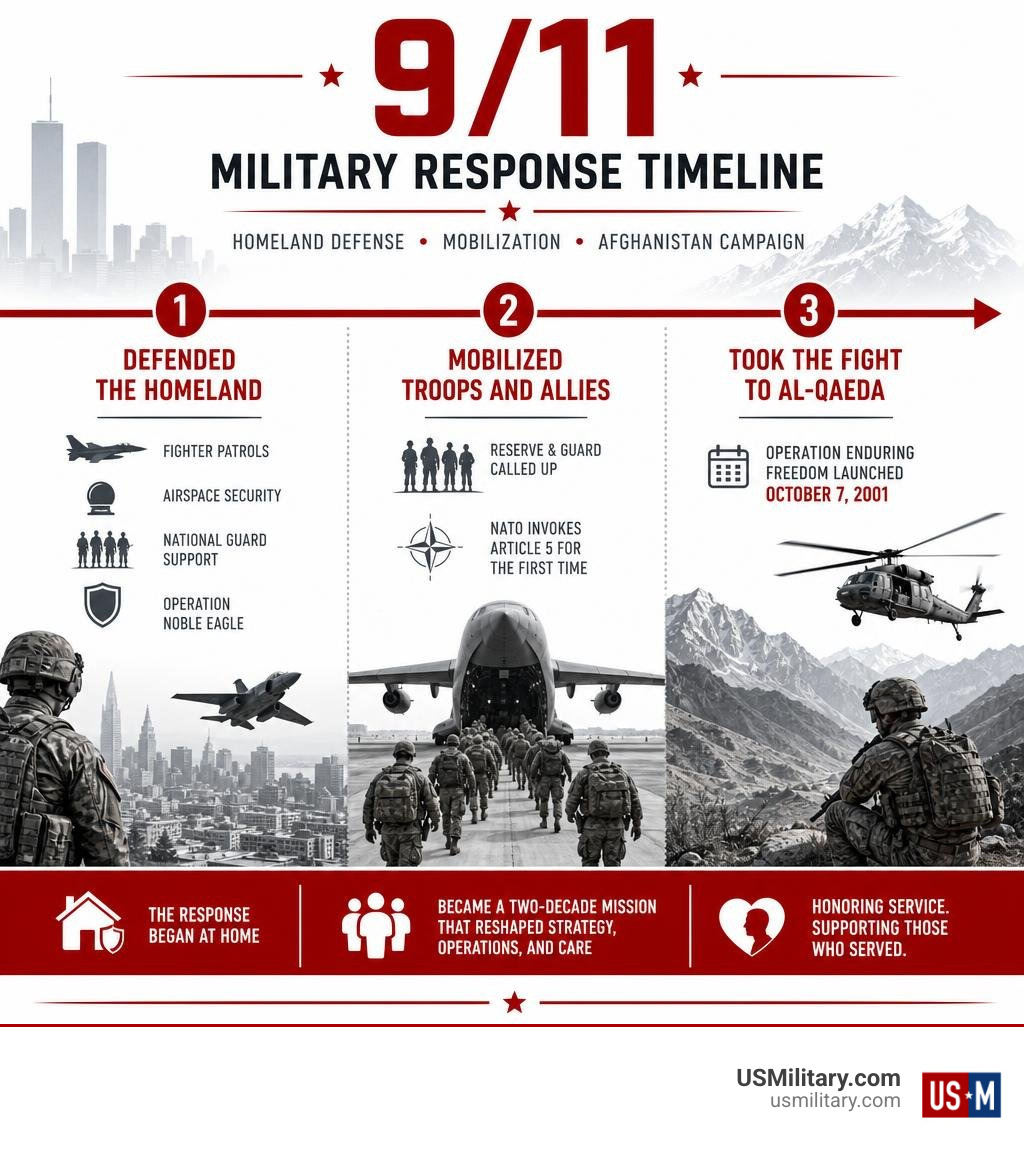
After the September 11, 2001 attacks, the U.S. military answered America’s call in three urgent ways:
- Defended the homeland through fighter patrols, airspace security, National Guard support, and Operation Noble Eagle.
- Mobilized troops and allies by calling up Reserve and Guard forces while NATO invoked Article 5 for the first time.
- Took the fight to al-Qaeda by launching Operation Enduring Freedom in Afghanistan on October 7, 2001.
The response began at home, where military members helped with rescue, recovery, security, logistics, and air defense. It then became a two-decade mission that reshaped combat strategy, special operations, intelligence sharing, veteran care, and homeland defense.
More Than 90% Of Clients Have Increased VA Disability Ratings! Why Settle For Less Than You Deserve? Expert Priority Help With Your VA Claim! Free Evaluation Call!
For those considering service or seeking to understand a loved one’s post-9/11 experience, this history explains both the mission and its human cost: repeated deployments, more than 2,000 U.S. military deaths in Afghanistan, and lasting physical and mental health needs for many veterans.
I am LARRY FOWLER, publisher of the USMilitary.com Network since 2007, where I have helped active-duty members and veterans navigate military careers, VA benefits, and service-related decisions. In covering How The Military Answered The Call Following 9/11 For America, I focus on clear, practical context for the people who served and the families who supported them.
Basic How The Military Answered The Call Following 9/11 For America glossary:
- How Massive is the US Military
- What is the Department of War
- Why Military Veterans Love President Donald J. Trump
How The Military Answered The Call Following 9/11 For America
When the first hijacked airliner struck the North Tower of the World Trade Center on that crisp Tuesday morning, the U.S. military shifted instantly into crisis mode. As the Federal Aviation Administration (FAA) took the unprecedented step of grounding all domestic civilian air traffic—safely landing roughly 4,500 airborne aircraft across the country—our Armed Forces scrambled to establish air sovereignty and coordinate emergency crisis action teams.

On the ground in New York City and at the Pentagon, service members were among the very first to respond. The selfless actions of New York National Guard units saw over 4,200 soldiers and airmen mobilize by the end of the day. Without waiting for formal activation orders, hundreds of Guard members reported directly to local armories. They set up security cordons, directed traffic through dust-choked streets, established supply routes, and sent elite pararescue teams into the smoking wreckage to pull survivors from the debris. Tragically, five New York National Guard members lost their lives in the World Trade Center collapse while working to save others.
Initial Air Defense and How The Military Answered The Call Following 9/11 For America
Prior to September 11, America’s air defense doctrine was built primarily around cold-war assumptions: detecting external, inbound threats over the oceans rather than hijacked commercial airliners inside domestic airspace. In fact, only seven North American Aerospace Defense Command (NORAD) alert sites remained operational across the continental United States.
When the Northeast Air Defense Sector (NEADS) received the initial emergency alerts, air battle managers worked against the clock to vector fighter interceptors toward hijacked targets. Pilots from the 102nd Fighter Wing in Massachusetts and the 119th Fighter Wing launched armed F-15s and F-16s, while unarmed jets from Andrews Air Force Base scrambled into the skies above Washington, D.C. With no onboard live munitions, those pilots prepared to make the ultimate sacrifice by ramming incoming threats if necessary. This extraordinary aerial shield demonstrated how strong the US military remains when tested under unprecedented pressure.
Securing the Homeland and Mobilizing the Reserves
The domestic defense mission quickly expanded into Operation Noble Eagle, establishing around-the-clock combat air patrols over more than 30 major metropolitan areas. To sustain this sprawling homeland defense perimeter, the Pentagon initiated a massive call-up of citizen-soldiers.
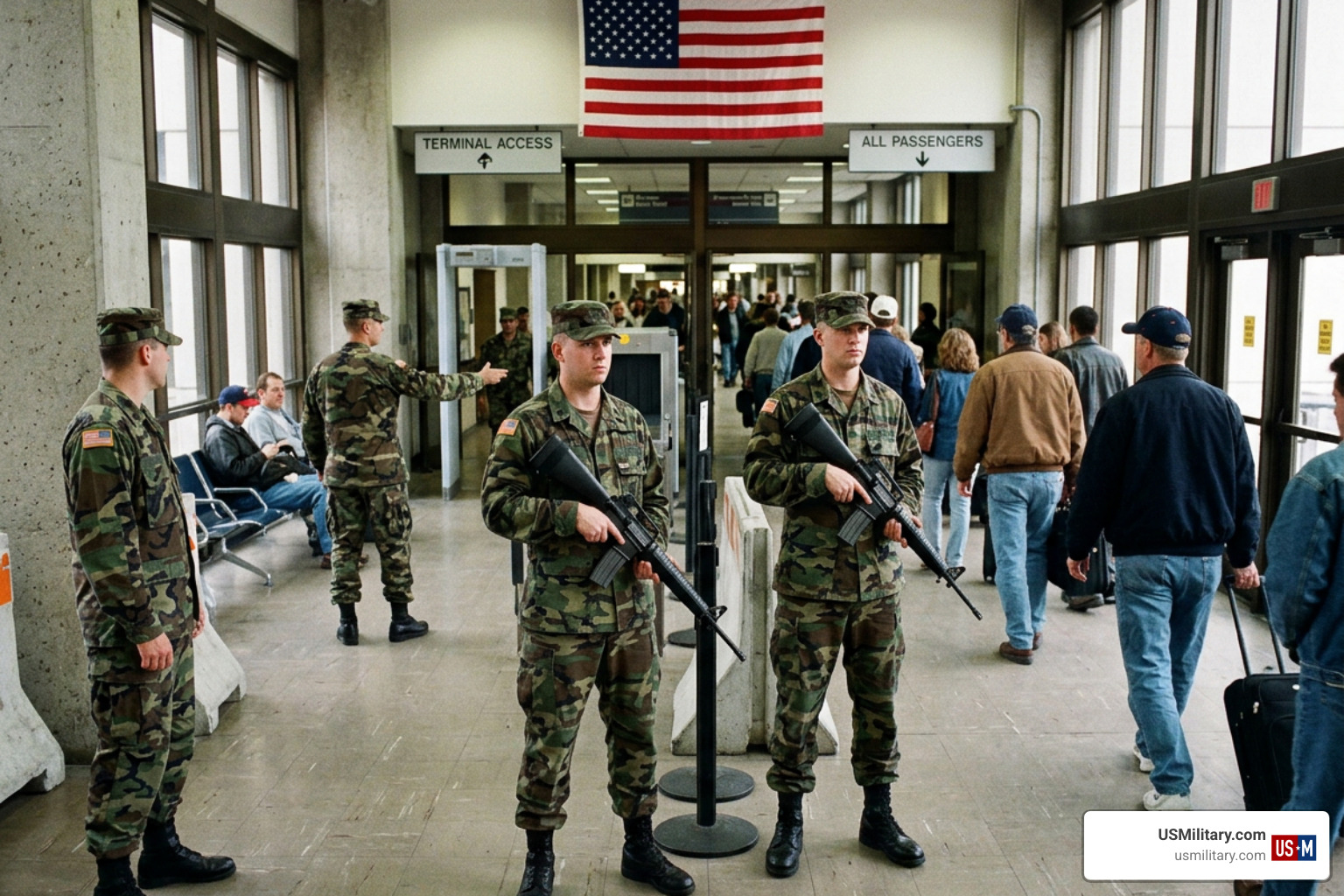
Within days of the attacks, the Department of Defense announced the initial call-up of reserve forces, deploying over 5,000 personnel from 24 states and the District of Columbia. In a major address, leadership praised how our Guard and Reserves define the spirit of America, highlighting their readiness to protect harbors, power grids, and transit centers. The detailed chronology of reserve and guard mobilizations shows that by November 2001, more than 52,000 reservists had stepped into uniform across specialized fields such as security forces, intelligence, civil engineering, and aeromedical evacuation.
Launching Operation Enduring Freedom and the Global Coalition
On October 7, 2001, the United States launched Operation Enduring Freedom (OEF) in Afghanistan, targeting the al-Qaeda network responsible for the 9/11 attacks and the Taliban regime that harbored them. This operation stood on a bedrock of strong public resolve: 77% of Americans favored ground deployments, and early 2002 polling showed an 83% approval rating for the military campaign.
The international response was equally historic. For the first time since its founding in 1949, NATO invoked Article 5 of the North Atlantic Treaty, declaring the assault on the United States an attack against all member states. 136 countries offered military assistance, while 142 nations issued asset-freeze orders to sever terrorist financing streams. As highlighted in Joint Forces Command congressional testimony, this multi-domain approach combined kinetic force, allied basing rights, and interagency intelligence sharing.
Special Operations and Unconventional Warfare in Afghanistan
Rather than opening with a massive, conventional ground invasion, the opening phase of the Afghanistan war relied on unprecedented operational flexibility. Fewer than 3,000 U.S. ground troops deployed during the initial push. Small teams of U.S. Army Special Forces (Operational Detachment Alphas) and CIA operatives linked up with Afghan Northern Alliance commanders, riding on horseback across rugged mountain passes.
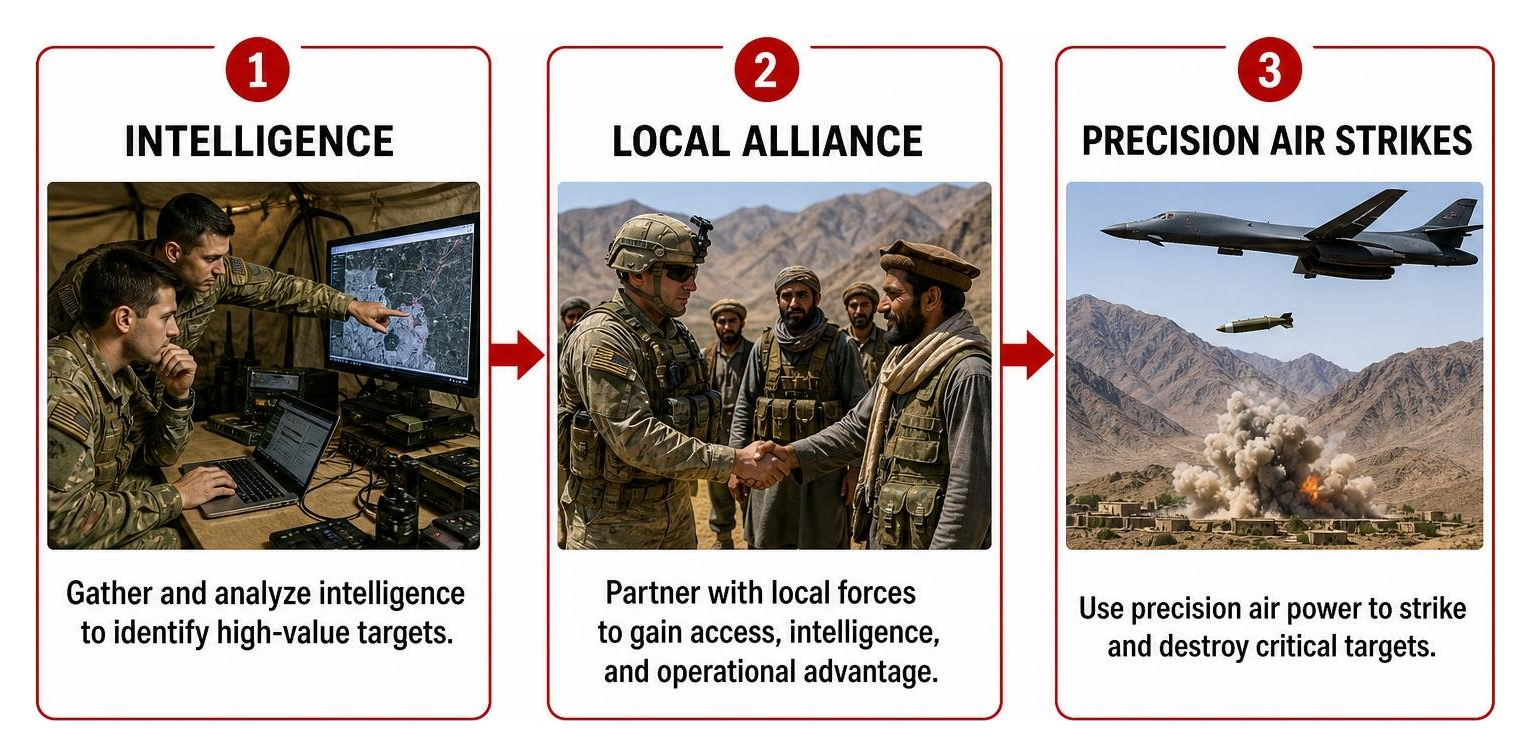
These Green Berets served as tactical force multipliers, using laser target designators to direct satellite- and GPS-guided precision munitions dropped from strategic bombers. Within weeks, this coalition destroyed at least 11 terrorist training camps and 39 Taliban command centers. Following the capture of Mazar-i-Sharif and Kabul, U.S. Marines established Forward Operating Base Rhino near Kandahar. In remote, unforgiving terrain, specialized Afghanistan logistical convoys overcame brutal geography to keep forward units fueled, armed, and supplied.
Humanitarian Relief Operations and Civil Support
From the opening days of the campaign, kinetic military operations were coupled with large-scale humanitarian assistance. U.S. Air Force C-17 Globemasters dropped more than two million daily humanitarian food rations to displaced Afghan civilians in isolated mountain pockets.
Military engineering and civil affairs personnel worked closely with non-governmental agencies to repair roads, dig fresh-water wells, build medical clinics, and restore critical infrastructure. A major operational breakthrough occurred when allied forces secured the reopening of the Friendship Bridge between Uzbekistan and northern Afghanistan, enabling tons of emergency grain, shelter supplies, and medicine to flow directly into previously cut-off communities.
Transforming Strategy, Command Structure, and Homeland Defense
The vulnerabilities exposed on 9/11 prompted the most sweeping overhaul of the U.S. national security apparatus since the passage of the National Security Act of 1947. To eliminate organizational blind spots and streamline interagency counterterrorism, the federal government enacted the Homeland Security Act of 2002, consolidating 22 separate federal agencies into the Department of Homeland Security (DHS).
This coordinated federal response to September 11 integrated civilian law enforcement, intelligence gathering, and defense capabilities into a unified operational framework.
| Metric / Domain | Pre-9/11 Defense Posture | Post-9/11 Unified Architecture |
|---|---|---|
| Homeland Defense Command | Fragmented among regional commands | Unified under U.S. Northern Command (USNORTHCOM) |
| Interagency Coordination | Stovepiped communications across agencies | Integrated DHS, NCTC, and multi-agency fusion centers |
| Airspace Surveillance | Outward-facing perimeter radar screens | Real-time FAA radar feeds integrated directly into NORAD |
| Special Operations Force | ~38,000 personnel; $2.3B annual budget | ~73,000 personnel; $13.7B+ annual budget |
| Reserve Component Role | Strategic reserve of last resort | Fully integrated, operational expeditionary force |
Creation of U.S. Northern Command and Homeland Restructuring
On October 1, 2002, the Department of Defense activated U.S. Northern Command (USNORTHCOM) at Peterson Air Force Base, Colorado. Built to unify homeland defense, USNORTHCOM assumed an area of responsibility encompassing the continental United States, Alaska, Canada, Mexico, and surrounding maritime approaches out to 500 nautical miles.
Working in lockstep with civilian emergency managers, USNORTHCOM integrated Joint Task Force-Civil Support (JTF-CS) to manage defense consequence responses to chemical, biological, radiological, or nuclear (CBRNE) incidents. Concurrently, the National Guard established certified Weapons of Mass Destruction Civil Support Teams across every state and U.S. territory, ensuring local governors possessed immediate, specialized detection and response assets.
Key Counterterrorism Milestones: How The Military Answered The Call Following 9/11 For America
Over two decades of intense counterterrorism operations, the U.S. military maintained constant pressure against hostile networks worldwide. Special operations forces evolved rapidly, doubling the size of U.S. Special Operations Command (USSOCOM) to meet expanding global requirements.
Among the most defining operational milestones was the May 2, 2011 helicopter raid into Abbottabad, Pakistan, known as Operation Neptune Spear, during which elite Navy SEALs brought al-Qaeda founder Osama bin Laden to justice. A decade later, on July 31, 2022, a precision drone strike in downtown Kabul eliminated his successor, Ayman al-Zawahiri, without civilian casualties.
These triumphs came alongside devastating moments of battlefield heartbreak. We remember the extraordinary courage of our fallen warriors during operations like the tragic loss of 38 American and Afghan personnel aboard Extortion 17 in August 2011. Every milestone stands as a testament to the quiet professionalism of our service members.
The Human Toll, Veteran Sacrifices, and the 2021 Afghanistan Withdrawal
The burden of answering America’s post-9/11 call was carried directly by an all-volunteer force. Across twenty years of conflict, more than 2,000 U.S. service members lost their lives in Afghanistan, while tens of thousands suffered life-altering physical and psychological wounds.
A unique cohort of citizens stepped forward to fill the ranks. In 2001 alone, active-duty enlistments reached 181,510, with another 72,908 joining the reserves. The moving personal stories of the generation inspired to serve capture young Americans from every background who put their civilian lives on hold. To support these men and women upon their return, Congress enacted the Post-9/11 GI Bill, providing essential tuition assistance, housing stipends, and educational benefits to millions of transitioning veterans. This deep bench of volunteers also reinforced why our nation relies on a capable, voluntary force rather than an active military draft system.
Long-Term Health Impacts and Veteran Support
Repeated combat rotations, environmental hazards, and exposure to toxic burn pits left lasting imprints on post-9/11 veterans. Conditions such as traumatic brain injury (TBI), complex musculoskeletal trauma, and chronic respiratory illnesses became common service-connected disabilities.
Equally critical is the ongoing struggle with post-traumatic stress. As we explore in our guide on veteran mental health and suicide prevention, addressing the invisible wounds of war requires compassionate, community-wide support and accessible medical care. Whether you are navigating VA disability ratings, pursuing vocational retraining, or seeking peer support, resources are available to ensure our veterans receive the benefits they earned through their service.
Concluding the Mission: The 2021 Kabul Airlift and Historical Perception
Between 2019 and August 30, 2021, the United States withdrew its remaining 14,000 troops from Afghanistan, bringing the twenty-year conflict to an official close. During the final, turbulent days of the mission, U.S. service members orchestrated the Kabul International Airport noncombatant evacuation operation—the largest military humanitarian airlift in history—safely evacuating more than 124,000 Americans, third-country nationals, and allied Afghans under extreme danger.
In the aftermath of the withdrawal, 69% of U.S. adults felt the nation had largely fallen short of its long-term strategic goals in Afghanistan, reflecting a significant shift in public sentiment since 2001. Yet, the tactical precision, personal bravery, and dedication of the service members who completed that mission remain beyond reproach. Their efforts prevented another mass-casualty foreign attack on the American homeland for over two decades.
Frequently Asked Questions About How The Military Answered The Call After 9/11
What was the military’s immediate domestic response on September 11, 2001?
Within minutes of the hijackings, air defense sectors scrambled armed fighter jets to secure major metropolitan areas, while Joint Forces Command activated emergency Crisis Action Teams. Concurrently, thousands of National Guard and Reserve troops deployed to protect vital infrastructure, secure transit hubs, and assist emergency workers with rescue and recovery at Ground Zero and the Pentagon under Operation Noble Eagle.
How many countries joined the coalition to support U.S. military operations?
Following the attacks, 136 countries offered various forms of direct military assistance, including overflight rights, basing access, intelligence sharing, and combat troops. Additionally, NATO invoked Article 5 for the first time in its history, unifying international partners in common defense against global terrorism.
What major military commands were created as a direct result of 9/11?
The Department of Defense established U.S. Northern Command (USNORTHCOM) in October 2002 to serve as the unified combatant command dedicated to homeland defense and civil support. The Pentagon also stood up Joint Task Force-Civil Support (JTF-CS) and doubled the personnel and budget allocations for U.S. Special Operations Command (USSOCOM).
Conclusion
The story of how our Armed Forces answered the call after September 11 is defined by immediate domestic courage, sweeping strategic adaptation, and twenty years of selfless sacrifice. From fighter pilots flying combat air patrols over American cities to special operators traversing Afghan mountain ranges, our service members met an unprecedented crisis with unwavering dedication.
As we look at today’s defense landscape, the lessons learned from 9/11 continue to guide military training, interagency intelligence sharing, and joint homeland defense operations. At USMilitary.com, we remain dedicated to supporting this extraordinary community by providing reliable, comprehensive guides on VA disability claims, home loan benefits, military career transitions, and veteran wellness programs.
Free for Service Members & Veterans
Get the military benefits intel no one tells you about.
Weekly updates on VA benefits, pay changes, and money tips — free for service members and veterans.
No spam. Unsubscribe anytime. Your info is never shared.


