How Much Does Active Duty Military Pay in 2026?
The active duty military pay chart for 2026 shows a 3.8% increase over 2025 levels, effective January 1, 2026. Here is a quick look at key monthly basic pay rates:
| Rank | Description | Monthly Basic Pay (2026) |
|---|---|---|
| E-1 | Enlisted, less than 4 months | $2,225.70 |
| E-1 | Enlisted, 4+ months | $2,407.20 |
| E-6 | Enlisted, 10+ years | $4,759.50 |
| E-9 | Senior Enlisted, 38+ years | $10,729.20 |
| SMA | Sergeant Major of the Army | $11,166.90 |
| O-1 | New Officer | $4,150.20 |
| O-4 | Mid-Career Officer, 10+ years | $9,420.00 |
| O-7 to O-10 | Senior Officers (capped) | up to $18,999.90 |
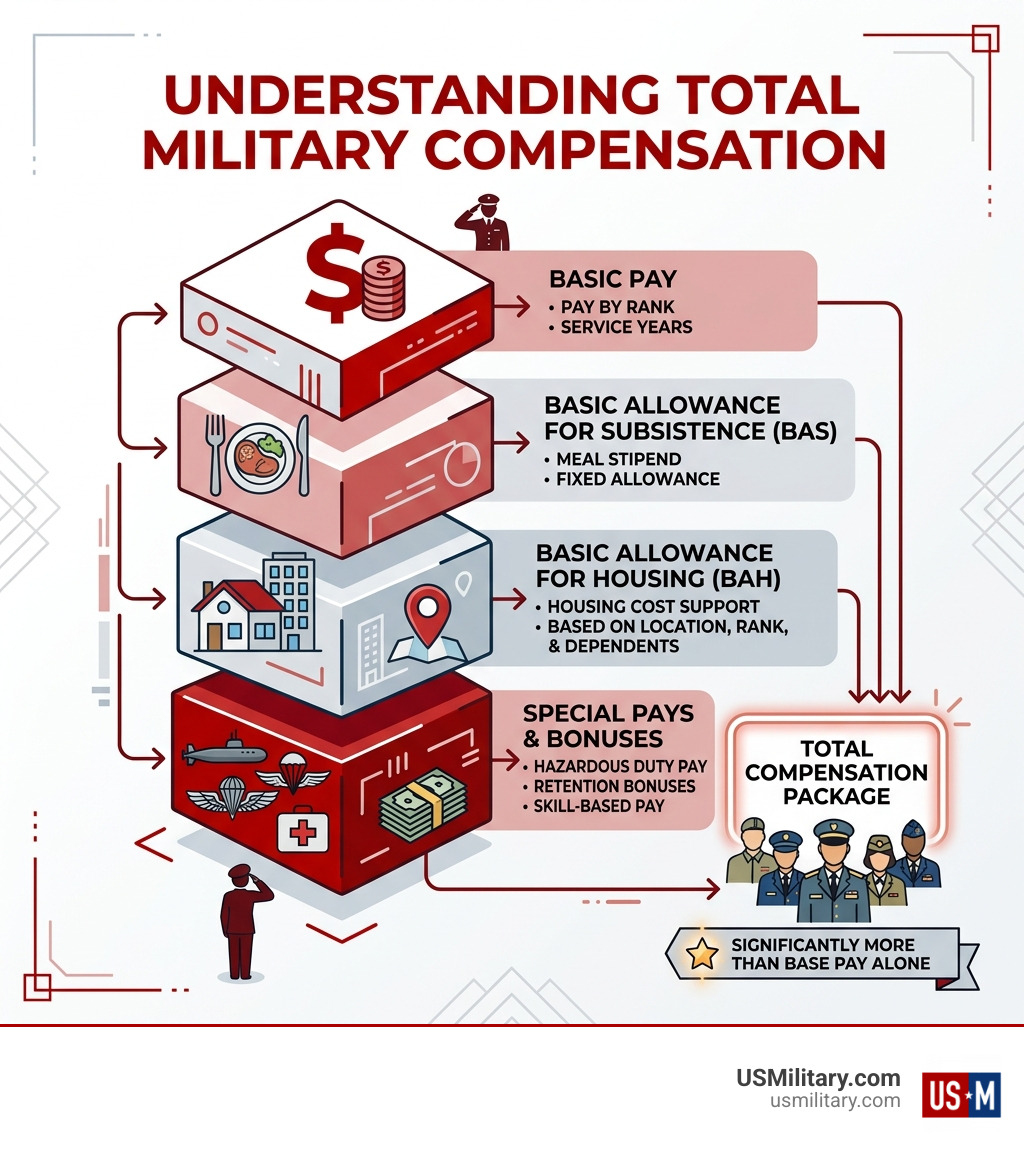
Your total pay goes beyond basic pay. It also includes tax-free allowances like Basic Allowance for Housing (BAH) and Basic Allowance for Subsistence (BAS), plus potential bonuses and special duty pay. Together, these can make military compensation significantly more valuable than base pay alone suggests.
I’m Larry Fowler, publisher of the USMilitary.com Network since 2007 and a longtime resource for active duty service members navigating the active duty military pay chart and military benefits. In this guide, I’ll break down exactly what you can expect to earn in 2026 — from your first paycheck to senior leadership compensation.
Understanding the 2026 Active Duty Military Pay Chart
Navigating military finance can feel like trying to read a map in a hurricane, but we are here to help clear the air. The active duty military pay chart is the foundation of every service member’s financial life. It isn’t just a random set of numbers; it is a highly structured system designed to reward both responsibility (rank) and loyalty (years of service).
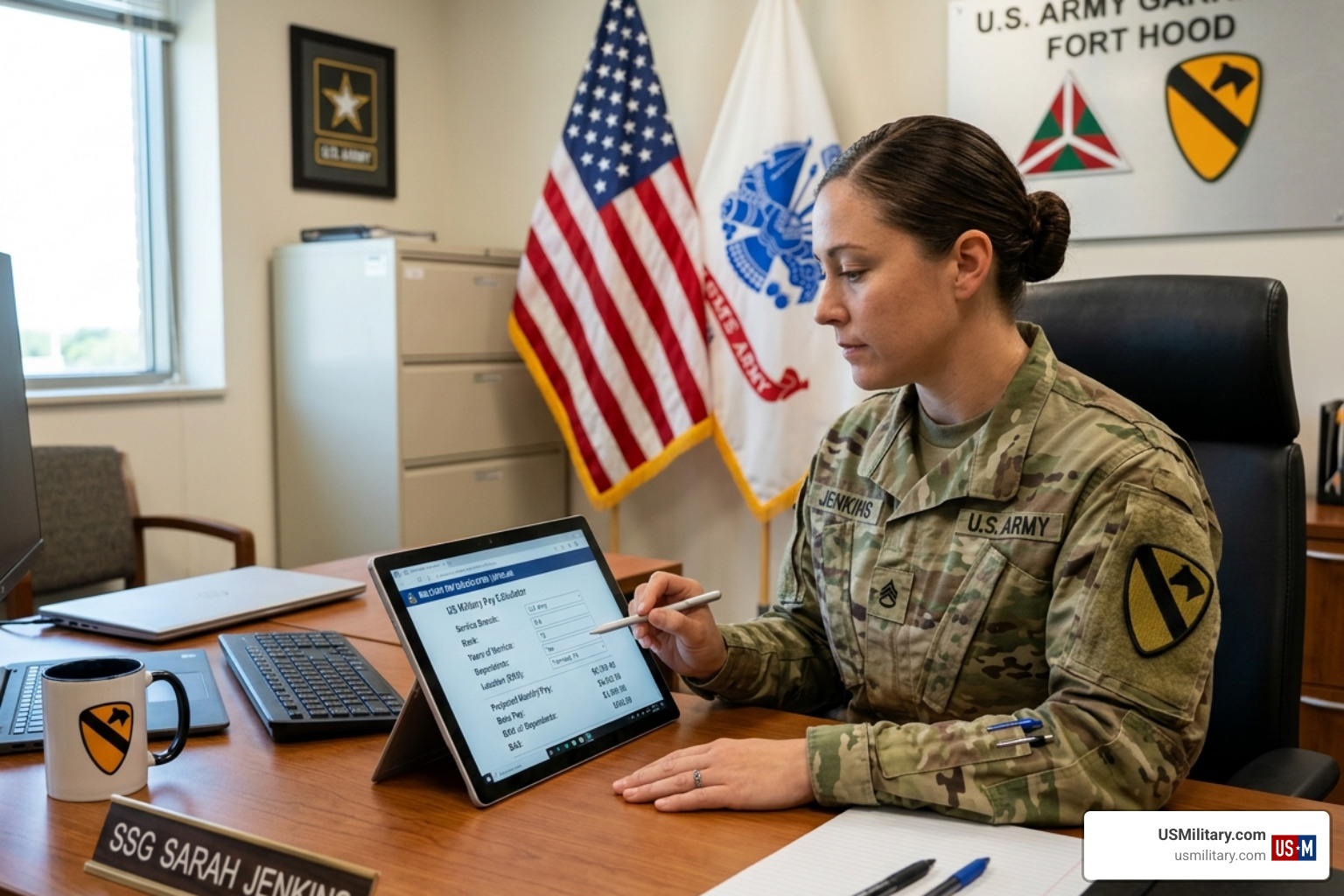
When you look at a Military Salary, you are seeing the “Basic Pay.” This is the core taxable income you receive for being on active duty. For 2026, these rates are set to increase by 3.8% compared to the 2025 levels. This annual adjustment isn’t just pulled out of a hat—it is largely driven by the Employment Cost Index (ECI). The ECI is a measure of the change in the cost of labor, calculated by the Department of Labor.
While the ECI provides the baseline, Congress ultimately has the final say. They can choose to match the ECI or, in some years, supersede it to ensure military pay remains competitive with the private sector. For the most accurate and granular data, you can always refer to the official Military Pay Tables & Information provided by the Defense Finance and Accounting Service (DFAS).
How Basic Pay is Calculated
Your position on the active duty military pay chart is determined by two primary factors: your paygrade (rank) and your creditable service (longevity).
- Paygrade: This is your rank, ranging from E-1 (Private/Seaman/Airman Basic) to O-10 (General/Admiral). As you take on more responsibility and promote, your paygrade increases.
- Years of Service: Also known as “longevity,” this tracks how long you have been in the military. Most paygrades have “steps” every two years. This means even if you don’t get promoted, you still get a raise just for staying in and doing your job.
It is important to note that “creditable service” can be complex. For example, Army Basic Pay for commissioned officers often requires specific point totals if they are coming from a Reserve component to ensure their time is accurately reflected on the active duty scale.
The 3.8% Annual Pay Increase
The 3.8% raise for 2026 is a welcome boost for our troops. This increase is designed to maintain “parity” with the private sector, ensuring that those who serve our country aren’t left behind by inflation. This raise becomes effective on January 1, 2026, meaning you will see the extra “clink” in your bank account starting with the mid-January pay period.
This follows a significant trend in recent years, such as the Proposed Military Pay For 2025, which saw a substantial 14.5% targeted raise for junior enlisted ranks (E-1 to E-4) to help our newest service members deal with rising costs of living.
2026 Basic Pay Rates for Enlisted and Officers
To give you a better idea of how the 2026 rates compare to the previous year, let’s look at the monthly basic pay for several common milestones.
| Rank | 2025 Monthly Pay (Est.) | 2026 Monthly Pay (3.8% Increase) |
|---|---|---|
| E-2 (under 2 years) | $2,599.20 | $2,697.97 |
| E-5 (6 years service) | $3,835.50 | $3,981.25 |
| O-1 (under 2 years) | $3,998.40 | $4,150.20 |
| O-3 (8 years service) | $7,552.20 | $7,839.18 |
Enlisted Rates on the Active Duty Military Pay Chart
For enlisted members, the 2026 active duty military pay chart provides clear progression. If you are just starting out, an E-1 with less than four months of service will earn $2,225.70 per month. Once you hit that four-month mark, your pay jumps to $2,407.20.
As you move into the NCO ranks, the rewards for longevity become even more apparent. An E-6 with over 10 years of service will bring home $4,759.50 in basic pay monthly. At the very top of the enlisted spear, the 2025 Basic Pay: Enlisted tables (which transition into the 2026 rates) show that an E-9 with over 38 years of service earns $10,729.20.
Special recognition is given to the highest-ranking enlisted member in each branch. For instance, the Sergeant Major of the Army (and their counterparts in the Navy, Air Force, Marines, and Space Force) receives a fixed basic pay of $11,166.90 per month in 2026, regardless of their total years in service. You can see how this has evolved by checking out the Military Pay Chart 2025.
Officer Compensation in the Active Duty Military Pay Chart
Commissioned officers start at a higher pay point due to their educational requirements and leadership responsibilities. A brand-new O-1 in 2026 starts at $4,150.20 per month. By the time an officer reaches the mid-career rank of O-4 (Major/Lieutenant Commander) with 10 years of service, their basic pay rises to $9,420.00 monthly.
There are also “prior enlisted” officer pay scales (O-1E, O-2E, O-3E). These are designed for those who served at least four years and one day as an enlisted member or warrant officer before commissioning. This recognizes their prior experience and offers a higher starting salary than a standard O-1.
It is worth noting that there are legal caps on high-level pay. For 2026, basic pay for O-6 and below is limited to $15,408.30 per month (Level V of the Executive Schedule). For general and flag officers (O-7 to O-10), the cap is $18,999.90 per month (Level II of the Executive Schedule). These caps are why you often see the Highest Paying Military Jobs 2024 leveling off at the very top of the chart.
Allowances, Bonuses, and Special Duty Pay
If you only looked at basic pay, you’d be missing half the story. The military provides a variety of allowances that are often tax-free, which significantly increases your “real-world” purchasing power.
Special Duty and Incentive Pay Eligibility
Beyond your standard paycheck, the military offers “Special Duty Pay” for those performing demanding or dangerous jobs. This includes:
- Hazardous Duty Incentive Pay (HDIP): For those involved in flight, demolition, or parachute jumping.
- Career Sea Pay: For those serving on ships.
- Submarine Duty Pay: For the “Silent Service.”
- Hostile Fire/Imminent Danger Pay: For those serving in designated combat zones.
Specialized roles like Navy SEALs often qualify for multiple incentive pays due to the rigorous nature of their work. If you’ve ever wondered How Much Do Seals Make, it is a combination of high basic pay, jump pay, dive pay, and demolition pay. You can find more details on Navy Seals Salary and general Special Duty Enlistment Pay on our site.
Understanding BAH and BAS Rates
The two biggest allowances are BAH and BAS.
Basic Allowance for Housing (BAH) is a tax-free allowance to help you pay for housing when you aren’t living in government quarters. The amount is based on your geographic location, your rank, and whether or not you have dependents. In high-cost areas like San Diego or DC, BAH can easily exceed $3,000 or $4,000 a month. Because it is tax-free, it is worth much more than an equivalent amount of taxable civilian salary.
Basic Allowance for Subsistence (BAS) is meant to offset the cost of your meals. For 2026, most officers and enlisted members not eating in a dining facility will receive over $300 a month. For a deeper look at how these add up, check out Your Ranger Paycheck Breaking Down Active Duty Compensation.
Comparing Military Compensation to Civilian Salaries
We often hear people ask, “Is the military pay actually good?” When you factor in the total compensation package, the answer is usually a resounding “yes.”
In the civilian world, you usually have to pay for:
- Health Insurance: Military members and their families receive comprehensive healthcare through TRICARE with zero premiums for active duty.
- Housing: Civilians pay for rent/mortgages with after-tax dollars. Military BAH is tax-free.
- Retirement: The military offers the Thrift Savings Plan (TSP) with matching contributions, plus a pension after 20 years.
- Vacation: Every service member earns 30 days of paid leave per year—far more than the average entry-level civilian job.
When you add up basic pay, tax-free BAH, BAS, and the value of free healthcare, a junior enlisted member often has a “civilian equivalent” salary that is 20-30% higher than their basic pay suggests. This is why many Top 6 Figure Military Jobs are actually attainable much earlier in a military career than in the corporate world. For more info, see our Top 10 Military Jobs Six Figures Guide.
Managing Your Earnings: The LES and Financial Planning
To manage your money, you have to understand your Leave and Earning Statement (LES). This is your monthly pay stub, accessible via the myPay portal.
Your LES is broken into several key sections:
- Entitlements: Everything you are being paid (Basic Pay, BAH, BAS, Special Pays).
- Deductions: Money taken out for taxes, Social Security, and Medicare.
- Allotments: Money you’ve designated to go elsewhere (like a savings account or a car payment).
- Leave: Your current balance of vacation days.
- Thrift Savings Plan (TSP): Your retirement contributions.
We always recommend checking your LES every single month. Errors happen, and it is much easier to fix a pay discrepancy in the same month than it is six months down the road. If you see something wrong, contact your unit’s finance or payroll office immediately.
Frequently Asked Questions about Active Duty Pay
When does military pay change each year?
Military pay rates typically change on January 1st of each year. This reflects the annual cost-of-living adjustment approved by Congress.
What is the difference between Basic Pay and Special Duty Pay?
Basic Pay is your standard salary based on rank and years of service. Special Duty Pay is extra money given for specific skills, locations, or dangerous assignments (like flight pay or sea pay).
How do I fix an error on my Leave and Earning Statement?
If you spot an error, don’t wait. Gather your documentation and visit your local Finance Office or Personnel Office. For Coast Guard members, you may need to contact the Pay & Personnel Center directly.
Conclusion
The 2026 active duty military pay chart represents more than just a 3.8% raise; it represents the nation’s commitment to those who stand the watch. Whether you are an E-1 just starting your journey or a senior officer leading thousands, understanding your compensation is vital for your financial readiness and your family’s future.
By combining basic pay with tax-free allowances and special incentives, the military provides a competitive and stable path for career progression. As we move through 2026, keep an eye on your LES, contribute to your TSP, and make the most of the benefits you’ve earned.
For the latest updates on the 2026 Military Pay Chart and all other military benefits, stay tuned to us right here at USMilitary.com. We are proud to be your central hub for military guidance.
Free for Service Members & Veterans
Get the military benefits intel no one tells you about.
Weekly updates on VA benefits, pay changes, and money tips — free for service members and veterans.
No spam. Unsubscribe anytime. Your info is never shared.


