How National Debt Could Weaken Military Security

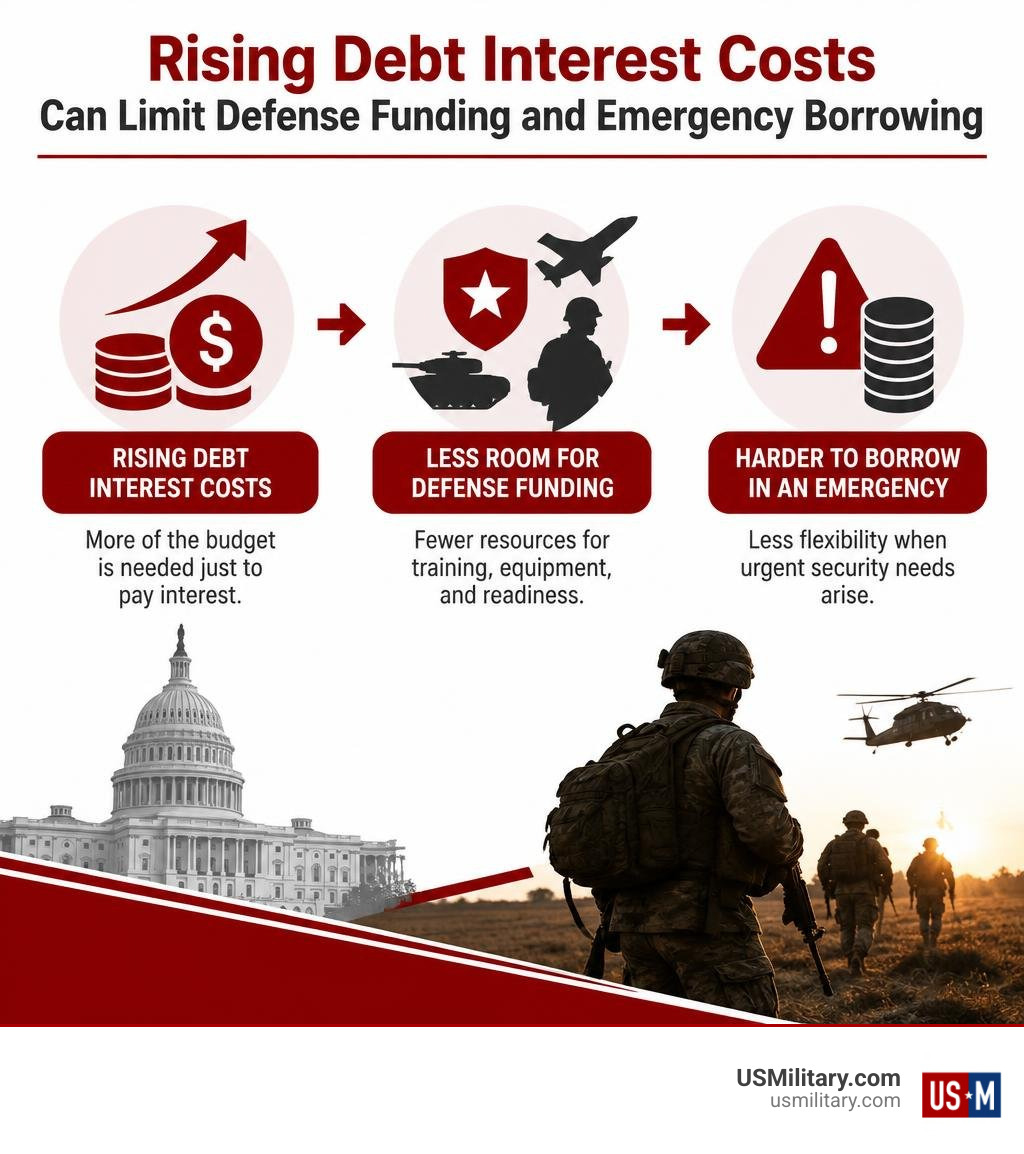
Could the national debt and congressional overspending affect the military and security of our nation someday? Yes. Rising interest costs leave Congress less room to fund training, equipment, and a fast response to a new conflict. In fiscal year 2024, federal net interest payments reached $882 billion, slightly more than the $874 billion spent on discretionary national defense, according to the Bipartisan Policy Center. That does not mean defense funding was cut by the same amount, but it shows how costly past borrowing has become.
I’m Larry Fowler, a Navy veteran, BUD/S Class 89 graduate, and publisher of USMilitary.com. My work with service members and veterans since 2007 shapes how I approach the question, “Could The National Debt And Congressional Over Spending Effect The Military And Security Of Our Nation Some Day?”
Could the National Debt and Congressional Overspending Affect the Military and Security of Our Nation Someday?
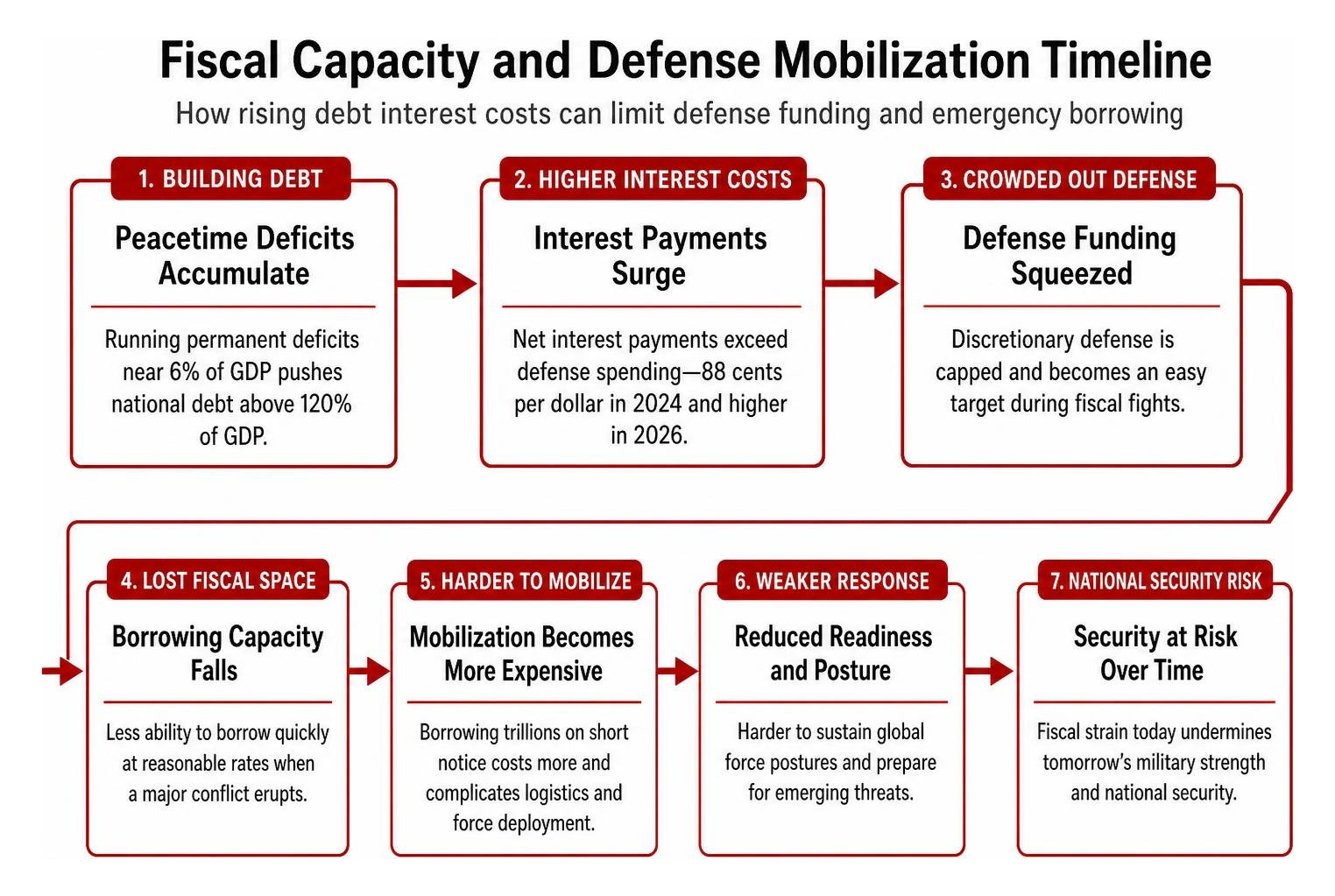
When we look at the federal budget, discretionary defense spending is increasingly squeezed by mandatory entitlements and soaring debt service costs. The national debt now exceeds 120% of our gross domestic product (GDP), and the Congressional Budget Office (CBO) projects publicly held debt will continue outpacing economic growth over the next decade.
Because defense is the largest component of discretionary spending, it often becomes an easy target for statutory budget caps during fiscal fights. However, private markets cannot step in to build fighter jets or recruit troops. When fiscal pressures mount, national security absorbs the shock, making it harder to sustain global force postures when we assess how massive is the US military size revealed.
| Fiscal Year | Net Interest Outlays | National Defense Outlays | Interest as % of Defense Outlays |
|---|---|---|---|
| 1980 (Cold War) | $53 Billion | $134 Billion | ~39.5% |
| 2008 (Great Recession) | $253 Billion | $616 Billion | ~41.0% |
| 2020 (COVID-19) | $345 Billion | $725 Billion | ~47.6% |
| 2024 (Milestone Year) | $882 Billion | $874 Billion | ~100.9% |
| 2026 (Current Projection) | $950+ Billion | $895 Billion | ~106.1% |
The Fiscal Tipping Point: When Debt Service Surpasses the Pentagon
We have officially crossed a historic line. Recent analysis confirming CBO: Federal Interest Payments Now Exceed Defense Spending highlights that the United States spent approximately 88 cents servicing accumulated debt for every dollar allocated to defense in 2024. In 2026, net interest payments remain higher than the entire base budget for national defense.
Over the next 10 years, CBO estimates interest costs will total over $16 trillion. When interest consumes revenue automatically before Congress appropriates a single dollar, baseline defense modernization takes a back seat.
Why Could The National Debt And Congressional Over Spending Effect The Military And Security Of Our Nation Some Day Through Lost Fiscal Space?
Fiscal space represents a nation’s financial cushion—its ability to borrow quickly at reasonable rates when an emergency strikes. Analysts track this through metrics like the Fiscal Space Index, which gauges borrowing health against defense obligations. In past major conflicts, America’s low peacetime debt allowed the Treasury to issue war bonds and finance emergency deployments without triggering panic in bond markets.
Today, running permanent peacetime deficits near 6% of GDP strips away that strategic depth. If a major conflict erupts, borrowing trillions on short notice becomes far more expensive, directly complicating the logistics of managing everything you need to know about current military deployments and equipment.
Historical Precedents: How Past Fiscal Crises Undermined Military Preparedness
History gives us clear warnings about the danger of neglecting military investment during economic strain. Following the 1929 stock market crash, the Great Depression ushered in severe fiscal austerity. The U.S. Army shrank to roughly 130,000 active-duty soldiers during the 1930s, leaving units undertrained and equipped with outdated World War I gear.
When World War II began, that lack of preparedness led to early battlefield setbacks, such as the tactical defeat at Kasserine Pass in North Africa. Although America successfully mobilized its industrial base and consolidated debt after 1945, our modern fiscal approach is different. As documented in America’s Fiscal Future | U.S. GAO, emergency borrowing from recent economic shocks was never rolled back, turning temporary crisis outlays into permanent structural deficits.
2013 Sequestration to 2026: The Lingering Legacy of Budget Dysfunction
We saw another example of self-inflicted damage under the Budget Control Act of 2011, which triggered automatic sequestration cuts in 2013. The Pentagon had to slash nearly $54 billion overnight, forcing the Air Force to ground combat squadrons, the Army to cancel major training rotations, and the Navy to delay depot maintenance on aircraft carriers.
✉ Get updates like this in your inbox
Weekly VA benefit changes, pay updates, and money tips for service members, veterans, and military families. Free, no spam.
In 2026, Congress still relies heavily on short-term Continuing Resolutions (CRs) instead of passing timely appropriations. Operating under CRs locks defense spending at prior-year levels, delaying new weapons contracts and creating supply chain bottlenecks for domestic defense manufacturers.

How Sovereign Debt Risks Threaten Military Readiness, Alliances, and Power Projection
Unchecked national debt does not just impact internal budgets; it reshapes our standing on the world stage. Research from the R Street Institute and the Foreign Policy Research Institute emphasizes that high sovereign debt limits international credibility. If foreign creditors begin to doubt U.S. fiscal solvency, the role of the U.S. dollar as the premier global reserve currency could weaken, giving strategic rivals like China an opening to expand their financial and regional influence.
Furthermore, when Washington is consumed by budget battles, international alliances feel the strain. Persistent fiscal disputes invite NATO burden-sharing friction, potentially emboldening adversaries who wager that domestic economic gridlock will prevent America from honoring its mutual defense pacts.
Will Mounting Deficits Compromise Servicemember Compensation and Retention?
Our armed forces depend on people. When budgets tighten, personnel accounts often face scrutiny. While active-duty basic pay is protected, high inflation and fiscal pressures can limit enlistment bonuses, delay base housing construction, and slow renovations on aging barracks.
Service members tracking the military pay scale in 2026 for enlisted and officers need assurance that their earned benefits remain solid. Preserving competitive compensation and safeguarding the ultimate guide to military benefits are vital to keeping our all-volunteer force fully staffed.
How Could The National Debt And Congressional Over Spending Effect The Military And Security Of Our Nation Some Day In Modern Warfare?
Modern warfare requires continuous technological investment across air, land, sea, space, and cyber domains. Shrinking defense purchasing power impacts key operational areas:
- Multidomain Operations (MDO): Delays in fielding unified battle management software and secure tactical communications networks.
- Defense Industrial Base: Inability to maintain surge production capacity for precision-guided munitions and critical artillery stockpiles.
- Space and Cyber Resilience: Strained resources to deploy resilient low-Earth orbit micro-satellite constellations and defend military networks against state-sponsored cyberattacks.
- Logistics Automation: Slower adoption of artificial intelligence and automated systems designed to streamline supply chains and lower operational costs.
Strategic Policy Solutions to Safeguard Defense Capabilities
Fixing our fiscal path while maintaining military superiority requires actionable, bipartisan reforms. We can protect national security by addressing structural debt drivers directly:
- Enact Budget Discipline and Offsets: Pair any proposed emergency defense expansions with spending offsets in non-defense discretionary programs.
- Modernize Pentagon Procurement: Overhaul the Planning, Programming, Budgeting, and Execution (PPBE) system to fast-track commercial dual-use tech into service hands.
- Address Long-Term Entitlement Drivers: Form bipartisan commissions to shore up Medicare and Social Security trust funds before they face automatic financing shortfalls.
- Issue Dedicated Defense Bonds: Reintroduce sovereign defense bonds during designated security crises to finance emergency readiness directly through voluntary public investment.
- Target Government Waste: Curtail improper payments, recover uncollected revenues, and eliminate bureaucratic overlap across federal agencies.

Frequently Asked Questions About National Debt and Military Security
How do rising net interest payments directly crowd out military defense funding?
Net interest is a mandatory obligation that must be paid to bondholders to avoid sovereign default. As interest costs climb past $900 billion annually, they take up a larger share of federal revenue. This leaves less funding available for discretionary categories, forcing lawmakers to make tough trade-offs between weapons modernization, troop levels, and infrastructure upkeep.
Can the United States simply grow or inflate its way out of defense debt risks?
No. An aging workforce and demographic shifts slow natural economic growth, meaning productivity gains alone cannot close the deficit gap. Additionally, inflating away debt fails because major entitlement obligations and military cost-of-living adjustments are tied to inflation, which drives interest rates higher and increases debt-servicing costs.
How would a sovereign debt crisis or default impact military personnel and VA operations?
Under the Anti-Deficiency Act, active-duty service members and essential VA medical staff stay on duty during government funding standoffs, but their paychecks can be delayed until borrowing authority is restored. A full sovereign default would spike borrowing costs, disrupt VA healthcare contracts, and rattle global financial markets.
Conclusion
Economic strength and military power go hand in hand. A strong defense requires a stable fiscal foundation. As interest costs outpace base defense budgets and emergency borrowing limits our flexibility, restoring budget discipline is essential to national defense.
At USMilitary.com, we believe that taking care of service members, veterans, and military families begins with keeping our nation financially sound. Protecting our competitive edge depends on clear-eyed fiscal management, ensuring our armed forces remain prepared for any challenge. To learn more about current troop levels and readiness, see our guide on evaluating overall active-duty strength and how many people are in the US military.
Free for Service Members & Veterans
Get the military benefits intel no one tells you about.
Weekly updates on VA benefits, pay changes, and money tips — free for service members and veterans.
No spam. Unsubscribe anytime. Your info is never shared.



Leave a Reply