Measuring Financial Success: How Successful Are Retired Navy SEALs In Their Civilian Life?

When measuring how former special operators fare after active duty, financial stability is one of the most quantifiable benchmarks. The earning potential for transitioning operators is exceptionally high, backed by corporate placement statistics and specialized recruiting data.
According to data from the Special Operators Transition Foundation (SOTF), which has helped place over 500 veterans into Fortune 500 companies since 2013, the average starting annual salary for a transitioning operator is approximately $140,000. Depending on the industry and geographic location, first-year compensation packages typically range from $80,000 to $120,000 in federal agencies or corporate security, scaling rapidly into six-figure roles as veterans calibrate their skills to business environments.
High-Paying Career Paths and Executive Compensation
Transitioning operators possess elite problem-solving capabilities, high risk tolerance, and proven crisis leadership. These traits map cleanly into specific high-paying industries:
- Private Security & Executive Protection: Protecting ultra-high-net-worth individuals or commanding corporate security departments offers annual earnings between $150,000 and $200,000+. High-threat, overseas Personal Security Detail (PSD) contracts can command $180,000 to $300,000+ per year.
- Paramilitary & Defense Contracting: Overseas defense contractors can earn between $100,000 and $250,000+ annually, often working four to six months per year.
- Commercial Aviation: Many former operators build flight hours while serving (an informal pipeline known internally as “Teeny Weenie Airlines” or TWA) to transition into commercial airline pilot roles, where median annual salaries reach $202,180.
- Corporate Leadership & Management Consulting: Senior consultants and executive directors commanding leadership development firms frequently earn $300,000 to $500,000+.
- Technology & Cybersecurity: Software developers (mean wage $144,570) and information security analysts (mean wage $127,730) leverage the logical systems thinking and adaptability honed in Naval Special Warfare.
- Healthcare: Former SEAL medics routinely build on their trauma medicine background to become Physician Assistants (PAs), earning an average of $136,900 annually.
Many of these positions are available through Top Companies That Hire Veterans, which actively recruit former special operations personnel for their dependability and executive stamina. For a deeper breakdown of salary structures, read Navy SEAL (SO) to Civilian: Your Complete Career Transition Roadmap (With Salary Data) .
Long-Term Financial Planning and Pension Wealth
A major factor influencing How Successful Are Retired Navy SEALs In Their Civilian Life is the military retirement system. Service members who complete a 20-year military career receive a guaranteed lifetime monthly pension starting immediately upon retirement (typically around age 43), alongside potential VA disability compensation and lifelong healthcare benefits through TRICARE.
When combining pension pay, tax-free disability compensation, civilian salary earnings starting at age 43, and 25 years of compounded 401(k) investment growth, a retired 20-year operator can achieve a projected lifetime financial value exceeding $17 million. This financial safety net allows retired operators to take calculated entrepreneurial risks, pursue executive education, or accept purpose-driven roles without the immediate pressure of living paycheck to paycheck.
Psychological Adjustments and Corporate Culture Shock
While the financial potential is undeniable, the psychological shift from elite military service to civilian employment represents a significant hurdle. In Naval Special Warfare, operators exist in an environment of extreme accountability, hyper-competence, and absolute trust.
Entering the civilian corporate world often introduces bureaucracy, ambiguous expectations, and slower decision-making cycles. Transitioning veterans frequently experience culture shock when confronting workplace politics, micromanagement, or a perceived lack of dedication among civilian peers. As explored in A Retired Navy SEAL Explains What It’s Like to Adjust to Civilian Life , stepping off the tip of the spear into an office environment requires intentional psychological recalibration.
Overcoming Isolation and Re-Establishing Purpose
The loss of brotherhood is perhaps the most difficult aspect of leaving the military. Active-duty operators live, deploy, and face life-or-death situations alongside teammates who share an unbreakable bond. Leaving active duty can lead to profound isolation, identity loss, and loneliness. As detailed in Why I Left Navy SEALs: I Wanted More Action and to Avoid Loneliness – Business Insider, the shift out of elite units demands an active effort to build new community networks.
Furthermore, long-term exposure to combat operations carries physical and psychological wear-and-tear, including traumatic brain injuries (TBIs), hypervigilance, and post-traumatic stress (PTS). Long-term civilian success relies heavily on proactively addressing these service-related health issues through structured wellness programs, veteran support organizations, or VA healthcare resources.
Navigating Workplace Communication and Leadership Mismatches
On active duty, communication is direct, concise, and focused on mission completion. In corporate environments, this military directness can be misconstrued as aggressive or insensitive.
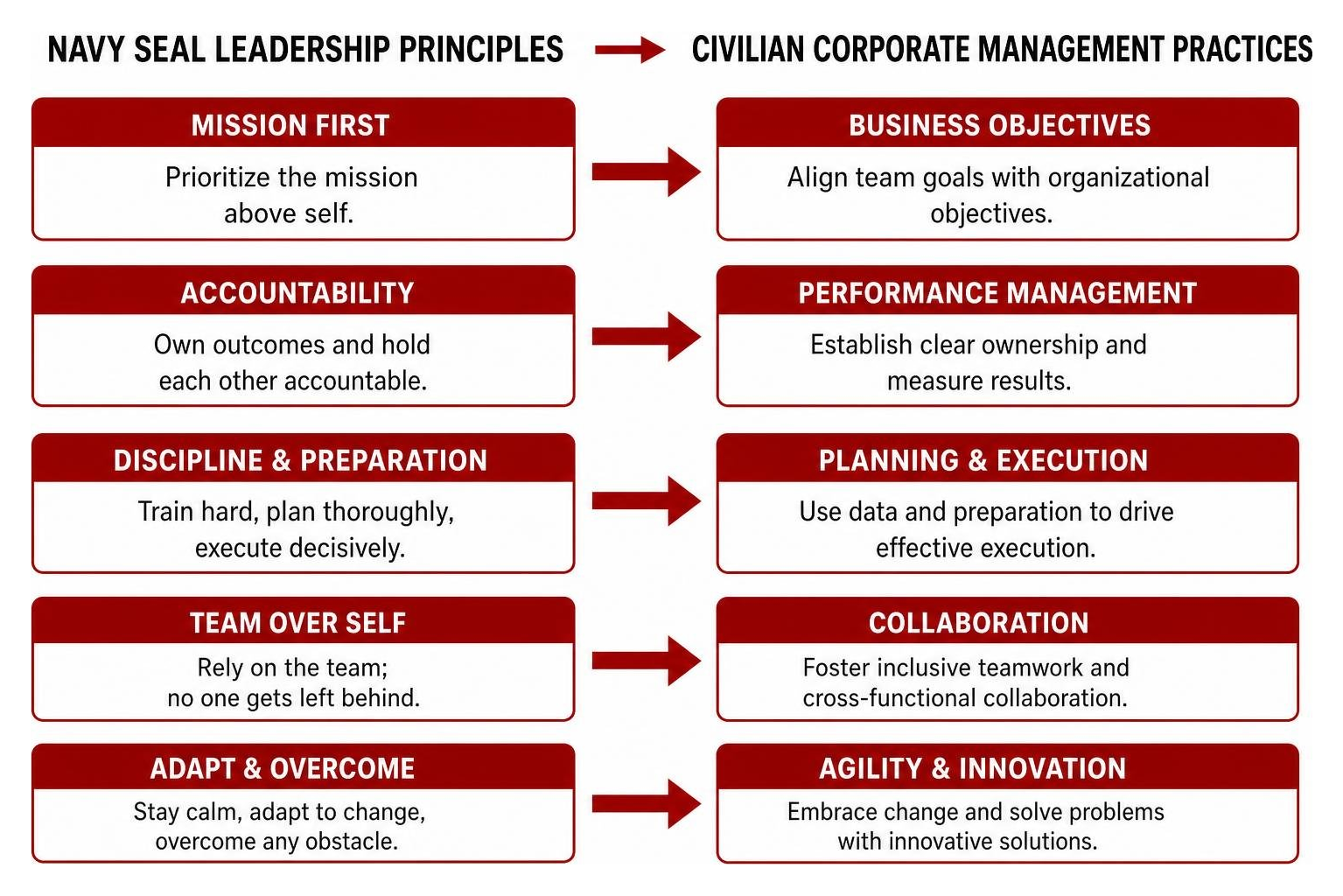
Successful veterans quickly learn that while military leadership relies on absolute operational command, corporate leadership requires diplomacy, cross-functional collaboration, and subtle negotiation. Adapting one’s tone while maintaining core principles like accountability allows former operators to lead effectively without alienating their civilian teams.
Skill Translation and Transition Resource Programs
A critical component of a smooth career transition is closing the “translation gap”—the divide between tactical military terminology and civilian corporate language.
When applying for civilian roles, describing combat operations using military acronyms like VBSS (Visit, Board, Search, and Seizure) or CAS (Close Air Support) often confuses corporate hiring managers. Successful operators reframe these experiences into universally valued business concepts: strategic planning, risk mitigation, operational efficiency, logistics coordination, and crisis management.
Key Factors Determining How Successful Are Retired Navy SEALs In Their Civilian Life
To maximize career trajectory, operators must translate hard tactical skills into executive soft skills. For additional insights on post-military pathways, see Career Paths That Former Navy SEALs Pursue After Military .
| Military Skill Set | Civilian Resume Equivalent | Corporate Business Value |
|---|---|---|
| Platoon Commander / Operations Chief | Senior Operations Manager / Program Director | Cross-functional leadership, resource allocation, and budget management |
| Tactical Troop Lead / Target Analysis | Risk Management Director / Strategic Analyst | Threat identification, crisis mitigation, and data-driven planning |
| Special Operations Medic (18D / SO) | Physician Assistant / Operations Health Director | Emergency medical response, trauma care, and high-stress decision-making |
| Combat Communications / EW | Cybersecurity Manager / IT Infrastructure Lead | Network security, data protection, and secure infrastructure deployment |
Transition Support Programs and Educational Pathways
Transitioning out of Special Operations is rarely a solo mission today. A powerful ecosystem of non-profit and government programs exists to guide veterans through career placement:
- DoD SkillBridge Program: Allows service members to spend their final 180 days of active duty interning with civilian companies while retaining full military pay and benefits. Learn more in our DoD SkillBridge Program Overview.
- The Honor Foundation (THF): A world-class transition institute tailored specifically for Special Operations Forces (SOF), offering 120+ hours of executive education, personal coaching, and corporate networking.
- Special Operators Transition Foundation (SOTF): Provides customized executive coaching and direct placement assistance into top-tier companies.
- Post-9/11 GI Bill: Provides 36 months of fully funded tuition, housing allowances, and book stipends, enabling veterans to earn top-tier MBAs, medical degrees, or specialized flight certifications.
Strategies and Daily Discipline for Post-Service Achievement
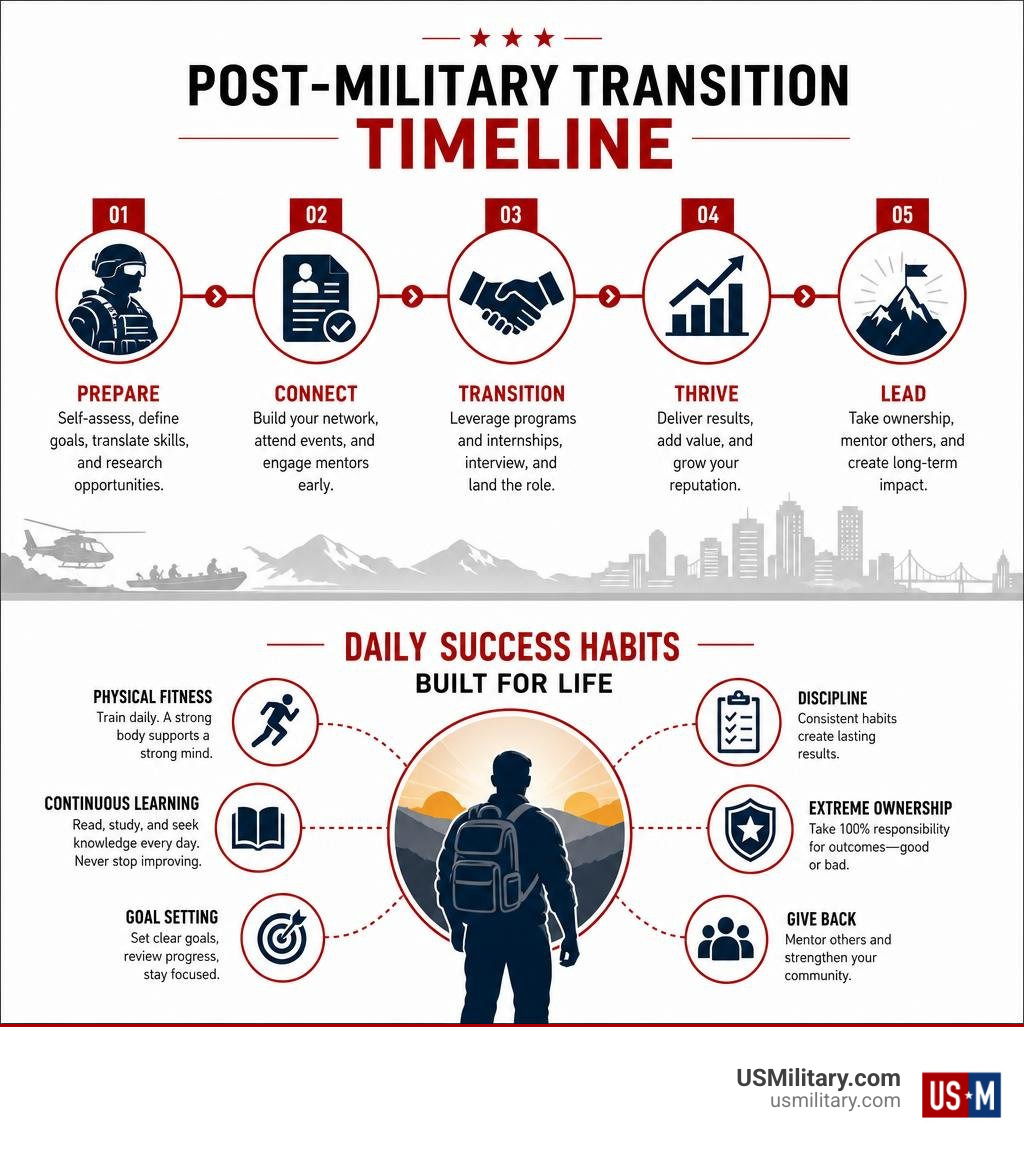
The operators who thrive in civilian life are those who channel the fundamental habits developed in Naval Special Warfare into their second careers. Success after service is rarely about resting on past laurels; it is about establishing a new standard of personal performance.
Elite Daily Habits and Mental Toughness
Many successful veterans maintain structured daily routines established during active service: early morning wake-ups, rigorous physical fitness schedules, continuous reading, and meticulous goal setting.
Applying the concept of Extreme Ownership—a leadership philosophy popularized by Navy SEAL veterans—means taking 100% accountability for personal failures, career setbacks, and team outcomes. To explore how daily discipline drives executive success, read our In-Depth Guide to Navy SEAL Jocko Willink.
Career Transition Roadmap: How Successful Are Retired Navy SEALs In Their Civilian Life
A successful departure from active duty requires an organized, step-by-step roadmap executed over the final 12 to 18 months of military service:
- Months 18–12 Out (Assessment & Planning): Define financial goals, evaluate target industries, and complete personal health assessments.
- Months 12–6 Out (Education & Certifications): Enroll in transition programs like The Honor Foundation, leverage GI Bill benefits for certifications (PMP, CISSP, Executive Protection), and convert military accomplishments into a corporate resume.
- Months 6–0 Out (SkillBridge & Networking): Complete a 180-day SkillBridge internship, activate professional networks on LinkedIn, and secure initial job interviews.
- Post-Separation (Execution & Scaling): Apply mission-focused discipline to new corporate roles, explore long-term wealth building, or consider Starting a Veteran-Owned Business.
Real-World Success Stories Across Diverse Industries
The range of civilian achievements among former Navy SEALs spans corporate boardrooms, media empires, medical science, and space exploration, proving that military operational skills transfer seamlessly across diverse disciplines.
High-Profile Veteran Achievements in Media and Public Life
Former operators have built massive cultural footprints in modern publishing, digital broadcasting, and public service:
- Media and Podcasting: Veterans like Shawn Ryan have built prominent media brands by translating military authenticity into long-form journalism and broadcasting. Read more at Shawn Ryan: From Navy SEAL to Podcaster.
- Medicine and Aerospace: Dr. Jonny Kim made history by graduating from Harvard Medical School, serving as a resident physician, and becoming a NASA astronaut selected for spaceflight missions. Learn about his career at Jonny Kim: Navy SEAL, Doctor, and Astronaut.
- Publishing and Executive Coaching: Multiple former operators have authored bestselling leadership books that shape modern corporate management. Learn more through our guides on Navy SEAL Authors, Best Navy SEAL Leadership Books, and Famous U.S. Navy SEALs.
Innovation in Business, Fitness, and Non-Profit Ventures
Beyond traditional corporate management, former operators frequently channel their tactical experience into entrepreneurial innovation:
- Tactical Gear & Consumer Brands: Veterans routinely launch functional gear manufacturers, supplement companies, and beverage startups—such as liquid energy packet products engineered specifically to solve operational problems encountered on deployment.
- Film, Acting, and Arts: Veterans like Mikal Vega served over two decades in combat before building a second career as a professional Hollywood actor while founding non-profit organizations (such as Vital Warrior) focused on recovering from PTS and TBI through holistic modalities like Kundalini Yoga.
- Private Security & High-Risk Contracting: Operators consistently lead elite risk-management agencies providing diplomatic security and high-net-worth executive protection across the globe.
To explore additional high-earning opportunities, review Highest Paying Civilian Careers for Retired Navy SEALs .
Frequently Asked Questions About Navy SEAL Civilian Transitions
What is the average starting salary for a retired Navy SEAL in civilian careers?
Transitioning operators placed through specialized organizations like the Special Operators Transition Foundation earn an average starting annual salary of approximately $140,000. Overall civilian starting packages generally range from $80,000 in entry-level public sector positions to $250,000+ in private defense contracting, executive protection, or corporate leadership roles.
What are the biggest challenges SEALs face when leaving active duty?
The primary transition challenges include losing the close-knit unit brotherhood, adjusting to corporate bureaucracy, managing service-related physical injuries or PTS/TBI, and overcoming the “translation gap” when presenting military achievements to corporate recruiters. For personal reflections on returning to home life, check out What is it like returning to civilian life for a Navy Seal? – Quora .
How do military pensions impact the financial stability of retired operators?
Service members retiring after 20 years receive a guaranteed, inflation-adjusted lifetime monthly pension starting immediately upon separation (around age 43), alongside TRICARE health benefits and potential VA disability pay. This baseline income drastically reduces financial stress, allowing retired operators to build wealth, launch businesses, or pursue second careers with long-term security.
Conclusion
When evaluating How Successful Are Retired Navy SEALs In Their Civilian Life, the evidence demonstrates that former operators possess extraordinary potential for financial, professional, and personal achievement. With starting corporate salaries averaging around $140,000 and lifetime income projections exceeding $17 million for 20-year retirees, the financial horizon is exceptionally bright.
However, true success requires more than a lucrative paycheck. The veterans who thrive long-term are those who actively translate their skills, prioritize their health, adapt their communication styles, and discover a rewarding new mission after taking off the uniform.
At USMilitary.com, we are committed to empowering service members, veterans, and military families through every stage of their career journey. Whether you are exploring military enlistment options via the official U.S. Navy SEAL Careers page, navigating VA disability ratings, or planning a transition into the civilian corporate world, we provide the accurate resources you need to execute your next chapter.
For complete coverage of Special Operations careers, benefits, and retirement planning, explore our comprehensive Navy SEALs Complete Guide or visit USMilitary.com today. For spiritual inspiration during times of personal transition, consider reading Dare to Live Greatly.
Free for Service Members & Veterans
Get the military benefits intel no one tells you about.
Weekly updates on VA benefits, pay changes, and money tips — free for service members and veterans.
No spam. Unsubscribe anytime. Your info is never shared.


