How to Start a US Military Pension Claim

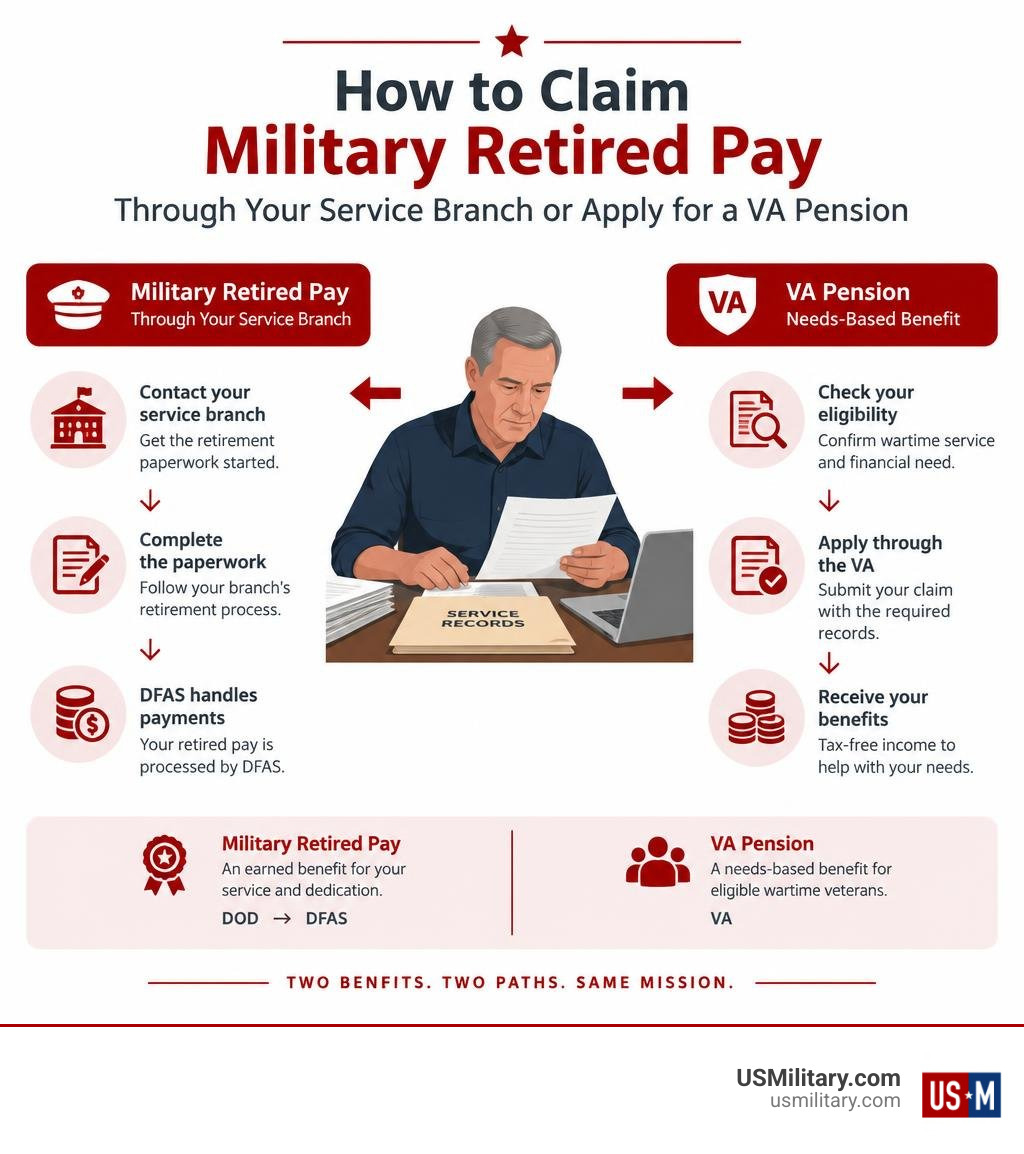
To file us military pension claims, first identify the benefit you need. For military retired pay, contact your service branch and complete its retirement paperwork; DFAS handles the payments. For a needs-based VA pension, check your wartime service and financial eligibility, then apply through the VA with your service, income, and asset records. These are different benefits with different claim processes.
I’m Larry Fowler, a Navy veteran and BUD/S Class 89 graduate who has published military and VA benefits guidance since 2007. My work on topics related to us military pension claims helps me explain where to start and which paperwork matters.
Understanding Military Retirement Pay vs. VA Pension Benefits
Navigating the federal system can feel like moving through a bureaucratic minefield. One of the most frequent misunderstandings we encounter involves confusing earned military retired pay with needs-based VA pension benefits.
Military retired pay is an earned longevity benefit managed by the Department of War (DoD or DoW) through the Defense Finance and Accounting Service (DFAS). It requires completing 20 qualifying years of service or receiving a qualifying medical retirement. In contrast, a VA Veterans Pension is a needs-based safety net administered by the Department of Veterans Affairs. It provides supplemental, tax-free income to low-income wartime veterans aged 65 or older who are permanently disabled, regardless of whether they served a full 20-year career.
Knowing the distinction helps you avoid months of delay. Review official Military and veteran retirement benefits guidelines alongside standard military pension eligibility requirements to see which category fits your military background.
Navigating US Military Pension Claims Under Legacy and BRS Systems
For service members retiring after a military career, your retirement plan determines your monthly payout formula:
- Final Basic Pay: Applies to members who entered service before September 8, 1980. Retired pay equals 2.5% times your years of service times your final active-duty basic pay rate.
- High-36 (Legacy): Applies to members who entered between September 8, 1980, and December 31, 2017. Pay equals 2.5% times your years of service times the average of your highest 36 months of basic pay.
- REDUX: An optional legacy system offering a career status bonus at 15 years in exchange for a reduced multiplier (2.0% per year) that partially restores at age 62.
- Blended Retirement System (BRS): Mandatory for service members entering on or after January 1, 2018. It combines a 2.0% multiplier per year of service with up to 5% DoD matching contributions to your Thrift Savings Plan (TSP) and a flexible lump-sum option at retirement.
| Retirement System | Standard Service Requirement | Multiplier Per Year of Service | Base Pay Calculation | Defined Contribution Component |
|---|---|---|---|---|
| Final Basic Pay | 20 Years | 2.5% | Final Active Duty Basic Pay | None |
| High-36 | 20 Years | 2.5% | Average of Highest 36 Months | Personal TSP Only |
| REDUX | 20 Years | 2.0% (restores at 62) | Average of Highest 36 Months | Personal TSP + Bonus |
| Blended Retirement System (BRS) | 20 Years | 2.0% | Average of Highest 36 Months | Up to 5% Government TSP Match |
Under the BRS, retirees can choose an upfront lump-sum payment of 25% or 50% of their future retired pay through Social Security normal retirement age, after which monthly pay returns to its full value. For more on transition strategies, check out our guide to active duty retirement options.
Non-Service-Connected VA Pension and Special Aid Rates
If you served during an eligible wartime period (such as the Vietnam Era, Gulf War, or post-9/11 operations) and have limited household income and net worth, you may qualify for a tax-free VA pension. The VA calculates this benefit by subtracting your countable family income from your Maximum Annual Pension Rate (MAPR).
Additionally, veterans requiring daily personal assistance or who are largely confined to their living quarters can claim enhanced pension rates:
- Aid and Attendance: Provides increased monthly support if you need help with basic daily activities (bathing, dressing, adjusting prosthetics) or live in a nursing home.
- Housebound: Provides a supplemental monthly payment if you are substantially confined to your home due to a permanent disability.
Federal statutory provisions in 38 CFR § 3.151 – Claims for disability benefits allow claims to be evaluated for both pension and disability compensation, awarding the benefit that gives you the highest monthly financial outcome.
Special Military Retirement Pathways: Reserve, Medical, and Concurrent Pay

Not every retirement follows a continuous 20-year active-duty path. Medical retirements and reserve service follow their own statutory benchmarks. Under Chapter 61 rules, service members found medically unfit for duty with a disability rating of at least 30% receive disability retirement regardless of total years served. For branch-specific requirements, see our breakdown of army pension eligibility.
✉ Get updates like this in your inbox
Weekly VA benefit changes, pay updates, and money tips for service members, veterans, and military families. Free, no spam.
Reserve Component Retirement Rules and Point Calculations
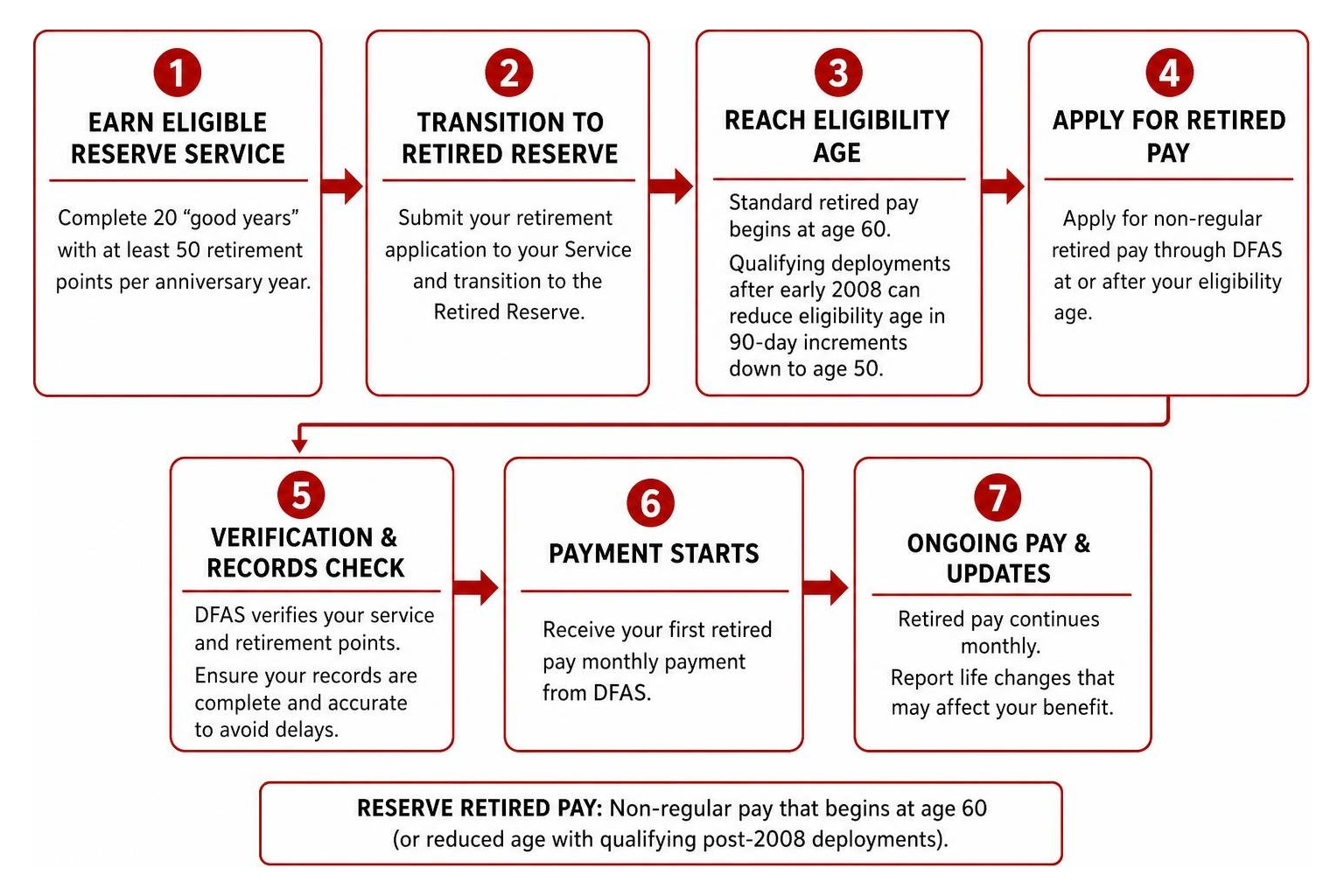
Reserve and National Guard service members qualify for non-regular retired pay after completing 20 “good years” (accumulating at least 50 retirement points per anniversary year). Unlike active-duty retirements, reserve pension payments do not start automatically when you transition to the Retired Reserve.
Standard reserve retired pay begins at age 60. However, qualifying active-duty deployments or contingency support performed after early 2008 can reduce your eligibility age in 90-day increments down to age 50. Learn more about calculating points in our reserve pension rules overview, or explore transitioning from active duty to reserves to maximize your career point totals.
Concurrent Receipt: CRDP vs. Combat-Related Special Compensation (CRSC)
Historically, military retirees who received VA disability compensation had their DoD retired pay reduced dollar-for-dollar by their disability award. Congress created two programs to restore these funds:
- Concurrent Retirement and Disability Pay (CRDP): Automatically restores retired pay for military retirees with a service-connected VA disability rating of 50% or greater. CRDP is fully taxable.
- Combat-Related Special Compensation (CRSC): A special, tax-free payment designed for retirees with combat- or training-related disabilities rated at 10% or higher.
The Combat-Related Special Compensation Board evaluates applications based on specific armed conflict or hazardous duty evidence. You can also review the detailed Navy and Marine Corps CRSC categories to understand how conditions that simulate war or involve the instrumentalities of war qualify.
Step-by-Step Guide to Filing US Military Pension Claims

Claiming your military retirement or wartime pension requires thorough paperwork and strict attention to official channels. Here is how to complete your filing efficiently:
- Verify Service and Character of Discharge: Review your discharge characterization to ensure you meet statutory standards under character of discharge rules.
- Complete the Correct Service Forms: For active or reserve retirement pay, fill out DD Form 2656 (Data for Payment of Retired Personnel) using the official DFAS Smart Wizard to avoid entry errors.
- Submit VA Pension Forms: For low-income wartime pensions, submit VA Form 21P-527EZ online via VA.gov or upload digital copies through the QuickSubmit tool.
- Attach Required Financial and Medical Documentation: Provide all household income records, medical expense reports, and doctor statements if applying for Aid and Attendance.
- Monitor Your Claim: Track your submission through myPay for DFAS processing or VA.gov for pension claims.
Key Documentation Required for US Military Pension Claims
Gathering your records before filing prevents administrative stalls:
- Certificate of Release or Discharge from Active Duty (DD Form 214): Your primary proof of active-duty wartime service and honorable discharge.
- VA Application for Veterans Pension (VA Form 21P-527EZ): Required for veteran pension filings.
- Application for Survivors Pension (VA Form 21P-10198): Surviving dependents should complete VA Form 21P-10198 to claim survivor support.
- Intent to File: Submitting an official Intent to File with the VA secures your effective date for retroactive back pay while you assemble records.
- Financial and Banking Records: W-2s, bank statements, and voided checks ensure correct direct deposit routing. Discover more about tracing and claiming veteran benefits to recover missing pay.
Avoiding Costly Mistakes and Six-Year Pay Claim Limits
A single missed deadline or clerical error can cost you thousands in delayed benefits. Keep these best practices in mind:
- Mind the Six-Year Statute of Limitations: Federal law imposes a strict six-year statute of limitations on claiming certain unpaid military pay and allowances following your date of separation.
- Never Forget to File an Intent to File: If your VA claim takes months to compile, an Intent to File ensures your payments backdate to the day you initiated the request.
- Update Direct Deposit Information Promptly: Unverified banking records cause immediate payment suspensions in DFAS and VA disbursement systems.
- Request a Discharge Review if Needed: If an other-than-honorable separation bars your pension access, apply to your branch’s Discharge Review Board to present mitigating evidence such as service-connected mental health conditions.
Survivor Benefits, SBP Annuities, and COLA Adjustments
Protecting your family’s financial security extends beyond your active retirement years. The Survivor Benefit Plan (SBP) allows military retirees to provide a continuing monthly annuity (up to 55% of retired pay) to eligible surviving spouses or dependent children. Legislative reforms eliminated the SBP-DIC offset. Surviving spouses can now receive both their full SBP annuity from DFAS and Dependency and Indemnity Compensation (DIC) from the VA without dollar-for-dollar deductions. Furthermore, military retirement pay and SBP annuities adjust annually for inflation; a 2.8% Cost-of-Living Adjustment (COLA) takes effect on December 1, 2025. Compare how these payout baselines align with active-duty earnings using the 2026 military pay scale details.
Frequently Asked Questions About Military Pensions and VA Claims
How long does it take DFAS and the VA to process military pension claims?
Standard DFAS retired pay processing takes up to 60 days after you submit all branch transition paperwork and complete DD Form 2656. VA wartime pension claims generally take between 90 and 150 days. Digital tools like the DFAS Smart Wizard or VA QuickSub help minimize delays.
Can I receive both military retired pay and VA disability compensation at the same time?
Yes. If you have 20 or more years of service and a service-connected VA disability rating of 50% or higher, Concurrent Retirement and Disability Pay (CRDP) automatically allows you to draw both checks. Alternatively, Combat-Related Special Compensation (CRSC) lets qualifying combat-injured veterans receive tax-free compensation alongside reduced retired pay.
How does the 2026 Cost-of-Living Adjustment affect my monthly pension?
The 2.8% COLA adjustment applied on December 1, 2025, increases gross monthly retired pay and SBP annuity disbursements across the board. This annual percentage adjustment protects your purchasing power against inflation.
Conclusion
Securing your earned military retirement pay or needs-based VA pension does not have to be an uphill battle against red tape. By identifying the exact benefit program that fits your military service, organizing your DD Form 214 and financial records early, and using modern digital tools, you can claim your compensation without unnecessary delays. If you encounter complex claim hurdles, accredited Veterans Service Officers (VSOs) and claims specialists can provide free, professional assistance. Take charge of your post-service finances today and explore the latest military retirement pay chart to calculate what you have earned.
Free for Service Members & Veterans
Get the military benefits intel no one tells you about.
Weekly updates on VA benefits, pay changes, and money tips — free for service members and veterans.
No spam. Unsubscribe anytime. Your info is never shared.



Leave a Reply