A U.S. F-15E Is Down in Iran — Here’s What We Know Right Now
The Intense Search For Missing F-15 Pilot in Iran is one of the most urgent military rescue missions currently underway, and here are the key facts:
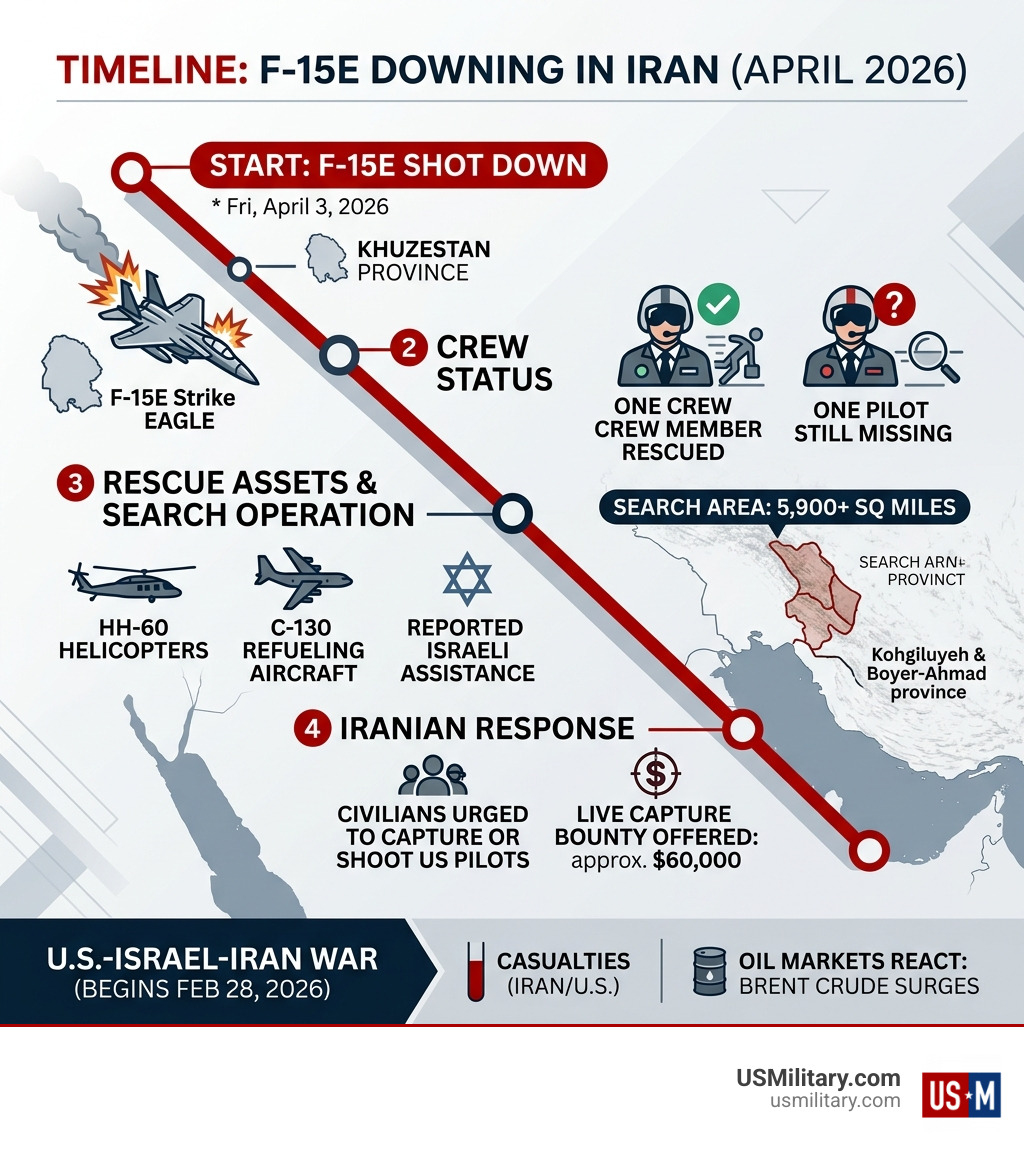
- What happened: A U.S. F-15E Strike Eagle was shot down over Iran’s Khuzestan province on Friday, April 3, 2026
- Crew status: One crew member has been rescued by U.S. forces; the second is still missing
- Search area: The operation spans Kohgiluyeh and Boyer-Ahmad province — over 5,900 square miles of mountainous, rural terrain
- Who’s searching: U.S. military assets including HH-60 helicopters and C-130 refueling aircraft, with reported Israeli assistance
- Iranian response: Iran’s state media urged civilians to capture or shoot U.S. pilots; a bounty of roughly $60,000 was offered for a live capture
- Broader context: This is the first confirmed loss of a U.S. manned aircraft since the U.S.-Israel-Iran war began on February 28, 2026
This incident marks a serious escalation in a conflict that has already claimed more than 1,900 Iranian lives and 13 U.S. service members. Oil markets reacted immediately — Brent crude surged 7.8% to $109 per barrel on the same day.
I’m Larry Fowler, publisher of USMilitary.com, and I’ve spent nearly two decades covering U.S. military operations, personnel issues, and national security developments for active-duty service members and veterans. The Intense Search For Missing F-15 Pilot in Iran reflects exactly the kind of high-stakes mission our community needs clear, reliable information about.
Intense Search For Missing F-15 Pilot in Iran terms to know:
- What is the Army new helicopter S-97 Raider
- The U.S. and its regional allies have deployed 64 Apache helicopters in a mission to take down Iran’s fleet
- Latest Update: Operation Epic Fury, Including Three American Deaths
The Downing of the F-15E Strike Eagle over Khuzestan
The aircraft involved in this high-stakes incident has been identified as an F-15E Strike Eagle, likely belonging to the 494th Fighter Squadron of the 48th Fighter Wing. This unit is typically based at RAF Lakenheath in the UK but has been heavily involved in Middle East operations since the conflict’s inception. While initial Iranian reports claimed they had downed a stealthy F-35, open-source intelligence (OSINT) experts quickly debunked this after analyzing wreckage photos. The debris clearly showed vertical stabilizer markings and tail flashes consistent with the “LN” tail code of Lakenheath-based Strike Eagles.
According to reports, one US crew member was rescued after a fighter jet was downed over Iran, but the fate of the second remains the central focus of the Pentagon. The F-15E is a two-seat multirole fighter, meaning both a pilot and a Weapon Systems Officer (WSO) are on board. This marks the first confirmed loss of a U.S. manned aircraft inside hostile Iranian territory since the war began on February 28, 2026.
The jet was reportedly brought down by an advanced air defense missile system operated by the IRGC Aerospace Force. Witnesses in the rural Khuzestan province described seeing a fireball in the sky followed by two distinct parachutes. The ejection sequence appears to have functioned correctly, giving both crew members a chance at survival on the ground, but landing in a combat zone is only the beginning of a very long day.
When a pilot goes down, the military’s Combat Search and Rescue (CSAR) machinery kicks into high gear. We are seeing a massive mobilization of assets to bring our person home. This isn’t just a few guys in a jeep; it’s a coordinated dance involving HH-60 Pave Hawk helicopters, which are specifically designed for “thick of it” rescues, and C-130 Hercules aircraft providing low-altitude refueling to keep those helicopters in the air for as long as possible.
The search is currently focused on the Kohgiluyeh and Boyer-Ahmad province. This is no easy stroll through the park. We’re talking about more than 5,900 square miles of rugged, mountainous terrain. It’s the kind of place where a single person can stay hidden for a long time, but it also makes it incredibly difficult for rescue teams to spot a signal.
Our teams are using every tool in the shed. Just as Searchers Use Night Vision Gear To Look For Pilot Of Downed Guard Jet In Virginia Forest/, the crews over Iran are relying heavily on advanced thermal imaging and night vision technology to scan the mountainsides under the cover of darkness. Flying low and slow over enemy territory is dangerous work, but it’s what these crews train for every single day.
Iranian Claims and the Hunt for U.S. Aircrew
On the other side of the line, the Iranian government is doing everything it can to interfere with the rescue. The IRGC Aerospace Force has been quick to claim victory, even if their initial reports about the aircraft type were a bit off. They’ve claimed that Iran: US F-35 Shot Down, Pilot Captured After Failed Recovery, though U.S. officials have confirmed that at least one crew member was successfully plucked from the danger zone.
Perhaps most concerning is the “civilian hunt” encouraged by Iranian state media. Reports indicate that a bounty equivalent to roughly $60,000 has been offered to any local who can capture a U.S. pilot alive. State television has aired images of the wreckage and urged the public to “shoot them if you see them” or hand them over to authorities.
This is where SERE (Survival, Evasion, Resistance, and Escape) training becomes a pilot’s best friend. Our aircrew members are trained to move at night, hide during the day, and use the terrain to their advantage. They carry minimal gear—usually just a sidearm and a basic survival kit—relying instead on their wits and the hope that the “low-flying birds” of the CSAR teams find them before the IRGC patrols do.
Strategic Impact on the U.S.-Iran Conflict and Global Markets
The Intense Search For Missing F-15 Pilot in Iran isn’t just a tactical rescue mission; it’s a geopolitical earthquake. The Strait of Hormuz, which usually handles about 20% of the world’s oil and LNG, has seen traffic drop by a staggering 90% since the war began. With a U.S. jet down and search operations active, the region is a powder keg.
Brent crude oil prices have already felt the heat, surging to over $109 per barrel. To maintain a presence and deter further escalations, the U.S. has been moving assets across the globe, similar to how we might deploy Raptor F-22 jet fighters to Kadena, Japan/ during Pacific tensions.
Interestingly, sources suggest that Israel is providing quiet assistance in the search and rescue operation, highlighting the deep level of cooperation between the two nations during this conflict. President Trump has been briefed on the situation, and while the White House has remained relatively quiet on the specifics of the search, the pressure to bring the missing crew member home is immense.
Frequently Asked Questions about the Missing F-15 Pilot
What is the current status of the Intense Search For Missing F-15 Pilot in Iran?
As of the latest reports, one crew member has been successfully rescued by American forces and is in stable condition. The Intense Search For Missing F-15 Pilot in Iran continues for the second crew member. The mission is considered extremely high-risk due to the mountainous terrain and the presence of hostile Iranian patrols and civilian “bounty hunters.”
How many crew members were on the downed F-15E Strike Eagle?
The F-15E Strike Eagle is a two-person aircraft. It carries a pilot in the front seat and a Weapon Systems Officer (WSO) in the back. Both are confirmed to have ejected from the aircraft before it crashed in Khuzestan province. The crew is believed to be from the 494th Fighter Squadron.
What are the primary risks during the Intense Search For Missing F-15 Pilot in Iran?
The primary risks include the difficult rural geography of the Kohgiluyeh and Boyer-Ahmad province, which spans nearly 6,000 square miles. Additionally, the Iranian government has offered a $60,000 reward for the capture of the pilots, leading to an increased presence of armed civilians and IRGC units in the crash vicinity. The missing pilot is likely operating with very limited survival gear and only a sidearm for defense.
Conclusion
At USMilitary.com, we know that nothing is more important to the military family than the creed “leave no man behind.” The Intense Search for Missing F-15 Pilot in Iran is a testament to the bravery of the CSAR teams and the resilience of our pilots. While the situation remains fluid and dangerous, the full weight of the U.S. military—and its regional allies—is being thrown into the effort to bring our hero home.
As we watch these events unfold, it’s a reminder of the incredible risks our service members take every day. If you’re looking to support the mission or even start your own journey in the service, you can explore Navy Jobs and Careers to see how you can contribute to our nation’s defense. We will continue to provide updates as the investigation into the downing and the status of the missing pilot develops. Stay safe, and keep those in the search area in your thoughts.
Free for Service Members & Veterans
Get the military benefits intel no one tells you about.
Weekly updates on VA benefits, pay changes, and money tips — free for service members and veterans.
No spam. Unsubscribe anytime. Your info is never shared.


