How the 2026 Midterms Could Affect the U.S. Military: Putting Aside Our Personal Preferences And Following The Facts.

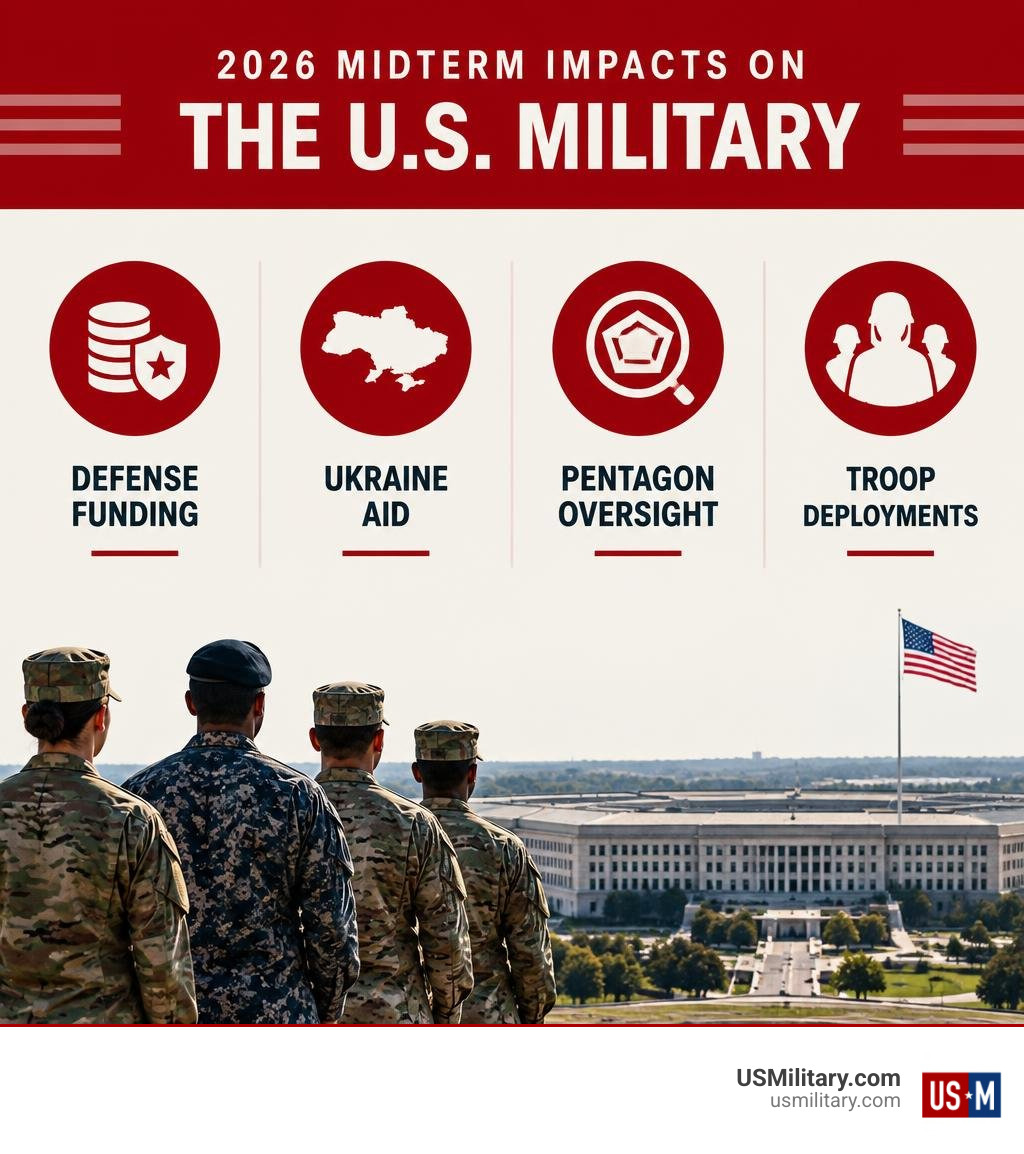
The 2026 midterms will not change who commands the U.S. military. They could change who controls Congress, which sets defense funding and oversees the Pentagon. That could affect the size of the defense budget, the speed of aid to Ukraine, and scrutiny of military operations involving Iran. The president would still direct deployments, while Congress could hold hearings and approve or restrict funding.
For service members and veterans, the key question is what Congress passes, not just who wins. Watch the FY2027 defense bills for decisions on military pay, equipment, and readiness. Changes to VA benefits or loans would require separate action.
I’m Larry Fowler, a Navy veteran and graduate of BUD/S Class 89. As publisher of USMilitary.com, I’ve spent years helping service members and veterans follow military policy; this guide explains how the mid-term elections will affect the U.S. military and what to watch after the vote.
How The Mid-Term Elections Will Affect The US Military Defense Budget and the NDAA
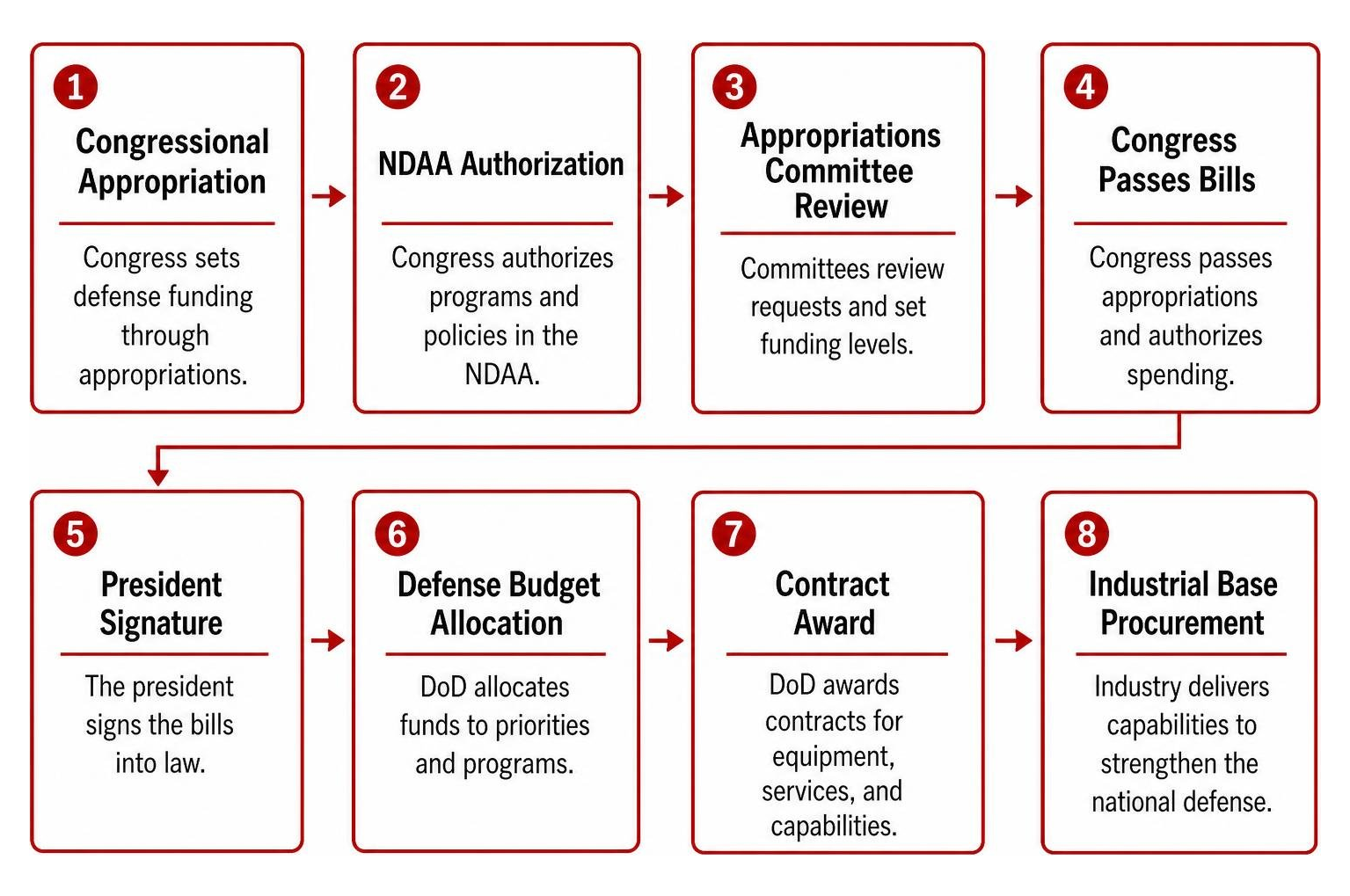
When election season heats up, Washington turns into a storm of campaign promises, but for the military community, everything comes down to defense appropriations. Under Article I of the Constitution, Congress holds the purse strings. Regardless of executive strategy, not a single ship sails, aircraft flies, or base operates without congressional authorization and funding.
The central debate for Fiscal Year 2027 centers on whether military spending should remain within standard discretionary spending caps or expand dramatically through mandatory spending allocations. Tracking these budget allocations is vital, especially when evaluating the military pay scale in 2026 for enlisted and officers alongside housing allowances and force structure funding.
| Budget Priority | Republican-Led Strategy | Democratic-Led Strategy |
|---|---|---|
| Overall Topline Target | Approaching $1.5 trillion | Standardized discretionary levels (~$850B–$895B) |
| Mandatory Funding Mechanism | Push for $350 billion in mandatory defense spending | Strict rejection of mandatory labeling; discretionary caps |
| Missile Defense | Expedited deployment of “Golden Dome” architecture | High-scrutiny technical audits and incremental milestones |
| Foreign Security Aid | Scrutiny and conditional packaging for European allies | Rapid, dedicated multi-year pipelines for Ukraine |
| Social & Personnel Policy | Restricting DEI programs and specialized healthcare travel | Protecting reproductive travel and inclusive force initiatives |
FY2027 NDAA Delays and the $1.5 Trillion Spending Battle
The legislative engine for the Department of Defense is the annual National Defense Authorization Act (NDAA). The House passed its version of the FY2027 NDAA (H.R. 8800) on July 22, 2026. However, gridlock in the Senate has stalled floor time, pushing final conference negotiations into a post-election lame-duck session.
The White House proposed an overall national defense blueprint approaching $1.5 trillion. A major flashpoint is the administration’s request for $350 billion in mandatory defense funding. Mandatory funding operates outside the regular annual appropriations caps. If Democrats secure majorities in either chamber, this $350 billion mandatory request faces virtually zero chance of passage. A divided or Democratic-led Congress would insist on standard discretionary accounts, requiring multi-year procurement programs to compete directly with domestic spending programs.
Golden Dome, Technology Standards, and Procurement Scrutiny
Large-scale acquisition programs face immediate scrutiny based on congressional leadership. The proposed “Golden Dome” homeland missile defense architecture represents billions in planned development. Under Republican committee gavels, Golden Dome funding would move forward with broad latitude. Under Democratic leadership, the House Armed Services Committee is expected to mandate strict technical benchmarks, cost-caps, and performance testing before releasing procurement tranches.
A similar divergence affects naval shipbuilding standards and military artificial intelligence. While the executive branch prioritizes rapid fielding of defense AI data centers and autonomous systems, incoming committee leadership from a flipped chamber would embed statutory safety baselines and transparency standards into every major acquisition pipeline.
War Powers and Foreign Deployments: Ukraine, Iran, and NATO
While Congress controls military funding, the Constitution designates the President as Commander-in-Chief. This operational dynamic means midterm election results produce immediate shifts in funding streams, even as day-to-day command authority remains in the Oval Office. Gaining historical perspective on executive defense commands through an in-depth guide to the Department of War helps clarify how modern civilian and legislative balances function during active conflicts.
How the Mid-Term Elections Will Affect the U.S. Military Aid Pipeline to Ukraine
The pace and mechanism of military aid to Ukraine represent one of the clearest contrasts on the ballot. The administration has frequently threatened to restrict procurement systems and narrow the pipeline of American weaponry bound for Eastern Europe. European partners coordinating through NATO’s Prioritised Ukraine Requirements List (PURL) remain heavily reliant on U.S.-sourced hardware and export licenses.
Representative Jim Himes and senior intelligence committee members have noted that if Democrats capture majorities in the House and Senate, military aid delivery timelines could compress dramatically—moving “in nine days or nine weeks on the outside” rather than lingering across nine months of bureaucratic delays. A shift in House leadership would empower the House Permanent Select Committee on Intelligence and Armed Services subcommittees to pass robust security supplementals and streamline foreign military sales.
Presidential War Powers, Iran Operations, and Troop Posture Abroad
Operations surrounding the ongoing Iran conflict showcase the limits of congressional intervention. Public opposition to the Iran conflict climbed from 47.3% in March 2026 to 55.7% by September 2026. Despite shifting public sentiment, the White House maintains tactical command over Middle East force posture.

History demonstrates that reining in an executive during active military operations is difficult. During the 2007 Iraq surge, despite a Democratic takeover of Congress, the executive branch maintained its strategic posture abroad. While lawmakers can invoke the 1973 War Powers Resolution or attempt to place statutory spending restrictions on specific strike packages, any direct limitation on wartime operations faces a certain presidential veto. Overriding that veto requires a two-thirds supermajority in both chambers.
Domestic Troop Deployment, Polling Places, and Posse Comitatus
Public discourse leading up to the midterms has included sharp debate regarding domestic military involvement. Examining the massive size of the U.S. armed forces highlights why maintaining strict firewalls between domestic politics and active-duty units is essential for public trust.
How The Mid-Term Elections Will Affect The US Military and National Guard Roles at Home
Concerns regarding uniformed troops near voting locations prompted formal congressional inquiries. In a formal letter to lawmakers, General Dan Caine, Chairman of the Joint Chiefs of Staff, clarified that the Joint Force has zero plans to station federal military personnel at polling places.
Statutory frameworks strictly limit domestic military activity:
- The Posse Comitatus Act of 1878: Prohibits federal military personnel from executing domestic civilian law enforcement unless expressly authorized by the Constitution or an act of Congress.
- 18 U.S.C. §§ 592 and 593: Makes it a federal crime for any military officer or civil official to order armed troops to polling locations unless necessary to repel armed enemies of the United States.
- The Insurrection Act: Provides narrow emergency authority, but legal analyses from institutions like the Brennan Center and the Center for American Progress confirm that emergency powers cannot be distorted to interfere with regular civilian elections.
Meanwhile, the National Guard deployment in Washington, D.C. has expanded from roughly 800 service members in August 2025 to nearly 5,000 personnel, with missions scheduled through January 2029. While these personnel operate under specific capital security mandates, military leaders emphasize that guard units operate in accordance with state and federal legal standards.
ICE Operations, Legal Constraints, and Election Day Neutrality
Immigration and Customs Enforcement (ICE) has expanded to 22,000 agents as of January 2026—a 120% staffing surge supported by recent federal spending packages. This expansion has generated public debate regarding federal enforcement on Election Day. A September 2026 poll conducted by the University of California, San Diego revealed that 40% of respondents anticipated seeing ICE personnel near voting sites.
Operational realities, however, keep federal agents away from ballot boxes. Federal courts have placed strict checks on Department of Homeland Security field investigations regarding voter registration, ensuring enforcement activities do not intimidate eligible voters.
Congressional Oversight, Pentagon Leadership, and Service Member Policies
Shifts in congressional leadership immediately alter the committee hearing schedule. Analyzing broader public trends, such as why Gallup poll data matters for military policy, shows that voter sentiment directly influences legislative oversight priorities.
House and Senate Committee Shifts and Defense Secretary Scrutiny
Defense Secretary Pete Hegseth holds a net approval rating of -22, generating friction across Capitol Hill. If committee gavels flip, the House Armed Services Committee will pivot from supporting executive defense plans to conducting rigorous oversight hearings.
Lawmakers have signaled plans to investigate senior command dismissals, operational readiness aboard naval carrier strike groups, and proposals to reclassify defense civil servants under Schedule F. A Democratic majority in the House could open formal inquiries or pursue cabinet-level impeachment measures. While an impeachment drive would be unlikely to achieve a two-thirds conviction in the Senate, prolonged hearings would pull senior Pentagon leadership into public legislative battles.
Social Policies, Service Member Benefits, and Recruitment Priorities
The midterm outcome will shape internal personnel directives that govern daily life in uniform. Legislative priorities will directly impact comprehensive military benefits, force retention, and healthcare access.
- Personnel Health Policies: A conservative majority would aim to codify restrictions on gender-affirming medical care and repeal DOD policies reimbursing travel expenses for reproductive healthcare. A progressive majority would protect these travel benefits and expand service member medical programs.
- Diversity and Force Development: Committee control will decide whether funding for military Diversity, Equity, and Inclusion (DEI) offices is defunded or maintained as part of broader recruitment and retention initiatives.
- Technology Standards: Lawmakers will establish regulatory frameworks governing artificial intelligence safety, data center energy allocation, and ethics standards across all service branches.
Frequently Asked Questions About the 2026 Midterms and the Military
Can the President deploy federal troops or ICE agents to civilian polling places on Election Day?
No. Federal statute (18 U.S.C. § 592) explicitly makes it unlawful for any military officer or federal agent to station armed forces at polling places. The Chairman of the Joint Chiefs of Staff has confirmed that no federal troops will be deployed to voting sites.
What happens if Congress fails to pass the FY2027 NDAA before the lame-duck session?
If the FY2027 NDAA remains stalled past the election, the Pentagon must operate under temporary Continuing Resolutions (CRs). This freezes base funding at previous-year levels, delays new multi-year procurement programs, and stalls specialized construction initiatives until a final compromise is enacted.
How would a shift in congressional power alter U.S. military aid to Ukraine?
A congressional majority supporting foreign aid could pass dedicated supplemental funding bills and streamline export licensing, cutting equipment delivery times via NATO procurement channels from several months down to weeks.
Conclusion
The 2026 midterm elections will set the statutory guardrails for national defense. While the White House retains operational control of deployments, Congress determines the funds, sets the equipment standards, and provides rigorous oversight across all branches of the military.
At USMilitary.com, we remain dedicated to providing clear, unbiased analysis for active-duty personnel, reserve components, veterans, and military families. Understanding how legislative elections impact pay, benefits, and global posture ensures our entire community remains informed, protected, and mission-ready.
Free for Service Members & Veterans
Get the military benefits intel no one tells you about.
Weekly updates on VA benefits, pay changes, and money tips — free for service members and veterans.
No spam. Unsubscribe anytime. Your info is never shared.



Leave a Reply