What Is the Military Draft and How Does It Work Right Now?
How the military draft works can be summarized in a few key steps:
- Congress authorizes a draft and the President signs it into law
- The Selective Service System activates and conducts a national lottery
- Birthdates are drawn randomly and paired with sequence numbers to set induction order
- 20-year-olds are called first, followed by ages 21, 22, 23, 24, 25, then 19, then 18
- Selected men report to a Military Entrance Processing Station (MEPS) for physical, mental, and moral evaluation
- Deferments, exemptions, and postponements can be claimed after receiving an induction notice
- First inductees must be delivered within 193 days of a draft being authorized
Right now, in April 2026, there is no active draft. The U.S. has relied entirely on an all-volunteer military since 1973. But the Selective Service System remains active as a national security backup — and a major change is coming. Starting December 18, 2026, eligible men will be automatically registered using federal databases, replacing the current manual sign-up process.
Nearly all male U.S. citizens and male immigrants between ages 18 and 25 are required to be registered. Understanding the system matters — because the rules, timelines, and consequences are real, even if a draft feels unlikely today.
I’m Larry Fowler, author of Dare To Live Greatly and publisher of USMilitary.com since 2007, and I’ve spent nearly two decades helping service members, veterans, and civilians navigate exactly these kinds of complex military systems — including tracking policy changes around how the military draft works. Let’s break down everything you need to know, step by step.
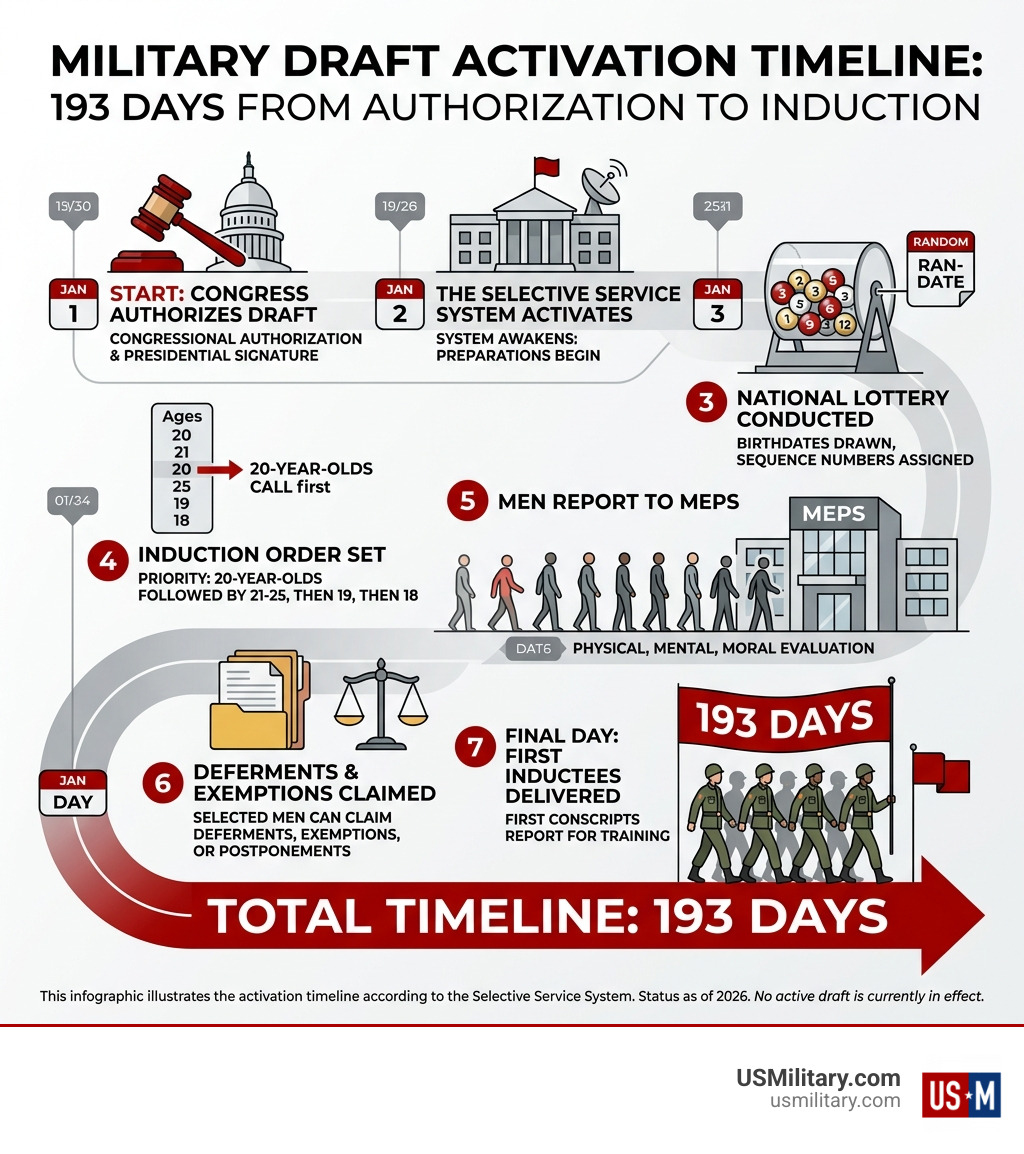
Simple guide to How The Military Draft Works terms:
How The Military Draft Works: Activation and the Lottery
To understand How The Military Draft Works, we have to look at the “big red button” that starts the whole process. Currently, the Selective Service System (SSS) is an independent agency that stays in a state of readiness. It doesn’t have the power to just start drafting people on its own.
Activation requires a specific sequence of legal events. First, a massive national emergency or conflict must occur that the all-volunteer force cannot handle alone. In this scenario, Congress must pass legislation to amend the Military Selective Service Act, authorizing the induction of personnel. Once both the House and the Senate agree, the bill goes to the President’s desk for a signature. Only after that signature is dried does the SSS pivot from “peacetime registration” to “draft mode.”

This transition is highly structured. The goal is to ensure that if a draft is ever needed again, it is conducted with far more transparency and fairness than the systems used in the early 20th century. For more on the history of this process, you can explore Conscription in the United States.
The Mechanics of the Military Draft Lottery System
The heart of a fair draft is the lottery. If you’ve ever seen old footage of the Vietnam-era drawings, the modern version looks quite similar but with even stricter oversight. The SSS uses a two-drum system to determine the order of call.
- Drum One: Contains 365 capsules (366 for leap years), each representing a day of the year.
- Drum Two: Contains 365 capsules with numbers from 1 to 365.
The drums are spun, and a capsule is pulled from each simultaneously. If “August 4” is pulled from the first drum and “32” is pulled from the second, every registered man born on August 4 in the priority year is assigned the sequence number 32. To ensure there is no “funny business,” the National Institute of Standards and Technology (NIST) helps develop the random selection process, and the entire event is broadcast publicly with official observers. This ensures that How the U.S. Draft Works | HowStuffWorks remains a transparent process for every citizen.
Who Gets Called First in a Military Draft?
One of the biggest myths about How The Military Draft Works is that 18-year-olds are the first to go. In reality, the SSS uses a “20-year-old first” rule. This means the lottery primarily targets men who turn 20 during the calendar year the draft is held.
If the military needs more bodies after all eligible 20-year-olds are processed, they move up the ladder: 21, then 22, 23, 24, and finally 25. Only if the crisis is so severe that the 20-25 age bracket is exhausted will the system look at 19-year-olds, and finally, those who are 18.5 years old.
| Priority Group | Age Range | Order of Call |
|---|---|---|
| First Priority | 20 Years Old | Lottery Sequence 1-365 |
| Second Priority | 21 Years Old | Lottery Sequence 1-365 |
| Third Priority | 22-25 Years Old | Ascending by year |
| Fourth Priority | 19 Years Old | Last resort |
| Fifth Priority | 18.5 Years Old | Absolute last resort |
The SSS is under a strict deadline: they must be able to deliver the first group of inductees to the military within 193 days of the draft being authorized. For a deeper dive into these age brackets, check out our guide on Military Draft Age.
Registration Requirements and the 2026 Automatic Shift
As we stand here in April 2026, the law is clear: almost all male U.S. citizens and immigrants (including permanent residents, refugees, and undocumented men) ages 18 through 25 must register with the Selective Service. Currently, most men do this through the DMV—over 60% of registrations in 2023 came from motor vehicle departments.
However, a massive shift is on the horizon. On December 18, 2026, the U.S. will move to a nationwide automatic registration system. Instead of you having to remember to sign up within 30 days of your 18th birthday, the Selective Service will use federal databases to identify and register eligible men automatically. This change, tucked into the National Defense Authorization Act (NDAA), aims to save costs and protect young men from accidentally losing benefits because they forgot to fill out a form.
This is a major update to Us Military Draft In 2026 that everyone in the 18-25 bracket needs to be aware of. For more details on this transition, you can read What to know about the U.S. automatic registration for military draft.
Penalties for Failing to Register
While the government hasn’t actually prosecuted anyone for failing to register since 1986, the “soft” penalties are incredibly harsh. Failing to register is technically a felony punishable by up to 5 years in prison and a fine of $250,000.
More commonly, men who don’t register find themselves “locked out” of the American dream. Over 1 million men have been denied government benefits for non-registration. This includes:
- Ineligibility for federal student aid (FAFSA).
- Ineligibility for federal job training programs.
- Being barred from federal and many state government jobs.
- Delays or denials in U.S. citizenship for immigrants.
Once you turn 26, the window to register closes forever. If you didn’t do it, you may find yourself filing expensive and time-consuming appeals later in life just to get a student loan. You can check your status right now using The Live Tracker For Your Current Draft Status.
Classifications, Deferments, and the MEPS Process
Receiving an induction notice in the mail doesn’t mean you are heading to boot camp the next morning. It means you have been ordered to report to a Military Entrance Processing Station (MEPS). This is where the military determines if you are actually fit for service.
At MEPS, you’ll undergo physical, mental, and moral evaluations. During the Vietnam era, millions were rejected for medical or educational reasons. In WWII, nearly 2 million were rejected for “neuropsychiatric” reasons alone. Today, standards remain high; it is estimated that only about 23% of Americans ages 17-24 meet basic military eligibility standards without waivers.
Once evaluated, you are given a classification. The most famous is 1-A, which means you are available for military service immediately. On the flip side, 4-F means you are not qualified for service due to physical, mental, or moral reasons. To see what might keep you out, read about Medical Conditions That Keep You Out Of The Draft.
Postponements and Exemptions
Once you receive that notice, you have a very short window—usually 10 days—to file a claim for a different classification. The SSS has a network of over 2,000 local boards made up of civilian volunteers who review these claims.
Common classifications include:
- Student Postponements: High school students can usually postpone service until graduation or age 20. College students can finish the current semester (or their senior year if they are in it).
- Hardship Deferments (3-A): For those whose induction would cause extreme hardship to dependents.
- Ministerial Exemptions: For practicing ministers and some divinity students.
- Conscientious Objectors (1-O or 1-A-O): For those who are morally or religiously opposed to war. A 1-A-O objector serves in the military in a non-combat role, while a 1-O objector performs alternative civilian service, like working in a hospital.
For a full list of how to navigate these claims, the Return to the Draft : Selective Service System page is an excellent resource. You can also find more details in our guide: Am I Eligible To Be Drafted Everything You Need To Know.
Specialized Drafts and Modern Considerations
While most people think of the general draft, there is another “standby” plan known as the Health Care Personnel Delivery System (HCPDS). This is a specialized draft designed to fill the military’s need for medical professionals during a crisis.
The HCPDS targets a pool of roughly 3.4 million doctors, nurses, and specialists in over 60 fields. Unlike the general draft, the medical draft:
- Can include both men and women.
- Targets a wider age range, typically 20 to 45 (and potentially up to 54).
- Is designed to have a minimal impact on the civilian healthcare system.
If a medical draft were activated, the SSS would pull from 57 different job categories to ensure our troops have the specialized care they need on the front lines.
Can Women Get Drafted in the Future?
This is one of the most frequently asked questions we get at USMilitary.com. As of April 2026, women are not required to register for the Selective Service. The current law specifically uses the term “male persons.”
However, the conversation is changing. Since 2013, all combat roles in the U.S. military have been open to women. Because the original reason for excluding women from the draft was their exclusion from combat, several courts have looked at whether the male-only draft is still constitutional. In 1981, the Supreme Court case Rostker v. Goldberg upheld the male-only draft, but more recent federal rulings have challenged that.
While Congress has debated including women in the registration process several times in recent years, no law has been passed to change the status quo. For a deep dive into this debate, see Can Women Get Drafted.
Frequently Asked Questions about the Military Draft
What is the cut-off age for the military draft?
For the general draft, the liability ends on your 26th birthday. If you are 26 or older, you are generally in the clear. However, specialized drafts like the HCPDS for medical professionals can extend much later, sometimes up to age 54. You can read more about these age limits at Cut Off Age For Military 2.
How does the medical draft work for healthcare workers?
The Health Care Personnel Delivery System is a “standby” plan. It would only be activated if the military faced a severe shortage of medical staff. It uses a specialized lottery to pull from a database of licensed healthcare providers. Those drafted would likely serve a two-year tour of duty in their professional capacity.
Will there be a military draft in 2026?
There is no concrete indication that a draft will be reinstated in 2026. The U.S. military remains committed to the all-volunteer force. However, the transition to automatic registration in December 2026 is a real administrative change that will affect all eligible men. For a full outlook, check our Military Draft 2026 Guide.
Conclusion
Understanding How The Military Draft Works is about more than just knowing a set of rules—it’s about understanding a core component of American national security readiness. While the all-volunteer force has been the standard for over 50 years, the Selective Service System remains the “insurance policy” that ensures our country can respond to a massive crisis.
The move toward automatic registration in late 2026 represents a significant modernization of the system, ensuring that the burden of registration doesn’t lead to the accidental loss of federal benefits for young men.
At USMilitary.com, we are committed to providing you with the most accurate, up-to-date information on everything from what is the U.S. Military Draft to navigating your VA benefits. Whether you are a young man approaching age 18 or a veteran looking for guidance on disability ratings, we are your central hub for military-related resources. Stay informed, stay prepared, and remember that knowledge is your best tool for navigating your future.
Free for Service Members & Veterans
Get the military benefits intel no one tells you about.
Weekly updates on VA benefits, pay changes, and money tips — free for service members and veterans.
No spam. Unsubscribe anytime. Your info is never shared.


