How to Read a Military Retirement Pay Chart

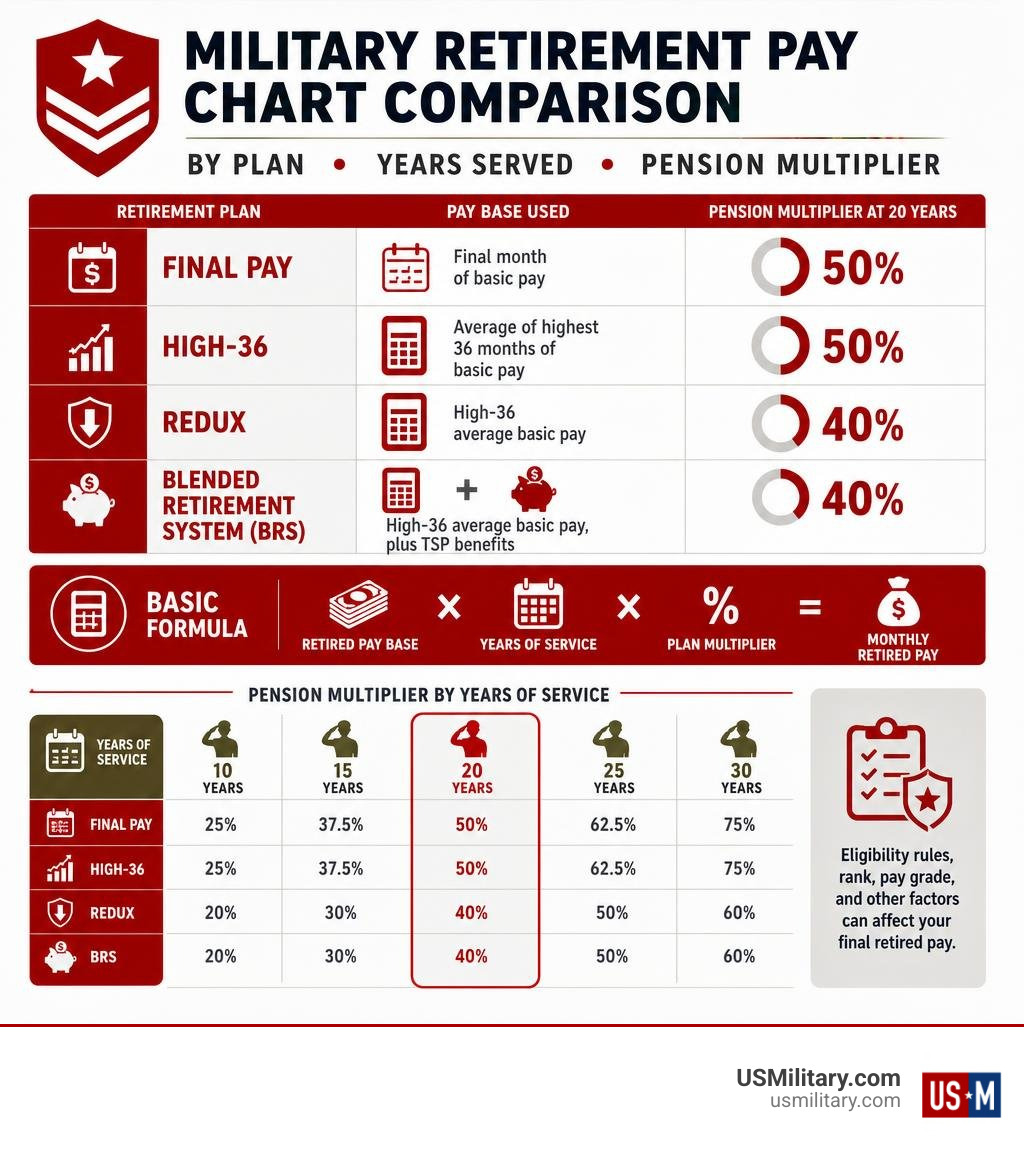
A military retirement pay chart helps you estimate a monthly pension by combining your retirement plan, years of service, and basic pay.
| Retirement plan | Pension multiplier at 20 years | Pay base used |
|---|---|---|
| Final Pay | 50% | Final month of basic pay |
| High-36 | 50% | Average of highest 36 months of basic pay |
| REDUX | 40% | High-36 average basic pay |
| Blended Retirement System (BRS) | 40% | High-36 average basic pay, plus TSP benefits |
For most active-duty retirees, the basic formula is:
Retired pay = retired pay base x years of service x plan multiplier
That means a High-36 retiree with 20 years generally receives 50% of their high-36 basic-pay average. A BRS retiree with the same service receives 40%, while also keeping government Thrift Savings Plan contributions and matching funds earned during service.
The number on a pay chart is only a starting point. Your Date of Initial Entry into Military Service (DIEMS), rank, retirement type, Reserve or Guard points, COLA increases, and possible disability status can all change the final amount.
I am Larry Fowler, publisher of the USMilitary.com Network since 2007, where I have helped active-duty members, Reservists, and veterans understand service-related benefits and financial decisions. In this guide, I break down the military retirement pay chart into clear formulas and practical rank-by-rank examples.
Military retirement pay chart definitions:
Understanding Military Retirement Systems and DIEMS Rules
To understand your personal pension calculation, we first have to look at your Date of Initial Entry into Military Service (DIEMS). Your DIEMS is the exact calendar date you first entered military service, whether through enlistment, entering a service academy, or enrolling in ROTC. Crucially, DIEMS never changes, even if you separate from active duty and rejoin the service years later.
Your DIEMS dictates which retirement structure applies to your career:
- Final Pay Plan: Applies to members with a DIEMS prior to September 8, 1980. The monthly pension is calculated by taking 2.5% per year of service times the final active duty basic pay rate.
- High-36 (High-3) Plan: Applies to members with a DIEMS between September 8, 1980, and December 31, 2017 (who did not opt into BRS or REDUX). The calculation uses a 2.5% per year multiplier applied to the average of your highest 36 months of basic pay.
- REDUX Plan: Offered to members who entered service between September 8, 1980, and December 31, 2017, and chose to accept a $30,000 Career Status Bonus (CSB) at their 15-year mark in exchange for a lower initial retirement pay multiplier.
- Blended Retirement System (BRS): Applies automatically to anyone entering service on or after January 1, 2018, and to eligible service members who opted into BRS during the 2018 opt-in window.
For a deeper dive into qualifying milestones, check out our guide on Military Pension Eligibility 101. You can also verify official Department of Defense guidelines directly on the official DoD Retirement portal.
Comparing BRS vs Legacy Multipliers in the Military Retirement Pay Chart
The fundamental difference between the legacy High-36 plan and the Blended Retirement System lies in how the defined benefit pension multiplier is structured alongside retirement savings.
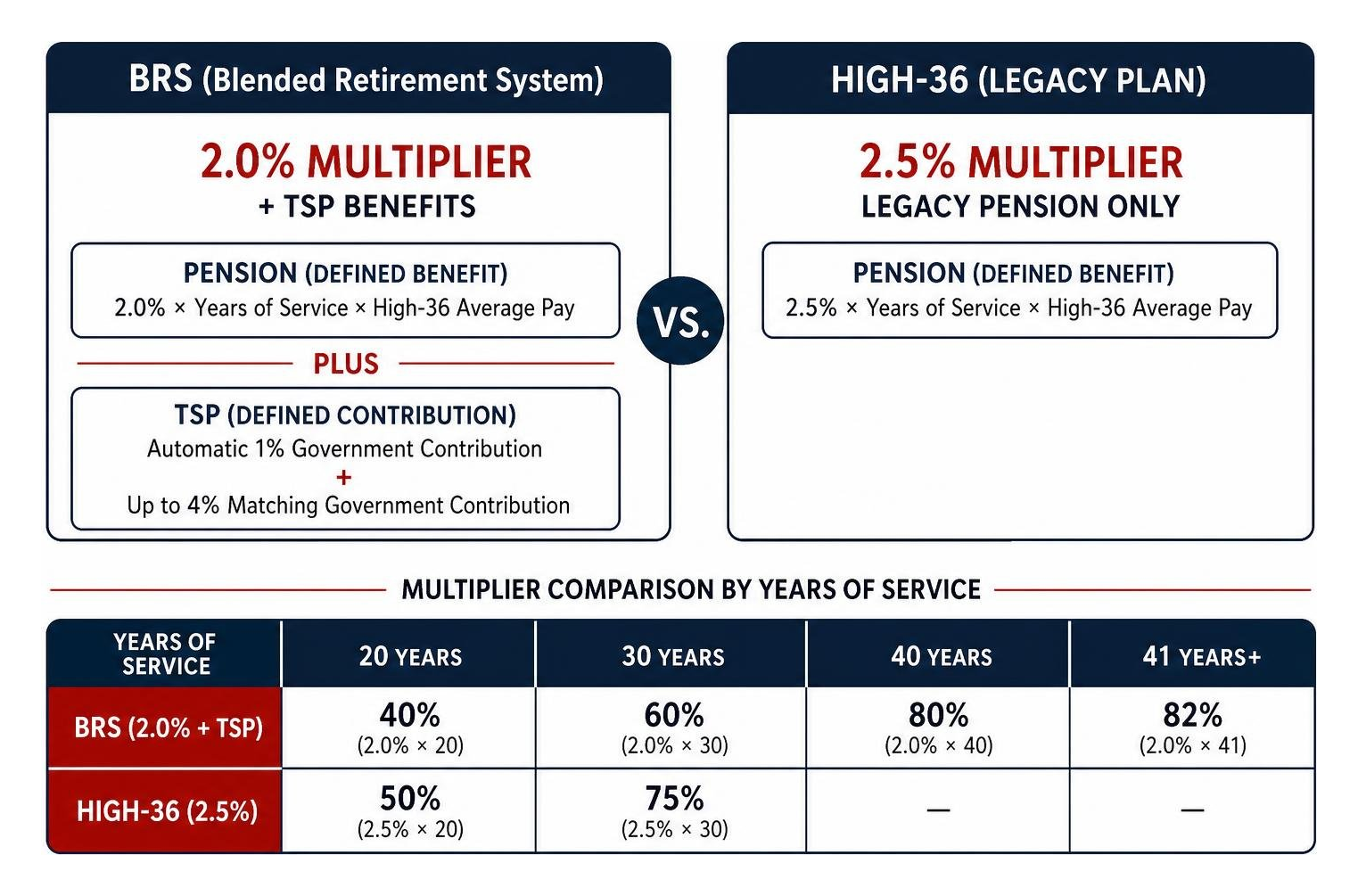
Under the legacy High-36 plan, service members earn a 2.5% retired pay multiplier for every year of active service. Upon reaching 20 years of active service, the retiree earns a 50% multiplier applied to their high-36 average base pay (20 years x 2.5% = 50%). At 30 years, the multiplier reaches 75%.
Under the Blended Retirement System (BRS), the pension multiplier is reduced to 2.0% per year of service. Reaching 20 years of active duty produces a 40% pension multiplier (20 years x 2.0% = 40%). At 30 years of service, the BRS pension multiplier equals 60%, at 40 years it is 80%, and at 41 years it reaches 82%.
To offset the lower pension multiplier, BRS provides automatic and matching Thrift Savings Plan (TSP) contributions:
- Automatic 1% Contribution: After 60 days of service, the government automatically deposits an amount equal to 1% of your basic pay into your TSP account.
- Matching Contributions: Beginning after your second year of service (24th month) and continuing through your 26th year, the government matches your TSP contributions dollar-for-dollar up to 3%, plus 50 cents on the dollar for the next 2%, allowing you to receive up to a total 4% government matching contribution (for a grand total of 5% in government contributions).
- Continuation Pay: Mid-career service members under BRS receive a one-time direct cash payout (Continuation Pay) between 8 and 12 years of service in exchange for an additional service commitment.
Career Status Bonus and REDUX Calculations
Although new enrollments in the Career Status Bonus (CSB)/REDUX option ended on December 31, 2017, thousands of current retirees and senior service members remain under this system.
Under REDUX, a service member accepted a tax-free $30,000 Career Status Bonus at 15 years of service. In exchange, their 20-year pension multiplier was reduced from 50% down to 40% (calculated as 2.0% per year up to 20 years, plus 3.5% for each year between 20 and 30 years). Furthermore, annual Cost of Living Adjustments (COLA) under REDUX are capped at COLA minus 1 percentage point.
However, REDUX includes critical statutory recalculations:
- Age 62 Catch-Up: At age 62, a REDUX retiree’s monthly payment receives a one-time re-adjustment. The monthly multiplier is restored to what it would have been under High-36 (e.g., 50% for 20 years of service), and lifetime COLA compounding is restored to full rates.
- The Age 52 Crossover Point: Financial modeling shows that assuming an 8% average return rate on the invested $30,000 bonus, the total cumulative lifetime cash flow of High-36 surpasses CSB/REDUX when the retiree reaches roughly age 52.
You can review complete historical analysis and payout structures at Military Compensation and Financial Readiness > Pay > Retirement > E7with20years.
Active Duty 2026 Military Retirement Pay Chart and Basic Pay Base
Your retired pay base is determined directly by monthly active-duty basic pay rates. As of 2026, basic pay charts reflect statutory pay adjustments across all enlisted and officer ranks.
To see exact active-duty base pay figures, download the official PDF 2026 Military Pay Chart or explore our complete breakdown in The Ultimate Guide to 2026 Military Pay Chart.

Below is an estimated military retirement pay chart showing monthly gross pension figures for active-duty members retiring in 2026 under both High-36 (50% multiplier at 20 YOS) and BRS (40% multiplier at 20 YOS) systems, based on estimated 2026 basic pay rates:
| Pay Grade & Title | 2026 Monthly Base Pay (20 YOS) | High-36 Monthly Pension (20 YOS / 50%) | BRS Monthly Pension (20 YOS / 40%) | High-36 Monthly Pension (30 YOS / 75%) |
|---|---|---|---|---|
| E-6 (Staff Sergeant / Petty Officer 1st Class) | $5,412.30 | $2,706.15 | $2,164.92 | $3,803.18 (70%) |
| E-7 (Sergeant First Class / Chief Petty Officer) | $6,245.70 | $3,122.85 | $2,498.28 | $4,371.99 |
| E-8 (Master Sergeant / Senior Chief) | $7,058.40 | $3,529.20 | $2,823.36 | $5,045.78 |
| E-9 (Command Sergeant Major / Master Chief) | $8,521.50 | $4,260.75 | $3,408.60 | $6,391.13 |
| W-3 (Chief Warrant Officer 3) | $7,214.10 | $3,607.05 | $2,885.64 | $5,049.87 |
| W-4 (Chief Warrant Officer 4) | $8,312.40 | $4,156.20 | $3,324.96 | $5,818.68 |
| W-5 (Chief Warrant Officer 5) | $10,169.70 | $5,084.85 | $4,067.88 | $7,118.79 |
| O-4 (Major / Lieutenant Commander) | $9,411.60 | $4,705.80 | $3,764.64 | $6,588.12 |
| O-5 (Lieutenant Colonel / Commander) | $10,882.20 | $5,441.10 | $4,352.88 | $7,617.54 |
| O-6 (Colonel / Captain) | $13,115.40 | $6,557.70 | $5,246.16 | $9,180.78 |
Note: The high-36 calculation in practice averages the preceding 36 months of basic pay rather than using a single month’s rate. Figures above reflect immediate 20-year and 30-year projections applied to 2026 pay tables for clear comparison.
Enlisted vs Officer Monthly Pensions in the Military Retirement Pay Chart
Comparing enlisted and officer pension lines demonstrates how commissioned pay structures influence lifelong retirement benefits.
For instance, an E-7 retiring with 20 years of service under the High-36 plan has a monthly pension base around $6,245.70, resulting in an estimated gross monthly pension of $3,122.85.
By contrast, an officer retiring as an O-5 (Lieutenant Colonel) at 20 years of service under High-36 earns a monthly basic pay base of $10,882.20, translating to a monthly retirement check of $5,441.10.
Prior-enlisted service offers a significant bump for commissioned officers through special prior-enlisted pay designations (O-1E, O-2E, O-3E). To qualify for O-1E through O-3E pay scales, an officer must have completed over 4 years (4 years and 1 day) of active duty service as an enlisted member or warrant officer before commissioning.
For example, an O-3E (Captain with prior enlisted service) with 10 years of total service earns $8,375.70 per month in basic pay, which is substantially higher than a standard O-3 with 10 years of service.
To learn more about how prior service affects rank compensation, check out From E-1 to O-4: A Deep Dive into Active Duty Military Pay and Benefits and our main guide on Military Retirement Pay.
Non-Regular Reserve and National Guard Pension Calculations
Members of the Army National Guard, Air National Guard, and Reserve components earn non-regular retirement pay under Title 10 of the U.S. Code. Unlike active-duty members who receive retirement pay immediately upon leaving service at 20 years, Reserve component members generally must wait until age 60 to begin drawing retired pay.

To qualify for non-regular retirement, a Guard or Reserve member must complete:
- 20 Qualifying Years: A qualifying year is a service year in which you earn a minimum of 50 retirement points.
- Point System: Points are earned through drill weekends (4 points per weekend), annual training (1 point per day), active duty mobilization (1 point per day), membership points (15 points per year automatically), and completing authorized military correspondence courses.
Converting Reserve Points to Equivalent Active Years
Reserve retired pay converts your lifetime point total into equivalent active-duty years using a standard math formula:
- Divide total retirement points by 360 to establish equivalent active duty service years.
- Multiply equivalent years by the plan multiplier (2.5% for High-36 or 2.0% for BRS).
- Multiply the resulting percentage multiplier by your High-36 average basic pay rate (using the active-duty pay scale in effect on the date you become eligible to receive pay).
Example Calculation:
Suppose a Guard soldier completes 20 qualifying years and earns a total of 3,600 career points under the High-36 plan:
- Equivalent active years: 3,600 / 360 = 10 years.
- Pension multiplier: 10 years x 2.5% = 25%.
- If their High-36 average basic pay for their rank at age 60 is $6,000 per month, their retirement check is $1,500 per month ($6,000 x 25%).
Even with the absolute minimum qualifying points (1,000 points across 20 years), the math equals 2.77 equivalent active years (1,000 / 360), yielding a multiplier of 6.94% (2.77 x 2.5%).
To explore point limits and rules, read A Complete Guide to Military Reserve Pension Rules.
COLA Adjustments, Disability Pensions, and Official Pay Tools
Once you retire, your monthly retirement check is protected against inflation through annual Cost of Living Adjustments (COLA). COLA rates are determined by federal changes in the Consumer Price Index (CPI).
Effective December 1, 2025, military retirees and Survivor Benefit Plan (SBP) annuitants received a 2.8 percent COLA increase. This adjustment appeared directly in monthly pension payments received in late December 2025 and early January 2026.
To manage direct deposit, tax withholdings, and view digital Retiree Account Statements (RAS), retirees rely on the Defense Finance and Accounting Service (DFAS). DFAS provides self-service features, including interactive Smart Wizards for DD Form 2656 (Data for Payment of Retired Personnel) and SF 1174 (Arrears of Pay).
You can access official pay tables and portal instructions via Military Pay Tables & Information.
How Disability Retirement Multipliers Are Determined
Service members who are medically retired due to service-connected disabilities receive retired pay under Chapter 61 of Title 10, U.S. Code.
When medically retired, DFAS calculates your pension using two different methods and awards you the higher monthly amount:
- Disability Multiplier Formula: Your awarded military disability rating percentage (e.g., 50%, 60%, 70%) multiplied by your High-36 base pay.
- Service Multiplier Formula: Your actual years of service multiplied by your retirement plan multiplier (2.5% or 2.0%) times your High-36 base pay.
By federal law, the maximum allowable disability retirement multiplier cap under Chapter 61 is 75 percent.
VA Disability Offset and Concurrent Receipt:
Historically, dollar-for-dollar reductions applied if a retiree received both military retired pay and VA disability compensation. However, under Concurrent Retirement and Disability Pay (CRDP), eligible retirees with a service-connected VA disability rating of 50% or higher receive both their full military pension and their full VA disability payments simultaneously without an offset.
To understand how VA disability ratings pair with military pensions, read our detailed guide: Can You Receive 100 VA Disability and Military Retirement Pay?.
Additionally, civil service employees comparing Department of Defense Nonappropriated Fund (NAF) benefits against federal systems can consult the official DoW Nonappropriated Fund (NAF) Component Retirement Plans and FERS Policy Reference Chart.
Frequently Asked Questions About Military Retirement Pay
What is the current COLA increase for military retirees?
The Cost of Living Adjustment (COLA) effective December 1, 2025, is 2.8 percent. This increase applies automatically to military retired pay, Survivor Benefit Plan (SBP) annuities, and VA disability compensation payments.
How is High-36 average basic pay calculated?
High-36 average basic pay is calculated by summing your highest 36 consecutive months of active-duty basic pay earned during your career and dividing that total by 36. For almost all service members, this corresponds to the final 36 months of service before retirement.
Can National Guard members receive retirement pay before age 60?
Yes. Under the National Defense Authorization Act (NDAA) of 2008, National Guard and Reserve members can lower their retirement pay eligibility age below 60. For every aggregate block of 90 days spent on qualifying active duty service (such as combat deployments or contingency operations), your retirement pay receipt age is reduced by 3 months. The absolute minimum reduced eligibility age under this law is age 50 (though healthcare benefits like TRICARE Retiree Dental and Health still begin at age 60).
Conclusion
Navigating a military retirement pay chart involves understanding how your rank, years of service, DIEMS date, and point history intersect. Whether you choose the blended retirement system with robust TSP matching or rely on legacy High-36 calculations, proper financial planning ensures you maximize your military benefits.
At USMilitary.com, we provide resources, calculators, and guidebooks to help active-duty service members, Reservists, and veterans secure their financial future. Explore our comprehensive planning tools at USMilitary Savings and Retirement Benefits to build your path toward retirement security today.
Free for Service Members & Veterans
Get the military benefits intel no one tells you about.
Weekly updates on VA benefits, pay changes, and money tips — free for service members and veterans.
No spam. Unsubscribe anytime. Your info is never shared.