What Are Military Spouse Benefits? (2026 Overview)
Military spouse benefits are a wide range of programs and allowances designed to support the families of active-duty, reserve, and retired service members — covering everything from health care and housing to education, career support, and survivor compensation.
Here is a quick summary of the core benefits available to military spouses in 2026:
| Benefit Category | Key Programs |
|---|---|
| Health Care | TRICARE Prime, TRICARE Select, CHAMPVA |
| Housing | Basic Allowance for Housing (BAH) |
| Education | MyCAA ($4,000), DEA (36 months), Fry Scholarship |
| Career Support | MSEP (600+ employers), SECO coaching, MSP |
| Shopping | Commissaries, tax-free exchanges |
| Family Support | Subsidized child care, Military OneSource, MWR |
| Survivor Benefits | DIC ($1,699.36/month), Death Gratuity ($100,000) |
| Life Insurance | Family SGLI (FSGLI) |
Military life is rewarding — but it is also demanding. Frequent moves, deployments, and career disruptions put real pressure on spouses and families. These benefits exist to ease that burden and provide financial stability, no matter where service takes your family.
I’m Larry Fowler, publisher of the USMilitary.com Network since 2007, and I’ve spent nearly two decades helping active-duty families and veterans understand complex topics like military spouse benefits. In this guide, I’ll break down every major benefit available in 2026 in plain, simple language so you can make the most of what you’ve earned.
Essential Healthcare and Housing Military Spouse Benefits
One of the greatest points of pride for the U.S. military is how we take care of our own. When you marry into the military, you aren’t just joining a person; you’re joining a community that prioritizes your physical and financial well-being.
Navigating TRICARE and Health Coverage

Healthcare is often the “crown jewel” of military spouse benefits. Most spouses will utilize TRICARE, which functions similarly to a high-quality civilian insurance plan but with significantly lower out-of-pocket costs.
To access these benefits, the very first step is ensuring you are registered in the Defense Enrollment Eligibility Reporting System (DEERS). Without DEERS registration and a valid military ID card, you simply don’t exist in the eyes of the healthcare system.
Once enrolled, you generally choose between two primary paths:
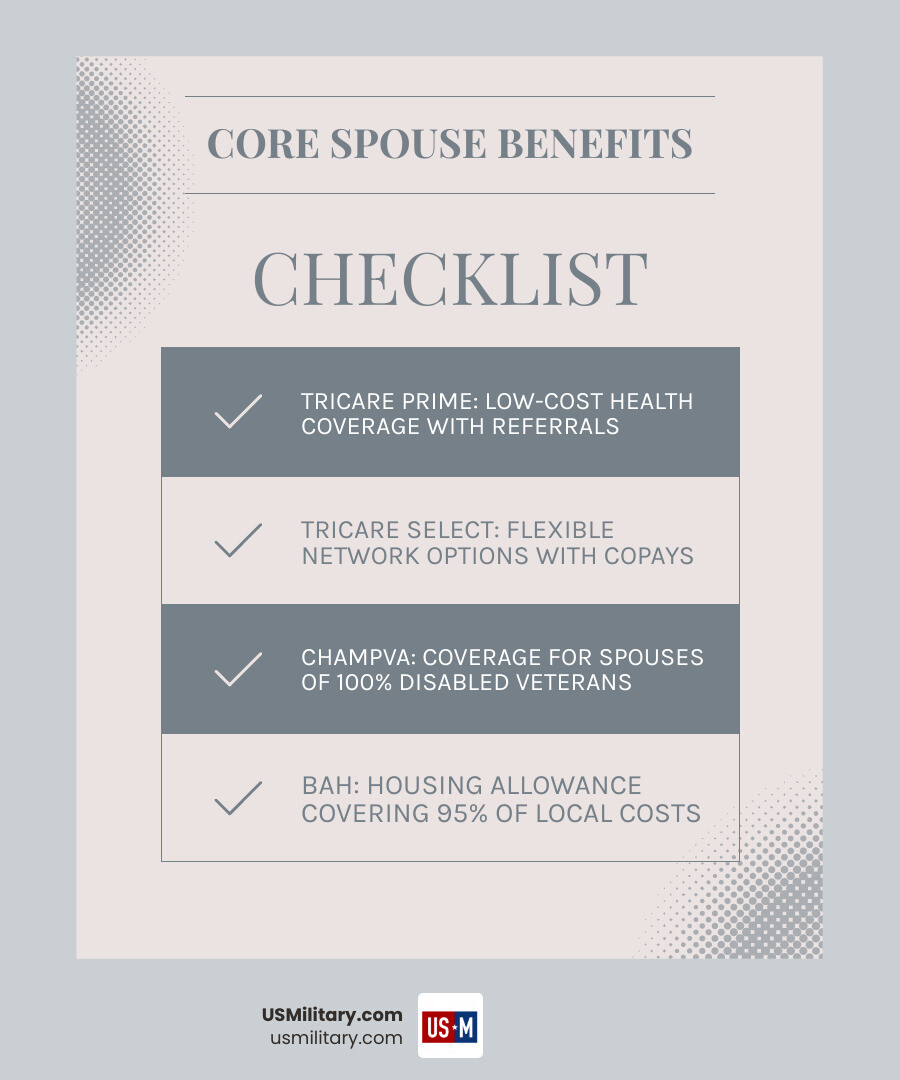
- TRICARE Prime: This is a managed care option similar to an HMO. You’ll have a Primary Care Manager (PCM) who coordinates your care. It offers the lowest out-of-pocket costs, often with no enrollment fees for active-duty families.
- TRICARE Select: This is a fee-for-service plan that works like a PPO. You have more flexibility to choose your own doctors, but you may have to pay deductibles and cost-shares.
For those supporting spouses with service-connected disabilities or for surviving spouses who do not qualify for TRICARE, the CHAMPVA program (Civilian Health and Medical Program of the Department of Veterans Affairs) provides essential coverage. In 2026, more than 112,000 women of reproductive age are enrolled in CHAMPVA, highlighting its vital role in family planning and wellness. Speaking of family planning, we recommend checking out our guide on Pregnancy Aid For Military Spouses for specific support during that journey.
For a broader look at how the VA supports the home front, visit the official VA Benefits For Family And Caregivers page.
| Feature | TRICARE Prime | TRICARE Select |
|---|---|---|
| Provider Choice | Assigned PCM | Any TRICARE-authorized provider |
| Out-of-Pocket Costs | Minimal to none | Deductibles and cost-shares apply |
| Referrals | Required for specialty care | Not required for most services |
| Enrollment | Required | Required |
Basic Allowance for Housing (BAH)
The Basic Allowance for Housing (BAH) is a monthly subsidy to help you afford a home in the civilian community. It is a critical component of your family’s financial stability.
A common point of confusion is how BAH is calculated. In 2026, BAH is based on the service member’s duty station zip code, not necessarily where you choose to live. However, if a service member is sent on a “hardship duty” or a deployment where the family cannot follow, the BAH is often based on the spouse’s location to ensure you are properly supported.
BAH is designed to cover approximately 95% of median housing costs (including utilities). One of the best “hidden” perks is that if BAH rates in your area drop, your rate is “grandfathered” in—you keep the higher rate as long as you remain at that station. If rates go up, your allowance goes up too!
Education and Career Advancement Opportunities
We know that being a military spouse often means putting your own goals on the back burner while you move from base to base. That is why the Department of Defense (DoD) has invested heavily in education and career military spouse benefits.
The MyCAA Scholarship
The My Career Advancement Account (MyCAA) Scholarship is a powerhouse program. It provides up to $4,000 in financial assistance for eligible spouses.
- Who is eligible? Spouses of service members on active duty in pay grades E-1 to E-5, W-1 to W-2, and O-1 to O-2.
- What does it cover? It’s designed for “portable” careers—fields that you can take with you when you move. This includes licenses, certifications, or associate degrees.
A great example of this in action is seen when Military Spouses Complete Certified Nurse Assistant Program through MyCAA funding, allowing them to find work at almost any duty station across the country.
Free Learning and Coaching
Beyond formal degrees, there are massive resources for self-improvement:
- Udemy: Military spouses currently have access to more than 5,000 free courses on Udemy, covering everything from tech skills to creative writing.
- SECO Coaching: The Spouse Education and Career Opportunities (SECO) program offers free, one-on-one career coaching to help you map out your professional future. You can learn more at the Military Spouse Career & Education Benefits portal.
- Discounts: Don’t forget that many private institutions offer Spouse Education Military Discounts that can be stacked with federal aid.
Maximizing Education and Career Military Spouse Benefits
If you are looking for long-term degree options, the Post-9/11 GI Bill transfer is a game-changer. If a service member has served at least six years and agrees to serve four more, they can transfer their 36 months of tuition benefits to their spouse. This covers tuition, a housing allowance, and a book stipend.
For those who need maximum flexibility due to the “PCS cycle,” online degrees are often the best route. Our guide on How To Boldly Thrive As A Military Spouse emphasizes choosing institutions like UMass Global that offer competency-based programs tailored for the mobile military lifestyle.
Employment Support and License Portability
Employment is one of the biggest challenges for spouses, with unemployment rates historically higher than the national average. To combat this, the Military Spouse Employment Partnership (MSEP) connects spouses with over 600 corporate partners—including major Fortune 500 companies—that have specifically committed to hiring and retaining military spouses.
✉ Get updates like this in your inbox
Weekly VA benefit changes, pay updates, and money tips for service members, veterans, and military families. Free, no spam.
Furthermore, the Military Spouse Preference (MSP) program gives you a “leg up” when applying for DoD civilian jobs. If you are a professional with a state-issued license (like a teacher or a hair stylist), new 2026 standards have made license portability much easier. Most states now have compacts or laws that allow you to practice your profession shortly after arriving at a new duty station without jumping through endless bureaucratic hoops.
For those looking for a jumpstart, the Career Accelerator pilot program even offers 12-week paid fellowships to help you get your foot in the door at top-tier employers. These programs are designed to help you maintain The Every Day Life Of Being A Confident Army Spouse by ensuring your career doesn’t have to stop just because the military says “move.”
Lifestyle, Shopping, and Family Support Services
Living “on or near the economy” is expensive. That’s where your shopping and lifestyle benefits come in.
Tax-Free Shopping and Savings
Your military ID card is essentially a “gold card” for savings.
- Commissaries: These are your on-base grocery stores. By law, they sell items at cost plus a small 5% surcharge that goes back into building new stores. This can save a family thousands of dollars a year.
- Exchanges (AAFES/NEX/MCX): These department stores are entirely tax-free. Whether you’re buying a new TV or a pair of boots, you’ll save the sales tax, and the revenue generated helps fund Morale, Welfare, and Recreation (MWR) programs like base pools, gyms, and movie theaters.
Family and Relationship Support
Military life is stressful. We want you to know that you don’t have to carry that stress alone. Military OneSource provides 24/7/365 confidential support. They offer:
- Child Care: Access to a national caregiver database with over a million providers to help you find care during a PCS or deployment.
- Relationship Tools: Tools like “Love Every Day,” a text-based tool for daily relationship communication, and the “Chill Drills” app for mindfulness and stress relief.
- Counseling: Free, non-medical counseling for everything from parenting challenges to relocation stress.
You can find a full list of these programs through the official Family Benefits | U.S. Army page.
Financial Security and Survivor Benefits
While we never want to think about the worst-case scenario, the military provides a robust safety net for surviving spouses. These military spouse benefits are designed to ensure that if a tragedy occurs, the family is not left in financial ruin.
Dependency and Indemnity Compensation (DIC)
DIC is a tax-free monthly payment for eligible surviving spouses. As of April 2026, the base rate for DIC is $1,699.36 per month.
There are several “add-ons” to this amount:
- Disability Longevity: An additional $360.85 if the veteran was rated totally disabled for at least eight continuous years prior to death.
- Children: $421.00 per child under age 18.
- Transitional Bonus: $359.00 for the first two years after the veteran’s death if there are children under 18.
The PACT Act has significantly expanded these benefits. For example, hypertension is now a “presumptive condition” for Vietnam-era veterans exposed to Agent Orange. This means many surviving spouses who were previously denied DIC can now file supplemental claims and potentially receive significant back pay.
Life Insurance and Education for Survivors
- FSGLI: Spouses can be covered by Family Servicemembers’ Group Life Insurance for up to $100,000.
- Death Gratuity: A one-time, tax-free payment of $100,000 is paid to survivors of service members who die on active duty to help with immediate expenses.
- Fry Scholarship: This provides up to 36 months of Post-9/11 GI Bill benefits to surviving spouses of those who died in the line of duty after Sept. 10, 2001.
For more guidance on navigating these difficult times, please see our Military Spouse Compass Benefits Support resource.
Eligibility Requirements for Military Spouse Benefits
To keep these benefits active, you must stay on top of the paperwork.
- DEERS Enrollment: Always keep your address and contact info updated in DEERS.
- Military ID Cards: Ensure your ID card is not expired; this is your key to healthcare and base access.
- Remarriage Rules: For surviving spouses, the rules on DIC changed recently. You can now generally keep your DIC benefits if you remarry after the age of 55 (if remarried after Jan. 5, 2021) or age 57 (if remarried between 2003 and 2021).
- Intent to File: If you are applying for VA benefits, always submit an “Intent to File” first. This “locks in” your effective date so you can get paid retroactively while you gather your evidence.
VA Home Loan
One Benefit Many Veterans Never Use: The VA Loan
Eligible veterans, service members and some surviving spouses can buy a home with no down payment and no PMI. Checking costs nothing.
USMilitary.com may be compensated when you request quotes from lenders through this link.
Frequently Asked Questions about Military Spouse Benefits
How does the Basic Allowance for Housing (BAH) work for spouses?
BAH is a monthly allowance to help cover housing costs when you live off-base. It is calculated based on the service member’s rank, dependency status, and the zip code of their permanent duty station. In 2026, it aims to cover 95% of median housing costs. If the service member is deployed to a location where you cannot follow, you can often receive BAH based on your current location to ensure you can stay in your home.
What is the MyCAA scholarship and who is eligible?
MyCAA is a $4,000 scholarship for military spouses to pursue associate degrees, certifications, or professional licenses in portable career fields. It is available to spouses of active-duty service members in pay grades E-1 to E-5, W-1 to W-2, and O-1 to O-2. The goal is to help you build a career that isn’t tied to a single geographic location.
Can surviving spouses keep their benefits if they remarry?
Yes, but it depends on your age at the time of remarriage. Under 2026 rules, if you remarry on or after reaching age 55, you can typically continue to receive Dependency and Indemnity Compensation (DIC). If you remarry before that age, benefits are usually suspended, though they can often be reinstated if the subsequent marriage ends.
Conclusion
At USMilitary.com, our mission is to ensure that no military family is left behind due to a lack of information. The landscape of military spouse benefits is constantly shifting—with new laws like the PACT Act and updated 2026 pay scales changing the math for your family every year.
Navigating these benefits is about more than just “free stuff”—it’s about the empowerment that comes with financial security and career independence. Whether you are using MyCAA to start a new career, utilizing TRICARE for your family’s health, or relying on the safety net of survivor benefits, these programs are the nation’s way of saying “thank you” for your sacrifice.
Stay confident, stay informed, and always reach out to a Veterans Service Organization (VSO) or a Military OneSource consultant if you feel overwhelmed. You’ve earned these benefits; now, make sure you use them.
Access your comprehensive military spouse benefits guide
Free for Service Members & Veterans
Get the military benefits intel no one tells you about.
Weekly updates on VA benefits, pay changes, and money tips — free for service members and veterans.
No spam. Unsubscribe anytime. Your info is never shared.


