Why So Many Veterans Struggle With the Military-to-Civilian Resume: How to Translate Your Service

Military to civilian resume: how to translate your service is one of the most common — and most frustrating — challenges veterans face after leaving the military.
Here’s a quick answer if you’re in a hurry:
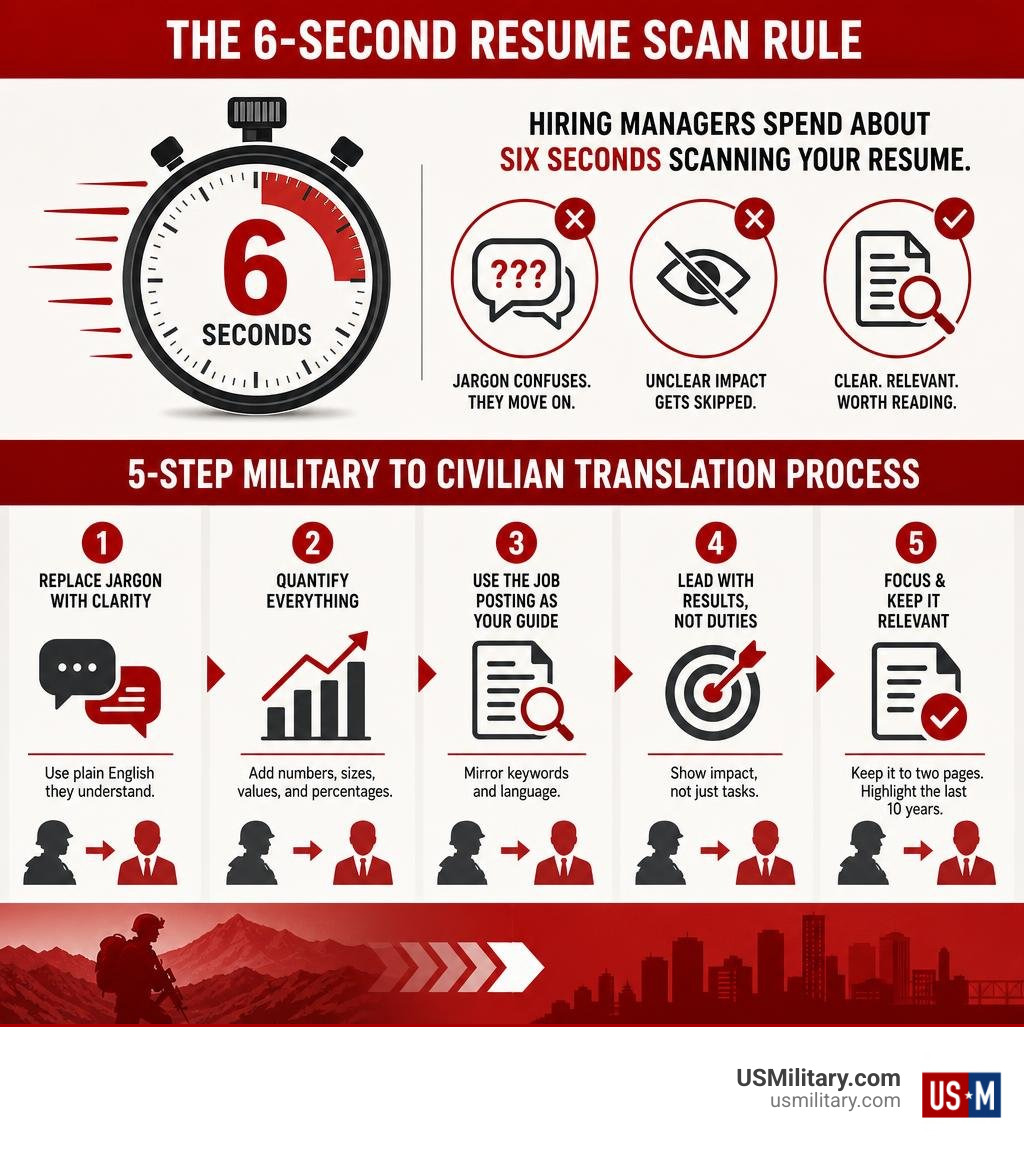
To translate your military resume for civilian employers:
- Replace military jargon – Swap acronyms, ranks, and MOS titles for plain civilian equivalents
- Quantify everything – Add dollar values, team sizes, and percentages to every bullet point
- Use the job posting as your guide – Mirror the exact language and keywords from the job description
- Lead with results, not duties – Show what you achieved, not just what you were assigned to do
- Keep it to two pages – Focus on the last 10 years and the most relevant experience
- List your security clearance prominently – It saves employers months and thousands of dollars in investigation costs
- Integrate military roles chronologically – Don’t isolate them in a separate section that creates perceived gaps
The stakes are real. Veterans who translate military experience into civilian language receive 2-3x more interview callbacks than those who leave military jargon on their resumes. Yet most veterans do exactly that — because military language becomes second nature after years of service.
Consider this: a hiring manager spends about six seconds scanning your resume before deciding whether to keep reading. If they see “conducted BDA following kinetic operations” or “NCOIC of battalion S4 section,” they move on — not because your experience isn’t valuable, but because they simply can’t decode it fast enough.
The experience is real. The skills are in demand. The translation is the missing piece.
I’m Larry Fowler, publisher of the USMilitary.com Network and a longtime resource for active duty service members and veterans navigating career transitions. Since 2007, I’ve worked directly with veterans on questions around military to civilian resume: how to translate your service — and I’ve seen what separates the resumes that get callbacks from the ones that don’t. In this guide, I’ll walk you through exactly what works, based on research, real resume examples, and the latest guidance available in 2026.
Military to Civilian Resume: How to Translate Your Service for Maximum Impact
When we talk about resume translation, we are not just talking about swapping out a few words. We are talking about reframing your entire mindset. In the military, you are trained to write evaluations (like NCOERs, OERs, or FITREPs) that jam as many acronyms and passive duties into a small block as possible. Those documents are written for military promotion boards who already speak the language.
On the civilian side, corporate recruiters do not know what a “property book” is, nor do they understand “MTOE.” To make an impact, you must strip away the camouflage and focus on business outcomes. Every bullet point on your resume should tell a civilian hiring manager three things: what you did (using their vocabulary), how much of it you did (scope and scale), and what the positive outcome was (business impact).
To start identifying these transferable skills, you can find helpful translation frameworks on resources like CareerOneStop Translating Terms, which help break down complex military functions into standard corporate operations.
Why a Military to Civilian Resume: How to Translate Your Service Matters to Recruiters
The corporate hiring process is fast, crowded, and highly automated. With hiring managers spending an average of 6 to 10 seconds on their initial scan of a resume, any point of friction will cause them to move to the next candidate. When a recruiter sees a resume dense with military terms, they do not see a leader; they see a translation project they do not have time to complete.
By mastering the process of a military to civilian resume: how to translate your service, you bridge this gap. You make your transferability obvious. Instead of forcing a corporate recruiter to guess how your experience as an Army squad leader applies to their project manager opening, your resume should explicitly show that you managed timelines, coordinated cross-functional teams, and mitigated risk under high-pressure conditions.
According to transition data, veterans who use civilian-equivalent keywords that match job postings rank significantly higher in automated systems and receive double the callback rates of those who do not. For a deeper dive into structuring these elements, you can read Indeed’s Guide on Military-to-Civilian Resumes.
Demilitarizing Your Language: Ranks, Acronyms, and Job Titles
Demilitarizing your resume means removing the terms that only make sense inside the gate. If you served as an NCOIC (Non-Commissioned Officer in Charge), you were a Supervisor or Department Manager. If you were a Commander, you were a Director or Division Head.
We must also translate our daily vocabulary. Instead of “combat,” we talk about “high-stress environments” or “critical operations.” Instead of “soldiers” or “subordinates,” we refer to “personnel,” “team members,” or “direct reports.” Instead of “weapons” or “tactical gear,” we use “equipment” or “assets.”
To help you visualize this, we have compiled a translation table of common terms:
| Military Term / Acronym | Civilian Equivalent |
|---|---|
| NCOIC / Chief | Supervisor / Department Manager |
| Commander / Commanding Officer | Director / Division Head / Operations Manager |
| XO (Executive Officer) | Deputy Director / Chief of Staff |
| Squad Leader / Platoon Sergeant | Team Leader / Operations Supervisor |
| MOS / AFSC / Rating | Specialty / Career Field / Job Role |
| TDY / TAD | Business Travel |
| PCS | Relocation |
| OER / NCOER / FITREP | Performance Evaluation / Annual Appraisal |
| Battalion / Squadron / Unit | Department / Division / Branch |
| Regulations / SOPs | Corporate Policies / Standard Operating Procedures |
By using these terms, you immediately make your resume readable. You can explore more of these job-specific mappings through VA Careers Skill Translation, which helps connect service specialties with matching federal and private-sector job series.
Step-by-Step Guide: Military to Civilian Resume: How to Translate Your Service by Rank
Your translation strategy should change based on where you stood in the military hierarchy. Let’s look at how to translate your service by rank tiers:
Enlisted Personnel (E-4 to E-6)
At this level, you are the technical expert and the first-line supervisor. Your resume should highlight hands-on execution, quality control, and direct team leadership. If you worked in Army maintenance, you weren’t just turning wrenches; you were managing maintenance schedules, ensuring safety compliance, and training junior technicians.
- Before: Led a fire team of 4 Soldiers during combat operations; maintained 100% accountability of M4 rifles.
- After: Supervised a 4-person team executing high-pressure field operations; managed accountability for technical equipment valued at $150,000 with zero losses.
If you are looking for how your specific MOS translates, check out our guide on the best jobs in the Army to see how tactical roles map to corporate functions.
Senior NCOs (E-7 to E-9)
As a senior NCO, you are a mid-to-senior manager. You manage budgets, coordinate logistics, oversee training programs, and advise executive leadership. Your resume should focus on resource allocation, process improvement, and large-scale personnel management.
- Before: Served as Platoon Sergeant for 42 Soldiers; managed sub-hand receipt valued at $2.4M.
- After: Directed operations and training for a 42-person department; managed physical assets and inventory valued at $2.4M, reducing maintenance downtime by 15%.
For those coming from maritime environments, you can look at the best Navy jobs to see how shipboard division leadership translates to industrial operations management.
Junior Officers (O-1 to O-3)
Junior officers are project managers and operational leaders. You plan missions, direct small-to-medium teams, and manage risk. Your resume should highlight operational planning, cross-functional coordination, and project execution.
- Before: Platoon Leader for an infantry platoon; planned and executed 50+ combat patrols.
- After: Project Manager for a 30-person team; designed and executed 50+ complex operations in high-risk environments with a 100% safety and compliance record.
If you led small units in the infantry or combat arms, read our resource on jobs in the Marines to learn how to frame rugged field leadership as corporate operations management.
Senior Officers (O-4 and Above)
Senior officers are corporate executives. You manage multi-million dollar budgets, design long-term strategic plans, and lead organizations of hundreds or thousands of people. Your resume should lead with strategic vision, vendor management, and organizational change.
- Before: Battalion Commander of a logistics battalion; managed $15M operating budget.
- After: Executive Director of an international logistics organization; directed supply chain operations for 800+ personnel and managed a $15M annual operating budget, achieving a 98% on-time delivery rate.
Even in high-tech, modern arenas like space and cyber, the translation rules remain the same. If you served in our newest branch, check out Space Force jobs to see how orbital tracking and satellite operations translate to aerospace and network engineering roles.
Structuring Your Resume: Placement, Length, and Guard/Reserve Balance
Now that you know how to translate your words, let’s talk about how to structure the document. A civilian resume has a very specific flow that recruiters expect. If your layout is confusing, your translated words won’t matter.
Where to Place Military Experience on a Civilian Resume
A common question we receive is: Should I put my military experience in its own section?
In almost every case, the answer is no. You should integrate your military service directly into your standard “Work Experience” or “Professional Experience” section.
Isolating your military service in a separate “Military Experience” section at the bottom of your resume can make it look like “non-traditional” work, or worse, create a perceived employment gap in your primary career timeline. By placing your military roles chronologically alongside any civilian roles, you show a continuous, upward trajectory of professional growth.
If your military role is completely unrelated to the job you are targeting (for example, you were an artilleryman but are now applying for a software engineering role), you should still list it chronologically. However, you should condense the bullet points to focus on universal soft skills like team coordination, project management, and problem-solving, rather than the technical details of firing systems.
Balancing National Guard and Reserve Service
Listing National Guard or Reserve service requires a careful balance. You want to showcase your leadership and technical skills without making a civilian employer worry that you will constantly be away from your civilian job.
The best way to handle this is to list your Guard or Reserve role chronologically as a concurrent position. To put employers at ease, clearly state the nature of the commitment in parentheses next to your job title.
For example:
- Operations Supervisor (Part-Time / National Guard) | US Army National Guard | 2020 – Present
- Bullet point: Coordinate logistics and training for a 30-person team during monthly training periods and annual active-duty training cycles.
If you were deployed during your Reserve service, list the deployment as a sub-bullet under your Reserve role, focusing on the operational and logistical management required to move and support your team overseas.
Determining Resume Length and What to Cut
For private-sector civilian resumes, the rule is absolute: two pages maximum. If you have fewer than eight years of experience, you should aim to fit everything onto a single page.
Senior NCOs and officers with 20-year military careers often struggle with this. They want to list every duty station, command, and assignment they ever had. This is a mistake. A resume is not a biography; it is a marketing document tailored for a specific job.
To keep your resume concise:
- Focus on the last 10 years: This is where you held your highest responsibilities.
- Group older roles: If you served from 2006 to 2016, you can combine your early junior ranks into a single, two-line entry at the bottom of your experience section (e.g., “Various Tactical and Technical Roles | US Army | 2006 – 2012”).
- Create a Master Resume: Write a comprehensive document that contains all your historical roles and bullets. When applying for a job, save a copy and prune away anything that does not directly support your candidacy for that specific role.
Optimizing for ATS, Security Clearances, and Certifications
Before your resume ever reaches a human recruiter, it will likely have to pass through an Applicant Tracking System (ATS). These automated systems scan resumes for specific keywords to rank candidates.
Beating the Applicant Tracking System (ATS)
ATS platforms do not reject resumes out of hand; instead, they grade them based on how closely the resume’s language matches the job description. If a job posting asks for “inventory control” and “team leadership,” and your resume lists “property book management” and “commanded a platoon,” the ATS will not recognize the match.
To optimize your resume for ATS:
- Mirror the job description: Read the target job posting and identify their core requirements. If they use the term “logistics management,” change your “supply chain operations” bullet to use their exact phrasing.
- Avoid complex formatting: Do not use tables, graphics, text boxes, or columns. ATS parsers read left-to-right, top-to-bottom, and complex layouts can scramble your text into unreadable gibberish.
- Save as standard formats: Stick to standard standard Word documents (.docx) or PDFs.
To help automate this process, you can use transition platforms like Hiring Our Heroes Digital Tools, which offer specialized resume engines to help translate military experience into ATS-friendly formats.
Highlighting Security Clearances and Military Training
If you hold a security clearance, you possess an asset that is highly valuable to defense contractors, government agencies, and consulting firms. An active security clearance can save an employer between 6 to 18 months in processing time and thousands of dollars in investigation costs.
Do not bury this information. If you are applying for defense-related roles, your security clearance belongs at the very top of your resume — either in your professional summary or in a dedicated “Clearances” line right below your contact information header.
Format it clearly:
- Security Clearance: Active Secret (PR Date: June 2025)
- Security Clearance: Active Top Secret / SCI (Adjudicated: August 2024)
For your military training, do not list every short course you took. Instead, review your Joint Services Transcript (JST) for ACE (American Council on Education) credit recommendations. If you completed advanced leadership courses (like ALC, SLC, or Captains Career Course), list them under a “Professional Development” section as certificate programs in “Organizational Leadership” or “Operations Management.”
Frequently Asked Questions About Military-to-Civilian Resumes
How do I translate combat experience for a civilian resume?
Unless you are applying for a role in physical security or law enforcement, you should focus entirely on the operational, logistical, and leadership aspects of your deployment. Frame your combat experience in terms of risk management, rapid decision-making under pressure, resource coordination, and safety compliance.
Instead of writing about tactical missions, describe how you managed personnel and equipment in highly unpredictable, fast-changing environments while maintaining strict operational standards.
Should I include my military rank on my resume?
You should not lead with your rank in your resume header or as your primary job title. Instead, use a translated civilian job title that reflects your actual function, such as “Operations Manager” or “Logistics Coordinator.”
If you want to maintain your military identity, you can place your rank in parentheses after your functional title (e.g., “Operations Manager (US Army, E-7)”). This keeps the focus on your professional capability while still acknowledging your service.
How do I handle employment gaps after separating from the military?
Short gaps of three to six months during your transition period are completely normal and rarely concern civilian employers. If you have a longer gap, do not leave it blank or write “Career Transition.”
Instead, fill that space on your resume by listing productive activities you completed during that time, such as professional certifications, college coursework, volunteer leadership roles, or participation in DoD SkillBridge internships.
Conclusion
Translating your military experience for a civilian resume is not about changing what you did — it is about changing how you describe it. Your service has given you a level of leadership, adaptability, and technical skill that civilian employers are actively looking for. By taking the time to demilitarize your language, structure your resume professionally, and focus on measurable business outcomes, you can make your value obvious to any hiring manager.
As you prepare to take the next step in your career, we encourage you to explore our comprehensive transition resources at USMilitary.com. If you are looking for roles that naturally align with your background, read our guide on military jobs that transfer to civilian jobs to map out your post-service career path. For those seeking personal inspiration during times of transition, you may also find encouragement in the principles outlined in Dare to Live Greatly.
Your military service was defined by mission success. With the right translation strategy, your civilian job search will be no different.
Free for Service Members & Veterans
Get the military benefits intel no one tells you about.
Weekly updates on VA benefits, pay changes, and money tips — free for service members and veterans.
No spam. Unsubscribe anytime. Your info is never shared.


