What Is Guard and Reserve Pay? (Quick Answer)

Guard and reserve pay is the compensation earned by National Guard and Reserve members for part-time military service. Here’s a fast breakdown:
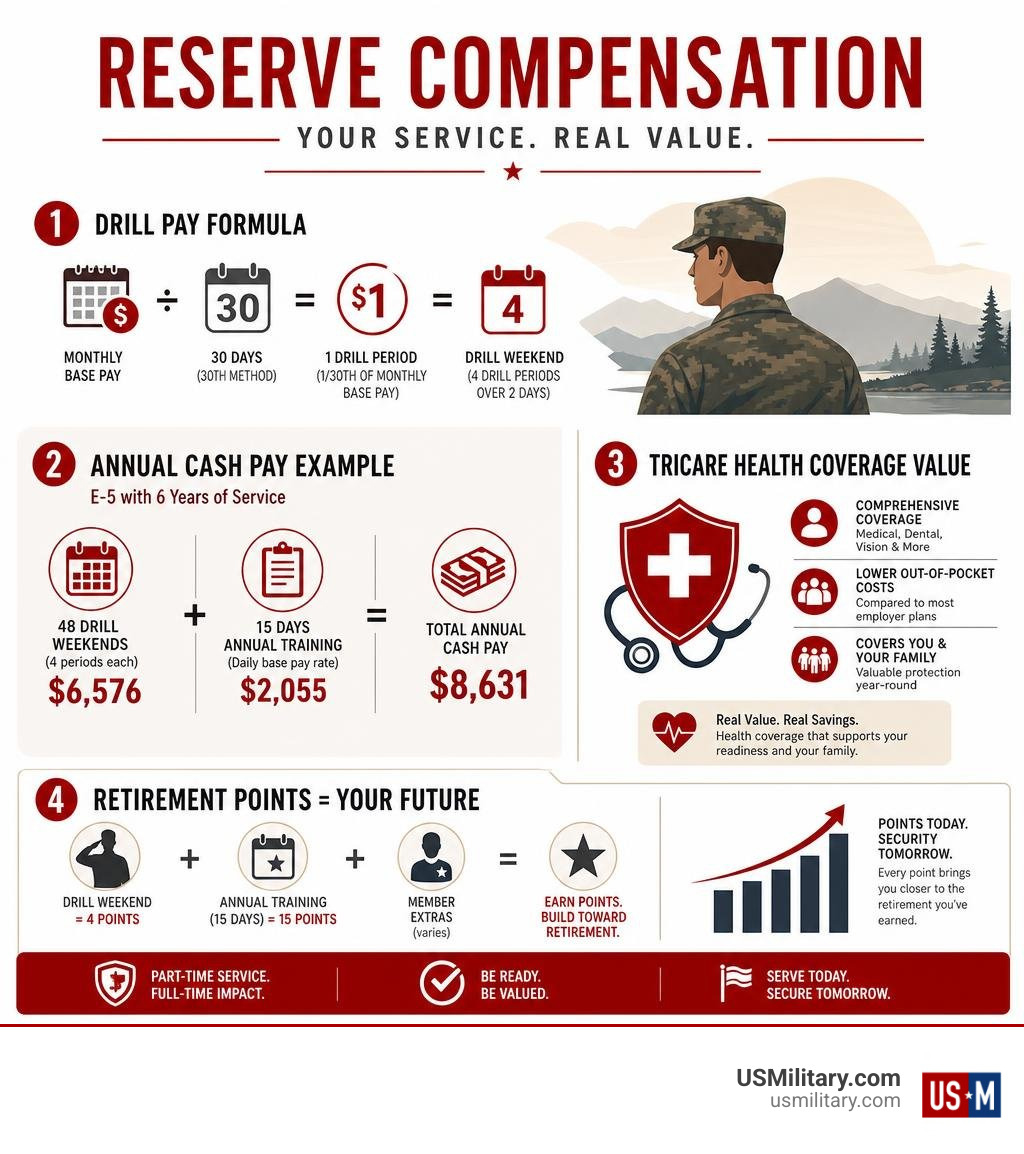
| Service Type | Pay Structure | Example (E-5, 6 yrs) |
|---|---|---|
| Drill Weekend (MUTA-4) | 4 drill periods | $548 |
| Annual Training (15 days) | Daily base pay rate | $2,055 |
| Total Annual Cash Pay | 48 drills + 15 AT days | $8,631 |
Key facts at a glance:
- One drill period = 1/30th of your monthly base pay
- A standard drill weekend = 4 periods across 2 days
- Standard commitment = 12 weekends + 2 weeks of Annual Training per year
- Pay is based on your rank and years of service — just like active duty
- Drill pay is fully taxable (federal, FICA, and Medicare)
Most people assume Guard and Reserve members earn a small stipend for their service. The reality is more nuanced. Beyond the base drill pay, members also access healthcare coverage, retirement points, and education benefits — each of which adds real dollar value to the total compensation picture.
Understanding the full value of what you earn as a part-time service member can make a significant difference in your financial planning and career decisions.
I’m Larry Fowler, publisher of USMilitary.com, and I’ve spent nearly two decades helping service members and veterans understand their military benefits — including Guard and reserve pay across every branch. In the guide below, I’ll break down exactly how drill pay is calculated, what the 2026 rates look like, and what your total compensation is actually worth.
Handy Guard and reserve pay terms:
- Military officer promotion timeline
- Need An Expert To Help With Increasing Your VA Disability Rating
- VA chronic pain management
Understanding Guard and reserve pay: How Drill Pay is Calculated
To understand how Guard and reserve pay works, we first have to throw out the idea of a standard civilian hourly wage. The military doesn’t pay you by the hour when you drill; instead, they pay you by the “drill period.”
A single drill period is legally defined as a minimum of four hours. When you attend a standard drill weekend, you are typically performing what the military calls a Multiple Unit Training Assembly (MUTA). Most standard drill weekends are MUTAs with four distinct drill periods (a MUTA-4) spread across two days: Saturday morning, Saturday afternoon, Sunday morning, and Sunday afternoon.

The magic formula for calculating your drill pay rests on the 1/30th rule. For every single drill period you complete, you receive 1/30th of the monthly active duty basic pay for your rank and years of service. Because a standard weekend has four drill periods, a traditional drilling reservist earns 4/30ths (or roughly 13.3%) of their active duty counterpart’s monthly base pay in just two days.
Let’s look at the math in action for an E-5 (Sergeant) with 6 years of service:
- Monthly Active Duty Base Pay: $4,110.00
- Daily Rate (1/30th): $137.00
- Single Drill Period Pay: $137.00
- Standard Weekend Pay (4 periods): $548.00
This identical calculation method is used across all branches of the reserve components. Whether you are looking at the Army Reserve vs Army National Guard or comparing the Air Force Reserve to the Navy Reserve, your base drill pay is pulled from the exact same federal pay tables. For those who want to look up their specific rates directly from the official source, you can review the Reserve Component Drill Pay 2026_Enlisted tables hosted by the Defense Finance and Accounting Service (DFAS).
2026 Drill Pay Rates and Annual Training Compensation
Military pay charts receive annual adjustments, and 2026 brought a welcome 3.8% pay raise across the board. This increase directly boosts both active duty basic pay and reserve drill pay.
While drill weekends keep your skills sharp throughout the year, the second major component of your annual service is Annual Training (AT). Typically lasting 15 days (often referred to as “two weeks in the summer”), AT pay is calculated differently than drill pay. Instead of the 1/30th formula per four-hour block, you receive full active duty basic pay and prorated active duty allowances for every day you are on active orders.
During AT, you may also become eligible for Basic Allowance for Housing (BAH) and Basic Allowance for Subsistence (BAS). However, keep in mind that BAH rules differ for short-term orders. For training periods under 30 days, you receive a prorated portion of BAH Type II (a non-locality housing allowance), rather than the full BAH with or without dependents based on your ZIP code.
To give you a clear picture of how these two pay types combine, we have compiled a comparison of estimated annual earnings using the DFAS Military Pay Tables for 2026:
| Rank & Years of Service | Standard Weekend (4 Drills) | Annual Drill Pay (48 Drills) | 15 Days of AT Pay (Base Only) | Total Annual Cash Pay |
|---|---|---|---|---|
| E-3 (Over 2 Yrs) | $387.84 | $4,654.08 | $1,454.40 | $6,108.48 |
| E-5 (Over 6 Yrs) | $548.00 | $6,576.00 | $2,055.00 | $8,631.00 |
| E-7 (Over 10 Yrs) | $716.40 | $8,596.80 | $2,686.50 | $11,283.30 |
| O-1 (Under 2 Yrs) | $510.60 | $6,127.20 | $1,914.75 | $8,041.95 |
| O-3 (Over 4 Yrs) | $916.32 | $10,995.84 | $3,436.20 | $14,432.04 |
Enlisted Guard and reserve pay Rates for 2026
For enlisted members, your Guard and reserve pay scales steadily as you climb the ranks and accumulate years of service. In your first year, an E-1 under 4 months of service starts with a monthly base pay of $2,225.58, which translates to $74.19 per drill period and $296.74 for a standard weekend.
As you progress, the financial return on your weekend time increases significantly. An E-4 with 4 years of service earns $487.80 per drill weekend, totaling $7,682.85 annually when combined with AT. For mid-career non-commissioned officers, an E-5 with 6 years of service brings home $548.00 per weekend and approximately $8,631.00 annually. Senior non-commissioned officers at the top of the pay scale, such as an E-9 with over 38 years of service, earn $1,430.56 per weekend.
You can view a complete breakdown of enlisted earnings across all ranks and service brackets by visiting our National Guard Pay Chart 2026 resource.
Officer Guard and reserve pay Rates for 2026
Commissioned officers and warrant officers carry significant operational and leadership responsibilities, and their pay rates reflect that reality. A newly commissioned O-1 with under two years of service earns $510.60 per drill weekend. However, many officers in the Guard and Reserve do not start at the bottom of the pay scale; they transition from the enlisted ranks.
If you have at least four years and one day of active duty service (or more than 1,460 retirement points as an enlisted member or warrant officer), you qualify for prior-enlisted officer pay rates (O-1E through O-3E). This distinction yields a massive pay bump. For example, a prior-enlisted O-1E with over 6 years of service earns significantly more than a standard O-1.
By the time an officer reaches O-3 (Captain) with over 4 years of service, they earn $916.32 per drill weekend and $14,432.04 annually between drill and AT. To calculate officer, warrant officer, or prior-enlisted rates for your specific rank, check out the 2026 Drill Pay Chart — Guard & Reserve Weekend Pay by Rank tool.
Beyond Cash: Healthcare, Retirement, and Education Benefits
Focusing solely on the cash in your drill check misses more than half of the actual value of your service. When evaluating Guard and reserve pay, we must look at the total compensation package, which includes premier healthcare coverage, a robust pension system, and educational assistance.
TRICARE Reserve Select and Healthcare Savings
For many traditional drilling members, the single greatest financial benefit of serving is access to TRICARE Reserve Select (TRS). TRS is a premium-based health plan available to qualified National Guard and Reserve members.
In 2026, the monthly premiums for TRS are incredibly low:
- Member-only coverage: $57.88 per month ($694.56 per year)
- Member and family coverage: $286.66 per month ($3,440.00 per year)
To put this in perspective, the average civilian employer-sponsored family health insurance plan costs families approximately $27,000 annually in premiums and contributions. By switching to TRICARE Reserve Select, a military family can easily save over $23,500 per year in premiums alone. When you add those healthcare savings back into your military compensation, the “effective” value of your weekend service sky-rockets. You can review the full coverage options and copays directly at the official TRICARE Reserve Select Costs page.
The Blended Retirement System (BRS) and TSP Matching
If you joined the military after January 1, 2018 (or opted in during the transition period), you are covered under the Blended Retirement System (BRS). The BRS combines a traditional defined-benefit pension with a defined-contribution plan via the Thrift Savings Plan (TSP).
Under the BRS, the government automatically contributes 1% of your basic pay to your TSP after 60 days of service. Once you have completed two years of service, the government will match your personal TSP contributions up to an additional 4%—giving you a total of 5% in matching contributions.
Crucial Tip: Government TSP matching for reserve component members only applies when you are earning basic pay during active duty periods (such as Annual Training, school orders, or active duty operational support) or standard drill weekends. Make sure you are contributing at least 5% of your military pay to capture every dollar of this matching benefit.
For the pension portion, reserve retirement is calculated using a point system rather than continuous years of active service. A standard, non-deployed drilling reservist typically accumulates 78 retirement points per year:
- 48 points from weekend drills (1 point per drill period)
- 15 points from Annual Training (1 point per day of active service)
- 15 points as a participation gratuity just for being an active member
To qualify for a pension, you must complete 20 “qualifying years” (years in which you earn at least 50 retirement points). Unlike active duty members who receive their pension immediately upon retirement, reserve component pensions typically begin at age 60. However, this age can be reduced by three months for every 90 days of qualifying active duty service performed in support of contingency operations. For a deep dive into how these points translate into a lifetime monthly check, read our A Complete Guide to Military Reserve Pension Rules handbook.
Transitioning from Active Duty to the Reserves
Transitioning from active duty to the National Guard or Reserves is one of the most common career paths for veterans. In fact, more than 1 in 4 active duty service members intend to join the reserves after separating. It is an excellent way to maintain your military career, keep your cheap healthcare, and continue building toward a retirement pension.
However, the drop in monthly military income can catch you off guard if you do not plan ahead.
When you transition, you lose your steady monthly active duty base pay, tax-free BAH, and tax-free BAS. An E-6 with 8 years of service on active duty might bring home upwards of $5,600 a month when factoring in allowances. In the reserves, that same E-6 will earn approximately $619 per drill weekend.
To bridge this financial gap, you must secure a civilian career that offsets the lost active duty income. When negotiating your civilian salary, you can use the military leadership, technical training, and security clearance you earned in the service to command a premium.
Before making the leap, we highly recommend using the Active Duty to Reserve Pay Transition Calculator – ToolcR to model your exact financial change. This will help you identify the minimum civilian salary you need to maintain your current lifestyle. Additionally, you should review the full suite of state and federal incentives listed in our National Guard Benefits overview.
Frequently Asked Questions About Guard and Reserve Pay
Is drill pay taxable?
Yes, drill pay is fully taxable. Unlike active duty service, which often includes tax-free allowances like BAH and BAS as a massive chunk of monthly take-home pay, standard weekend drill pay consists entirely of basic pay.
This means your entire drill check is subject to:
- Federal income tax
- Social Security tax (FICA)
- Medicare tax
- State income tax (depending on your state of residence)
The only time a reserve component member receives tax-free compensation is if they are deployed to a designated Combat Zone Tax Exclusion (CZTE) area, during which their active duty basic pay is excluded from federal income tax.
Do reservists get BAH and BAS?
No, reservists do not receive BAH or BAS during standard drill weekends.
You only receive these housing and food allowances when you are on active duty orders. For short-term orders under 30 days (such as your 15 days of Annual Training), you receive a prorated daily rate of BAS and BAH Type II (non-locality BAH). If you are ordered to active duty for 30 or more consecutive days (such as for a deployment or extended school), you will receive full active duty BAH (based on your home ZIP code) and full BAS.
Does reserve service count toward VA disability benefits?
Yes, absolutely. A common myth is that only active duty veterans qualify for VA disability compensation. National Guard and Reserve members can receive VA disability ratings and tax-free compensation for injuries or illnesses that were incurred or aggravated in the “line of duty.”
For traditional drilling members, this includes injuries sustained during weekend drill, Annual Training, or while traveling directly to and from your duty location. If you receive a VA disability rating, you must choose between receiving your daily VA compensation or your daily military drill pay for the days you serve, as federal law prohibits receiving both simultaneously. Most members choose to waive their VA pay for drill days because drill pay is typically higher.
To understand how this process works and how to protect your rights, read our guide on Does the National Guard Get VA Disability Benefits?.
Conclusion
At first glance, Guard and reserve pay might look like a modest part-time paycheck. But when you look closer, the numbers tell a completely different story.
When you combine your weekend drill checks and Annual Training pay with the massive premium savings of TRICARE Reserve Select, employer matching in the TSP, and the long-term value of a lifetime retirement pension, the total compensation package is incredibly competitive. It is a powerful financial engine that allows you to serve your country, build a civilian career, and secure your family’s future all at the same time.
We are dedicated to helping you navigate every stage of your military and post-military journey. Whether you are looking to buy a home with a 0%-down VA loan, seeking guidance on your disability rating, or comparing career paths across different branches, we have the resources you need.
Explore your VA benefits and military resources at USMilitary.com to make sure you are maximizing every single benefit you have earned.
Free for Service Members & Veterans
Get the military benefits intel no one tells you about.
Weekly updates on VA benefits, pay changes, and money tips — free for service members and veterans.
No spam. Unsubscribe anytime. Your info is never shared.