 The national guard pay chart shows how much you earn based on two things: your rank and your years of service. Here’s a quick snapshot of 2026 drill weekend pay (4 drill periods) for common ranks:
| Rank | Years of Service | Monthly Base Pay | Drill Weekend Pay |
|---|---|---|---|
| E-1 | Under 2 | $2,407.20 | $320.96 |
| E-5 | 6 years | $4,110.00 | $548.00 |
| E-6 | 10 years | $4,759.50 | $634.60 |
| O-3 | 4 years | $7,382.70 | $984.36 |
| E-9 | Any | $11,166.90 | ~$1,488.92 |

Understanding the National Guard Pay Chart Structure
When we look at a national guard pay chart, we aren’t just looking at a random list of numbers. The structure is actually quite logical once you know the “coordinates.” Think of it like a grid: one axis is your Rank (Pay Grade), and the other is your Years of Service. In the National Guard, your compensation is tied directly to these two factors. Whether you are in the Army National Guard or the Air National Guard, the base pay rates are standardized across the Department of Defense. This means an E-5 in the Guard makes the same base drill pay as an E-5 in the Reserves or an E-5 on active duty (pro-rated for time served). To get the most accurate, up-to-the-minute data, we always recommend checking the Military Pay Tables & Information provided by the Defense Finance and Accounting Service (DFAS). If you are just starting your journey and haven’t donned the uniform yet, you might want to check out joining the National Guard: 10 questions for your recruiter to understand how your initial rank will be determined.How to Read the Enlisted National Guard Pay Chart
The enlisted side of the house ranges from E-1 (Private or Airman Basic) to E-9 (Sergeant Major or Chief Master Sergeant). When you look at the national guard pay chart, you’ll notice that pay increases horizontally as you hit “time-in-service” milestones. Common milestones occur at 2, 3, 4, 6, and 8 years, continuing up to 40 years for senior leaders. For example, an E-4 with four years of service earns significantly more than an E-4 with less than two years. This rewards experience and retention. If you’re curious about where these ranks can take you, you can explore National Guard careers to see which path fits your skills.Finding the Official National Guard Pay Chart Sources
While many websites post pay tables, we always suggest going to the source. The official Money & Pay Charts – US Army page and the DFAS website are the gold standards. Once you are in the Guard, you will use a system called myPay to view your Leave and Earnings Statement (LES). Your pay typically falls under Title 32, which refers to state control with federal funding. This is different from Title 10 (Active Duty), though the pay rates themselves are mirrored from the same federal tables.How to Calculate Your Drill Weekend Earnings
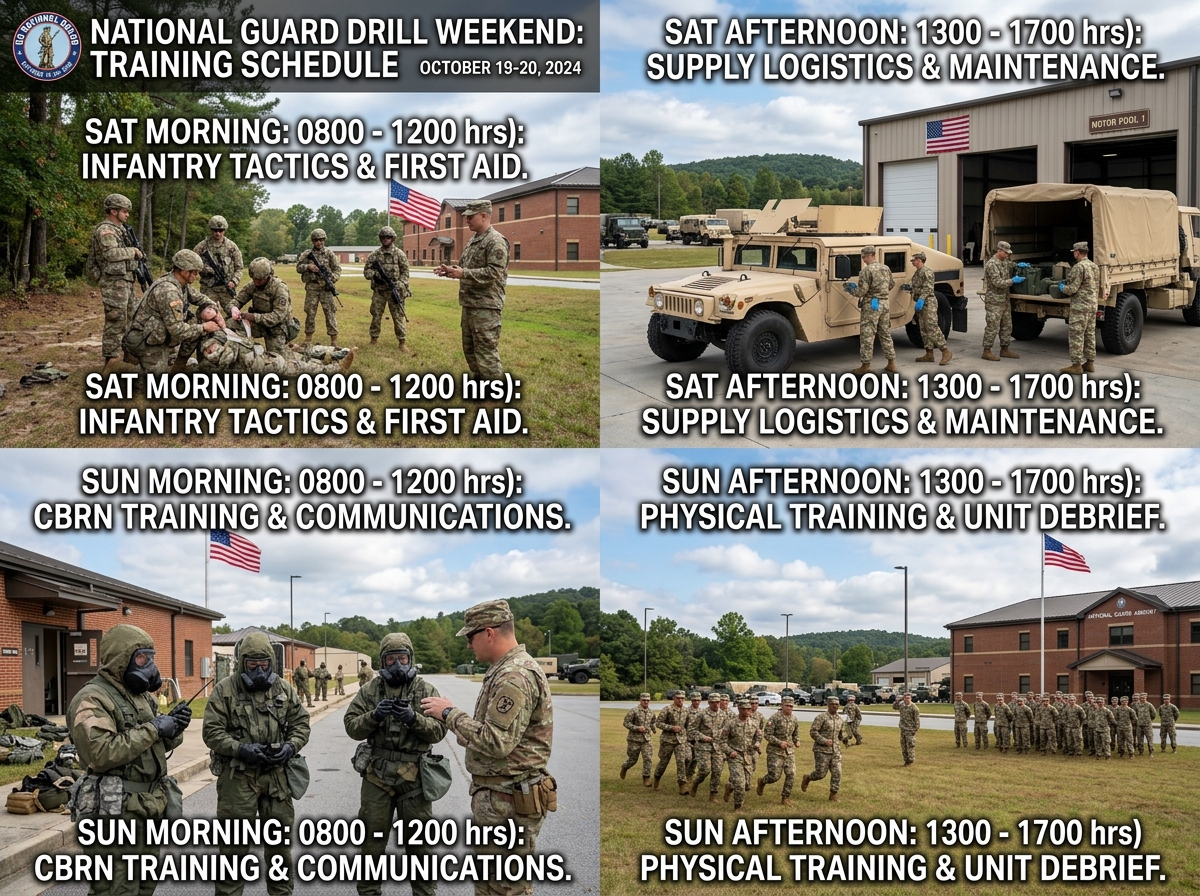 One of the most common questions we hear is: “How much will I actually take home for a weekend?” To answer that, we use the 1/30th Rule.
In the eyes of the military, a “month” is always 30 days. Therefore, one day of active duty pay is 1/30th of the monthly base pay. However, a National Guard “drill period” is defined as a four-hour block of training. A standard “drill weekend” usually consists of four of these periods:
- Saturday Morning (Period 1)
- Saturday Afternoon (Period 2)
- Sunday Morning (Period 3)
- Sunday Afternoon (Period 4)
Annual Training and Drill Income Estimates
Beyond the monthly weekends, you also have Annual Training (AT), which is typically 15 days of continuous service. During AT, you are paid the daily active duty rate for each of those 15 days. When we combine 48 drill periods (12 weekends) and 15 days of AT, we can estimate a healthy annual “part-time” salary. Here is how those numbers look for 2026 based on common ranks:| Rank | Years of Service | Est. Annual Drill + AT Income |
|---|---|---|
| E-4 | 4 Years | $7,682.85 |
| E-6 | 10 Years | $9,994.95 |
| O-3 | 4 Years | $15,503.67 |
The 2025 and 2026 National Guard Pay Chart Raises
Military pay isn’t static. Every year, Congress typically authorizes a pay raise to keep up with the cost of living and private-sector wage growth. This is determined by the Employment Cost Index (ECI) and finalized in the National Defense Authorization Act (NDAA). For 2025, Guard members saw a 4.5% increase across the board. Looking ahead to 2026, the national guard pay chart is projected to include a 3.8% increase, effective January 1, 2026. This means if you are looking at the army pay chart 2026 or the military pay chart 2026-2, you are seeing the results of these annual adjustments designed to maintain your purchasing power.Effective Dates and Paycheck Impact
These raises almost always take effect on January 1st of the new year. However, because of how drill pay is processed, you might not see the higher amount in your bank account until your first drill weekend in January is processed—usually mid-to-late January. It is interesting to look back at the 2017 military pay chart to see how far compensation has come. Over the last decade, consistent annual raises have significantly boosted the “weekend warrior” paycheck.Beyond Basic Pay: Allowances and Incentives
While the national guard pay chart focuses on basic pay, it’s not the only way you get paid. When you are on active duty for more than 30 days (such as for Initial Entry Training or a deployment), you become eligible for several allowances that are often non-taxable.- BAH (Basic Allowance for Housing): This is designed to cover your rent or mortgage. The amount depends on your rank, your zip code, and whether you have dependents.
- BAS (Basic Allowance for Subsistence): This is a monthly allowance for food.
- Special Duty Pay: If you have a high-demand job or are in a “hot” MOS, you might receive extra monthly pay.
- Hazardous Duty Incentive Pay (HDIP): For those in jump status, flight status, or other dangerous roles.
Tax Implications and Deductions
It’s important to remember that drill pay is taxable. Just like a civilian job, Uncle Sam takes his cut. Your drill pay is subject to:- Federal Income Tax
- FICA (Social Security and Medicare)
- State Income Tax (depending on your state)
National Guard vs. Active Duty Pay
The biggest difference between Guard pay and active duty pay is the time commitment. Active duty soldiers are paid a full monthly salary for a 24/7 commitment. Guard members are paid a prorated amount of that same salary for their part-time service. However, there is a “hidden” benefit to Guard pay: Retirement Points. For every drill period you perform, you earn one retirement point. When you reach 20 qualifying years of service, these points are used to calculate your “non-regular” retirement pay, which you typically begin receiving at age 60. Being in the Guard also allows for unique roles like Dual-Status Technicians, who work as federal civilians during the week but wear the uniform and follow the national guard pay chart on the weekends. To understand more about the “dual nature” of this service, you can read what is the National Guard and discover 5 reasons the National Guard is good for you.VA Home Loan
Your Service Earns a $0-Down Home Loan Benefit
Eligible service members and veterans can buy a home with no down payment and no PMI. Check your VA loan eligibility in a few minutes.
USMilitary.com may be compensated when you request quotes from lenders through this link.
Frequently Asked Questions about National Guard Pay
Are Army National Guard and Air National Guard pay charts different?
No. Whether you are wearing OCPs in the Army Guard or the Air Guard, the basic pay and drill pay rates are identical. They are both based on the same federal pay grades (E-1 through O-10) and years of service.How often do National Guard members get paid?
Unlike active duty, which is paid on the 1st and 15th, traditional Guard members are paid after their drill weekend is processed by their unit’s administrative staff. Usually, you can expect to see your drill pay in your bank account within 7 to 10 days after the Sunday of your drill weekend.Do National Guard members get BAH during drill?
Generally, no. You do not receive BAH for a standard two-day drill weekend. However, if you are on active duty orders (like Annual Training) for less than 30 days, you may receive a smaller, prorated version called BAH Type II. If you are on orders for 30 days or more, you receive the full BAH rate for your rank and location.Conclusion
Navigating the national guard pay chart doesn’t have to feel like decoding a secret message. By understanding the 1/30th rule and knowing how rank and years of service interact, you can take control of your financial planning. Whether you’re using this income to pay for college, supplement your civilian career, or build a retirement nest egg, the National Guard offers a stable and transparent compensation system. At USMilitary.com, we are committed to providing you with the resources you need to succeed in your military career. From understanding your paycheck to planning for your future, we’re here to help. View the full 2026 Military Pay Chart


Hi, My name is april thomas and I’m ready to prove to myself that I CAN handled the responsibility of raising my two daughters. My family is all military. I posponed my desires to serve when i got pregnat with my first daughter in 2008, Now that I have my second daughter, I am at a burden finacially supporting them both. I want to finally prove myself honorable; to my family and my country. My family has always served. The army has raised me. Now I want it to help raise my own family.
If im just joining what would be pay for the one weekend a month. Can somebody explain what i would be getting myself into pay wise and training
ok is this for the people that only do a weekend a month is that still how much you get a month or is it different if you arejust part time
My son is in the Wisconsin National Guard and his drill base is Mauston, WI. He is a E3 and he received orders for 3 months to preform duties at the Eau Claire, WI National Guard Recruiters office there. He travels all over the State of Wisconsin. He donen’t have a place to stay in Eau Claire so he travels about a hour and half to get there for duty from his home in the Lacrosse, WI area.. Sometimes he stays overnight at the Armory there. The other day he traveled to Superior, WI with a Naional Guard Truck to deliver some stuff by 1900 Hours and returned to Eau Claire to get some sleep and returned to Superior the next morning to help with the climing wall for High School Students this last Memorial Day weekend. He is afraid to ask Questions about his travel, Per-Diem, Travel stuff and his pay while he is working full time as a Nathional Guard under his travel Orders. He has not received any advance pay and he broke. What can He do? Is he entiled to Per-Diem and Meals? What about his traveling to Eau Claire every day for an 1 1/2 hours to get there. he just a E-3 with 2 years in the Service. Thank You, Grandpa John Hammes E-6 Retired Air Force, My Phone is 608-385-6033