Your Roadmap to Becoming a Navy SEAL
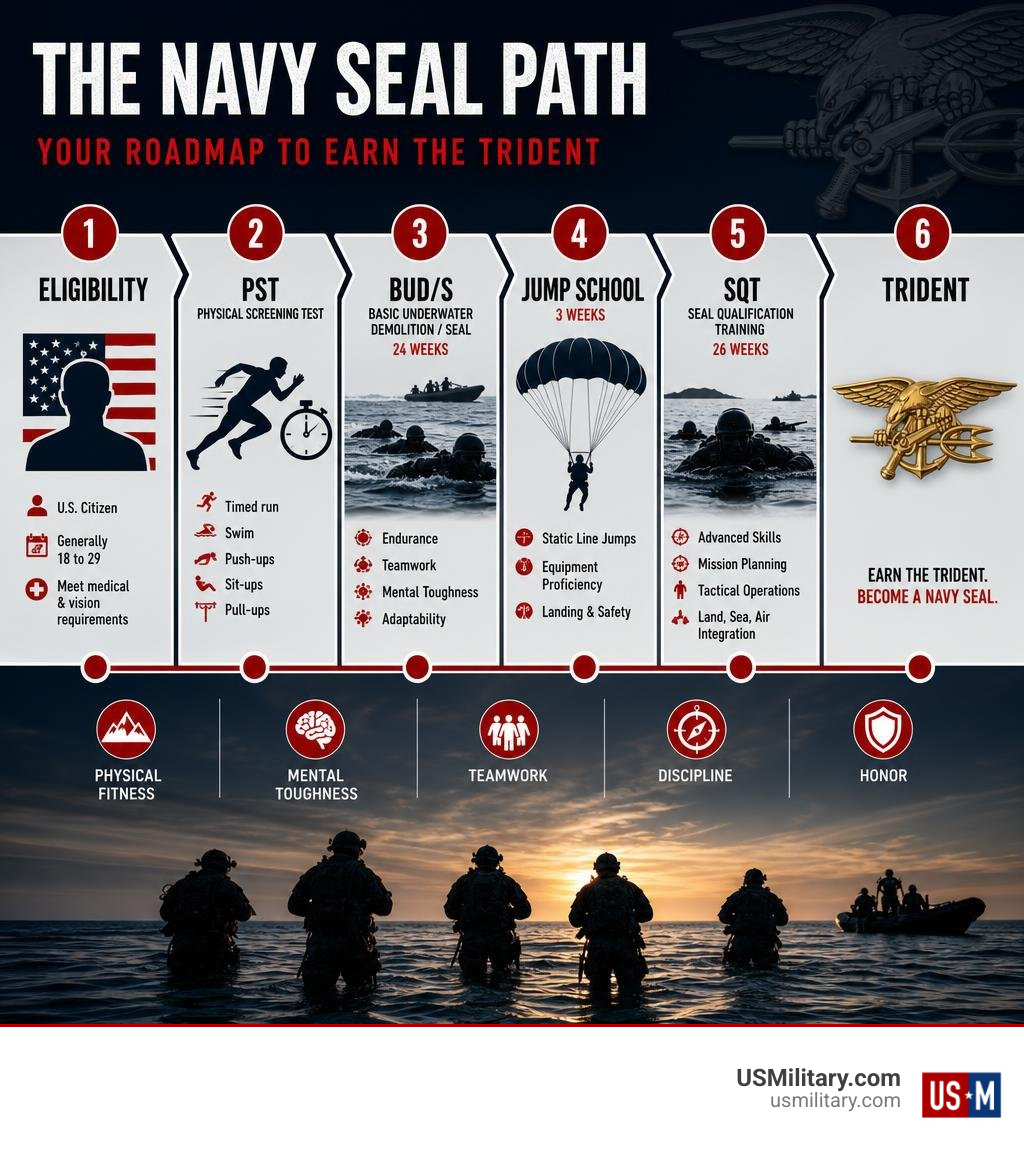
To become a Navy SEAL, you must qualify to enlist, earn a competitive score on the Physical Screening Test (PST), and complete a demanding training pipeline that lasts well over a year. That path includes Navy boot camp, Naval Special Warfare Prep, 24 weeks of BUD/S, jump school, and SEAL Qualification Training before you earn the Trident.
Navy SEALs: Training, Pay & How to Become One starts with more than meeting minimum standards. Candidates need U.S. citizenship, must generally be 18 to 29, meet medical and vision rules, and score well above the PST minimums to be competitive. The reward is a career in one of the Navy’s smallest and most demanding communities, with base military pay plus qualifying special-duty pays and allowances.
The reality is hard: roughly 68% to 75% of candidates do not complete BUD/S, and only about 9.5% of people who enter the broader pipeline reach the finish line. This guide explains the requirements, training phases, likely pay, officer and enlisted routes, and what it takes to prepare intelligently.
I am LARRY FOWLER, publisher of the USMilitary.com Network since 2007, where I have helped active-duty members, veterans, and prospective recruits understand military careers and benefits. In this guide to Navy SEALs: Training, Pay & How to Become One, I will help you separate the official requirements from the myths and map out the next steps.
Navy SEALs: Training, Pay & How to Become One terms you need:
- Navy SEALs BUD/S Training Requirements
- How Much Do Navy SEALs Make Per Year
- What is Navy SEAL Training 3 Phases And Why is it so tough
Eligibility Standards and Enlistment Screening
The journey into Naval Special Warfare requires meeting stringent baseline standards before setting foot on a grinder or diving into a pool. For those looking at Beyond the Basics: Unpacking Navy SEAL Requirements and Selection, the foundation begins with age, citizenship, and education. Prospective candidates must be U.S. citizens between the ages of 18 and 29. Applicants must possess a high school diploma or equivalent educational credential and maintain a clean legal record to qualify for a Secret security clearance.
Academic and cognitive qualification hinges on the Armed Services Vocational Aptitude Battery (ASVAB). To qualify for a Special Operator (SO) rating, an applicant must achieve a composite score meeting specific line-score formulas:
- Formula 1: General Science (GS) + Mechanical Comprehension (MC) + Electronics Information (EI) $\ge$ 170
- Formula 2: Verbal Expression (VE) + Math Knowledge (MK) + Mechanical Comprehension (MC) + Coding Speed (CS) $\ge$ 220 (with VE + Auto and Shop Information [AS] $\ge$ 110 and MC $\ge$ 50)
Medical screening is uncompromising. Uncorrected vision must be no worse than 20/70 in the worst eye, correctable to 20/25 in both eyes, and candidates must possess normal color vision. Any history of severe musculoskeletal injuries, chronic cardiovascular conditions, or disqualifying medical concerns will halt the enlistment process before it starts.
Navy SEAL Physical Screening Test (PST) Standards
Entering the Delayed Entry Program (DEP) with a SEAL Challenge Contract requires passing the official Physical Screening Test (PST). The test is administered in a strict, single-session sequence with mandatory rest intervals between events. While the Navy publishes bare-minimum passing standards, achieving only the minimums will virtually guarantee a recruit never secures an SO contract.
The table below breaks down the minimum official cutoffs versus the competitive scores necessary to earn a contract during the nationwide draft:
| PST Event | Mandatory Minimum | Competitive Standard | Rest Interval |
|---|---|---|---|
| 500-Yard Swim (Breaststroke / Combat Side Stroke) | 12:30 minutes | Under 9:00 minutes | 10 Minutes |
| Push-ups (2 Minutes) | 50 reps | 80 – 100+ reps | 2 Minutes |
| Sit-ups (2 Minutes) | 50 reps | 80 – 100+ reps | 2 Minutes |
| Pull-ups (No Time Limit, Dead Hang) | 10 reps | 15 – 20+ reps | 2 Minutes |
| 1.5-Mile Timed Run (Boots and Trousers/Shoes) | 10:30 minutes | Under 9:30 minutes | Complete |
In addition to physical metrics, prospective sailors undergo the Computerized Special Operations Resiliency Test (C-SORT), an assessment engineered to evaluate personality traits, stress tolerance, and performance capabilities under extreme pressure.
Enlisted Special Operator vs. SEAL Officer Pathways
Candidates can pursue Naval Special Warfare through two distinct avenues: enlisting as a Special Operator (SO) or earning a commission as a Special Warfare Officer (1130 designator).
Enlisted operators serve as the tactical backbone of the SEAL platoons, focusing heavily on weapons handling, point-man responsibilities, communications, medical support, and demolitions. They begin their careers by securing a challenge contract through Navy recruiters and advancing directly into boot camp.
Officers shoulder administrative, strategic, and tactical command responsibilities. Prospective officers can commission via the United States Naval Academy (USNA), Navy ROTC units, or Officer Candidate School (OCS) for civilian college graduates. Lateral transfers from other naval communities are also considered. All aspiring leaders must submit extensive application packages and earn an invitation to the SEAL Officer Assessment and Selection (SOAS) course held during the summer in Coronado, California. For explicit timelines, refer to the official SEAL Officer Selection guidelines.
Navy SEALs: Training, Pay & How to Become One Pipeline Overview
The pipeline from civilian life to the operational teams is a multi-stage crucible designed to test physical durability, aquatic competence, and mental resilience.
Every enlisted candidate begins their journey at Recruit Training Command (RTC) in Great Lakes, Illinois. After completing standard eight-week boot camp, sailors transition directly into preparatory conditioning before heading west to the Naval Special Warfare Center at Naval Amphibious Base Coronado. To explore more about entry roles, review U.S. Navy SEAL Careers.
Step-by-Step Roadmap: Navy SEALs: Training, Pay & How to Become One
The path to earning the coveted Special Warfare insignia (the Trident) follows a structured sequence:
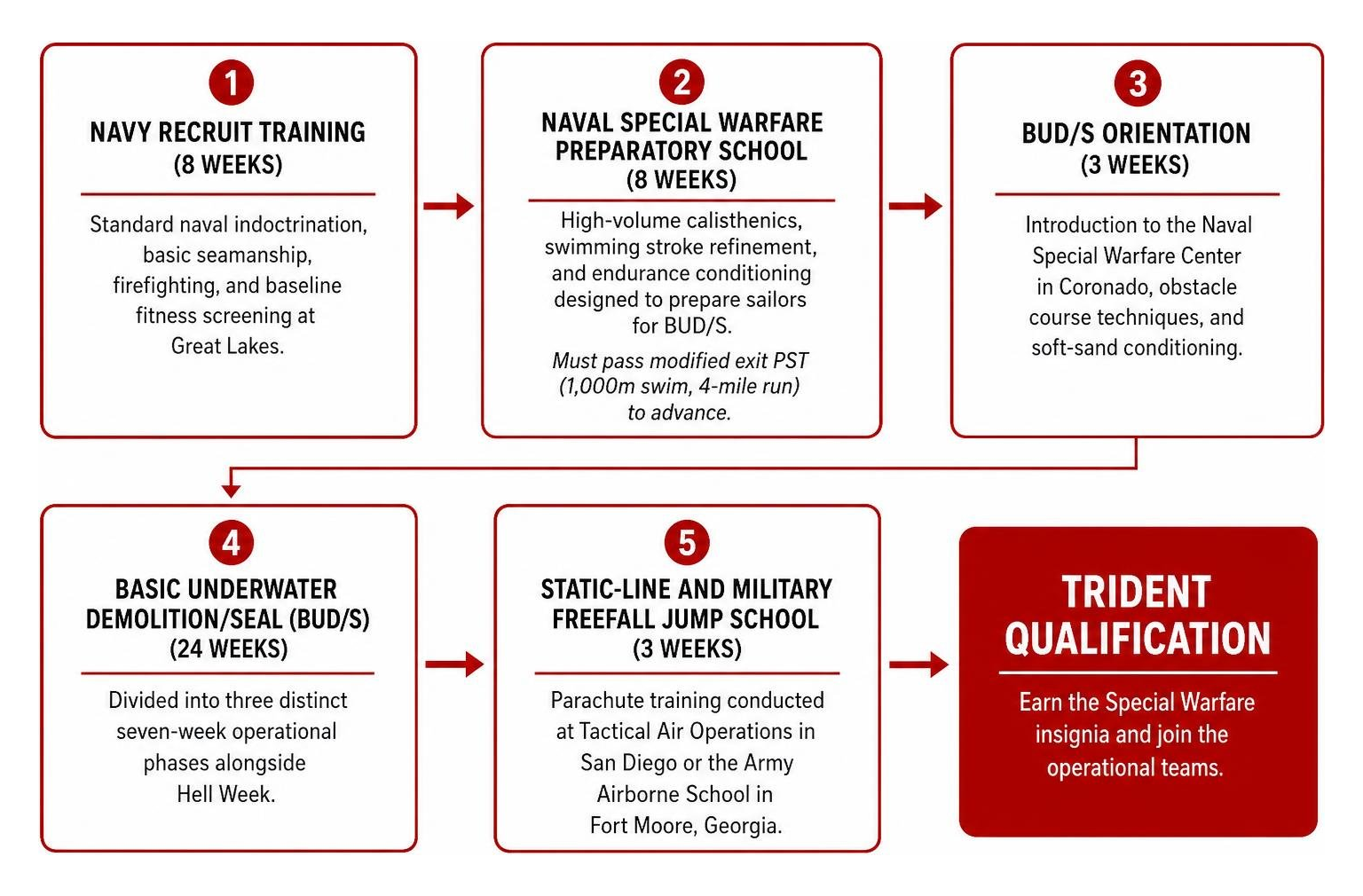
- Navy Recruit Training (8 Weeks): Standard naval indoctrination, basic seamanship, firefighting, and baseline fitness screening at Great Lakes.
- Naval Special Warfare Preparatory School (8 Weeks): High-volume calisthenics, swimming stroke refinement, and endurance conditioning designed to prepare sailors for BUD/S. Candidates must pass a modified exit PST (1,000m swim, 4-mile run) to advance.
- BUD/S Orientation (3 Weeks): Introduction to the Naval Special Warfare Center in Coronado, obstacle course techniques, and soft-sand conditioning.
- Basic Underwater Demolition/SEAL (BUD/S) (24 Weeks): Divided into three distinct seven-week operational phases alongside Hell Week.
- Static-Line and Military Freefall Jump School (3 Weeks): Parachute training conducted at Tactical Air Operations in San Diego or the Army Airborne School in Fort Moore, Georgia.
- SEAL Qualification Training (SQT) (26 Weeks): Advanced tactical instruction covering weapons marksmanship, close-quarters combat (CQC), maritime operations, cold-weather survival, and SERE school.
For an extensive look at initial entry phases, read our detailed Navy SEALs BUDs Training Requirements Guide.
Attrition Rates and Why Candidates Drop Out
The attrition rate across the SEAL pipeline sits between 68% and 75% for BUD/S alone, with overall completion from initial contract signing to Trident qualification hovering at roughly 9.5%. At any given time, there are approximately 2,500 active-duty SEAL operators serving across all teams.
Dropouts occur for several primary reasons:
- Drop on Request (DOR): A candidate voluntarily quits by ringing a polished brass bell three times in the BUD/S courtyard and leaving their green helmet liner on the grinder.
- Medical Rollbacks and Drops: Stress fractures, acute soft-tissue injuries, ruptured eardrums, or immersion pulmonary edema (SIPE) often force instructors to roll candidates back to subsequent classes or medically discharge them from the pipeline.
- Academic and Tactical Performance Drops: Failing timed 4-mile soft-sand runs, pool competency evolutions, or land-navigation courses.
- Mental and Environmental Exhaustion: Relentless exposure to cold water, heavy surf, and sleep deprivation breaks candidates who lack deep internal resolve. Instructors utilize the “Four Pillars of Resilience”—goal setting, mental rehearsal, positive self-talk, and arousal control (box breathing)—to teach students how to withstand these psychological pressures.
The Three Phases of BUD/S and Post-BUD/S Crucible
BUD/S is headquartered at Naval Amphibious Base Coronado, sandwiched between the Pacific Ocean and San Diego Bay. To understand why this course remains renowned worldwide, see The Ultimate Guide to Navy SEAL Training: 3 Phases and Why Is It So Tough.
Phase Breakdown: Conditioning, Combat Diving, and Land Warfare
BUD/S is organized into three 7-week blocks following the initial 3-week orientation:
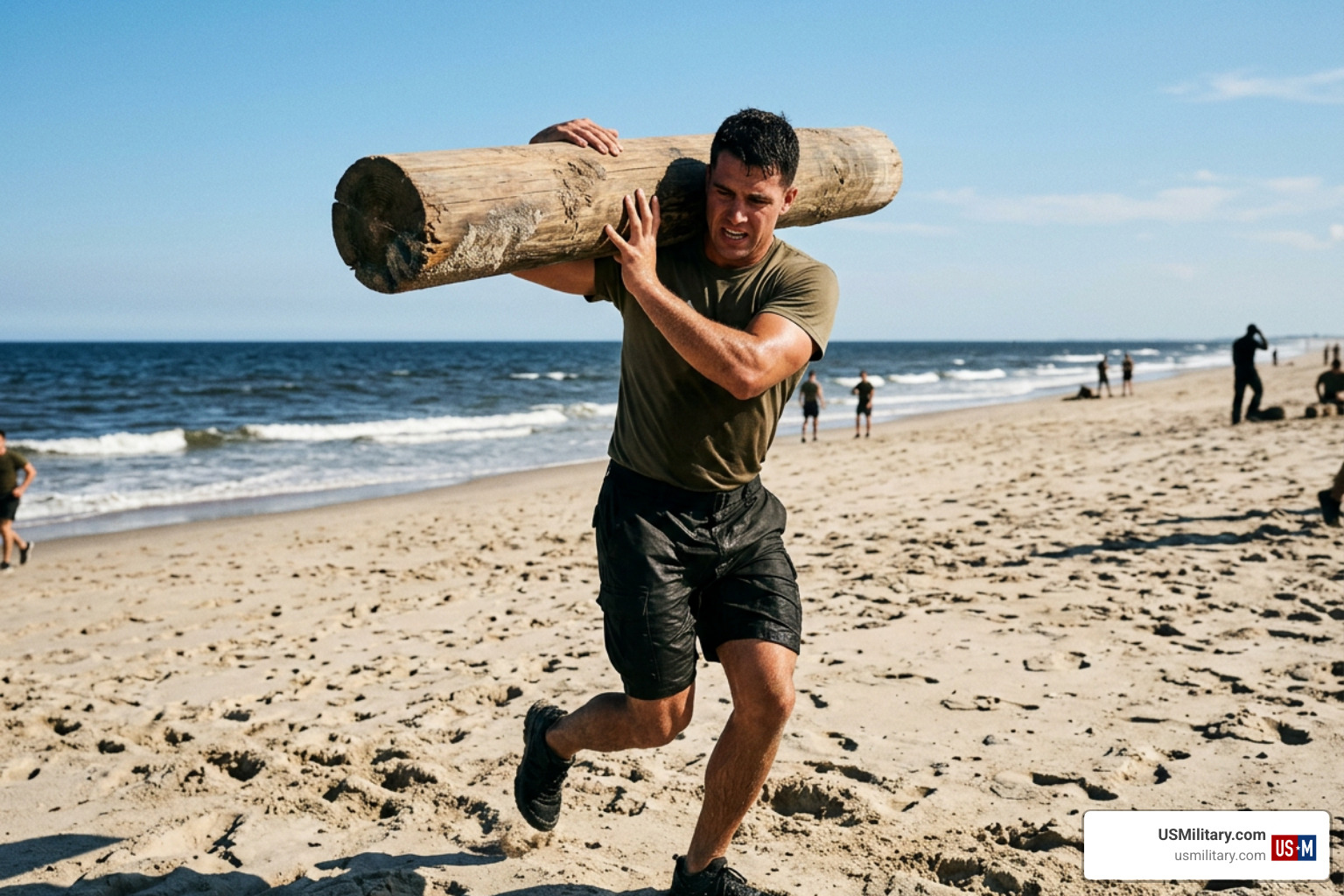
- First Phase (Physical Conditioning – 7 Weeks): Focuses on physical stamina, log physical training (Log PT) using 200-pound telephone poles, ocean swims up to two miles, endless calisthenics on the grinder, and timed runs on soft sand. It tests teamwork and mental grit above all else.
- Second Phase (Combat Diving – 7 Weeks): Concentrates on underwater skills using open-circuit SCUBA and closed-circuit rebreathers (Dräger LAR V). Students learn underwater compass navigation and must pass “pool competency,” where instructors simulate catastrophic gear malfunctions underwater while students remain calm and resolve equipment issues.
- Third Phase (Land Warfare – 7 Weeks): Conducted on San Clemente Island. Instruction covers tactical weapons handling, basic demolitions, field reconnaissance, patrolling, small-unit tactics, and rapid room-clearing drills.
Hell Week: The Ultimate Test of Mental Fortitude
Hell Week takes place during the fourth week of First Phase. Running from Sunday evening through Friday afternoon, candidates endure 5.5 consecutive days of continuous operational training, covering over 200 miles while receiving less than four hours of total sleep.
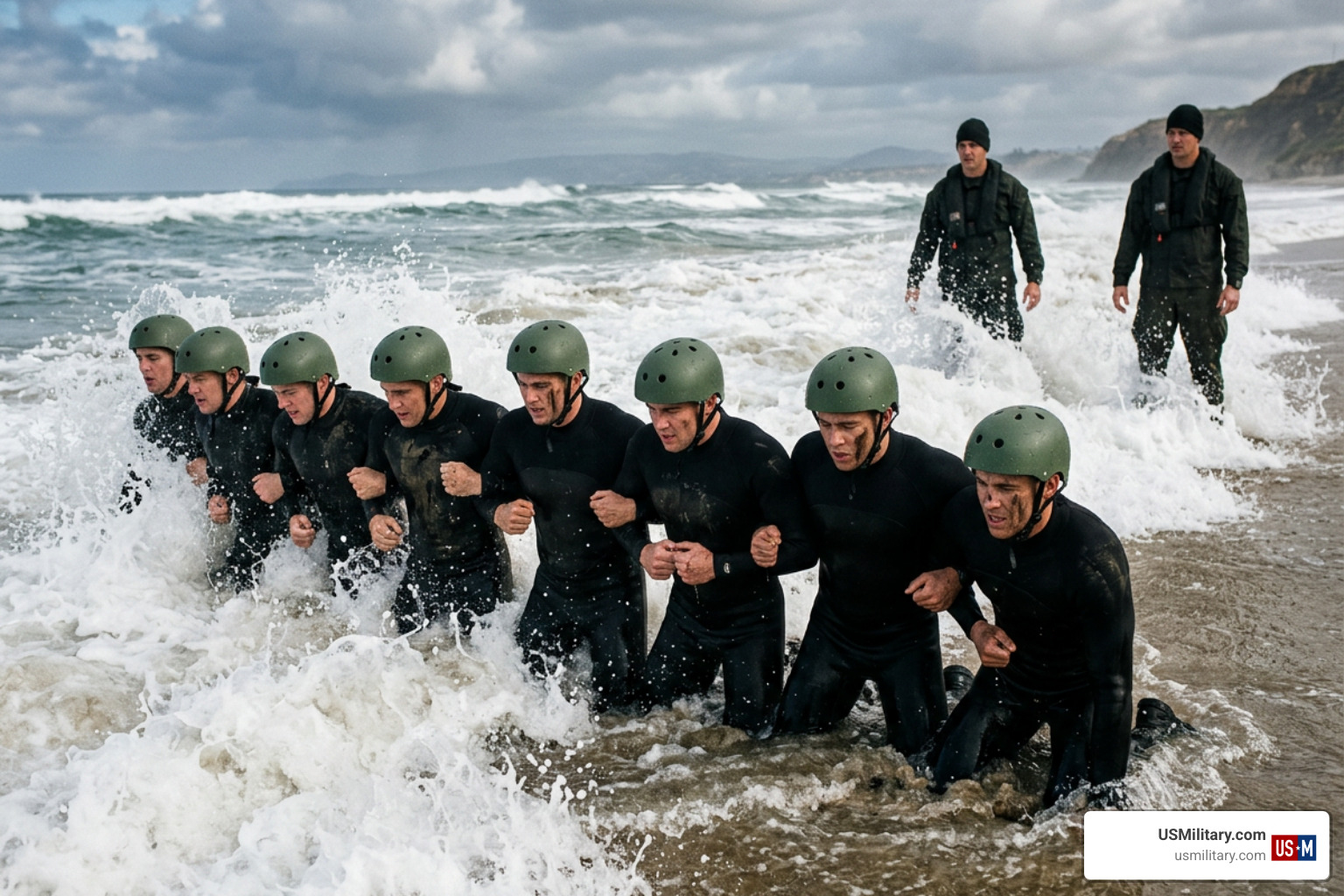
Candidates face constant immersion in Pacific surf, paddle inflatable small boats (IBS) through breaking waves, and crawl through muddy mud flats under heavy physical loads. Hell Week eliminates more than 75% of the starting class, weeding out anyone who cannot place mission and team needs ahead of personal comfort.
Post-BUD/S Qualification: Jump School, SQT, and Earning the Trident
Graduating BUD/S is not the final hurdle. Graduates immediately transition into specialized training:
- Basic Parachute Training: Three weeks mastering static-line jumps and advanced high-altitude military freefall (HALO/HAHO) techniques.
- Survival, Evasion, Resistance, and Escape (SERE): Training designed to prepare operators for evasion behind enemy lines and survival under prisoner-of-war conditions.
- SEAL Qualification Training (SQT): A 26-week curriculum refining advanced combat shooting, dynamic room entry, combat trauma medicine (TCCC), and tactical communications.
Upon successful graduation from SQT, operators are awarded the Special Warfare Breast Insignia—the Navy SEAL Trident—and are designated with the Special Operator (SO) rating before reporting to their assigned operational SEAL Team.
Compensation, Allowances, and Career Progression
Navy SEAL compensation consists of standard military basic pay combined with tax-free allowances and hazardous-duty incentive pays.
Active-duty pay grades reflect time in service and rank. For an in-depth breakdown of current compensation packages, visit our guide on What is the Salary for an Enlisted Navy SEAL in 2026?.
An active-duty SEAL’s annual base pay generally ranges from $60,000 to $100,000, depending on their rank and time in service. In addition to basic pay, operators receive:
- Basic Allowance for Housing (BAH): A tax-free monthly stipend tailored to duty location, rank, and dependency status.
- Basic Allowance for Subsistence (BAS): A standard monthly tax-free allowance for meals.
Special Duty Incentive Pays and Bonuses
Because SEAL operations involve high operational risks, qualified operators receive substantial monthly incentive pays:
- Dive Pay: $375 per month for open- and closed-circuit diving operations.
- HALO (Jump) Pay: $225 per month for high-altitude parachute jump operations.
- Special Delivery Vehicle (SDV) Team Pay: Up to $300 per month for dry- or wet-submersible operations.
- Special Duty Assignment Pay (SDAP): $110 or more per month depending on operator level.
- Foreign Language Proficiency Bonus: Up to $1,000 per month for fluency in critical operational languages.
- Enlistment and Reenlistment Retention Bonuses: Qualified operators are often eligible for significant retention incentives throughout their careers.
Financial Rewards and Career Growth for Navy SEALs: Training, Pay & How to Become One
Once assigned to an active SEAL Team, operators enter an operational deployment cycle consisting of maintenance, unit-level training, integrated joint exercises, and forward deployment. To see how these schedules unfold daily, read The Definitive Guide to a Day in the Life of a Navy SEAL Operator.
Career progression offers specialized certifications:
- Specialty Schools: Sniper school, joint terminal attack controller (JTAC), master breacher, lead combat medic, or technical surveillance.
- Tier-One Selection: Senior operators may screen for the Naval Special Warfare Development Group (DEVGRU / SEAL Team Six) via its selection course (Green Team).
- Civilian and Veteran Transitions: Post-service career options include private defense consulting, federal law enforcement, corporate security, and executive leadership.
Frequently Asked Questions About Becoming a Navy SEAL
What is the overall attrition rate for Navy SEAL training?
The overall attrition rate for the entire pipeline is roughly 90.5%, meaning only about 9.5% of all candidates who sign an initial enlistment contract earn the Trident. BUD/S itself experiences an attrition rate between 68% and 75%, with the vast majority of candidates dropping out during Phase 1 conditioning and Hell Week.
Can women become Navy SEALs, and what are the current standards?
Yes. Since December 2015, all military combat positions, including Naval Special Warfare, have been open to female applicants. Standards are entirely gender-neutral; every candidate must meet identical ASVAB, PST, BUD/S, and SQT performance thresholds.
While female candidates have entered the SEAL selection process, none have completed the full pipeline. On July 15, 2021, the first woman successfully completed the Naval Special Warfare pipeline to earn qualification as a Special Warfare Combatant-craft Crewman (SWCC).
What is the maximum age limit to volunteer for SEAL training?
The standard age window for enlisted candidates is 18 to 29 years old. Seventeen-year-olds may enlist with parental consent. Age waivers are evaluated on a case-by-case basis for highly qualified candidates up to age 30, and prior-service members or officer candidates can occasionally receive waivers extending eligibility further based on community needs.
Conclusion
Becoming a Navy SEAL demands relentless physical conditioning, mental discipline, and an unwavering commitment to the teammate standing beside you. The training pipeline is intentionally engineered to push individuals past their perceived physical and mental limits to ensure that only the most dedicated operators earn the right to wear the Trident.
If you are prepared to pursue this elite career path, begin by establishing a disciplined physical training regimen, studying the academic requirements, and contacting a Navy special warfare recruiter. Explore our full Navy SEALs Complete Guide to learn more about the history, missions, and preparation needed to serve in Naval Special Warfare.
Free for Service Members & Veterans
Get the military benefits intel no one tells you about.
Weekly updates on VA benefits, pay changes, and money tips — free for service members and veterans.
No spam. Unsubscribe anytime. Your info is never shared.


