What Happens If You Don’t Register for Selective Service (And Why It Matters More Than You Think)
What happens if you don t register for selective service can affect the rest of your life — not just in theory, but in very real, practical ways.
Here’s a quick summary:
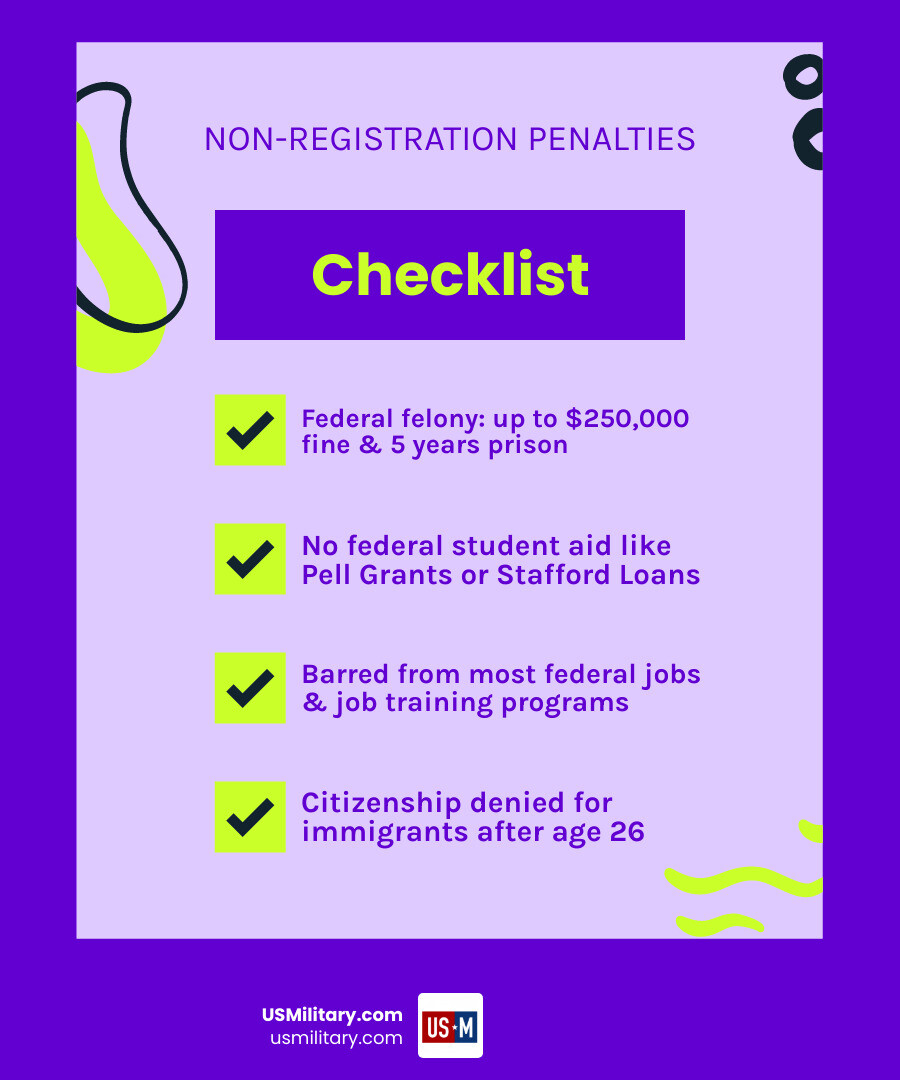
| Consequence | Details |
|---|---|
| Federal crime | Felony charge, up to $250,000 fine, up to 5 years in prison |
| No federal student aid | Ineligible for Pell Grants, Stafford Loans, and FAFSA-based aid |
| No federal jobs | Barred from most federal agency employment |
| No job training | Locked out of Workforce Innovation and Opportunity Act programs |
| Citizenship denied | Immigrants can be denied naturalization |
| Permanent after 26 | Once you turn 26, you can never register — consequences become lifelong |
Most men register and never think about it again. But for those who miss the window — sometimes through no fault of their own — the consequences can quietly close doors for decades.
Take this real example: a man who spent his late teens in prison missed his registration window. Years later, at 39, he couldn’t get student loans to attend business school. He had built a landscaping company from scratch, but the system had no path forward for him.
That’s what makes this topic so important to understand before it’s too late.
I’m Larry Fowler, publisher of the USMilitary.com Network since 2007, and I’ve spent years helping active military, veterans, and civilians navigate exactly these kinds of complex military and government benefit issues — including what happens if you don t register for selective service. In this guide, I’ll walk you through every consequence, every exception, and every step you can take if you’ve already missed the deadline.
Handy what happens if you don t register for selective service terms:
- Does the US currently have a military draft
- Who gets pulled first in a draft?
- What disqualifies you from the military draft
Understanding the Selective Service Registration Requirement
The Selective Service System is a civilian agency of the U.S. government. Its primary mission is to maintain a list of names of men who would be available for military service if the President and Congress ever decided to reinstate a draft during a national emergency. While there hasn’t been a draft since 1973, the law still requires nearly all male residents to register.
So, who exactly needs to be on this list? We often get asked if “everyone” has to sign up. The answer is: almost every male between the ages of 18 and 25 living in the United States.
- U.S. Citizens: This includes all male citizens, whether they live in the U.S. or abroad.
- Immigrant Males: This is where many people get confused. You are required to register even if you are not a citizen. This includes lawful permanent residents (Green Card holders), refugees, asylees, and even undocumented immigrants.
- Dual Citizens: If you hold U.S. citizenship along with another country’s passport, you are still required to register.
There are very few exemptions for non-immigrants. For example, men who are in the U.S. on valid student, visitor, or diplomatic visas (non-immigrant visas) are generally not required to register as long as they maintain that legal status. Additionally, men who are continuously incarcerated or hospitalized between the ages of 18 and 26 may be exempt.
To dive deeper into the specifics of who the government looks for during a national call-to-arms, you can read our guide on who is eligible for the draft.
What Happens If You Don’t Register for Selective Service?
If you are required to register and you choose not to, or simply forget, you are technically breaking federal law. According to 50 U.S.C. 3811(g) legal consequences, the penalties on paper are quite severe. Knowing what happens if you don t register for selective service starts with the potential for a felony charge.
A conviction for failing to register can result in:
- A fine of up to $250,000.
- Imprisonment for up to 5 years.
- A permanent criminal record that can follow you for life.
Now, let’s look at the reality of the Department of Justice (DOJ) prosecution history. Since 1980, only about 20 men have been criminally charged for refusing to register, with the last indictment occurring in 1986. While the government refers thousands of names to the DOJ every year (over 112,000 in 2018 alone), they rarely pursue criminal trials.
However, don’t let that low prosecution rate fool you into thinking the law has no teeth. The government has shifted its strategy from “jail time” to “benefit denial.” Instead of putting you in a cell, they simply lock the doors to the opportunities you need to succeed in America. With discussions about military draft 2025 updates occasionally surfacing in policy circles, staying compliant is more important than ever.
Federal Student Aid and What Happens If You Don’t Register for Selective Service
For many young men, the first time they realize they’ve made a mistake is when they fill out the FAFSA (Free Application for Federal Student Aid). To receive federal help for college, you must be registered.
If you aren’t registered, you are immediately ineligible for:
- Pell Grants: Free money for college that doesn’t have to be paid back.
- Stafford Loans: Low-interest federal student loans.
- Federal Work-Study: Programs that help you earn money while in school.
Many states also link their own state-funded grants and institutional aid to Selective Service registration. If you want that college degree without drowning in private debt, registration isn’t optional—it’s a prerequisite.
Citizenship Delays and What Happens If You Don’t Register for Selective Service
For immigrant men, the stakes are even higher. If you apply for U.S. citizenship via naturalization (Form N-400), the USCIS will check your registration status. To become a citizen, you must demonstrate “good moral character.” Failing to register for the draft is often viewed as a lack of that character, especially if the failure was “knowing and willful.”
The immigration consequences of non-registration can lead to an outright denial of your citizenship application. This is particularly tricky for men who arrived in the U.S. between ages 18 and 26 but didn’t realize the law applied to non-citizens.
There is an “Age 31 rule” that some use to get around this. Since USCIS usually looks at the five years immediately preceding your application to determine moral character, waiting until you are 31 (or 29 if married to a U.S. citizen) can sometimes help, as the period you were “required” to register is no longer within the five-year window. However, this is a long delay that can be avoided by simply registering on time.
Lifelong Career and Employment Barriers
Even if you finish school and have your citizenship settled, what happens if you don t register for selective service can still come back to haunt your career.
Most federal executive agencies require registration for employment. This includes:
- The U.S. Postal Service
- The FBI and CIA
- The Department of Veterans Affairs
- Positions with federal contractors
If you are a male born after December 31, 1959, and you didn’t register, you are generally barred from these jobs. While the Office of Personnel Management (OPM) can grant waivers, they are rare—only about 160 requests were even considered in a recent fiscal year.
Furthermore, registration is often a requirement for job training programs under the Workforce Innovation and Opportunity Act (WIOA). These programs are designed to help people get back on their feet with new skills, but if you missed your registration window, you might find yourself locked out of the very help you need. If you’re wondering about other things that might keep you out of service or these benefits, check out what disqualifies you from the draft.
The Age 26 Cliff: Why You Can’t Register Late
The most dangerous part of the Selective Service law is the “Age 26 Cliff.” You can register starting at age 18, and you can register late up until your 26th birthday.
Once you turn 26, the door slams shut. The Selective Service System legally cannot accept your registration after that point. There is no such thing as “retroactive registration.”
If you are over 26 and find yourself being denied a benefit, you will be told to provide a Status Information Letter (SIL). This letter from the Selective Service officially states that you are not registered and that you are now too old to do so.
To get your benefits back, the burden of proof is on you. You must prove to the agency (like the Department of Education or OPM) by a “preponderance of evidence” that your failure to register was not “knowing and willful.” This usually involves:
- A Sworn Declaration: A written statement where you explain in detail why you didn’t know about the requirement.
- Supporting Documentation: Letters from teachers, employers, or religious leaders who can attest to your lack of knowledge or the circumstances of your life at the time.
Administrative appeals can be long, expensive, and stressful. With news about a potential US military draft in 2026 or other future changes, the government is unlikely to make these waivers easier to get.
How to Verify and Correct Your Registration Status
If you aren’t sure whether you registered (maybe you did it while getting your driver’s license and forgot), you should check immediately.
You can verify your registration status online in about two minutes. You will need your Social Security Number and your date of birth. If you are registered, you can print out an official acknowledgment letter as proof for employers or schools.
If you find an error on your record—like a misspelled name or an incorrect birth year—it’s important to fix it. Correcting registration errors usually takes 4 to 6 weeks.
- Name Changes: If you’ve legally changed your name, you must send a copy of the court order.
- Address Updates: You are technically required to notify the Selective Service of address changes until you turn 26.
- SSN Errors: These usually require a phone call to the Selective Service System to resolve.
Frequently Asked Questions about Selective Service
Are there any exemptions for disabled men or conscientious objectors?
This is a very common point of confusion. Conscientious objectors must still register. Registration is just a list of names; it is not enlistment. If a draft were ever called, a conscientious objector would then have the opportunity to file for a non-combatant role.
Similarly, most men with physical or mental disabilities are still required to register unless they are continuously confined to an institution or hospital. The government decides who is fit for service after a draft starts, not during the registration phase. To see how the call-up order works, read who gets pulled first in a draft.
Is criminal prosecution for non-registration common today?
As we mentioned, actual criminal indictments are extremely rare. The Justice Department hasn’t prosecuted anyone for this since the mid-80s. However, the “administrative prosecution”—the loss of student aid, jobs, and citizenship—is incredibly common. Over 1 million men have been denied benefits because of their registration status. So, while you likely won’t go to jail, you might not be able to go to college or get your dream job. The question of could there be a military draft remains a topic of debate, but the registration requirement is very much active.
Do women have to register for the Selective Service?
Under current law, only “male persons” are required to register. While there have been many legislative debates and even court cases regarding women and the military draft, the law has not yet changed. As of today, women do not need to register and do not face any of the penalties mentioned in this guide.
Conclusion
At USMilitary.com, we believe in keeping you informed so you can make the best decisions for your future. What happens if you don t register for selective service isn’t just a matter of military readiness; it’s a matter of personal opportunity.
Failing to spend two minutes registering today can lead to years of hurdles later. Whether you are looking for federal student aid, a career in government, or the honor of becoming a U.S. citizen, registration is the key that keeps those doors open.
If you’re under 26, go register now. If you’re over 26 and struggling with these penalties, start the process of requesting your Status Information Letter and gathering your evidence. Don’t let a simple administrative requirement stand in the way of your American dream. To stay updated on all things related to service and the law, learn more about the U.S. military draft on our main portal.
Free for Service Members & Veterans
Get the military benefits intel no one tells you about.
Weekly updates on VA benefits, pay changes, and money tips — free for service members and veterans.
No spam. Unsubscribe anytime. Your info is never shared.


