Understanding the Age Limit to Rejoin Military Service
The age limit to rejoin military service is not a single number—it varies by branch, prior service, and whether you’re looking at Active Duty, National Guard, or Reserves. Policies also evolve over time, so age caps you might remember from years ago may be different in 2026.
Maximum Re-enlistment Ages by Branch (approximate, as of mid‑2020s):
| Branch | Active Duty Max Age | Reserve/Guard Max Age | Prior Service Benefit |
|---|---|---|---|
| Army | Around 35 (can be higher with waivers) | Around 35 (higher with waivers in some cases) | Yes – time often subtracted |
| Navy | Around 41 | Around 41 | Yes – time often subtracted |
| Air Force | Around 39 | Around 39 | Yes – time often subtracted |
| Marine Corps | Around 28 | Around 28 | Yes – time often subtracted |
| Coast Guard | Around 40–41 | Around 40 | Yes – time often subtracted |
| Space Force | Around 42 | N/A | Yes – time often subtracted |
Important: These figures are general reference points. Actual maximum ages, waiver policies, and program‑specific limits can change with recruiting needs and updated regulations. Always verify current numbers with an official Service or prior‑service recruiter.
Key Point: If you’ve served before, most branches subtract your prior service time from your current age for enlistment purposes. For example, if you’re 37 with four years of prior service, a branch that uses adjusted age would treat you roughly like a 33‑year‑old applicant.
Your previous service can extend your eligibility to rejoin well past the standard age limits for new recruits. Your path back to military service depends on three main factors:
- Your prior service time – This is usually subtracted from your current age.
- Your RE (Re-entry) code – Found on your DD Form 214, this determines if you need a waiver.
- The specific branch and component – Each has different policies and current manning needs.
If you served honorably and stayed reasonably fit, rejoining is often straightforward. The military values experience, and your prior training and leadership skills make you a valuable asset.
What affects your eligibility:
- Your discharge type (honorable vs. other)
- How long you’ve been separated (break in service)
- Current physical and medical fitness
- The military’s current needs for your skills or specialty
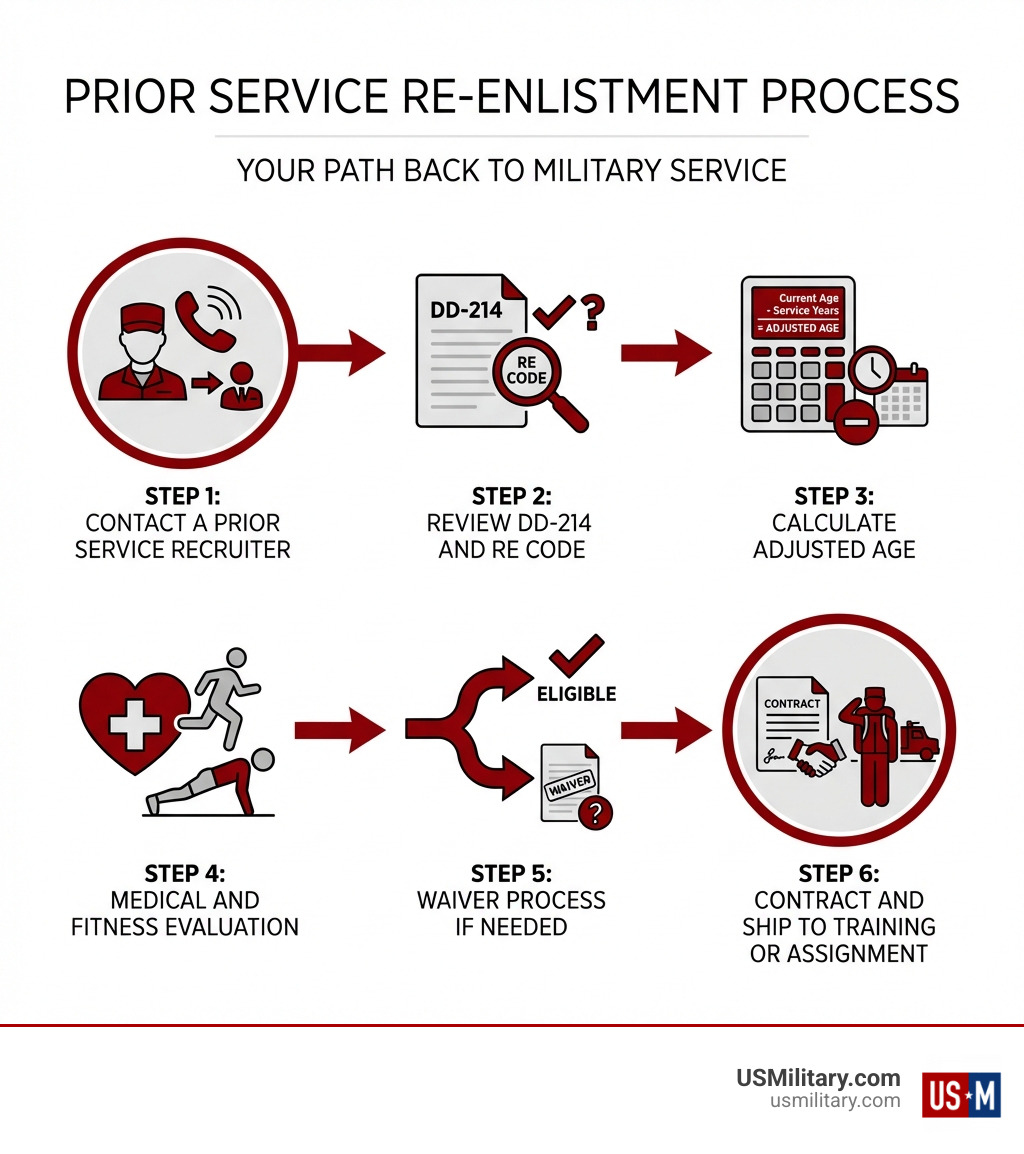
The process involves contacting a prior service recruiter, verifying your eligibility, potentially getting a waiver, and then shipping out—often without repeating Basic Training.
Understanding Initial Enlistment vs. Re-enlistment
When we talk about joining the military, it’s crucial to differentiate between initial enlistment and re-enlistment. For those who have previously served, the rules are often quite different—and usually more flexible—than for someone joining for the very first time.
Initial enlistment is for those with no prior military service. Applicants must meet age, education, physical, and moral standards laid out in federal law and current Service regulations. For instance, 17-year-olds need parental consent, as outlined in 10 U.S.C. §505. All new recruits must pass the Armed Services Vocational Aptitude Battery (ASVAB) test and meet Department of Defense (DoD) medical standards in effect at the time they apply.
Re-enlistment is for those with prior service. Instead of starting from scratch, your service record, discharge type, and Re-entry (RE) code on your DD Form 214 are central to your eligibility. This makes the age limit to rejoin military service more nuanced and often more forgiving than for first-time applicants.

Standard Age Limits for New Recruits
For new recruits, each branch sets age limits based on the physical demands of service and the time needed to complete a career. These limits can shift over time with recruiting goals, so it is essential to confirm up-to-date numbers with a recruiter in 2026.
Here are the general age ranges commonly used for initial enlistment (non-prior service) in active duty in the mid‑2020s:
- Army: 17–35
- Navy: 17–around 41
- Air Force: 17–around 39
- Marine Corps: 17–28
- Coast Guard: 17–around 41
- Space Force: 17–around 42
National Guard and Reserve age limits can be higher. For example, while the Army National Guard generally follows the Army’s 35-year baseline, federal law allows original enlistment up to age 45 (32 U.S.C. §313), with even higher upper limits for some categories of veterans. Reserve components often mirror their active-duty counterparts but may offer waivers.
For a comprehensive look at the general qualifications for joining the military, including age, citizenship, and education, you can refer to A guide to the qualifications for joining the military.
How Prior Service Changes the Rules
“Prior service” (generally 180+ days of active duty, though definitions can vary by branch and program) changes the rules. Your experience is a valuable asset that directly influences your eligibility to return.
A major benefit is the “adjusted age calculation.” Many branches subtract your years of qualifying service from your current age, which can extend your age limit to rejoin military service by several years.
Your break in service—how long you’ve been out—also matters. For instance, the Air Force has historically preferred a break of less than six years for some prior service programs, though exceptions are possible and can change with demand.
Finally, your Re-entry (RE) Code on your DD Form 214 is a key determinant of your eligibility to reenlist. A favorable code makes rejoining much smoother, while some codes require a waiver or, in rare cases, a formal appeal.
The Prior Service Advantage: How Your Military Experience Affects the Age Limit to Rejoin the Military
Your previous military experience is a significant advantage when rejoining. The military seeks trained professionals, which is why prior service members often have more leeway with age restrictions. Your skills, training, and maturity are highly valued—especially in a competitive recruiting environment like the mid‑2020s.

Calculating Your Adjusted Age: The Key to the Age Limit to Rejoin the Military
The “adjusted age calculation” is key for prior service members. Many branches subtract your previous active duty time from your current age to determine your eligibility age for specific programs.
Let’s look at a concrete example: The Marine Corps has a strict initial enlistment age limit near 28 years old. If you’re a 37-year-old former Marine with 10 years of qualifying service, your “enlistment age” might be considered 27 (37 – 10 = 27) under an adjusted‑age policy. This could make you eligible, even though your chronological age is higher. However, anyone over the base limit may still require an age waiver, and prior service strengthens the request.
The Army and other branches use similar adjusted-age concepts, though details vary and may be updated over time. This adjusted age, combined with the military’s need for your specific skills (MOS or rating), can make you an attractive candidate, especially if there’s a critical shortage in your field.
The Impact of Your Discharge and RE Code
Your discharge type and Re-entry (RE) code are paramount. They detail your separation circumstances and indicate your eligibility for future service.
An honorable discharge is the gold standard and provides the clearest path back. Other discharge types can create significant obstacles and may require waivers or corrections.
RE codes, found on Block 27 of your DD Form 214, dictate whether you’re eligible to reenlist after separation.
Here’s a general breakdown of the RE codes:
- RE-1: Eligible for reenlistment with no restrictions.
- RE-2: Conditional eligibility (for example, eligible for certain components or under specific circumstances, depending on branch policy).
- RE-3: Eligible for reenlistment, but a waiver is required.
- RE-4: Typically disqualified from reenlistment.
If you have an RE-3 code, speak with a recruiter to initiate the waiver process. If you have an RE-4 or believe your code is an error, you can appeal to the appropriate review board, such as the Board for Correction of Military Records (BCMR). This process is challenging, and it’s best to file an appeal as soon as you find a potential error. Requirements and timelines can vary by branch, so be sure to review the latest guidance.
Branch-Specific Re-enlistment Age Policies
While general principles apply everywhere, each branch has specific policies regarding the age limit to rejoin military service. Understanding these nuances is key to choosing your path, especially as rules and waiver practices are periodically updated.
| Branch | Active Duty Max Age (Prior Service) | Reserve/Guard Max Age (Prior Service) | Notes & Considerations |
|---|---|---|---|
| Army | Around 35 (often up to low 40s with waivers) | Around 35 (often up to low 40s with waivers) | Adjusted age (subtract service time in many cases); needs of the Army; officer/enlisted programs. |
| Navy | Around 41 | Around 41 | Adjusted age in many cases; must be able to meet service‑specific retirement rules. |
| Air Force | Around 39 | Around 39 | Adjusted age; preferred break in service often limited; specific officer programs. |
| Marine Corps | Around 28 (adjusted age, waivers beyond base limit) | Around 28 (adjusted age, waivers beyond base limit) | Among the strictest age limits; prior service time may be subtracted from chronological age. |
| Coast Guard | Around 40–41 | Around 40 | Adjusted age in many cases; specific critical skills may allow for waivers. |
| Space Force | Around 42 | N/A (Active Duty only for enlisted) | Adjusted age where applicable; emphasis on critical skills in high-tech fields. |
Note: All age limits are subject to change based on military needs and can often be waived for those with critical skills or exceptional qualifications. For the most accurate information in 2026, speak directly with an official recruiter or consult current Service regulations.
Army and Army Reserve/National Guard
The Army’s general age limit for enlistment is around the mid‑30s, but this can be extended by subtracting prior service time, depending on the program. Waivers into the early 40s are sometimes possible, especially for in-demand skills. The Army National Guard is often more flexible, with statutes allowing enlistment for some veterans up to age 64 under specific conditions.
For detailed, up-to-date guidance on enlistment policies and age considerations, refer to current Army regulations and resources such as the Army enlistment regulations and then confirm details with a recruiter.
Navy and Navy Reserve
The Navy’s maximum age for most enlisted accessions is generally in the early 40s for both active duty and the Reserve. Prior service time may be subtracted from your age, subject to current policy. Prior service members (NAVET/OSVET) typically do not repeat basic training.
Officer candidates may use the Direct Commission Officer (DCO) program, which can have higher or more flexible age limits, especially for professional fields. For the Reserve, a common rule is that you must be able to complete the required qualifying service for retirement within the age limits set by current Navy Reserve policy.
Air Force and Air Force Reserve/Air National Guard
The Air Force age limit is generally in the upper 30s for active duty, Reserve, and Air National Guard enlistment, with specific numbers and waiver authority subject to change. Age requirements vary by program, so contacting a recruiter is essential.
The service has historically preferred a break in service not exceeding several years for certain prior service programs, but exceptions may be made based on needs. A selective Prior Service Line Officer (PS LO) program exists for officers wishing to return to active duty, and its age limits are governed by current Air Force instructions.
Marine Corps and Marine Corps Reserve
The Marine Corps is among the strictest, with a base limit near 28 years old. However, it often uses an adjusted age calculation (current age minus years of service) for certain prior service opportunities. For example, a 37-year-old with 10 years of service might have an adjusted age of 27 for eligibility purposes.
Anyone chronologically over the base age still typically needs an age waiver, which requires exceptional physical fitness and a strong service record. Officer and enlisted programs can have different age caps, so it is important to review the latest Marine Corps guidance.
Space Force and Coast Guard/Reserve
The Space Force, the newest branch, has a maximum enlisted age generally in the early 40s and seeks prior service members with technical and cyber-related skills. Many accessions still occur through transfers from the Air Force and other Services, and policies continue to mature.
The Coast Guard active duty limit is typically around 40–41, while the Reserve is around 40, with prior service time and critical skills sometimes allowing waivers. Both components value prior service members with experience relevant to maritime safety, security, and law enforcement missions.
Because policies for these branches can evolve quickly, especially in the 2020s, always confirm current age limits, waiver criteria, and program availability with an official recruiter.
Navigating Waivers, Legal Statutes, and Special Exceptions
If you don’t meet the standard age criteria, don’t be deterred. The military’s needs are dynamic, and waiver policies are periodically updated. Age waivers exist for a reason, and they are a normal part of the process for many prior service applicants.
When and How to Get an Age Waiver
Age waivers are formal requests to exceed the standard maximum age limit. They are not automatic but are a common part of the recruiting process for prior service members, especially in fields where experience is critical.
The criteria for granting an age waiver typically depend on:
- Needs of the Military: A critical shortage in your skill set increases your chances.
- Your Qualifications: Exceptional fitness, a stellar record, and valuable civilian experience strengthen your case.
- Justification Letter: Your recruiter will help you prepare a justification for the waiver.
- Supporting Documentation: This includes your DD Form 214, performance reviews, awards, and any other relevant records.
Your recruiter is your primary advocate and will help prepare the waiver request in line with current Service instructions. Be transparent about your medical history or other factors, since undisclosed issues can delay or derail approval. Authority for age waivers typically resides with higher-level commands within the recruiting or medical echelons, and the exact approval chain can change over time.
Officer vs. Enlisted: A Different Age Limit to Rejoin the Military?
Age limits for officers can differ from enlisted personnel, often with higher maximums to attract those with advanced education and experience. Direct Commission Officer (DCO) programs for professionals like doctors, lawyers, and chaplains have some of the most flexible age limits, sometimes extending into the 50s, subject to current regulations.
For prior enlisted members, your service is a significant advantage when seeking a commission. Many branches offer enlisted-to-officer pathways with their own age and time-in-service requirements. Because officer policies can change and are often program-specific, up-to-date Service instructions or a commissioned-officer recruiter are the best sources of detail.
The Legal Basis for Military Age Limits
Military age limits are based on federal law and regulations, which provide the framework for each branch’s specific policies.
- 10 U.S.C. §505 – Regular components: qualifications, term, grade: This statute sets the maximum age for original enlistment in regular components, while allowing each branch to establish lower limits in its own regulations.
- 32 U.S.C. §313 – National Guard age limitations: This law sets National Guard enlistment and appointment age limits, allowing service for some up to age 64 under defined conditions.
These laws provide the authority, while Department of Defense Instructions (DoDI) and branch-specific regulations provide the detailed guidance recruiters use. Because implementing rules can change, always rely on the most recent version of these instructions when planning to rejoin in 2026 or later.
Frequently Asked Questions about Rejoining the Military
We understand you likely have many questions about rejoining, especially concerning age. Let’s tackle some of the most common ones we hear.
Can I rejoin the military if I am over 40?
Yes, it is possible in many cases. Several branches are open to prior service members over 40, depending on the current policies and needs at the time you apply.
The Navy, Coast Guard, and Space Force have historically had upper age limits around 40 or slightly above. The Army can sometimes grant waivers into the early 40s. The National Guard may allow some veterans to serve until age 64 in limited, statute-based categories.
Your adjusted age (if the branch uses an age subtraction formula), your skills, your RE code, and your medical fitness are the key factors. Because age rules can change, you should always confirm the latest standards with a recruiter in 2026.
Do I have to go back to Basic Training if I re-enlist?
Usually, no. If you’ve completed basic training, you likely won’t have to repeat it. However, there are some nuances:
- Navy Reserve: Prior service members from any branch (NAVET/OSVET) typically won’t need to repeat Recruit Training.
- Other Services: You will likely go through a streamlined orientation or transition course, not full basic training.
- Break in Service: A very long break might require a short refresher or skills course, depending on current policy.
- Branch Transfer: Transferring to a new branch might require a modified course to learn its specific culture, customs, and procedures.
Always consult with a prior service recruiter to get the exact requirements for your situation and the current year.
How does my RE code on my DD-214 affect my ability to rejoin?
Your RE code is critical. It indicates your re-enlistment eligibility:
- RE-1: Eligible for reenlistment.
- RE-2: Conditionally eligible, depending on branch-specific rules.
- RE-3: Eligible with a waiver (this is common for prior service members with certain separation circumstances).
- RE-4: Generally ineligible without a successful appeal to upgrade the code.
Check your DD Form 214 for your code. If you have an RE-3, talk to a recruiter about a waiver. For an RE-4, the path is difficult and may require a formal appeal or correction request through the appropriate board, following the most up-to-date procedures for your branch.
Your Next Chapter of Service Awaits
Rejoining the military is a significant decision, and age limits can seem daunting. However, your prior service is a powerful advantage, as the military continues to value experience and dedication in 2026 and beyond.
Here are the key takeaways:
- Prior service is valuable: Your time in uniform means your age limit to rejoin military service is often much more flexible than for new recruits.
- Age is often adjustable: Many branches subtract your previous service time from your current age, giving you an “adjusted age” that can help you meet enlistment criteria.
- Waivers are possible: Even if you exceed the standard age, waivers are frequently granted, especially if you have critical skills, a strong record, and meet current medical standards.
- RE codes matter: Your DD Form 214 holds the key to your re-enlistment eligibility. Understand your RE code and how it impacts your path, and seek corrections if needed.
- Recruiters are your guides: For personalized, up-to-date advice, the best first step is always to speak with a prior service recruiter from the branch you are interested in.
At USMilitary.com, we’re dedicated to empowering you with information for your military career. If you’re ready to explore your options, contact a recruiter and review the latest Service regulations. Your next chapter of service might be just around the corner.
To dive deeper into the general requirements for military service, including more on age and other qualifications, Explore more about the age limit to join the military.
Free for Service Members & Veterans
Get the military benefits intel no one tells you about.
Weekly updates on VA benefits, pay changes, and money tips — free for service members and veterans.
No spam. Unsubscribe anytime. Your info is never shared.


