What Are Surviving Spouse Benefits (And Who Qualifies)?
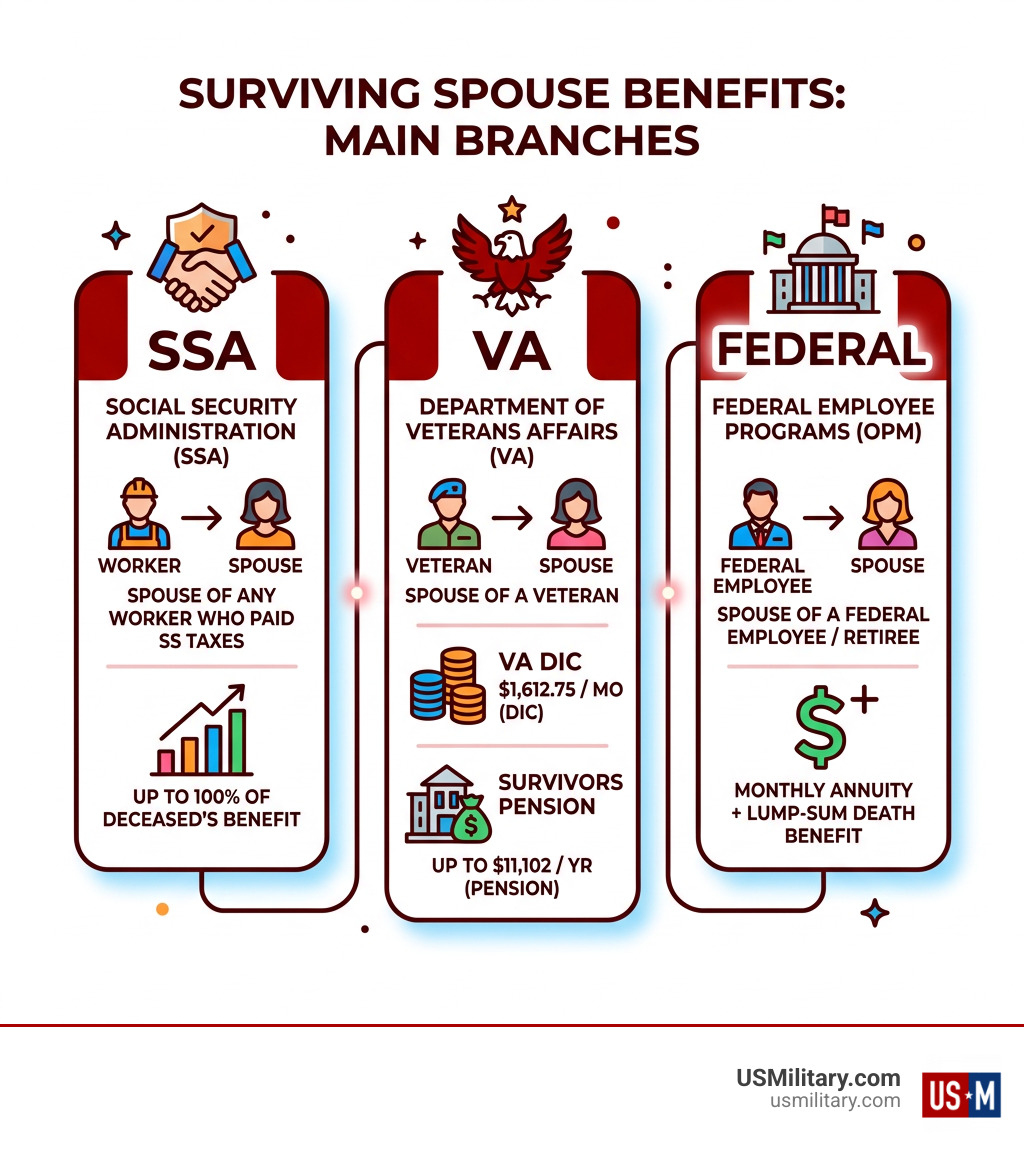
Surviving spouse benefits are monthly payments and other financial supports paid to the widow or widower of a deceased worker, veteran, or federal employee. Here’s a quick breakdown of what’s available:
| Program | Who It’s For | Key Benefit |
|---|---|---|
| Social Security (SSA) | Spouse of any worker who paid SS taxes | Up to 100% of deceased’s benefit |
| VA DIC / Survivors Pension | Spouse of a veteran | $1,612.75/mo (DIC) or up to $11,102/yr (Pension) |
| Federal Employee (OPM) | Spouse of a federal employee/retiree | Monthly annuity + lump-sum death benefit |
The short answer: If your spouse worked and paid into Social Security, served in the military, or was a federal employee, you are likely eligible for some form of monthly payment — sometimes from more than one program at once.
As of September 2025, more than 3.8 million widows and widowers are already receiving Social Security survivor benefits. The average monthly payment is around $1,800 — money that can make a real difference when you’re already dealing with grief.
But here’s the problem most people run into: each program has its own rules, its own forms, and its own deadlines. Miss a step, and you could lose months of payments you were owed.
I’m Larry Fowler, publisher of USMilitary.com and a longtime advocate for veterans and military families navigating VA benefits, surviving spouse benefits, and the often-confusing world of federal support programs since 2007. In this guide, I’ll walk you through everything you need to know — in plain English.
Surviving spouse benefits terminology:
Understanding Your Eligibility for Surviving Spouse Benefits

When we talk about surviving spouse benefits, we have to start with the “who” and the “when.” The Social Security Administration (SSA) doesn’t just hand out checks to anyone who was once married; there are specific hoops to jump through.
Generally, you must have been married to the deceased for at least nine months before their death. We call this the “9-month marriage rule.” However, life doesn’t always follow a schedule, so if the death was accidental or occurred in the line of military duty, that nine-month requirement is often waived.
Age is the other big factor. To collect a standard survivor benefit, you typically need to be at least 60 years old. If you are disabled, that age requirement drops to 50. But there is a major “loophole” (the good kind!): if you are caring for the deceased’s child who is under age 16 or disabled, you can receive benefits at any age, regardless of how long you were married.
It’s also worth noting that the SSA has modernized. In many cases, members of non-marital legal relationships (like civil unions or domestic partnerships) may now qualify for benefits depending on state law. For more on how these rules apply specifically to veterans, check out our guide on va-benefits-assisted-living-veterans-and-spouses/. You can also find deep-dive details in the Social Security Guide to Survivor Benefits.
Requirements for Disabled Widows and Widowers
If you are a widow or widower with a disability, the rules are a bit more flexible but require more paperwork. You can start receiving surviving spouse benefits as early as age 50, provided your disability started before or within seven years of your spouse’s death.
You’ll need to provide medical evidence that meets the SSA’s strict definition of disability. If you qualify, you might also be eligible for Supplemental Security Income (SSI) in addition to your survivor payments. For those whose spouses were highly rated by the VA, our 100-percent-disabled-veteran-benefits-for-spouses-guide/ offers specific advice on coordinating these different systems.
Exceptions to the Marriage Duration Rule
We mentioned the nine-month rule, but let’s look at the “get out of jail free” cards. You don’t need to meet the nine-month mark if:
- The death was an accident.
- The death occurred while the spouse was on active U.S. military duty.
- You are the mother or father of their biological child.
- You were married to them previously for at least 10 years (more on ex-spouses later!).
Calculating Your Monthly Social Security Payments
How much will you actually see in your bank account? The amount is a percentage of the deceased worker’s basic Social Security benefit. The “magic number” depends almost entirely on your age when you claim.
If you wait until your Full Retirement Age (FRA)—which is currently 66 or 67 depending on your birth year—you get 100% of what your spouse was receiving. If you claim at age 60, you’ll get a reduced amount, usually 71.5%.
Don’t forget the “Lump-Sum Death Payment.” It’s a one-time payment of $255. While it won’t pay for a whole funeral, it’s a small bit of support the SSA provides to help with immediate costs. For a more detailed breakdown of these numbers, see What you could get from Survivor benefits. Also, many spouses ask will-my-wife-receive-my-va-disability-when-i-die-3/ regarding VA pay; the answer involves different rules than Social Security, which we will cover next.
The Impact of Early Claiming
Claiming early is tempting, especially when bills are piling up. However, taking benefits at age 60 locks you into that 71.5% rate for life. If you can afford to wait, every year you delay (up until your FRA) increases that monthly check. Unlike your own retirement benefit, survivor benefits do not get “delayed retirement credits” for waiting past your FRA, so there is no reason to wait until age 70.
Managing the Family Maximum Benefit
There is a limit to how much the SSA will pay out on one person’s work record. This is called the Family Maximum Benefit. Usually, the total amount payable to a widow and their children is between 150% and 180% of the deceased worker’s benefit.
If the total exceeds this, everyone’s check (except the widow’s in some cases) is reduced proportionally. Interestingly, benefits paid to a divorced surviving spouse do not count toward this family maximum—which is a win for everyone else in the family!
✉ Get updates like this in your inbox
Weekly VA benefit changes, pay updates, and money tips for service members, veterans, and military families. Free, no spam.
Military and Federal Employee Survivor Programs
If your spouse served in the military or worked for the federal government, Social Security is just one piece of the puzzle. The Department of Veterans Affairs (VA) and the Office of Personnel Management (OPM) have their own robust surviving spouse benefits.
For military families, the gold standard is Dependency and Indemnity Compensation (DIC). This is a tax-free monthly payment for survivors of service members who died on active duty or veterans who died from service-connected disabilities. As of late 2023, the basic monthly rate is $1,612.75.
Federal employees under FERS (Federal Employees Retirement System) have the Basic Employee Death Benefit (BEDB). This is a significant lump sum—roughly $15,000 plus 50% of the employee’s final salary. To see how these interact with assisted living costs, visit va-disability-pay-out-for-veteran-spouse-assisted-living/ or who-qualifies-for-veteran-benefits-for-assisted-living/.
Understanding VA DIC vs. Survivors Pension
It’s easy to confuse these two, but they are very different:
- DIC: Not income-based. It’s for service-connected deaths. It pays a flat rate regardless of your net worth.
- Survivors Pension: This is needs-based (sometimes called a “death pension”). It is for survivors of wartime veterans who died of non-service-connected causes. You must meet strict income and net worth limits to qualify.
For the official word on these, visit the Survivors Pension | Veterans Affairs page.
Federal Civil Service Death Benefits
If your spouse was a “civil servant,” you’ll deal with OPM. You’ll need to fill out Form SF 2800 (for CSRS) or SF 3104 (for FERS).
- 18 Months Rule: The employee must have had at least 18 months of creditable service for the spouse to get a monthly annuity.
- TSP: The Thrift Savings Plan (TSP) is paid out based on the beneficiary designation on file. If no form was filed, it follows a strict “order of precedence” (Spouse > Children > Parents > Executor).
- FEGLI: Federal Employees’ Group Life Insurance is also available and requires the FE-6 claim form.
Maximizing Surviving Spouse Benefits for Divorced Partners
Believe it or not, you can be eligible for surviving spouse benefits even if you were divorced at the time of your ex-spouse’s death. The big requirement here is the “10-year rule.” You must have been married to them for at least 10 years.
If you meet that requirement and you are currently unmarried (or you remarried after age 60), you can claim survivor benefits on their record just like a current spouse would. This does not take away from the current spouse’s benefits!
For private-sector pensions, things get a bit more legal. You might need a Qualified Domestic Relations Order (QDRO) from your divorce to prove you are entitled to a portion of the pension. You can read more about these protections in the Rights of Surviving Spouses fact sheet.
Remarriage Rules and Benefit Retention
Remarriage is the “elephant in the room.” If you remarry before age 60 (or 50 if disabled), you generally lose your Social Security survivor benefits. However, if that new marriage ends (by death or divorce), you can often get your original benefits back.
If you wait until after age 60 to remarry, your Social Security survivor benefits are safe—they won’t be affected. For VA benefits and federal pensions (OPM), the magic age is usually 55. If you remarry after 55, you can typically keep your VA Survivors Pension or CHAMPVA health insurance.
Navigating Health Insurance and Additional Support
Healthcare is often the biggest worry for survivors. If you were covered under your spouse’s Federal Employees Health Benefits (FEHB), you can usually continue that coverage as long as you are eligible for a monthly survivor annuity.
Military survivors often look to CHAMPVA or TRICARE. CHAMPVA is a comprehensive health program in which the VA shares the cost of covered health care services and supplies with eligible beneficiaries. For more on how the VA supports spouses in long-term care, see va-assisted-living-benefits-for-spouses/ and will-the-va-pay-for-assisted-living-for-veteran-spouses/.
Educational Assistance for Survivors
There are two main programs for survivors wanting to head back to school:
- Fry Scholarship: For spouses and children of service members who died in the line of duty after September 10, 2001. It provides 36 months of Post-9/11 GI Bill benefits.
- DEA (Dependents’ Educational Assistance): Provides a monthly allowance for degree programs, certificates, or apprenticeships.
To apply for either, you’ll need to submit VA Form 22-5490.
How to Apply for Surviving Spouse Benefits Without the Stress
The first step is reporting the death. Most funeral homes will do this for you if you provide the deceased’s Social Security number, but it’s always good to double-check.
Pro-tip: You cannot apply for Social Security survivor benefits online. You must call them at 800-772-1213 or visit a local office. For federal retirees, use the OPM Report of Death form online to get the process started.
Required Documentation Checklist
Don’t show up to the SSA or VA office empty-handed. You will almost certainly need:
- The death certificate (get at least 10 certified copies; you’ll need them!).
- Your marriage license.
- Birth certificates for you and any dependent children.
- The deceased’s DD214 (discharge papers) if they were a veteran.
- Recent W-2 forms or self-employment tax returns for the deceased.
- Your bank account information for direct deposit (checks are a thing of the past).
Frequently Asked Questions about Survivor Benefits
Can I switch from my own retirement benefit to a survivor benefit?
Yes! This is one of the best strategies for widows. If you are eligible for both your own retirement and a survivor benefit, you can choose to take the survivor benefit first (as early as age 60) and let your own retirement benefit grow until age 70. Or, if your own benefit is higher, you can take it and ignore the survivor benefit. The SSA will always pay you the higher of the two amounts, but you have to be proactive about the timing.
How does the “Intent to File” help with VA benefits?
When applying for VA surviving spouse benefits, you should submit an “Intent to File” form immediately. This “sets the date” for your benefits. Even if it takes you six months to gather all your paperwork, the VA will pay you retroactively back to the date you filed that intent form. It’s a great way to protect your effective date while you’re still organizing your life.
What happens to my benefits if I work while receiving them?
If you are under your Full Retirement Age and you earn more than the annual limit (which changes every year), the SSA will temporarily withhold some of your benefits. In 2024, they withhold $1 for every $2 you earn above the limit. Once you reach your FRA, there is no earnings limit—you can make a million dollars and still get your full survivor check.
Conclusion
Navigating surviving spouse benefits is a marathon, not a sprint. Whether you are dealing with the SSA, the VA, or OPM, the key is to stay organized and act quickly. At USMilitary.com, we are dedicated to providing the resources and advocacy you need to ensure you get every penny you are entitled to.
From financial planning to finding the right forms, we’re here to help you find peace of mind. Don’t leave your future to chance—explore the full Benefits of Military to see what other support might be waiting for you. Stay strong, and remember: you don’t have to do this alone.
Free for Service Members & Veterans
Get the military benefits intel no one tells you about.
Weekly updates on VA benefits, pay changes, and money tips — free for service members and veterans.
No spam. Unsubscribe anytime. Your info is never shared.


