Understanding Military Service Age Limits
Age restrictions for joining the military are one of the most fundamental eligibility requirements you’ll encounter when considering enlistment. Here’s what you need to know at a glance:
- Minimum Age: 17 years old (with parental consent) or 18 without
- Maximum Age: Varies by branch, ranging from 28 to 42 years old
- Parental Consent: Required for all 17-year-old applicants
- Branch Differences: Each service has its own upper age limit
- Enlisted vs. Officer: Officer candidates face stricter age restrictions
The reality is that age is often less of a barrier than people think. In 2012, U.S. Rep. Paul Broun Jr. (R-GA) tried to push through legislation allowing people of any age to join the military as long as they could meet the minimum health and fitness requirements. While the House voted against it, the effort highlighted an important truth: many potential candidates incorrectly believe they are too old if they don’t join between ages 18-22.
The truth is more complex. The Department of Defense sets baseline standards, but each branch has flexibility to adjust limits based on their needs. Prior service members can add their years of service to the maximum age. Special operations units have their own rules. And in certain cases, waivers exist for individuals with critical skills.
Whether you’re a high school senior, a 35-year-old career changer, or a veteran considering re-enlistment, understanding these age restrictions is essential to planning your path forward.
I’m Larry Fowler, and since 2007, I’ve helped thousands of prospective service members steer military enlistment requirements, including age restrictions for joining the military, through the USMilitary.com Network. My team and I have worked directly with recruiters from all branches to provide accurate, up-to-date information for individuals at every stage of their military journey.
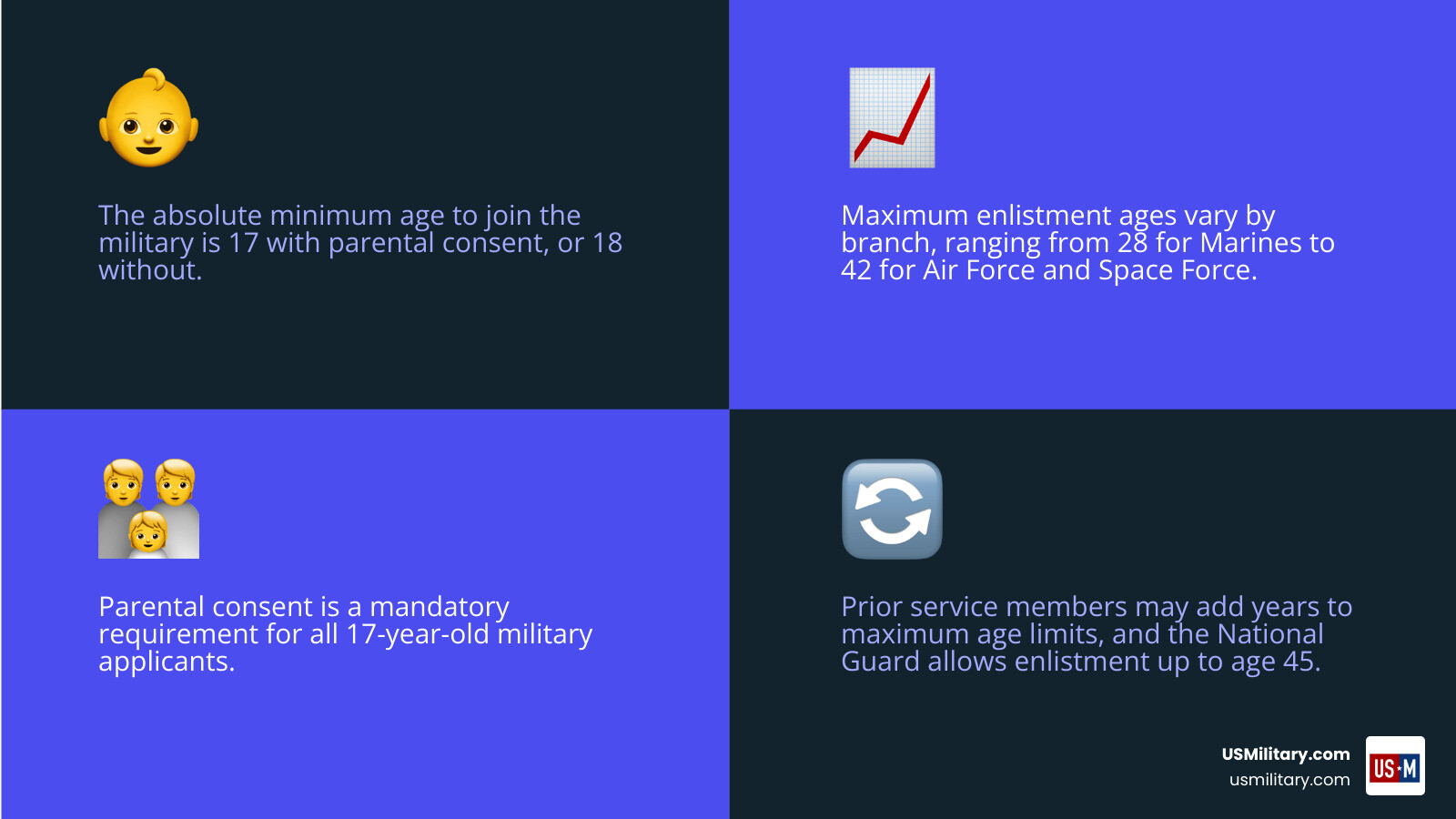
Age restrictions for joining the military terms to remember:
A Branch-by-Branch Breakdown of Age Restrictions for Joining the Military
When we talk about age restrictions for joining the military, one of the first things to understand is that there isn’t a single, universal maximum age limit for all branches. While the minimum age to enlist across the board is 17 (with parental consent) or 18 (without), the upper age limits vary significantly, reflecting the different roles and physical demands of each service. This means that a window of opportunity that might be closed in one branch could still be wide open in another.
Below, we’ve compiled a clear comparison of the age limits for initial, non-prior service active duty enlistment across the different branches of the U.S. Armed Forces. These are general guidelines, and exceptions or specific programs might have slightly different criteria.
| Branch | Active Duty Enlistment Age Limits |
|---|---|
| Army | 17-35 years old |
| Marine Corps | 17-28 years old |
| Navy | 17-41 years old |
| Air Force | 17-42 years old |
| Space Force | 17-42 years old |
| Coast Guard | 17-41 years old |

Army Age Limits
The U.S. Army, a cornerstone of our nation’s defense, sets its active duty enlistment age range from 17 to 35 years old. For those considering part-time service, the Army Reserve shares the same age window, accepting individuals between 17 and 35 years old. This relatively broad age range reflects the Army’s diverse needs, from combat roles to highly specialized support functions. If you’re looking to explore the specific requirements and opportunities within the Army, we recommend checking out the official Army enlistment requirements for comprehensive details.
Marine Corps Age Limits
Known for its rigorous training and elite fighting force, the Marine Corps has historically maintained some of the strictest age restrictions for joining the military. For active duty, the age range is 17 to 28 years old. Similarly, the Marine Corps Reserve also adheres to this 17 to 28 years old limit. This tighter age window often means that individuals considering the Marine Corps need to act earlier in their lives compared to other branches. If the Marine Corps calls to you, make sure to review their general requirements to ensure you meet all criteria.
Navy Age Limits
The U.S. Navy offers a more expansive age range for those wishing to serve on the seas or in its aviation and land-based roles. Active duty enlistment is open to individuals between 17 and 41 years old. The Navy Reserve also provides a generous window, with an age range of 17 to 41 years old. This flexibility allows individuals with varied life experiences and skills to contribute to naval operations. For a deep dive into what it takes to join the Navy, visit their joining requirements page.
Air Force & Space Force Age Limits
The Air Force and its newest sibling, the Space Force, lead the pack with the most accommodating maximum age restrictions for joining the military. Both branches accept active duty enlistees between 17 and 42 years old. The Air Force Reserve also aligns with this, allowing enlistment from 17 to 42 years old. This broader age limit reflects their focus on technological expertise and specialized skills, which can be acquired later in life. Individuals interested in the Space Force typically go through the Air Force recruitment process. You can find more information on Air Force active duty on their official site.
Coast Guard Age Limits
While often overlooked, the U.S. Coast Guard plays a critical role in maritime safety and security. Its active duty enlistment age range is 17 to 41 years old. For those eyeing the Coast Guard Reserve, the age limit is slightly different, welcoming individuals from 17 to 40 years old. The Coast Guard’s mission-critical roles, from search and rescue to law enforcement, benefit from a diverse age range of recruits. For a detailed look at their eligibility criteria, refer to the official Coast Guard eligibility requirements.
Enlisted vs. Officer: How Your Career Path Affects Age
The path you choose—whether you aim to serve as an enlisted member or a commissioned officer—has its own set of age restrictions for joining the military, which are often stricter for those seeking a commission. It’s like choosing between two different doors, each with its own sign indicating who may enter.
Enlisted Personnel Age Requirements
For most individuals considering military service, the enlisted path is the entry point. The minimum age to enlist across all branches is 17 years old. However, if you’re 17, you’ll need the written consent of a parent or legal guardian. Without that consent, you must be at least 18 years old to sign up.
Beyond age, enlisted recruits typically need a high school diploma or a GED. You’ll also take the Armed Services Vocational Aptitude Battery (ASVAB) test, which measures your aptitudes and helps determine which military jobs you’re qualified for. While the minimum age is consistent, the maximum age for enlisted personnel varies significantly by branch, as we explored in the section above. For instance, you could be 35 and join the Army, but if you’re aiming for the Marine Corps, you’d need to be 28 or younger.
Commissioned Officer Age Requirements
If you’re dreaming of leading troops, strategizing missions, or specializing in a professional field within the military, the commissioned officer path is for you. This route usually comes with stricter age restrictions for joining the military because of the significant investment the military makes in training and developing its officers.
To become a commissioned officer, you generally need a four-year college degree. You might then pursue Officer Candidate School (OCS), ROTC, or a direct commission if you have specialized skills (like being a doctor or lawyer). The maximum age limits for commissioned officers are often lower than for enlisted personnel, reflecting the longer career trajectory expected from officers.
Here’s a quick look at the typical maximum ages for commissioned officers by branch:
- Army: 35 years old
- Navy: 29 years old
- Air Force: 28 years old
- Marine Corps: 28 years old
- Coast Guard: 27 years old
That these are general guidelines, and specific programs or fields might have slight variations. If you’re passionate about leading, we encourage you to learn more about becoming an officer through official military resources.
Waivers, Exceptions, and Prior Service Rules
While age restrictions for joining the military are generally firm, they are not always absolute. We understand that life happens, and sometimes the timing isn’t perfect for joining right out of high school. Thankfully, the military recognizes this too, offering waivers and special rules for those who have served before or possess highly sought-after skills. Think of it as having a “fast pass” or a special entry ticket, provided you meet certain criteria.

Understanding Age Waivers
An age waiver is essentially an official permission to exceed the standard maximum age limit for enlistment or commissioning. These aren’t handed out lightly; they’re typically granted on a case-by-case basis when the needs of the service align with an applicant’s unique qualifications. For example, if you possess in-demand skills, such as being a medical professional, a legal expert, or a chaplain, the military might be willing to overlook a few extra years to bring your expertise into the ranks.
Common reasons for waivers include:
- Critical Skill Shortages: If the military has an urgent need for specific skills (e.g., certain language proficiencies, technical expertise), they may be more flexible with age.
- Prior Military Service: As we’ll discuss next, previous service can significantly impact your age eligibility.
- Specialized Professions: Doctors, nurses, lawyers, and religious leaders often have higher age limits or are eligible for waivers due to their specialized training and professional experience.
- Exceptional Qualifications: In rare instances, an applicant with an extraordinary background or set of achievements might be considered for a waiver.
A waiver is never guaranteed. The decision rests with the individual service branches, who weigh the applicant’s overall qualifications, physical fitness, and the military’s current needs. The best way to understand your options is to speak directly with a recruiter from your desired branch.
How Prior Service Affects the Age Restrictions for Joining the Military
For those who have already worn a uniform, prior military service can be a game-changer when it comes to age restrictions for joining the military. The Department of Defense recognizes the value of experience, and as such, it offers provisions that allow former service members to re-enlist even if they’ve passed the standard maximum age for non-prior service applicants.
The general rule of thumb, as outlined in DoD policy, is that the maximum age for a prior service enlistee can be determined by adding the individual’s years of prior service to age 42. This adjusted age calculation provides a significant extension for many veterans looking to return to service. For instance, a 41-year-old veteran with four years of prior service might still be eligible to re-enlist in the Air Force because their adjusted age (41 – 4 = 37) falls below the 39-year-old cutoff (using the Air Force’s prior service age calculation).
Re-enlistment eligibility is also influenced by the type of discharge you received and the time elapsed since your last service. Generally, an honorable discharge is required. The specific rules can be complex and vary slightly between branches and for different components (Active Duty vs. Reserve). We highly recommend reviewing the official DoD Qualification Standards for Enlistment, Appointment, and Induction for the most comprehensive and up-to-date details on how prior service impacts age eligibility.
Age Rules for Reserve, National Guard, and Special Operations
Beyond active duty and officer commissions, there are other unique avenues of military service, each with its own set of age restrictions for joining the military. Part-time service in the Reserves or National Guard, and the highly demanding world of special operations units, often have distinct age considerations that differ from standard active-duty enlistment.
Active Duty vs. Reserve and National Guard Age Restrictions for Joining the Military
Serving in the Reserve or National Guard offers a unique blend of civilian life and military commitment. While active duty involves full-time service, the Reserve and National Guard typically require one weekend a month and two weeks a year, allowing individuals to pursue civilian careers or education. This difference in commitment often translates to slightly different age requirements.
The National Guard, which operates under both state and federal authority, has its own specific age limits, as outlined in federal law (Title 32, Section 313 of the U.S. Code). For original enlistment, a person must be at least 17 years of age and under 45. However, for former members of the Regular Army, Navy, Air Force, or Marine Corps, the maximum age for original enlistment can extend to under 64 years of age. For reenlistment in the National Guard, an individual must generally be under 64 years of age. If you’re looking to become an officer in the National Guard, you’ll need to be at least 18 years old and under 64. For precise legal wording and any nuances, consult Title 32, Section 313 of the U.S. Code.
The Reserve components of the other branches (Army Reserve, Navy Reserve, Air Force Reserve, Marine Corps Reserve, Coast Guard Reserve) generally follow similar patterns to their active-duty counterparts but may have slightly extended maximum age limits or more flexibility for prior service members, depending on the branch’s needs. For example, the Army Reserve has an age range of 17-35, while the Air Force Reserve goes up to 42. It’s always best to check with a recruiter for the most current information for your specific situation.
Age Considerations for Special Operations Units
If you’re drawn to the most challenging and elite units in the military, prepare for some of the most stringent requirements, including age restrictions for joining the military. These physically demanding roles require peak performance, and as such, they often have stricter age standards than general enlistment.
While you might meet the general age requirements for a branch, qualifying for special operations units like Navy SEALs, Army Special Forces, or Army Rangers means meeting additional, often lower, age cutoffs. This is because the training is incredibly intense, and the recovery demands are high.
Here are some general age considerations for certain special operations units:
- Navy SEALs: The upper age limit for students to attend SEAL training is typically 29 years old.
- Army Special Forces: The age limit for entry into Army Special Forces training is generally 36 years old.
- Army Rangers: Interestingly, Army Rangers can begin training at a slightly higher age, up to 41 years old, possibly due to the nature of their roles and the value of experience.
- Air Force Special Operations: For Air Force Special Operations, the age limit is often around 39 years old.
These age limits reflect the extreme physical and mental demands of these roles. Even if you’re within the age limit, you’ll need to be in exceptional physical condition, often exceeding standard fitness requirements.
Frequently Asked Questions about Military Age Limits
We know that navigating the various age restrictions for joining the military can bring up a lot of questions. Here, we address some of the most common ones our team encounters.
What is the absolute minimum age to join any branch of the military?
The absolute minimum age to begin the process of joining any branch of the U.S. military is 17 years old. However, at this age, you are legally required to have the signed consent of a parent or legal guardian. This consent acknowledges that your parents are aware of your decision and support your commitment to military service. Without parental consent, an individual must be 18 years old, which is the legal age of adulthood in the United States, to enlist independently.
What are the consequences of not meeting the age requirements?
Simply put, if you do not meet the established age restrictions for joining the military for your desired branch and role, you will be ineligible for enlistment or commissioning. The military has these limits in place for various reasons, including physical readiness, career longevity, and the significant investment made in training service members. Unless an applicant qualifies for and is granted an age waiver (which are typically reserved for specific circumstances like prior service or highly critical skills), they will not be able to join the military. It’s a hard truth, but these rules are in place to maintain the effectiveness and readiness of our armed forces.
Are there any legal statutes or DoD instructions that govern military age restrictions?
Yes, absolutely. Military age restrictions are not arbitrary; they are governed by federal law and further elaborated by Department of Defense (DoD) instructions and individual service branch regulations. For instance, Title 10 of the U.S. Code broadly covers the organization and functions of the armed forces, including enlistment standards. Specifically, Title 32, Section 313 of the U.S. Code, outlines age limitations for appointments and enlistments in the National Guard.
Furthermore, the Department of Defense Instruction (DoDI) 1304.26, “Qualification Standards for Enlistment, Appointment, and Induction,” provides a comprehensive framework for eligibility across all military services, including detailed guidance on age limits for both non-prior and prior service individuals, as well as criteria for waivers. These legal and regulatory documents ensure consistency and provide the official basis for all age restrictions for joining the military.
Your Next Steps
Understanding the age restrictions for joining the military is the first crucial step on a potential career path that offers unparalleled opportunities for service, growth, and personal development. While rules exist to ensure our armed forces remain strong and capable, it’s clear that there are also exceptions and specific pathways for individuals of various ages and backgrounds.
The key takeaway is this: don’t let assumptions about your age deter you. Whether you’re a recent high school graduate, navigating a career change in your 30s, or a veteran considering a return to service, the military might still have a place for you. The most important thing is to know the specific requirements for the branch and role you are interested in, and to be prepared to meet those standards.
At USMilitary.com, we are committed to providing you with the resources you need to steer your journey. We encourage you to explore all options, ask questions, and determine the best path forward for your unique situation. For a complete overview of all enlistment criteria, we invite you to explore detailed military requirements on our platform.
Free for Service Members & Veterans
Get the military benefits intel no one tells you about.
Weekly updates on VA benefits, pay changes, and money tips — free for service members and veterans.
No spam. Unsubscribe anytime. Your info is never shared.



More Than 90% Of Clients Have Increased Ratings! Why Settle For Less Than You Deserve? Expert Priority Help With Your VA Claim Today! Free Evaluation Call!
The mission of Veteran Services United is to support veterans in filing and winning disability claims by offering expert guidance, advocacy, and personalized assistance. Through dedicated service, Veteran Services United empowers veterans to secure the benefits they have earned, ensuring they receive the care and support they deserve.