What Is the Average Age for Joining the Military?
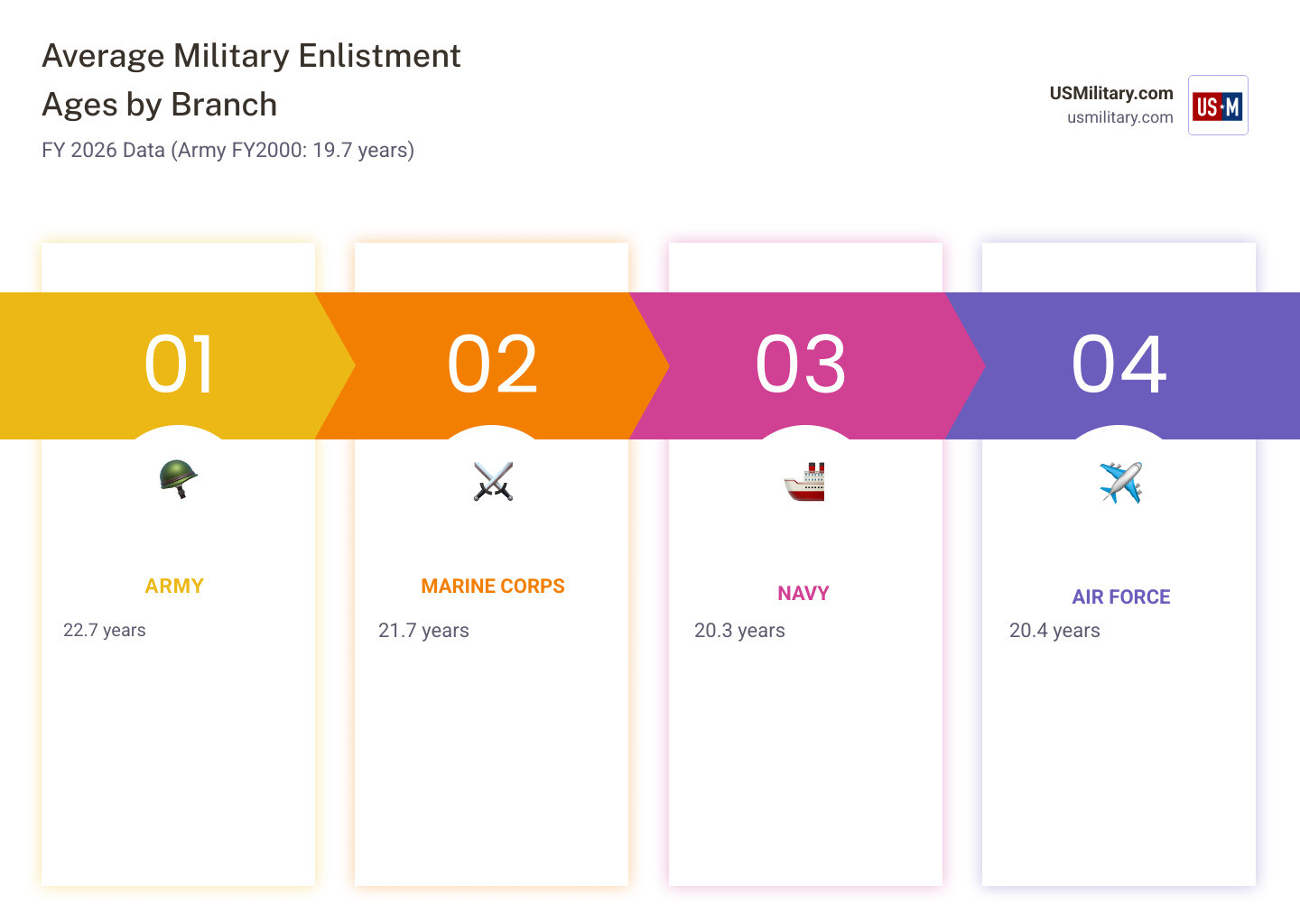
The average age for joining the military varies by branch, but most new recruits are between 20 and 23 years old. Here’s a quick snapshot of current averages:
| Branch | Average Enlistment Age |
|---|---|
| Army | 22.7 years (FY 2026) |
| Marine Corps | 21.7 years |
| Air Force | 20.4 years |
| Navy | 20.3 years |
| Coast Guard | 18–27 years (typical range) |
Those numbers may already surprise you. And the trend is moving upward — the Army’s average enlistment age has climbed from 19.7 years in FY 2000 to 22.7 years in FY 2026. That’s a meaningful shift, and it’s reshaping how the military recruits, trains, and retains its force.
Whether you’re fresh out of high school or considering a second career, understanding where you fall on the age spectrum can help you make a smarter decision about enlisting.
I’m Larry Fowler, publisher of USMilitary.com — and since 2007, I’ve been tracking enlistment trends and the average age for joining military service across all branches to help prospective recruits navigate the process with confidence. Let’s break down exactly what the data says and what it means for you.
Average age for joining military helpful reading:
Breaking Down the Average Age for Joining Military Branches
When we think of a “new recruit,” the image that often pops into our heads is a teenager fresh out of high school, still clutching their diploma in one hand and a duffel bag in the other. While that remains a significant part of the pipeline, the reality at Military Entrance Processing Stations (MEPS) across the country is changing. We are seeing more “grown-ups” in the hallway—people who have already held jobs, started families, or even completed degrees.

Current Branch-Specific Averages
The average age for joining military service isn’t a “one size fits all” number. Each branch has its own culture and mission, which naturally attracts different age groups.
- Army (22.7 years): Currently leading the pack with the highest average age for new recruits in fiscal year 2026. This reflects a deliberate push to find people with life experience and specialized skills.
- Marine Corps (21.7 years): While still relatively young, the Marines have seen an increase as well. Historically, the Corps has been the “youngest” branch, but even they are seeing a shift toward slightly more mature applicants.
- Air Force (20.4 years): The Air Force remains near the lower end of the spectrum, though they have recently raised their maximum age limits to allow for more flexibility.
- Navy (20.3 years): The Navy sits closely with the Air Force. Interestingly, while their average is lower, the Navy has been aggressive in raising their maximum age to 41 to meet recruitment goals.
- Coast Guard (18–27 years): The Coast Guard typically sees a range of recruits, but they have traditionally been very selective, often attracting those who specifically want to serve in maritime law enforcement or search and rescue.
To see how you stack up against these numbers, check out our guide on are you average? A look at typical enlistment ages.
Historical Trends in Enlistment
If we look back to the year 2000, the Department of Defense (DoD) total average for enlisted accessions was just 19.3 years. Back then, a staggering 87% of new recruits were between the ages of 18 and 24.
The Army’s average in 2000 was 19.7 years, while the Marine Corps—true to its “young and hungry” reputation—averaged just 18.5 years. Throughout the 2000s, the average hovered around 21.7 years, dipping slightly to 21.1 in the 2010s.
However, we’ve seen specific “spikes” in the average age for joining military service before. During the Great Recession (2007–2008), the average age jumped to 22.7 and 22.4 respectively. Why? Because when the civilian job market gets tough, the military’s steady pay and benefits look a lot more attractive to people in their mid-20s.
Why the Average Age for Joining Military Service is Rising
You might be wondering why the military is suddenly so interested in “older” folks. It isn’t just a coincidence; it’s a strategic shift. Following the COVID-19 pandemic, the military faced one of the toughest recruiting environments in history. To hit their goals, they had to look beyond the high school locker room.
Targeting the “Non-Traditional” Recruit
The Army, in particular, has openly stated that they are looking beyond the traditional “high school to boot camp” pipeline. They are now targeting what we call the “non-traditional” recruit. These are individuals whose initial career plans might not have panned out or who are looking for a more meaningful path after a few years in the civilian workforce.
Recruiters are finding that these slightly older recruits often bring:
- Professional Experience: Someone who has worked as a mechanic or a coder for four years is much easier to train than someone starting from scratch.
- Maturity Factors: Older recruits often have more “skin in the game.” They might have a spouse or children, which provides a high level of motivation to succeed and stay in the service.
- Failed Civilian Plans: Many people join at 23 or 24 because they realized their “dream job” wasn’t what they expected, and they want the structure and purpose the military provides.
For a deeper dive into these requirements, see our article on unpacking military enlistment age requirements.
Impact on Training and Readiness
Does a higher average age for joining military service hurt the force? Actually, the data suggests the opposite. Older recruits typically bring higher education levels and higher ASVAB (Armed Services Vocational Aptitude Battery) scores.
While an 18-year-old might have the edge in a pure sprint, a 25-year-old often has better mental resilience and “trainability.” They tend to understand the why behind the orders, which can lead to better retention rates. The challenge, of course, is physical conditioning. A 30-year-old’s knees might feel those 12-mile rucks a bit more than a teenager’s, but with modern sports science, the military is getting better at keeping older recruits in top shape.
Minimum and Maximum Age Requirements by Branch
While the “average” is rising, the “legal” limits are what you really need to know before you head to the recruiter’s office. Every branch has a floor and a ceiling.
Enlisted vs. Officer Age Caps
The rules change depending on whether you want to be “the boss” (an officer) or “the boots” (enlisted). Generally, officer programs have stricter age cutoffs because the military wants to get a long career out of the significant investment they make in officer training.
- Army: Enlistment max is 35; Officer Candidate School (OCS) max is 35.
- Navy: Enlistment max is 41; OCS max is 29 (though this varies by specialty).
- Air Force: Enlistment max is 42; Officer max is 39.
- Marines: Enlistment max is 28; Officer max is 28.
- Coast Guard: Enlistment max is 41; Officer max is 27.
If you’re looking at the leadership track, you’ll want to read our guide on decoding officer age requirements. You can also find the official Army enlistment qualifications on their site, or check out the ultimate guide to military enlistment ages right here on our platform.
How Prior Service Affects the Average Age for Joining Military Units
If you’ve served before, the clock resets—sort of. The military uses what’s often called the “adjustment method.” Usually, you can subtract your years of prior honorable service from your current age to see if you meet the cutoff.
For example, if you are 40 years old but served 5 years in the Army previously, your “enlistment age” for eligibility purposes might be considered 35. This allows the military to bring back experienced veterans who still have plenty of “gas in the tank.” This is especially common in the National Guard. For more on that, see National Guard age limits.
The Role of Age Waivers and Special Programs
What if you’re a 37-year-old with a burning desire to serve, but the branch limit is 35? Don’t hang up your boots just yet. This is where age waivers come in.
Age waivers are granted on a case-by-case basis. They aren’t guaranteed, but the military is much more likely to say “yes” if you have a high-demand skill. If you are a surgeon, a nurse, or a high-level cyber security expert, the military will often move mountains (and age limits) to get you into uniform.
Even for general enlistment, if you show up to a recruiter’s office in fantastic shape with a high ASVAB score, they might be willing to put in the paperwork for a waiver. If you have questions about this, your best bet is to contact a military recruiter for waiver info or check out our specific breakdown of Marine Corps enlistment age cutoffs.
Active Duty vs. Reserve and Guard Requirements
The average age for joining military service tends to be higher in the Reserves and National Guard. These components are designed for people who want to serve while maintaining a civilian career.
The National Guard, in particular, has very flexible rules because they serve both state and federal missions. In some cases, individuals can join the Guard up to age 45. For those with prior service, that limit can sometimes extend even higher—up to age 64 in very specific circumstances for former regular members. You can find more details on National Guard eligibility on their official site.
Advantages of Joining Later in Life
While joining at 18 is the “classic” path, joining at 25 or 30 has some serious perks:
- Life Experience: You’ve likely dealt with difficult bosses, paid bills, and handled crises. Basic training is a mental game, and older recruits often find it easier to keep their cool.
- Financial Stability: You might enter with less debt or a better understanding of how to manage your military pay.
- Technical Expertise: If you already have a trade or a degree, you might qualify for a higher rank (like E-3 or E-4) right out of the gate.
- Faster Promotions: Maturity and a solid work ethic don’t go unnoticed. Older recruits often rise through the ranks quickly because they already know how to lead.
Frequently Asked Questions about Military Enlistment Ages
We hear a lot of questions about the average age for joining military service. Here are the most common ones we get at USMilitary.com:
What is the absolute oldest age you can join the military?
As of current 2026 standards, the Air Force has the highest general “ceiling” at 42. The Navy and Coast Guard follow closely at 41. The Army generally caps at 35, and the Marines are the strictest at 28. However, prior service and age waivers can extend these limits significantly for the right candidates.
Can I join the military at 17 without my parents?
The short answer is: No. Legally, you are a minor. To enlist at 17, you must have parental consent. Once you hit your 18th birthday, you are legally an adult and can sign your own enlistment contract. Many 17-year-olds join the Delayed Entry Program (DEP), which allows them to “reserve” their job while they finish high school. For the fine print, you can look at the basic qualifications for enlistment.
Does the average age for joining military service vary for special operations?
Yes, and it might not be in the direction you think! While Special Ops (like Navy SEALs or Army Green Berets) require extreme physical fitness, they also value extreme maturity.
- Navy SEALs: Generally accept applicants from 17–28, but they have been known to grant waivers for candidates in their early 30s who are in phenomenal shape.
- Army Special Forces: You often can’t even apply until you’ve reached a certain rank or age (usually 20), and they accept candidates well into their 30s.
Conclusion
The average age for joining military service is no longer just a “young person’s game.” Whether you are 18 or 38, there is likely a place for you in the U.S. Armed Forces if you meet the physical and mental standards.
At USMilitary.com, our goal is to provide you with the nonbiased info you need to navigate these choices. The recruitment landscape is shifting, and the military is more open than ever to the “non-traditional” recruit. Your personal goals, career longevity, and life experience are all valuable assets to our nation’s defense.
Ready to see if you qualify? Explore military age limits and eligibility today and take the first step toward your new career.
Free for Service Members & Veterans
Get the military benefits intel no one tells you about.
Weekly updates on VA benefits, pay changes, and money tips — free for service members and veterans.
No spam. Unsubscribe anytime. Your info is never shared.


