Why Active Duty to Reserve Retirement Could Be Your Best Career Move
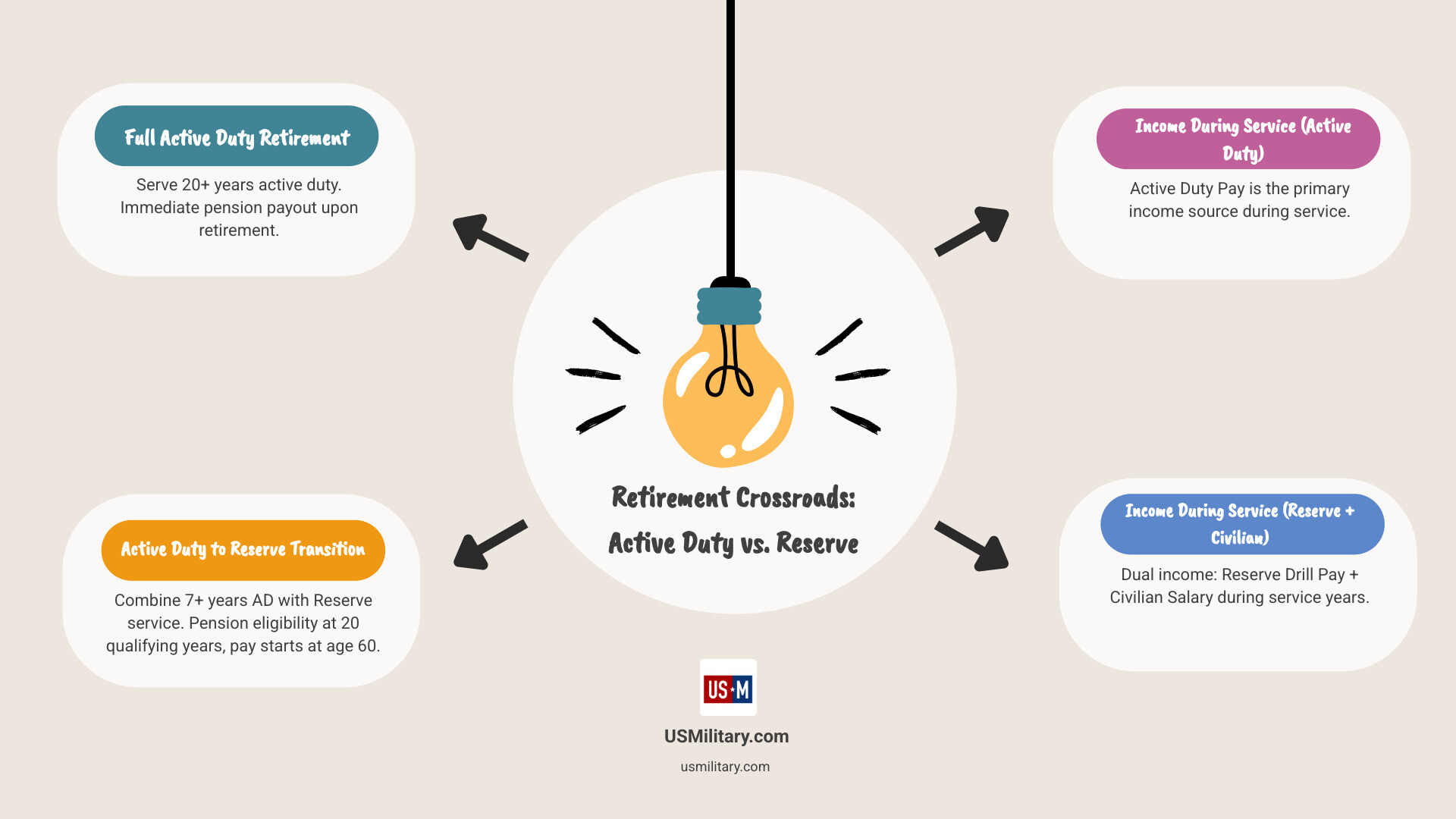
Active duty to reserve retirement is a strategic path that allows service members to continue earning retirement benefits while pursuing civilian careers, rather than serving a full 20 years on active duty.
Quick Answer: Key Benefits of Transitioning from Active Duty to Reserves
- Flexibility: Serve one weekend per month and two weeks per year instead of full-time active duty.
- Dual Income: Combine Reserve drill pay with civilian employment earnings.
- Retirement Benefits: Still qualify for military retirement at age 60 with 20 qualifying years.
- Work-Life Balance: More time with family and control over your schedule.
- Career Growth: Leverage military skills in the civilian workforce while maintaining military benefits.
As an active duty service member, you may feel you have only two options: serve 20 years for a pension or leave the military entirely. However, there is a third path that many overlook.
Transitioning from active duty to the Reserves or National Guard is a strategic career move, not an end to your retirement benefits. It offers the best of both worlds: you continue building toward a military pension while gaining the freedom to pursue a civilian career, spend more time with family, and control your schedule. It’s a smart financial decision that leverages the time you’ve already invested while opening new doors.
This guide will walk you through how the Reserve retirement system works, the benefits you’ll maintain, and how to maximize your financial security. Understanding this path can transform your military career and your life.
Why Make the Switch? The Strategic Advantage of Reserve Service
Many service members transition from active duty to the Reserves or National Guard for greater work-life balance and family stability. Active duty service, while rewarding, often involves demanding schedules, frequent moves, and long deployments. The active duty to reserve retirement transition offers a way to continue serving while planting roots, raising a family without constant upheaval, and building a civilian career.
Instead of “gutting it out” for 20 years on active duty solely for the pension, the Reserves and National Guard offer a flexible third option. It allows you to adapt your career priorities without sacrificing the financial security you’ve earned.
This pathway allows you to:
- Regain Work-Life Balance: The typical “one weekend a month, two weeks a year” commitment is far less demanding than full-time active duty.
- Improve Family Stability: Fewer relocations mean your family can settle down and build stronger community ties.
- Develop a Civilian Career: You can transition into a civilian profession, leveraging your military skills in a new environment.
- Retain Military Benefits: You maintain access to valuable benefits like TRICARE Reserve Select and commissary/exchange privileges.
- Enjoy Dual Income Potential: You can combine your Reserve drill pay with a civilian salary, often leading to a higher overall income.
- Maintain Career Fulfillment: Stay connected to the military mission and camaraderie without the full-time demands.

Financial Implications: A Holistic View
Transitioning to the Reserves involves a significant financial shift. While you will lose active duty pay, BAH, and BAS, it’s crucial to consider the gains from other sources. Your civilian job will become your primary income, supplemented by Reserve drill pay. Many service members find their military experience translates into well-paying civilian careers.
- Reserve Drill Pay: You’ll receive pay for drill weekends, annual training, and any additional active duty orders.
- Civilian Employment Income: Your primary income source, where military skills are often highly valued.
- TSP Contributions: You can continue contributing to your Thrift Savings Plan (TSP) from both your Reserve and civilian pay. Under the Blended Retirement System (BRS), you may also receive government matching on your Reserve pay.
Let’s consider a simplified comparison of potential income streams:
| Income Stream | Active Duty (E-6, 10 YOS, with BAH/BAS) | Reserve (E-6, 10 YOS, 4 drill days/month, 2 weeks AT) + Civilian Job ($70k/year) |
|---|---|---|
| Military Base Pay/Drill Pay | ~$4,000/month | ~$700/month (drill pay + AT) |
| BAH/BAS | ~$2,500/month | N/A (accounted for in civilian budget) |
| Civilian Salary | N/A | ~$5,833/month |
| Total Monthly Gross Income | ~$6,500 | ~$6,533 |
Note: This is a highly simplified example. Actual pay varies greatly by rank, location, civilian job, and individual circumstances. It does not include bonuses, special pays, or tax implications.
Within a few years of leaving active duty, total compensation from Reserve/Guard drills and civilian earnings can potentially exceed active duty pay. The key is strategic financial planning.
Career Advantages and Considerations
This transition is a career move with distinct advantages and challenges.
Advantages:
- Leveraging Military Skills: Your leadership, technical expertise, and discipline are highly valued in the civilian sector.
- Networking Opportunities: The Reserve component is a fantastic networking hub, connecting you with professionals in diverse industries.
- Continued Service and Promotion: You can continue to advance in rank and take on leadership roles within your Reserve unit.
- Maintaining Security Clearance: Remaining in the Reserves helps you maintain your security clearance, a valuable asset for many civilian jobs.
- Professional Development: The military continues to offer training and education that benefit both your military and civilian careers.
Considerations:
- Balancing Two Careers: Juggling Reserve duties with a civilian job and family life requires excellent time management.
- Potential for Deployments: Reserve members can still be mobilized and deployed, a factor to discuss with your family and employer.
- Employer Support: A supportive civilian employer is crucial. USERRA protects your job, but a supportive culture makes a significant difference.
- Different Pace and Culture: The Reserve environment can have a different tempo and culture compared to active duty.
Understanding the Reserve Retirement System: Points, Pay, and Timelines
Reserve retirement, or “non-regular retirement,” is a point-based system. Instead of counting years of active service, it credits you for various types of military duty. This allows you to build a pension with a part-time commitment.
Reaching 20 qualifying years of service makes you eligible for retirement, but you won’t receive pay until you reach a specific age (typically 60). This waiting period is known as the “gray area.” Upon completing your service, you’ll receive a Notice of Eligibility (NOE), or “20-year letter,” which confirms you’ve met the minimum requirements for retired pay.
Qualifying for Your Pension: The Point System Explained
To qualify for Reserve retirement, you need at least 20 “qualifying years.” A qualifying year is any year in which you earn a minimum of 50 retirement points. Understanding how points are earned is essential.
Here’s how you accumulate points:
- Inactive Duty Training (IDT): One point per drill period attended.
- Active Duty (AD) / Active Duty for Training (ADT): One point for each day of active service (e.g., annual training, deployments).
- Reserve Membership Points: 15 points annually for being an active Reserve component member.
- Funeral Honors Duty (FHD): One point per day of duty.
- Correspondence Courses: One point per three credit hours.
There are annual limits on the number of inactive duty points you can earn, which have changed over time. For retirement years ending on or after October 30, 2007, the maximum is 130 inactive duty points. You can earn a maximum of 365 total points per year (366 in a leap year). Regularly check your point statement to ensure accuracy. For a detailed guide, see the Defense Finance and Accounting Service (DFAS) page on Reserve Retirement.
Calculating Your Future Paycheck: Active vs. Reserve Formulas
Reserve retirement pay is calculated differently from active duty. It uses your total accumulated points to determine your pension.
Here’s the general formula for non-regular retired pay:
✉ Get updates like this in your inbox
Weekly VA benefit changes, pay updates, and money tips for service members, veterans, and military families. Free, no spam.
(Total Career Retirement Points / 360) x 2.5% x “High-36” Average Basic Pay
- Total Career Retirement Points: The sum of all points from your entire military career (active and reserve).
- 360: This converts your points into “equivalent years” of service.
- 2.5%: The multiplier per equivalent year (for legacy retirement systems).
- “High-36” Average Basic Pay: The average of the highest 36 months of basic pay for your rank and years of service, based on pay tables in effect when your pension starts.
Your active duty time significantly boosts your total points. For example, 7 years of active duty provides about 2,555 points (7 * 365), giving you a strong foundation.
Example Calculation:
An officer leaves active duty after 7 years (2,500 points) and serves 13 more years in the Reserves, earning an average of 77 points per year (1,001 points). They retire as a Lieutenant Colonel with a total of 3,501 points.
- Multiplier: (3,501 / 360) x 2.5% = 24.31%
- Pension: If the High-36 pay for an O-5 is $8,000/month, the monthly pension at age 60 would be approximately $1,945 ($8,000 x 24.31%).
The ‘Gray Area’: Navigating the Wait for Your Pension
The “gray area” is the period after you’ve completed your 20 qualifying years and retired from drilling but are not yet old enough to receive your pension.
A Gray Area Retiree is a service member who has qualified for retired pay but has not yet reached the eligibility age to receive it. During this time, you still have access to key benefits:
- TRICARE Retired Reserve: A premium-based healthcare plan for you and your family.
- Commissary and Exchange Privileges: Continued access to on-base stores.
- ID Cards: You and your dependents remain eligible for military ID cards, which grant access to installations and benefits. You can find a location to get your card using the RAPIDS ID Card Office Online Locator.
DFAS has a “Future Retiree” myPay account for Gray Area Retirees to help you stay connected and manage your information. It’s crucial to keep your personal email and mailing address updated in myPay, as your military email will be deactivated upon retirement. This ensures a smooth transition when you apply to start receiving your pay.
The Mechanics of Your Active Duty to Reserve Retirement Transition
Planning your active duty to reserve retirement crossover requires proactive steps to ensure a smooth transition. Key planning actions include:
- Engage Early: Inform your active duty command and career counselors of your intent to transition.
- Contact a Recruiter: Speak with a Reserve or National Guard recruiter early to discuss available units, billets, and the transfer process.
- Know Your Branch’s Procedures: Research the specific guidance for transitioning from active duty to the Reserve component of your branch.
- Transfer Records: Ensure all your active duty service records are correctly transferred to your new component for accurate point tracking.
- Prepare Logistically: Plan for personal logistics like housing, civilian employment, and family adjustments.
The Application Process for your active duty to reserve retirement
The journey to receive your Reserve retirement pay begins long before the checks arrive.
- Receive Your 20-Year Letter (NOE): Within a year of completing 20 qualifying years, your service branch should send you a Notice of Eligibility (NOE). This confirms your eligibility for retired pay at age 60.
- Apply for Retirement (Without Pay): With your NOE, you’ll apply for “Non-Regular Retirement without Pay.” This officially places you in the Retired Reserve, or “gray area.”
- Apply for Pay at Eligibility Age: Your retirement pay is NOT automatic. You must apply for it when you reach your eligibility age (typically 60). Submit your application to the military department where you last served.
- Plan for Processing Time: It can take several months to process your pay application. Submit it well in advance of your eligibility date. Throughout this process, keep your contact information current in myPay.
Protecting Your Loved Ones: The Reserve Component Survivor Benefit Plan (RCSBP)
The Reserve Component Survivor Benefit Plan (RCSBP) provides a continuous income (annuity) to your beneficiaries after your death. The election for RCSBP is made much earlier than the active duty SBP—typically within 90 days of receiving your 20-year letter (NOE). This is a critical, time-sensitive decision.
You have three primary options:
- Option A: Defer Election Until Age 60: This is the default. You decline coverage during the “gray area.” If you die before age 60, your beneficiaries receive no annuity.
- Option B: Coverage Now, Annuity at Age 60: If you die before 60, your beneficiaries will receive an annuity, but payments won’t start until the date you would have turned 60.
- Option C: Coverage Now, Annuity Now: This provides the most comprehensive coverage. If you die at any time, your beneficiaries receive an annuity starting immediately. This is the most expensive option.
Discuss these options with your spouse and a financial advisor before the 90-day deadline.
The Age Factor: When Can You Actually Start Collecting?
The standard age to receive Reserve retired pay is 60. However, this age can be reduced.
- Reduced Retirement Age: The 2008 National Defense Authorization Act (NDAA) allows you to reduce your retirement age. For every cumulative 90-day period of qualifying active duty performed after January 28, 2008, your retirement age is reduced by three months.
- Earliest Possible Age: The retirement age cannot be reduced below 50.
For example, 360 days of qualifying active duty would reduce your retirement age by one year, allowing you to start receiving pay at 59. Eligibility for full retiree TRICARE benefits typically still begins at age 60, even if your pay starts earlier.
Blended Retirement System (BRS) vs. Legacy: What’s Different for Reservists?
The military retirement system that applies to your active duty to reserve retirement depends on your Date of Initial Entry into Military Service (DIEMS).
- Legacy System (High-36): Applies if your DIEMS was before January 1, 2018, and you did not opt into BRS. It uses a 2.5% pension multiplier.
- Blended Retirement System (BRS): Applies if your DIEMS is on or after January 1, 2018, or if you opted in. BRS combines a pension with a Thrift Savings Plan (TSP).
Key BRS features for reservists include:
- Defined Contribution (TSP): The government automatically contributes 1% of your basic pay to your TSP and matches your contributions up to an additional 4%.
- Continuation Pay: A one-time bonus around 12 years of service in exchange for an additional service commitment.
- Defined Benefit Pension: You still receive a monthly pension, but the calculation is different.
How BRS Changes the active duty to reserve retirement Calculation
For Reserve members under BRS, the pension calculation uses a 2.0% multiplier instead of the 2.5% used in the legacy system.
- Legacy Formula: (Total Points / 360) x 2.5% x High-36 Pay
- BRS Formula: (Total Points / 360) x 2.0% x High-36 Pay
While the BRS pension is smaller, the system is designed to provide a more robust retirement package through government TSP contributions, which have significant long-term growth potential. BRS also offers a lump-sum option at retirement, allowing you to take a portion of your pension upfront in exchange for reduced monthly payments until age 67. For more details, visit the Official BRS Information page.
Frequently Asked Questions about the Transition
Here are answers to common questions about the transition from active duty to Reserve retirement.
What are the main differences between retiring from the Reserves vs. the National Guard?
While the federal retirement benefits are the same, the service experience can differ. The core difference is command structure and mission.
- Funding & Command: The Reserves are federally funded and controlled. The National Guard has a dual status: it’s state-controlled by the governor for state missions (Title 32) but can be federalized by the president for national missions (Title 10).
- Mission Focus: The Reserves primarily support federal military missions. The National Guard has a dual mission of serving both state and federal needs, often with a greater focus on domestic emergencies.
Your retirement pay is a federal benefit managed by federal agencies, so the process is consistent for both components.
How do I prepare financially for the transition from active duty pay?
Shifting from a steady active duty paycheck to a mix of Reserve and civilian income requires careful financial planning for your active duty to reserve retirement.
- Create a Budget: Track your spending to understand your financial needs and identify areas to save.
- Build an Emergency Fund: Save at least 3-6 months of living expenses to cover any income gaps or unexpected costs.
- Estimate Civilian Income: Research salaries for jobs that match your skills to set realistic income expectations.
- Factor in Reserve Pay: Understand your estimated drill and annual training pay, which may be paid on a different schedule than active duty pay.
- Continue TSP Contributions: Keep contributing to your TSP from your Reserve pay. Also, take advantage of any 401(k) plans offered by your civilian employer.
- Plan for the ‘Gray Area’: Ensure your savings and civilian income are sufficient to cover expenses until your military pension begins at age 60 (or your reduced age).
Is it possible to replace a full active duty pension by switching to the Reserves?
Replacing a 20-year active duty pension dollar-for-dollar with a Reserve pension alone is unlikely. However, the goal is to look at your total compensation and quality of life.
- Holistic Financial Picture: Your total retirement income will come from your Reserve pension, Social Security, and savings from your civilian career (like a 401(k) and your TSP). This combined portfolio can be very strong.
- Civilian Career Growth: Your civilian salary may grow faster than military pay, and consistent investing can create a substantial nest egg.
- Quality of Life: The value of improved work-life balance, family stability, and personal freedom is significant. These non-monetary benefits are a major reason service members make the switch.
When you combine a Reserve pension with a successful civilian career and robust savings, your overall financial security and personal fulfillment can easily surpass what you might have achieved by remaining on active duty.
Conclusion: Charting Your Course to a Flexible and Secure Retirement
The transition from active duty to the Reserves or National Guard is a strategic life choice, not just a career change. This path offers a compelling blend of continued service, financial security, and personal freedom, moving beyond the “20-year or nothing” mindset.
Understanding the point system, pension calculations, and critical decisions like RCSBP is key to maximizing your benefits. This journey requires proactive planning and financial preparation, but the rewards are immense: a military pension, a robust civilian career, more family time, and the continued pride of service.
At USMilitary.com, we are committed to providing the resources you need to make informed decisions. Take control and chart your course to a flexible and secure retirement.
Explore all your military benefits and resources with us: Explore all your military benefits.
Free for Service Members & Veterans
Get the military benefits intel no one tells you about.
Weekly updates on VA benefits, pay changes, and money tips — free for service members and veterans.
No spam. Unsubscribe anytime. Your info is never shared.


